Will Nuclear Fusion Soon Be the “Norm?”

By Duggan Flanakin

The dream of humanity to imitate the forces that created their habitat has been alive for at least as far back as the time when humans with a single language decided to build a city with a tower that reached the heavens. For such a people, “nothing they plan will be impossible to them,” it is recorded.

For at least the same time frame, humanity has sought comfort through technology. While primitive heat producers like coal and wood are still used today, the discovery that petroleum, natural gas, and even moving water could generate a newly discovered phenomenon known as “electricity” transformed the industrial revolution into the modern era.

Not until the 1930s did German scientists build on Enrico Fermi’s discovery that neutrons could split atoms to recognize that splitting atoms would release significant energy – energy that could be used for both bombs and electricity generation. By the 1950s, scientists began building nuclear fission-based power plants that today provide about a tenth of the world’s electricity.

Scientists and engineers also began to envision the potential of nuclear fusion — the reaction of light atomic nuclei powers the sun and the stars. Since that time, they have worked feverishly, but with little success, to replicate this energy-rich reaction using deuterium and tritium.

One group of scientists and engineers decided to try an alternative approach.

Founded in 1998, California-based TAE Technologies has been developing a reactor that runs on proton-boron aneutronic fusion – that is, a fusion reaction that fuses a hydrogen nucleus with non-radioactive boron-11 instead of fusing hydrogen isotopes of deuterium and tritium. Their goal is to develop commercial fusion power with the cleanest-possible environmental profile.

All efforts at fusion require chambers that can withstand temperatures of millions of degrees Celsius and immense pressure that are needed to fuse two isotopes together. To accomplish this requires huge amounts of energy – and until recently, more energy than the fusion produced.

Most fusion researchers, including those building the ITER project being built in France, rely on a donut-shaped tokamak reactor chamber, in which a stream of plasma must be held away from its walls by electromagnets for any energy to be produced. The tokamak design uses a toroidal magnetic field to contain the hydrogen plasma and keep it hot enough to ignite fusion.

Sadly, as with ITER, project costs have soared and timeframes have fallen by the wayside despite occasional breakthroughs. Over decades, tokamak designs became gigantic, with huge superconducting magnetic coils to generate containment fields; they also had huge, complex electromagnetic heating systems.

Spurred by the failures of wind and solar to fully satisfy the desire for “clean energy,” governments and private investors began investing heavily into fission and fusion projects. Oak Ridge, Tennessee, has tapped into a $60 million state fund intended to bolster both fission and fusion energy in atomic energy’s American birthplace.

New research at the University of Texas, in conjunction with Los Alamos National Laboratory and Type One Energy Group, uses symmetry theory to help engineers design magnetic confinement systems to reduce plasma leakage from tokamak magnetic fields.

The old method used for a stellarator reactor relied on perturbation theory. The new method, which relies on symmetry theory, is a game changer. It can also be used to identify holes in the tokamak magnetic field through which runaway electrons push through their surrounding walls and greatly reduce energy output.

The TAE Technology reactor is entirely different than any of the tokamak or stellarator fusion chambers.  In 2017, the company introduced its fifth-generation reactor, named Norman, which was designed to keep plasma stable at 30 million C. Five years later the machine had proven capable of sustaining stable plasma at more than 75 million C.

That success enabled TAE to secure sufficient funding for its sixth-generation Copernicus reactor and to envision the birth of its commercial-ready Da Vinci reactor. But in between, TAE developed Norm.

Norm uses a different type of fusion reaction and a new reactor design that exclusively produces plasma using neutral beam injections. The TAE design dumps the toroidal field in favor of a linear magnetic field that is based on the “field-reversed configuration” (FRC) principle, a simpler, more efficient way to build a commercial reactor.

Instead of massive magnetic coils, FRC makes the plasma produce its own magnetic containment field. The process involves accelerating high-energy hydrogen ions and giving them a neutral charge, then injecting them as a beam into the plasma. That causes the beams to be re-ionized as the collision energy heats the plasma to set up internal toroidal currents.

Norm’s neutral beam injection system has cut the size, complexity, and cost, compared to that of Norman, by up to 50%. But not only is an FRC reactor smaller and less expensive to manufacture and operate, says TAE, it can also produce up to 100 times more fusion power output than a tokamak — based on the same magnetic field strength and plasma volume.

The FRC reactor also can run on proton-boron aneutronic fusion, which, instead of producing a neutron it produces three alpha particles plus a lot of energy. The fewer neutrons also do less damage to the reactor; the energy being released as charged particles is easier to harness. Less shielding is required, and, perhaps best of all, boron-11 is relatively abundant and not radioactive.

So, while “Norm” may not be the final step in developing commercial fusion energy, TAE’s hope is that fusion energy will the “norm” as early as the mid-1930s (sic, 2030s?). FRC technology has materially de-risked Copernicus, according to TAE CEO Michi Binderbauer.

If Norm is as advertised, it will accelerate the pathway to commercial hydrogen-boron fusion – a safe, clean, and virtually limitless energy source.

But is humanity ready for free energy to be the “norm?”

Duggan Flanakin is a senior policy analyst at the Committee For A Constructive Tomorrow who writes on a wide variety of public policy issues.

This article was originally published by RealClearEnergy and made available via RealClearWire.


Discover more from Watts Up With That?

Subscribe to get the latest posts sent to your email.

via Watts Up With That?

https://ift.tt/jnl9sQA

May 16, 2025 at 08:05PM

Trump Administration Targets State Climate Laws

By Steve Goreham

A version of this article was originally published in The Wall Street Journal.

Hydrocarbon fuel producers gain a powerful ally with Trump’s order challenging rules to promote renewable energy.

In the Trump administration’s first 100 days, advocates for climate policy have been hit by actions to close climate departments, halt offshore wind leases, cut green energy funding, and impose tariffs on renewable equipment imports from China. Just when it seemed things couldn’t get worse, President Trump has ordered the federal government to challenge state climate laws.

Last month the President issued an executive order titled, “Protecting American Energy from State Overreach.” The order said that state laws “seek to regulate energy beyond their constitutional or statutory authorities.” It mentioned laws in California, New York, and Vermont and used the term “extortion law.” The order directed U.S. Attorney General Pam Bondi to “identify all state and local laws … burdening the identification, development, siting, production, or use of domestic energy resources that are or may be unconstitutional, preempted by federal law, or otherwise unenforceable” within 60 days. It also directed her to recommend “Presidential or legislative action” necessary to stop the enforcement of these laws. The federal government is now entering the climate battle on the side of producers of hydrocarbon energy, meaning coal, gas, and oil.

For the last 10 years, left-leaning states have enacted regulations to block the use of coal, gas, and oil and to force the adoption of renewable energy. These laws exceed states’ legal authority, aiming to dictate national and international energy policy. States and cities have imposed regulations and monetary penalties on producers of hydrocarbon energy that emit carbon dioxide when used. Businesses that consume hydrocarbons are forced to pay large sums to “trade” carbon credits. Coal, gas, and oil companies spend millions on legal fees to defend their right to produce energy.

In May 2024, Vermont passed its Climate Superfund Act holding “fossil fuel extractors” or “crude oil refiners” responsible for “costs due to climate change.” Vermont seeks millions of dollars in damages from companies that produced fuel connected to more than a billion metric tons of global greenhouse-gas emissions from 1995 through 2024. The law’s supporters blame Vermont’s July 2023 floods on climate change caused by emissions from oil companies. They apparently do not remember the Great Vermont Flood of 1927, the worst flood in the state’s history, which happened when global CO2 emissions were only ten percent of today’s. Vermont Lieutenant Governor S. Hollister was killed in the 1927 flood after getting out of his car into flood waters.

New York enacted its own version, the Climate Change Superfund Act, in December. That law imposes a huge tax on hydrocarbon fuel companies, an estimated collective total of $3 billion a year, beginning in 2028.

Like Vermont, New York seeks payments from firms that produced fuel connected with global emissions of more than a billion tons of CO2 from a past period, in this case 2000 through 2018. In February, a coalition of 22 states along with several industry associations filed a lawsuit against New York officials responsible for implementing and enforcing the law.

Among other climate impacts, the New York act blames “rising sea levels” on the “historical polluters.” It is true that sea levels at The Battery Gauge in New York rose 0.96 feet from 1856 to 2024, a rate of almost seven inches per century. But the National Aeronautics and Space Administration has pointed out that ocean levels rose about 390 feet in the last 20,000 years. No scientist knows when natural sea-level rise ended, and human-caused sea-level rise began.

Maryland passed its Responding to Emergency Needs from Extreme Weather (RENEW) Act this month, seeking to “make polluters pay.” Legislators appear to believe that greenhouse gas emissions are causing extreme weather and storms to get stronger.

But evidence from satellites does not show that storms are becoming more frequent or stronger. Dr. Ryan Maue, formerly chief scientist at the National Oceanic and Atmospheric Administration, shows that the number of global tropical cyclones (hurricanes and tropical storms) has not been increasing over the last 50 years. Since 2006, the accumulated cyclone energy of tropical cyclones has declined to the lowest level since the 1970s.

Efforts to enact “superfund” laws to seek monetary damages from fuel companies are also underway in California and Massachusetts. Voters rejected a similar proposed statute this month in Oregon.  But Maryland, New York, and Vermont laws have serious legal weaknesses. The Constitution explicitly states that neither the Congress nor any state may pass an “ex post facto Law,” which imposes criminal liability for past actions that weren’t restricted at the time. The Maryland, New York, and Vermont acts all propose to tax companies retroactively for legally producing fossil fuels.

The 1970 Clean Air Act gives the Environmental Protection Agency the responsibility for establishing air pollution standards. States have responsibility for local and indoor air pollution, but not nationwide or global air pollution, as the superfund laws appear to cover.


Discover more from Watts Up With That?

Subscribe to get the latest posts sent to your email.

via Watts Up With That?

https://ift.tt/6l0vKtm

May 16, 2025 at 04:04PM

Half of Australia doesn’t want to pay a single cent on Net Zero targets

City ruins, doom, dystopia, fire, death.

By Jo Nova

Nobody believes the Experts

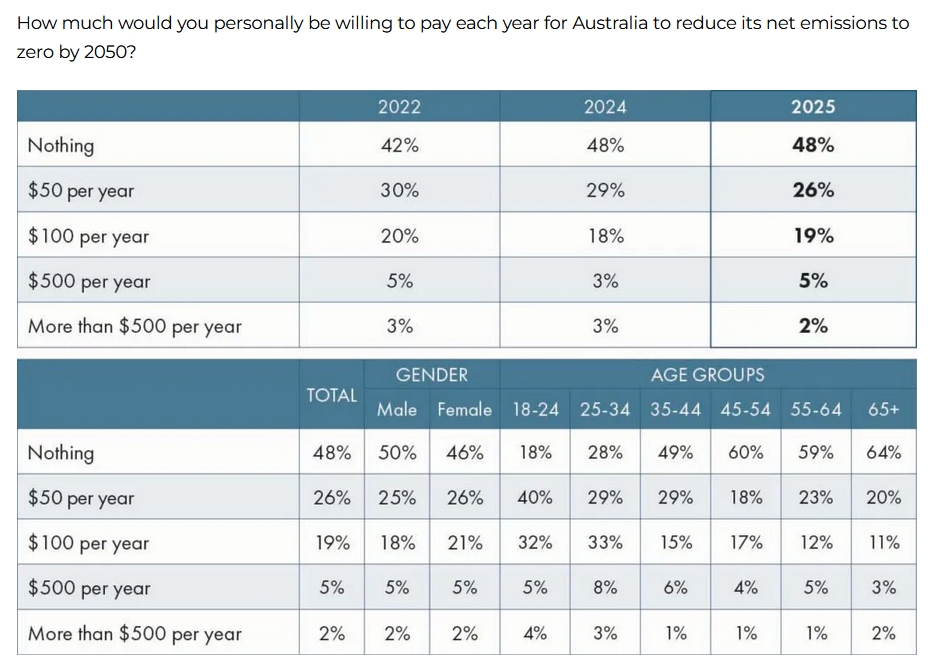
Four thousand climate scientists have cried about climate change on TV. Weather maps are red-hot. And every fire, flood and dry weekend is caused by climate change, yet somehow,  half the country doesn’t want to pay a cent to stop these catastrophes and most of the other half just want to pay one or two dollars a week, which is practically nothing — not even a coffee.  It’s so low it might be “go-away” money — as in, they hope the pollster will go away and stop asking more questions about climate change. None of these people take carbon emissions seriously and this is 90% of the country.

The IPA asked 1,027 Australians how much they would personally be willing to pay for the nation to reach Net zero by 2050, and half of them said, nothing.  Another quarter said “$50 a year” which is one pitiful dollar a week.  Most of the rest said “$2” a week, which leaves barely 7% of people ticking the boxes $500 or more per year, which everyone is already paying and has been paying for years. They just don’t know it, because the cost was hidden in their electricity bills.

Could there be any more skeptical position than “zero dollars”?

I guess the surveyors could start asking how much money people would need to be paid to believe in “Net Zero”, but that wasn’t an option. So we are left to interpret the “zero money” for Net Zero as people who don’t think the world is warming, and people who like warming, and people who think the UN is a basket of nematodes.

Whichever way we look at it, it’s clear, none of the 48% who said “nothing” believe what the CSIRO, NOAA, NASA and the Bureau of Meteorology are selling. These are the die-hard skeptics. Since we live in a democracy I have to ask — which side of politics speaks for them? (Looking at you Liberals and Nationals). And which journalists at the ABC ask the questions this half of the country are thinking? Obviously, not a single one.

The few small sane political parties that do speak for half the population (or more) are treated like anti-matter, so most voters have no idea who they are.

And lets not forget the 45% who said they’d spend a tiny one or two dollars a week. Clearly, they have no idea the government is helping themselves to so much more. If conservatives could suck up the courage to explain what the costs are, and how pointless they are, 93% of the votes are there for the taking. Most of the country are skeptics, men and women, young and old.

After 30 years of climate agitprop (or perhaps because of it) it’s a rather devastating testament to the loss of whatever prestige university professors used to have.

And worse, it’s a bit of a cluster bomb on the idea of democracy. The Blob has been siphoning off this money for years, and 93% don’t want to spend it, and yet the money keeps flowing.

IPA Poll: Attitudes towards Net Zero, Daniel Wild, May 15th, 2025

Poll, Survey, Australia.

Image by taiga_valley_media from Pixabay


0 out of 10 based on 0 rating

via JoNova

https://ift.tt/I4fCAoP

May 16, 2025 at 03:24PM

Friday Funny: Where Have All the Protests Gone?

For the past decade, the Left treated climate change not merely as an environmental concern, but as the looming catastrophe around which all politics, morality, and policy had to revolve. The media described climate change as an existential emergency, a threat not just to polar bears and coastlines but to the very survival of civilization.

via Watts Up With That?

https://ift.tt/ifyHYRN

May 16, 2025 at 01:06PM