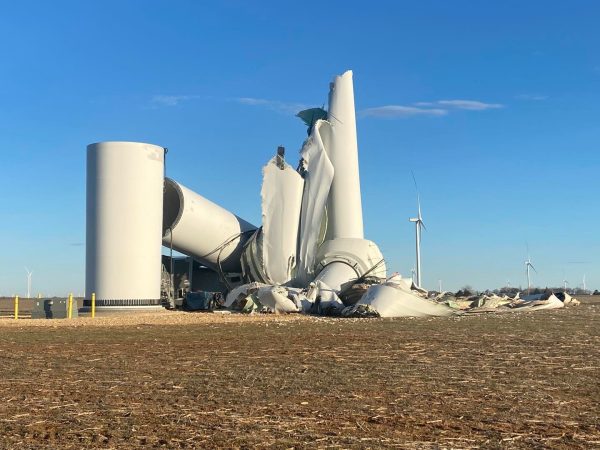
Desperate and increasingly defenceless, the carpetbaggers profiting from the great wind and solar scam are struggling to quell a popular revolt against rocketing power bills and blackouts. Spaniards and Portuguese, among them.
And as the utterly obscene hidden costs of net-zero insanity bubble to the surface, the outrage is palpable.
Which brings us to this week’s roundup.
The first piece from Chris Morrison, who details the £1.5 billion bill to be lumped on taxpayers to try and overcome the destructive effect that wind turbines have on Britain’s radar system.
That these things mess with radar is hardly news. See above a GIF capturing South Australia’s weather radar (one of which operates from Buckland Park north of Adelaide). Blue images are meant to signify rain, yellow images heavy rain, which may also represent local thunderstorms.
What’s depicted is the product of two separate aggregations of turbines. On the left, north of Lochiel and south of Snowtown sit 137 turbines at what’s called the Snowtown Wind Farm. To the right between Saddleworth and Robertstown you’ll find 43 of these things (occasionally operating) at Waterloo. The suggestion of a permanent localised rainstorm over wind turbines is, of course, a meteorological fiction.
With Britain’s wind turbines generating a little power, now and again, but a clear and present danger to shipping and aviation, taxpayers will be lumped with an enormous bill to attempt to fix the problem created by these things.
As David Turver explains, the rising, and already crippling, costs of attempting to generate occasional electricity offshore in a corrosive marine environment has caught up with, and killed off, yet another offshore pipe dream.
In a ‘don’t say we didn’t warn you’ moment, Russ Schussler goes back to his predictions of 2015 when he outlined precisely why increasing reliance on chaotically intermittent wind and solar leads to an inevitable collapse in reliability and an inevitable surge in power prices.
the Energy Bad Boys, Isaac Orr and Mitch Rolling chime in with their very helpful and detailed analysis of the wind and solar driven disaster that hit the Iberian Peninsula.
El Blackout
Substack
Isaac Orr and Mitch Rolling
3 May 2025
Terry L. Headley spreads the focus to the poverty and deindustrialisation that follows the switch to costly and chaotic wind and solar.
The team from Jo Nova take a look at efforts by the Climate Industrial Complex to brainwash and indoctrinate school kids with their grand ‘wind and solar will save us’ narrative. What they reveal reminds STT of Comrade Lenin’s edict in the same vein when he said: “Give us the child for 8 years and it will be a Bolshevik forever”.
Details of the £1.5 billion Project Njord are to be found in the recently-published Ministry of Defence Acquisition Pipeline document. Seven separate amounts of £210 million under the heading “The procurement of Mitigation Solution(s) to negate the adverse effects of offshore wind farms on AD radars” are being given to RAF radar stations from Saxa Vord in Shetland to Portreath on the coast of Cornwall.
The radar problem might eventually have to be solved by a costly transfer of ground facilities to the air. Professor Justin Bronk is a leading expert on air power and technology and he recently noted that unless there was a “breakthrough” in mitigating the effect of wind turbines on ground-based radar, “Britain is going to need a more capable airborne detection service”.
I suppose I shouldn’t be surprised. For the uninitiated, while Politico is allegedly a news organization, it has a history of supporting Progressive and Leftist causes.
To be fair, the summary lead at the top of the article is pretty good: “A common refrain: Climate policy hurts the poor, and the continued use of fossil fuels is a boon for humanity.“ But, at best, today’s Politico article entitled, “Meet the 4 influencers shaping Chris Wright’s worldview” is a mix of truths, half-truths, and misleading innuendoes. The article is by Scott Waldman. The four alleged influencers of Energy Secretary Chris Wright’s views on climate science and energy policy are, in order, Bjorn Lomborg, me, Alex Epstein, and John Constable.
I will let the others speak for themselves. What follows is, verbatim, the article addressing my influence on Sec. Wright. I don’t need to comment on everything because some of it is true. I will only offer clarifications where appropriate. Why? Because there are a lot of untruths circulating about me and unless I address them from time to time, those things become part of a narrative that is difficult to dislodge.
Quotes from the article are in italics; my response & clarifications are in bold:
Spencer, whose work was cited as a resource in Wright’s report, is a research scientist at the University of Alabama in Huntsville and is listed as an adviser to the Heartland Institute, which promotes climate misinformation.I used to give talks at Heartland conferences, but haven’t in recent years. I don’t have a formal relationship with them. I don’t speak for Heartland Institute, but I thoroughly disagree with the claim that they promote “climate misinformation”. That shoe fits Politico much better.
While some of Spencer’s work on atmospheric temperatures and other areas of study has been funded by NASA and the Energy Department, he has attacked federal climate researchers as being biased because they receive taxpayer money, and he has claimed that people alive today won’t experience global warming.On the first point… true. On the second point, I believe what I have said is that most people today will never notice global warming in their lifetimes because it is too weak (about 0.02 deg. C per year) compared to natural climate, seasonal, and day-to-day weather variability.In my book, people who believe they have witnessed human-caused global warming are about as delusional as flat-Earthers.
Spencer also served as a visiting fellow for the Heritage Foundation, which produced the Project 2025 policy proposal that has guided the first months of President Donald Trump’s second term.
The groups Spencer has been affiliated with have received millions of dollars in donations from foundations that oppose regulations, but he claims the American public has “been misled by the vested interests who financially benefit from convincing the citizens we are in a climate crisis.” That includes environmental groups and journalists, in his telling. And I stand by that claim. Look at the artwork at the top of this article, and see if you can figure out what it implies.
“Climate change is big business for a lot of players,” he wrote in a Heritage Foundation publication. “That includes a marching army of climate scientists whose careers now depend on a steady stream of funding from governments.”True.And I have said my career also depends upon that funding.
For years, Spencer has worked with organizations that have received funding from an interlinked network of fossil fuel companies — a multitrillion-dollar global industry — as well as wealthy foundations with billions of dollars in holdings that support groups opposing climate and energy regulations.What are you implying, Scott? That I’ve been paid off by this multitrillion dollar global industry? I know that’s what you are doing. But they have never funded me. At most, I have giving an occasional invited talk, which I receive honoraria for when offered (standard practice, and the same has applied to environmental organizations I have spoken to).
He states on his website that he has not been paid by oil companies, but a court filing in 2016 revealed that he received funding from Peabody Energy, the coal giant that for years spent millions of dollars on funding climate denial groups.That was one of my invited talks: As I recall, it was a Peabody board of directors meeting, and they wanted someone to provide a counterpoint to a Natural Resources Defense Council (NRDC) talk given at the same meeting. Peabody never funded me to do work.
Spencer has appeared before Congress a number of times, typically as a Republican witness attacking climate policy and downplaying climate risks. He served as the climatologist for the late conservative commentator Rush Limbaugh, who regularly promoted climate denialism on his show.Again with the “climate denialism” mantra? You really don’t have a second gear, do you, Scott? I don’t deny “climate”. I don’t even deny recent warming. I don’t even deny that recent warming is probably mostly due to humans.
Like Lomborg, Spencer claims climate policy will hurt the poor even as science has overwhelmingly shown the effects of global warming would disproportionately affect the world’s most vulnerable populations. “Science” has shown no such thing. Opportunistic researchers have indeed made such claims, though. But Lomborg, Epstein, and Roger Pielke Jr. are better at refuting those claims than I am.
He authored a book entitled: “Climate Confusion: How Global Warming Hysteria Leads to Bad Science, Pandering Politicians and Misguided Policies That Hurt the Poor.”
Spencer did not respond to a request for comment.True. I long ago learned which media outlets cannot be trusted to represent what I say fairly.
Discover more from Watts Up With That?
Subscribe to get the latest posts sent to your email.
Current Climate Conditions Aren’t Historically Extreme or Unusual, New Research Shows
Recently, a number of new studies and analyses have been published indicating what readers of CCW have long known: recent climate conditions are not historically unusual. An examination of long-term wildfire trends, plus research comparing past climate conditions to current conditions in central Africa and Germany, show current conditions are well below extremes experienced historically.
A relatively new Substack platform, “Grok Thinks,” publishes analyses of scientific and technological developments and research by the AI tool/assistant Grok3beta. A post in its first week of operation examined claims by geographer Elizabeth Hoy, Ph.D., a senior support scientist with NASA’s Carbon Cycle and Ecosystems Office Goddard Space Flight Center. Grok’s analysis used hard data to show Hoy makes at least 10 false claims about wildfire history and trends on NASA’s “Wildfire and Climate Change” webpage.
Grok writes, in introducing the analysis,
On its “Wildfires and Climate Change” page, and in the accompanying video on YouTube, NASA—through Physical Geographer Elizabeth Hoy—paints a stark picture: climate change, fueled by human activity, is making wildfires longer, more frequent, and more destructive. It’s a compelling story, one that resonates with our instinct to connect dramatic events to a larger cause. But when you peel back the layers, something unsettling emerges: NASA’s claims don’t match the evidence.
This isn’t a minor quibble over data points. NASA’s narrative, endorsed by Hoy, is riddled with exaggerations, omissions, and outright fabrications. Over ten key claims, they twist regional trends into global crises, ignore contradictory evidence, and sidestep the messy reality of wildfire dynamics. Using global datasets, historical records, and peer-reviewed studies—including a groundbreaking paper I co-authored, A Critical Reassessment of the Anthropogenic CO₂-Global Warming Hypothesis—this article dismantles their story piece by piece. The stakes are high—when a trusted institution misleads, it doesn’t just confuse us; it undermines our ability to tackle wildfires effectively.
The paper Grok refers to was published in Science of Climate Change and coauthored with an international group of scientists from the United States and Hungary. Among the lies that NASA tells about wildfires which Grok AI refutes, data ignored or suppressed by NASA, are that the world is experiencing longer wildfire seasons and is experiencing a surge of wildfire activity, both of which are resulting in growing wildfire-related carbon dioxide emissions.
Each of these three claims is refuted by hard data, some of which comes from NASA itself. Grok reports:
The Global Fire Emissions Database (GFED), a gold standard for tracking wildfire activity, shows a stunning trend: global wildfire CO₂ emissions have dropped by more than 20% from 2003 to 2025. …
Zoom in on the United States, and history deepens the contradiction. In the 1920s and 1930s, wildfires consumed up to 50 million acres annually—five times the 8-10 million acres burned today. …
Globally, wildfires aren’t surging; they’re shrinking. A landmark study by Andela et al. (2017) in Science found that the area burned worldwide dropped ~25% from 1998 to 2015. The GFED confirms this, with emissions crashing in recent years.
Grok then helpfully provides two graphics which show the decline in global wildfire emissions and the sharp drop in acreage burned in the United States:
Although still below the historic trends, the recent uptick in wildfires is due to a number of factors, but primarily down to a changed firefighting philosophy which considers forest fires as natural and beneficial rather than a destruction of national, natural assets. This has resulted in reduced logging and brush-clearing in federal forests and the ripping out of firefighting roads there. Heartland’s Climate At A Glance has not examined CO2 emission trends from wildfires, but it has examined both U.S. and global wildfire trends, citing data from peer-reviewed research and NASA and European Space Agency satellite data, all showing declining wildfire trends, which would presumably mean lower emissions.
Most of the remaining “lies” Grok’s article debunks are variants of or overlap these three, being different ways Hoy/NASA say the same thing over and over using alternative language to reinforce the claim human CO2 emissions are causing dangerous increases in wildfires, their severity, their size, and the damage they cause.
Moving from global climate change claims to regional ones, recent research published in the journal Organic Geochemistry using temperature proxies to reconstruct past temperature trends in Central Africa finds Cameroon currently is probably cooler than at any time in the past 7,000 years.
Branched glycerol dialkyl glycerol tetraether (brGDGT) lipids are described in the journal Palaeogeography, Palaeoclimatology, Palaeoecology as “membrane-spanning lipids of some bacteria that are sensitive to environmental gradients, which makes it possible to use brGDGT proxies to estimate changes in environmental temperatures in paleoenvironmental studies.”
In the recent Organic Geochemistry study, a team of nine scientists from universities and research institutes in France (the lead author), Cameroon, Germany, and the United States used brGDGT to reconstruct past temperatures in and around crater lakes in Cameroon.
They write, “we provide the first reconstruction of Mid- to Late-Holocene GDGT-based air temperatures for a crater lake in Cameroon (Central Africa), revealing a temperature decrease of 2.5 °C over the last 7000 years, which agrees with recently published records for East Africa but exceeds current model predictions.” Once again, climate models overstate temperatures, this time for both Central and East Africa.
Debunking another claim about the regional impacts of climate change, Pierre L. Gosselin at No Tricks Zone examines recent media hype about a bout of dry weather in Germany since February which made March one of the driest since measurements began in 1881, according to Deutscher Wetterdienst (DWD), Germany’s national weather service. The media has jumped on this to push the narrative that human-caused climate change is making droughts more severe in Germany. Gosselin uses data to debunk that claim and refute the narrative.
“Four of the 5 driest years on record in Germany occurred before 1960,” writes Gosselin. “Eight of the top 9 occurred before man-made climate change was ever an issue (before 1980).” (See chart below.)
The No Tricks Zone article also points out DWD data show an increasing precipitation trend for Germany since the late 1800s, consistent with the U.N. Intergovernmental Panel on Climate Change statement that it has “‘high confidence’ that precipitation has increased over mid-latitude land areas of the Northern Hemisphere . . . during the past 70 years, while IPCC has ‘low confidence’ about any negative trends globally,” as meteorologist Anthony Watts writes in Climate At A Glance: Drought.
Wildfire, flood, rainfall, and crop production vary, regionally and globally, from year to year. That is weather, not climate change. No single year’s dry or wet spell, wildfire season, or effect on crop production can be honestly attributed to human-caused climate change, regardless of what the mainstream media and attribution study authors claim. Only a documented long-term trend could implicate climate change, and there is no such trend in Germany or elsewhere.
Climate models, with seemingly a single exception, consistently overstate warming and sea level rise trends when compared to real-world data. When data and theory collide, it is time to rethink or fine-tune the theory, not suppress, ignore, cherry-pick, or tamper with (“adjust”) the data to fit what the theory and the models developed to reflect the theory say should be occurring or what we should expect.
If models and theory don’t accurately reflect current and recent trends, we should not rely on their projections into the future to inform science, and certainly not to shape public policy.
Despite Climate Pledges, China Continues to Build and Finance International Coal Use
In 2021, as part of a commitment to fight climate change, China pledged to stop funding coal development and use abroad—not domestically, mind you, but just to stop helping developing countries develop mines and coal-fueled power plants.
A new report by the climate think tank Global Energy Monitor (GEM) shows that, as with so many other pledges, China is breaking its commitment and is continuing to build out coal power plants in a number of countries, particularly in the BRICS nations (Brazil, Russia, India, China, and South Africa), and has subsequently expanded to include Belarus, Bolivia, Cuba, Egypt, Ethiopia, Indonesia, Iran, Kazakhstan, Malaysia, Nigeria, Thailand, Uganda, the United Arab Emirates, and Uzbekistan.
The GEM report finds China is involved in areas such as funding, construction, and management in 88 percent of new coal development within BRICS, while also backing wind and solar development.
“Chinese firms are backing 7.7 GW of new coal, virtually all found in Indonesia, despite President Xi’s pledge to end support for overseas coal projects,” Global Energy Monitor reports.
“New power generation projects across the new BRICS members are mostly hydrocarbon forms of capacity, the climate think tank also reported, noting that total oil, gas, and coal capacity under construction across the 10 new members amounts to 25 GW,” an article in Oil Price reports. “Wind and solar capacity under construction, on the other hand, stands at a measly 2.3 GW.”
“Close to two-thirds of all the new capacity under construction in the new BRICS members, hydrocarbon and alternative, features Chinese state-owned companies, Global Energy Monitor also reported,” says Oil Price.
BRICS’ newest members are largely eschewing renewable energy development, and instead, with China’s help, are rapidly developing coal, gas, and oil for power generation.
Conservationists Begin Questioning Renewable Energy Push
Since the dawn of agriculture, habitat loss has posed the biggest threat to wildlife.
As to energy development, no types of energy production pose a bigger risk to wildlands and wildlife than industrial wind and solar power. Heartland has published numerous studies detailing the environmental damage wreaked by large wind and solar development, first and foremost among them their environmental footprint. Most recently, in Heartland’s publication “Affordable, Reliable, and Clean: An Objective Scorecard to Assess Competing Energy Sources,” Heartland President James Taylor writes, “It requires approximately 60 square miles of solar panels to generate the same amount of power as a conventional power plant. It requires approximately 320 square miles of wind turbines to do the same.”
It seems that at least one environmental leader in Australia has recently woken up to the land and wildlife impacts of wind and solar and is willing to speak about it publicly.
Kelly Jones, creative director at Australia’s Carbon8 Fund, which advocates transitioning to “regenerative” agriculture, recently posted an article questioning the merits of big wind and solar developments and asking why conservation groups aren’t speaking out about the habitat loss and wildlife displacement industrial wind and solar facilities cause.
Jones frames the problem as a moral dilemma for wildlands/wildlife advocates:
The Australian government’s aggressive push for renewable energy has created a significant moral dilemma for conservation charities. On one hand, these organisations are entrusted with protecting ecosystems and biodiversity; on the other, they are increasingly reliant on public funding tied to government renewable energy initiatives. The result? A deafening silence in the face of environmental destruction, as raising concerns about habitat loss could jeopardise their financial stability. This isn’t conservation—it’s capitulation.
Renewable energy projects are a double-edged sword. Large-scale solar farms, wind turbines, and associated infrastructure are touted as solutions to the climate crisis, but their development comes at the cost of native forests and critical habitats. Vulnerable species like koalas are being pushed to extinction, yet conservation charities, aware of these impacts, find themselves in a compromising position: challenge the renewable energy narrative and risk losing funding, or remain silent and perpetuate the destruction.
Corporate influence further complicates the issue. Renewable energy companies, eager to greenwash their operations, channel significant donations into conservation initiatives. These partnerships create a façade of environmental responsibility while insulating companies from criticism. Conservation organisations, incentivised by these donations, turn a blind eye to the damage caused.
The apparent co-opting of conservation groups by corporate and government funding is causing a loss of public trust in the operations of these groups, Jones warns. To deserve and to continue to receive public support, Jones argues, conservation groups should speak honestly about the harms imposed by industrial wind and solar and be transparent about any funding that might call into question their respective positions on those forms of energy production.
H. Sterling Burnett, Ph.D., is the Director of the Arthur B. Robinson Center on Climate and Environmental Policy and the managing editor of Environment & Climate News.
Discover more from Watts Up With That?
Subscribe to get the latest posts sent to your email.