Net Zero Fades As the Deluded Cling to Its Fantasy

By Vijay Jayaraj

The grand vision of “Net Zero” initiatives – by which emissions of carbon dioxide magically balance with expensive and futile capture and storage systems – have long been sold as the redemption arc for humanity’s profligate modern ways. Yet, like a poorly scripted dystopian thriller, the holes in this plot are glaring.

Net Zero was always a fragile concept. It rested on shaky and illogical assumptions: that wind turbines, solar panels and “green” hydrogen could reliably replace fossil fuels, that governments could redesign economies without unintended consequences, that voters would accept higher costs for daily necessities, and that developing countries would sacrifice growth for climate targets they had no hand in creating.

None of those fantasies held. Countries did not decarbonize nearly at the speed promised, even though climate bureaucracies clung to the illusion. Long-range targets, five-year reviews and international pledges lacked common sense and defied physical and economic realities. The result? An unaccountable machine pushing impractical policies that most people never voted for and are now beginning to reject.

If Net Zero were a serious endeavor, its architects would confront the undeniable: China and India are more than delaying their decarbonization timelines – they’re burying them. Why has this been ignored?

China and India – responsible for more than 40 percent of global CO2 emissions in the last two decades – are accelerating fossil fuel use, not phasing it out. In Southeast Asia, coal, oil and natural gas continue to dominate. Vietnam, Indonesia and the Philippines are building new electric generating power plants using those fuels. These countries understand that economic growth comes first.

Africa, too, is pushing back. Leaders in Nigeria, Ghana and Senegal have criticized Western attempts to block fossil fuel financing. African nations are investing in exploitation of the oil and gas reserves.

If Asia represents the global rejection of Net Zero, Germany and the U.K. are poster children of the West’s self-inflicted wounds. Both nations, once hailed as Net Zero pioneers, are grappling with the harsh realities of their green ambitions. The transition to “renewables” has been plagued by economic pain, energy insecurity and political backlash, exposing the folly of policies divorced from facts. When the war in Ukraine cut off energy supplies, Germany panicked. Suddenly, coal plants were back online. The Green Dream died a quiet death.

Trump funding cuts likely will accelerate the fall of Net Zero’s house of cards. The president’s decisions to slash financing for international and domestic green programs has severed the lifeline for global climate initiatives, including the United Nations Environment Program. Trump also vowed to redirect billions from the Inflation Reduction Act – Biden’s misnomered climate law – toward fossil fuel infrastructure.

The retreat of Net Zero interrupts the flow of trillions of dollars into an agenda with questionable motives and false promises. Climate finance had developed the fever of a gold rush. Banks, asset managers and consulting firms hurried to brand themselves as “green.” ESG (Environmental, Social, Governance) investing promised to reward “climate-friendly” firms and punish alleged polluters.

The fallout was massive market distortions. Companies shifted resources to meet ESG checklists at the expense of fiduciary obligations. Now the tide is turning. The Net Zero Banking Alliance comprising top firms globally has been abandoned by America’s leading institutions. Similarly, a Net Zero investors alliance collapsed after Blackrock’s exit.

Perhaps the fundamental failure of Net Zero was political. Permission was never sought from taxpayers and consumers who would pay the costs and suffer the consequences of an always ill-fated enterprise. Climate goals were set behind closed doors. Policies were imposed from above. Higher utility bills, job losses and diminished economic opportunity became the burdens of ordinary families. All while elites flew private jets to international summits and lectured about the need to sacrifice.

A certain lesson in the slow passing of Net Zero is this: Energy policy must serve people, not ideology. That truth was always obvious and remains so. Yet, some political leaders, legacy media and industry “yes-men” continue to blather on about a “green” utopia. How long the delusion persists remains to be seen.

This commentary was first published at Townhall on May 9, 2025.

Vijay Jayaraj is a Science and Research Associate at the CO₂ Coalition, Arlington, Virginia. He holds an M.S. in environmental sciences from the University of East Anglia and a postgraduate degree in energy management from Robert Gordon University, both in the U.K., and a bachelor’s in engineering from Anna University, India.


Discover more from Watts Up With That?

Subscribe to get the latest posts sent to your email.

via Watts Up With That?

https://ift.tt/NZHpIt1

May 9, 2025 at 04:01PM

Children of 2020 face unprecedented exposure to Extreme Climate Nonsense…

By Jo Nova

It’s like expert scientists in Nature have never heard of an air-conditioner?

The Blob launched its latest permutation of Fire and Brimstone. By using broken climate models, and ignoring ten thousand years of bones, rocks, sediments, ice-cores, caves and corals, they were able to pretend that babies today will suffer “unprecedented” storms, floods and fires of every kind and it’s all your fault.

The paper by Grant et al ticks the full Marxist Bingo Card whipping up class warfare driven by “intergenerational inequality”. It was funded by the EU and is being used to shake down citizens to get more money and power for the EU, so they will be happy. “Mission accomplished”. (That’s what ‘The ScienceTM’ is for right?)

But it is embarrassing. We have to talk about that formerly esteemed “Nature” journal. For starters, the researchers behave like the universe only formed in 1960. Their whole shtick is that babies today will live through more ghastly heatwaves than their grandparents born in 1960 did. And it’s all “unprecedented”.  It’s as if the Holocene did not exist. Sea levels were at least a metre higher 8,000 years ago, how could the world not have been hotter?

Spare a thought for the babies of 6,000 BC who lived through far more heatwaves in their lifetime than any will today, and they didn’t have an air conditioner, a baby monitor, or a Fire Department to call when a bushfire broke out. Somehow they didn’t become extinct.

The solution to all the potential, imagined cataclysm of one more degree (if it even happens) is cheap electricity. If we try to save babies with slave-made-solar panels from Xingjiang we’ll be committing a crime (and more than one).

We’ll save more babies by burning fossil fuels and making electricity cheap again, so people can afford to turn the air-con on.

Airconditioners are the miracle that save 20,000 lives in USA each year. As it got hotter in Spain from 1980 to 2015 fewer  people died — and it was because more of them were able to get air conditioning. The Science says fossil fuels save lives.

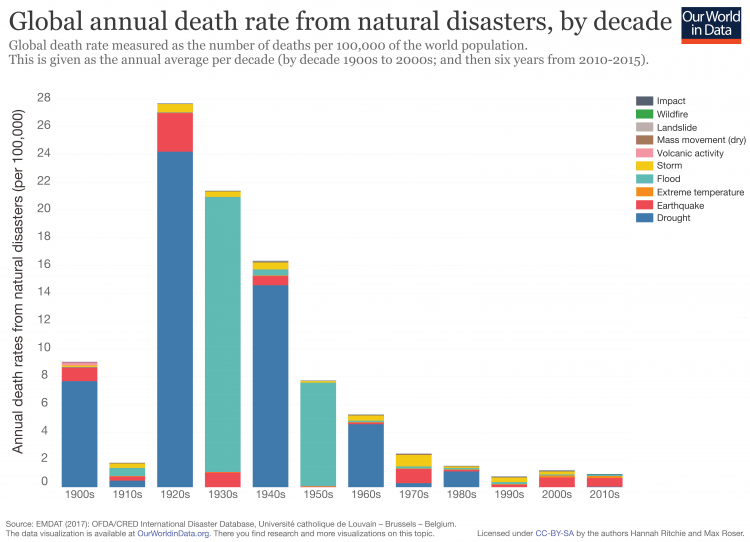
Global deaths and disasters are down in the last 100 years. But shameless UN lies are up. To solve the increase in global disasters, just axe the UN.

Global annual death toll disasters

Global death rate from disasters last century, per capita, per decade. Our World in Data. Hannah Ritchie and Max Roser.

Deaths are down per capita from fire, landslide, storm, flood, extreme temperatures and drought.(Our World in Data).

Global weather disaster costs have also declined since 1990 as a percentage of our GDP. The more CO2 we emit the less we spend on global weather disasters.

REFERENCE

Grant, L., Vanderkelen, I., Gudmundsson, L. et al. Global emergence of unprecedented lifetime exposure to climate extremes. Nature 641, 374–379 (2025). https://ift.tt/QwEpSPR


0 out of 10 based on 0 rating

via JoNova

https://ift.tt/Z7xj1TY

May 9, 2025 at 03:51PM

Peston’s Power Con Trick

By Paul Homewood


Andrew Montford unravels Woke ITV’s deliberately misleading attempt to blame high electricity prices on gas:


 image

There has been a concerted campaign in recent weeks to convince the public that current high electricity prices are mostly a function of high gas prices. This argument is entirely incorrect. Robert Peston’s recent interview of Kemi Badenoch on his eponymous show on ITV appears to have been part of this campaign. At the start of the segment, Peston’s co-presenter Anoushka Asthana set out some data, apparently sourced from Carbon Brief, that entirely misled viewers and set out a false basis for the interview that followed. Her argument about high electricity bills was in two parts

  • they were not due to Net Zero policies;

  • instead, they were due to high wholesale costs, caused by high gas prices.

Full story here.

via NOT A LOT OF PEOPLE KNOW THAT

https://ift.tt/NKW7SMf

May 9, 2025 at 03:44PM

Mixed Messaging

A Guardian article today leaves me frustrated and bemused (as is so often the case with articles in the Guardian whenever there is a connection, however, tenuous, with climate change). Its main headline suggests good news: “Midsummer butterflies spotted early in Britain after sunny spring” but its secondary headline suggests bad news: “Scientists fear early emerging insects may fall out of sync with pathogens, predators or availability of food”.

The article itself opens with good news: “Midsummer butterflies are on the wing in early May after a sunny spring prompted one of the most advanced seasons for Britain’s Lepidoptera on record.

But there’s also bad news: “Last year was the second worst for common butterflies since scientific monitoring began 50 years ago” followed by more good news:

butterfly experts are hoping that the sunny spring enables populations to recover some of their numbers.

It’s been a wonderful spring for butterflies in Scotland,” said Prescott. “The butterflies are on the wing much longer and many species are moving north rapidly.”

That sounds pretty reassuring after last year’s dreadful statistics. But wait a minute – there’s more bad news: “While some species appear to be adapting their lifecycles to climatic changes, there are fears some early emerging insects may fall out of sync with pathogens, predators or the availability of food for their caterpillars.”

And of course we have to be worried about climate change: “Lepidopterists said the early appearances this year were caused by the prolonged sunny, dry spring but were also a clear sign of insects responding to global heating.” [My emphasis].

One sunny spring? Really? Global heating? Or just weather? Thirteen years ago, reflecting on the mixed weather in spring 2012, the Guardian made it clear that cold and wet weather are bad for butterflies:

…Some spring species emerged several weeks early in March, but the wettest April on record and the continuing rain this month has delayed the appearance of many butterflies.

And wildlife charity Butterfly Conservation is warning that if the wet conditions continue it could affect the breeding success of some species later in the year.

Cold, wet weather makes butterflies less active, reducing feeding and mating….

As for climate versus weather, it looked like weather was the predominant factor then, as I suspect it is now:

He [Richard Fox, Butterfly Conservation surveys manager] added: “Last year we had a hot spring and a poor summer. This year we’re having a poor spring, so let’s hope the summer is better.”

Speaking of the charity Butterfly Conservation, I thought I would take a look at their website, and in particular an article about the long-term decline of UK butterfly species. Unfortunately, this falls foul of the issue I complained of in Climate Change Ate My Homework, namely throwing climate change in as a makeweight with a load of other factors, while failing to assess the significance of each factor. Thus (Dr Richard Fox again):

I am devastated by the decline of our beloved British butterflies, and I’m sorry to say it has been brought about by human actions: we have destroyed wildlife habitats, polluted the environment, used pesticides on an industrial scale and we are changing the climate.

Destroyed habitats, polluted environment, industrial scale pesticide use….but climate change.

That means that when we have poor weather, these already-depleted butterfly populations are highly vulnerable and can’t bounce back like they once did – and with climate change, that unusual weather is becoming more and more usual.

Is it? Really? In the UK the weather has always involved extremes. Hot, cold, wet, dry, stormy, anticyclonic periods of calm – none of these things are new or unusual. They are just UK weather. And while weather from season to season and from year to year is clearly an influential factor in the success or failure of butterflies, nevertheless, according to Butterfly Conservation’s article, the problem appears to be predominantly habitat loss:

These species all require specific habitat to thrive, and those habitats have been destroyed over the past century.

…By far the best thing we can do to help butterflies is to create more habitat. Last year we published research which showed that letting parts of your garden grow wild with long grass increases the number and variety of butterflies that you see. That is why we are calling on people and councils across the UK to pledge to not cut their grass this year from April to September: this simple act can make a real, immediate difference to butterflies, moths and other wildlife…

Returning to today’s Guardian article, interestingly Dr Fox also notes that evolutionary factors can help:

If the weather has tricked some into coming out too early it should not be a disaster. There should also be plenty of scope for evolutionary adaptation.

It’s clearly a very complicated subject, one worthy of more thoughtful and detailed analysis than scare-mongering about climate change in the context of weather variation from year to year. I prefer to celebrate the good news both for myself and for butterflies: a dry, sunny spring this year, as opposed to last year’s wet and miserable one, which, where I live, continued damp and cool through the summer.

via Climate Scepticism

https://ift.tt/5wOnKPV

May 9, 2025 at 02:36PM