
A massive blackout shut down the Iberian Peninsula on Monday shortly after Spain announced that it was running on 100% "renewable" energy for the first time ever.
via CFACT
May 2, 2025 at 07:29AM
A massive blackout shut down the Iberian Peninsula on Monday shortly after Spain announced that it was running on 100% "renewable" energy for the first time ever.
via CFACT
May 2, 2025 at 07:29AM
The Version 6.1 global average lower tropospheric temperature (LT) anomaly for April, 2025 was +0.61 deg. C departure from the 1991-2020 mean, up a little from the March, 2025 anomaly of +0.57 deg. C.
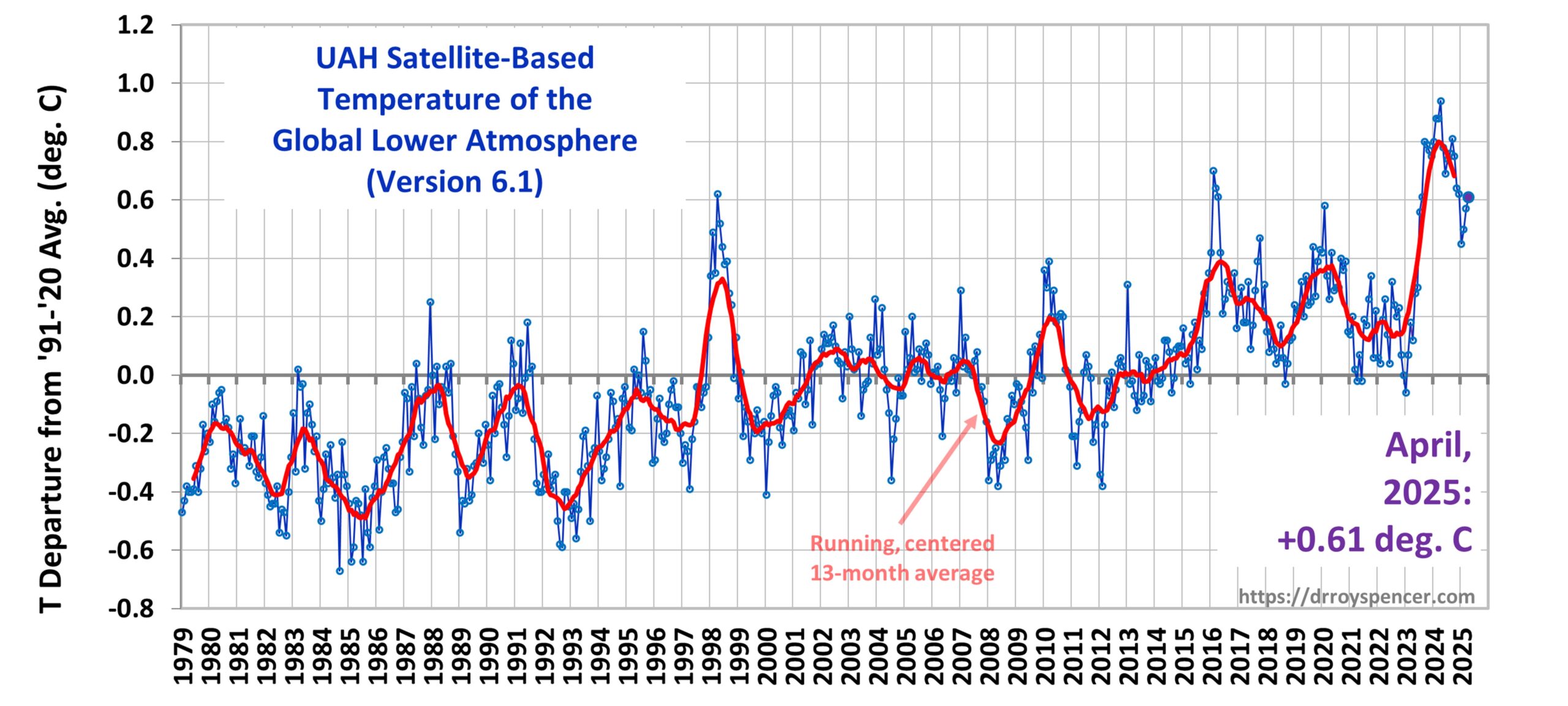
The Version 6.1 global area-averaged linear temperature trend (January 1979 through April 2025) remains at +0.15 deg/ C/decade (+0.22 C/decade over land, +0.13 C/decade over oceans).
The following table lists various regional Version 6.1 LT departures from the 30-year (1991-2020) average for the last 16 months (record highs are in red).
| YEAR | MO | GLOBE | NHEM. | SHEM. | TROPIC | USA48 | ARCTIC | AUST |
| 2024 | Jan | +0.80 | +1.02 | +0.58 | +1.20 | -0.19 | +0.40 | +1.12 |
| 2024 | Feb | +0.88 | +0.95 | +0.81 | +1.17 | +1.31 | +0.86 | +1.16 |
| 2024 | Mar | +0.88 | +0.96 | +0.80 | +1.26 | +0.22 | +1.05 | +1.34 |
| 2024 | Apr | +0.94 | +1.12 | +0.76 | +1.15 | +0.86 | +0.88 | +0.54 |
| 2024 | May | +0.78 | +0.77 | +0.78 | +1.20 | +0.05 | +0.20 | +0.53 |
| 2024 | June | +0.69 | +0.78 | +0.60 | +0.85 | +1.37 | +0.64 | +0.91 |
| 2024 | July | +0.74 | +0.86 | +0.61 | +0.97 | +0.44 | +0.56 | -0.07 |
| 2024 | Aug | +0.76 | +0.82 | +0.69 | +0.74 | +0.40 | +0.88 | +1.75 |
| 2024 | Sep | +0.81 | +1.04 | +0.58 | +0.82 | +1.31 | +1.48 | +0.98 |
| 2024 | Oct | +0.75 | +0.89 | +0.60 | +0.63 | +1.90 | +0.81 | +1.09 |
| 2024 | Nov | +0.64 | +0.87 | +0.41 | +0.53 | +1.12 | +0.79 | +1.00 |
| 2024 | Dec | +0.62 | +0.76 | +0.48 | +0.52 | +1.42 | +1.12 | +1.54 |
| 2025 | Jan | +0.45 | +0.70 | +0.21 | +0.24 | -1.06 | +0.74 | +0.48 |
| 2025 | Feb | +0.50 | +0.55 | +0.45 | +0.26 | +1.04 | +2.10 | +0.87 |
| 2025 | Mar | +0.57 | +0.74 | +0.41 | +0.40 | +1.24 | +1.23 | +1.20 |
| 2025 | Apr | +0.61 | +0.77 | +0.46 | +0.37 | +0.82 | +0.85 | +1.21 |
The full UAH Global Temperature Report, along with the LT global gridpoint anomaly image for April, 2025, and a more detailed analysis by John Christy, should be available within the next several days here.
The monthly anomalies for various regions for the four deep layers we monitor from satellites will be available in the next several days at the following locations:
via Roy Spencer, PhD.
May 2, 2025 at 05:35AM
By Paul Homewood
Following OFGEM’s publishing of plans for a monstrously expensive upgrade of local and regional power distribution networks for Net Zero, it is worth looking again Mike Travers GWPF paper five years ago, which analysed the costs and implications:

London, 16 July: The UK faces a £200 billion bill to rewire the country if the government follows through on plans to electrify the country’s homes and transport systems. That’s because installation of electric car chargers and heat pumps will push up demand for power beyond the capacity of the existing wiring.
The findings are set out in a new report from the Global Warming Policy Foundation, which is published today. According to author Mike Travers, this will mean that most streets in the UK will need to be dug up (with diesel-driven machinery):
“At present new home car chargers and heat pumps are using up all the spare capacity. But we will soon reach the point where the network will not be able to handle the extra demand. So in towns and cities, the underground cables which carry the power will be inadequate. That means that we are going to have to dig up almost every urban street and many rural ones too. The whole distribution grid is going to need to be replaced.”
And the cables that carry power into the homes will need to be dug up too.
According to Travers:
“The power cables taking electricity into your home probably run underneath your front drive. So if you want a car charger and a heat pump you are going to have to pay to dig it up. If you have an expensive monoblocked drive, that will not be cheap. Distribution boards, main fuses and smart meters in homes are going to have to be upgraded too.”
Travers has estimated the cost of all this work at around £200 billion, even before considering the cost caused by the disruption. “Many homeowners will be paying thousands”, he says.
Notes for journalists
Mike Travers CEng, MIMechE, FIET is an electrical engineer, whose career spanned periods in the Royal Engineers, in the hydroelectric sector, and industry. He previously sat on the the IET Wiring Regulations Committee and was the industry representative on the committee that rewrote the Grid Codes for Scotland.
His paper is entitled The Hidden Cost of Net Zero: Rewiring the UK and can be downloaded here (pdf)
Five years on that £200 billion is probably nearer £300 billion, particularly given the global shortage of copper and other raw materials.
The work will of course be funded by the distribution network operators (DNOs), but they will paid back via higher charges on electricity bills.
It is true of course that extra demand for power will generate higher revenues for DNOs anyway, but the existing network is so old that it has effectively been fully depreciated long ago. The cost of a installing what is effectively a new network will introduce costs of an entirely different magnitude.
OFGEM seem to regard a return of around 10% as the norm, meaning annual bills could increase by £30 billion. Even if electricity consumption doubles, this would still add 15% to bills.
According to OFGEM, the average customer currently pays about £100 a year for distribution. This could increase to £430.
via NOT A LOT OF PEOPLE KNOW THAT
May 2, 2025 at 05:33AM
Once considered a key technology in the green energy transition, companies are waking up and finding out that hydrogen isn’t the answer to the challenges posed by renewable energies such as wind and sun.

Symbol image generated by Grok 3 AI
“Instead of progress, disillusionment dominates. The EU in particular – especially Germany – is increasingly being criticized for its costly projects,” reports German online Blackout News. “Companies are pulling out”.
Hydrogen is expensive, hazardous and a real technical challenge that doesn’t promise to be economically feasible. The gas is metallurgically aggressive, highly flammable, explosive. It’s chemical properties make a comprehensive infrastructure difficult to manage. Moreover, producing green hydrogen is “barely affordable” and industries are reluctant to use the volatile gas because it risks being unprofitable.
High costs, low demand and political misplanning are currently jeopardizing the strategy, according to an analysis by Westwood Global Energy Group. “Only a fraction of the planned EU hydrogen pipeline is likely to be operational by 2030.”
Germany has funded an ambitious green hydrogen project in Namibia, in a protected desert area and now it may be demolished for port expansion as the country’s new president is reportedly reassessing the project and looking at a potential shift towards the established oil sector. Technical analyses indicate hydrogen is only suitable as a selective energy source.
Unless there is a major change of course, the EU’s hydrogen strategy risks being a costly failure.
via NoTricksZone
May 2, 2025 at 05:29AM

