A Simple, Factual, and Sensible Rebuttal to the Chemtrail Conspiracy Theory

I have been getting a lot of flak on social media about “chemtrails” from conspiracy theorists lately, as I’m sure many of you readers have also experienced. So, I decided to work up a reference post that uses bullet points factoids to make rebuttal points. You can also reference my rebuttal from 2016. Feel free to share and use anywhere – Anthony

The chemtrail conspiracy theory alleges that aircraft contrails are chemical agents deliberately sprayed for sinister purposes. This theory is unsupported by scientific evidence and contradicts well-established atmospheric science, logistical realities, and environmental data. Below is a concise rebuttal addressing key misconceptions, with additional references to strengthen the argument.

  • Contrails are water vapor, not chemicals: Contrails form when water vapor from aircraft engine exhaust immediately condenses and freezes into ice crystals at high altitudes (above 25,000 feet), where temperatures are below -40°C. See the graphic below. These crystals create visible trails that persist based on humidity and temperature, as detailed in Shearer et al. (2016). Studies like Schumann (2005) further confirm contrails are primarily water-based, with trace emissions (e.g., soot, sulfur) insufficient to suggest deliberate chemical dispersal.
  • Persistence is a natural phenomenon: Chemtrail proponents cite long-lasting trails as evidence of chemicals. However, contrails persist in cold, humid conditions because ice crystals sublimate slowly, as explained in Shearer et al. (2016). The IPCC (1999) report on aviation notes that contrail spreading is a meteorological effect, not a sign of spraying.
  • No evidence of chemical spraying: Claims of “chemtrails” rely on anecdotal reports or misinterpretations of contrail behavior. No peer-reviewed studies support a large-scale spraying program. Shearer et al. (2016) found 98% of atmospheric scientists reject the chemtrail theory, aligning with assessments from NASA (2017) that confirm contrails are benign aviation byproducts.
  • Logistical impossibility of secrecy: A global chemtrail conspiracy would require coordination among thousands of pilots, technicians, scientists, and officials across nations. Maintaining secrecy is implausible, as noted by Spencer (2025). The Manhattan Project, a far smaller operation, faced leaks; a visible, widespread program like chemtrails would be impossible to conceal, per Mick West’s analysis (2018).
  • Water testing misinterpretations: Alleged evidence of metals like aluminum or barium in rainwater is often cited by chemtrail advocates. These elements occur naturally in seawater, soil, and dust, which contribute to rainwater composition through evaporation and precipitation. Spencer (2025) and the USGS (2004) confirm that trace metals in water are consistent with natural environmental processes, not aerial spraying.
  • Historical context of the theory: The chemtrail theory arose in the 1990s from misinterpretations of weather modification research, like cloud seeding, and distrust in institutions. Spencer (2025) and West (2018) trace its spread to misinformation about routine aviation, with no credible evidence emerging despite decades of scrutiny.

How contrails form from jet engine exhaust:

Source: AirServicesAustralia.com

Bottom Line:

In conclusion, the chemtrail theory is refuted by extensive scientific evidence showing contrails as water vapor condensing into ice crystals at high altitudes. Their persistence is a natural atmospheric process, and alleged chemical evidence aligns with environmental norms. The impracticality of orchestrating a secret, global spraying program further discredits the theory.


References:


Discover more from Watts Up With That?

Subscribe to get the latest posts sent to your email.

via Watts Up With That?

https://ift.tt/lAU278u

April 30, 2025 at 08:06PM

Bombshell: Sir Tony Blair says climate policies are unworkable, irrational, and everyone is afraid of being called a denier

By Jo Nova

What a bomb to drop in the last days before the Australian election

The aggressive climate action of the Australian Labor Party is suddenly wildly far out on a branch.

There are council elections in the UK, and Nigel Farage’s party is “expected to make large gains”. So as Ed Cummings in The Telegraph describes it, Tony Blair, former Prime Minister, “chose this moment to lob a large grenade”.

Blair is possibly the first person within the Blob to say what skeptics have been saying for years, as if he thought of it all by himself. He’s pulling the pin on the idea that “Net Zero” is sensible, possible, and essential, but this is no mea culpa — more like an escape plan. The populist parties are rising across Europe, grids are falling, and the failures of the Left are becoming too obvious.

Watch the pea — on the one hand, it’s good that an influential figure on the Left is saying that Net Zero is “riven with irrationality” and “unworkable” and “doomed to fail” but he’s tacitly pretending the left have figured this out by themselves and are victims of the namecalling they started. The namecalling that has been their greatest weapon, and his remarks have made it to the Sydney Morning Herald today:

A political tide is turning across Europe, and at its centre is a hard truth

— by Rob Harris, The Sydney Morning Herald

In Britain, Sir Tony Blair’s sharp critique of the government’s net zero strategy this week marks a watershed moment for green policy debate. The former Labour prime minister, who has been quietly advising Downing Street, accused politicians of pushing unrealistic and politically unsustainable climate agendas.

“People are being asked to make financial sacrifices and changes in lifestyle when they know that their impact on global emissions is minimal,” Blair said in a foreword to a new report from his think tank released on Tuesday.

This is a remarkable admission. The Blob have ostracized and ruthlessly punished anyone who stepped outside the line. It’s been their substitute for rational argument for thirty years:

According to Blair, the political elite is paralysed by a climate discourse he described as “riven with irrationality”. He argued that many leaders know the current approach is unworkable but are “terrified” of voicing that view for fear of being labelled climate change deniers. “The movement now needs a public mandate, attainable only through a shift from protest to pragmatic policy,” he said.

This big shift has been forced upon them by Donald Trump, by Nigel Farage, and belatedly the UK Conservative party. Above all, it’s been forced upon them by reality. The shocking price rises, the blackouts, the crippling loss of industrial power — and now finally, the rise of powerful political opposition in the UK. This is their escape hatch.

The Foreward, he says people are turning away from politics (meaning Labour politics).

People know that the current state of debate over climate change is riven with irrationality. As a result, though most people will accept that climate change is a reality caused by human activity, they’re turning away from the politics of the issue because they believe the proposed solutions are not founded on good policy.

So, in developed countries, voters feel they’re being asked to make financial sacrifices and changes in lifestyle when they know that their impact on global emissions is minimal.

It’s about The Backlash

The Paris agreement failed because of Covid and the War in Ukraine, you know:

Therefore, there has been a period where climate-change action and global agreements, notably the Paris Agreement in 2015, seemed to herald a new era; but that momentum has been followed – exacerbated by external shocks like Covid and the Ukraine war – by a backlash against such action, which threatens to derail the whole agenda.

However, because of the levels of growth and development, present policy solutions are inadequate and, worse, are distorting the debate into a quest for a climate platform that is unrealistic and therefore unworkable. 

And though action by the developed world is still vital, by 2030 almost two-thirds of global emissions will come from China, India and South-East Asia. Yet the global financial flows for renewable energy in the developing world have fallen and not risen in the past few years.

It’s not the end of coal and oil:

These are the inconvenient facts, which mean that any strategy based on either “phasing out” fossil fuels in the short term or limiting consumption is a strategy doomed to fail.

But this is not good news for Wind and Solar power.

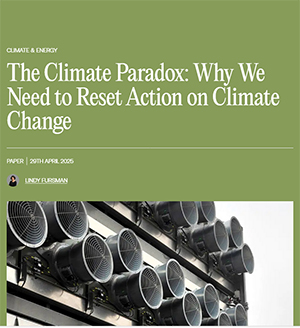
The Climate Paradox: Why We Need to Reset Action on Climate Change, by Tony Blair (Click to download the report).

This is a Big Blob document

But make no mistake, in the conclusions he’s still calling for the ultimate Blob wet dream — he wants weather control with geoengineering and that will need global governance:

Actions to address the climate-change challenge must include:

        1. Accelerating and scaling technologies that capture carbon, together with significant investment and acceleration of engineered permanent carbon-dioxide-removal technologies, including direct air capture (DAC) solutions.

        2. Harnessing the power of technologies, including AI, to streamline and speed up both climate mitigation and adaptation.

        3. Investing in breakthrough and frontier energy solutions to ensure future generation can be clean.

        4. Scaling nature-based solutions in order to buy time for more systemic solutions.

In the most extreme case, in which we fail to make significant progress on decarbonisation, the world may need to seriously consider solar radiation management (SRM), a technology generally considered a last resort for addressing global warming. One of the most radical and controversial forms of disruption, SRM involves the direct manipulation of the Earth’s climate system to counteract global warming through techniques aiming to reflect sunlight away or limit the radiation that reaches the Earth. While highly controversial, such technologies may become necessary if mitigation efforts fail to prevent catastrophic climate shifts. …

Because the impacts of SRM are likely to be global and unequally felt, the world needs a robust governance framework to ensure its equitable and ethical use. This framework could mirror past efforts at limiting the proliferation of nuclear weapons.

There is currently significant risk that a single country could move ahead unilaterally with this technology at scale, resulting in extreme weather effects that transcend national borders. As such, political leaders globally should progress with urgency a governance framework. The potential for unintended consequences such as regional climate disruptions or unforeseen ecological impacts, including risks from sudden temperature rise on the ceasing of SRM activities, underscores the importance of international cooperation and oversight, and makes this intervention the most disruptive of technological options.

In Part 7. “Rethinking the Role of Finance, Including Philanthropy”,  free men of the world will want to know Tony Blair wants to harness the power of philanthropic funding, and one of the successes he mentions is this:

One good example of the power of philanthropic investment is the Bill & Melinda Gates Foundation’s investment in mRNA vaccine technology – years before the Covid-19 pandemic.

That’s just in case, you were wondering if Tony Blair was still an active part of the Global Blob — The Billionaires, the United Nations Bureaucrats, the Davos Ski Club, and the largest corporate leaders in the world. He is.

h/t TdeF and OldOzzie, GWPF


0 out of 10 based on 0 rating

via JoNova

https://ift.tt/fEm5bAK

April 30, 2025 at 04:48PM

Claim: Trump Tariffs to Blame for the UK Economic Slump (Not Climate Policy)

Essay by Eric Worrall

Nothing to do with Mad Miliband’s green energy policies.

UK growth forecast to slow sharply as Trump tariffs push confidence to record low

EY Item Club predicts GDP of only 0.8% this year as Ipsos poll shows three-quarters of Britons expect economy to get worse

Mark Sweney Mon 28 Apr 2025 09.01 AEST

The UK economy is set to slow sharply for the next two years as Donald Trump’s global tariff war weighs on consumer spending and business investment, a study by a leading forecaster has predicted.

The findings by EY Item Club, which is sponsored by the big four accountancy firm EY, come as a separate survey reported that confidence in Britain’s economy has fallen to the lowest level on record.

The latest poll by Ipsos, which has been tracking net economic optimism in Britain since 1978, found that three-quarters of Britons expect the economy to get worse over the next year. Just 7% of Britons think the economy will improve, while 13% thought it would stay the same, equating to a net score of -68.

EY’s forecast said it now expects UK gross domestic product (GDP) to grow by 0.8% this year, down from a projection of 1% in February, and has cut its 2026 forecast from 1.6% to 0.9% as longer-term effects hit the UK.

…

Read more: https://www.theguardian.com/business/2025/apr/28/uk-growth-forecast-to-slow-sharply-as-trump-tariffs-push-confidence-to-record-low

Back in the real world, Britain’s extreme green energy policies were doing harm well before President Trump won the election and threatened Britain with reciprocal tariffs.

At the end of 2024, before President Trump took office, the situation got so desperate the British PM started begging regulators to brainstorm new ideas to stimulate the British economy.

Starmer asks UK regulators for ideas to boost growth

29 December 2024ShareSave
Joe Pike
Politics investigations correspondent, BBC News

Prime Minister Sir Keir Starmer, the chancellor and business secretary have written to the UK’s main regulators asking them to come up with ideas for reform that could boost economic growth.

They contacted watchdogs, including energy regulator Ofgem and water regulator Ofwat, before Christmas asking them to submit proposals by mid-January.

This comes after figures published earlier this week indicated the UK economy had flatlined between July and September.

Shadow business secretary Andrew Griffith said the letter “says all you need to know” about Sir Keir’s government, claiming he has to “beg his own government to create growth after Labour’s damaging Budget”.

…

Read more: https://www.bbc.com/news/articles/cy0n14ywzqpo

Obviously new tariffs on British exports to the USA are adding to pressure on the British economy. But trying to suggest President Trump is the main reason for the slump in the British economy in my opinion is an absurd fiction.


Discover more from Watts Up With That?

Subscribe to get the latest posts sent to your email.

via Watts Up With That?

https://ift.tt/XouisWr

April 30, 2025 at 04:06PM

Dunkelflautes: Germany versus Belgium

Previous post detailed the Dunkelflautes in Germany during the period 1 November 2024 until 28 March 2025. Belgium being a neighbor country of Germany and having the same energy strategy (increasing solar and wind while decreasing dispatchable electricity sources) will most likely going through similar periods of Dunkelflautes.

Let’s just compare both countries in the same period with the same methodology (Dunkelflaute = period in which total daily production of solar and wind is less than 10% of its installed capacity).

This is the graph depicting the Belgian electricity production of solar and wind compared to the 10% threshold in the same period:

Chart29c: Dunkelflautes Belgium November 1, 2024 - March 28, 2025

There is some similarity with the graph of the situation in Germany from previous post. This is the comparison of both below each other with roughly the same height (attention: the volumes are vastly different in both countries, Germany has roughly ten times more production – this graph is just meant to compare the frequency of days with a low production in both countries):

Dunkelflautes: Germany vs Belgium comparison November 1, 2024 - March 28, 2025

The appearance of both graphs is rather similar. The share of solar in electricity production is pretty small from November through January and picks up speed starting at the end of January.

Those graphs are maybe not that clear when it comes to the Dunkelflaute periods and how much these overlap. Let now just focus on the length of the Dunkelflaute periods and compare both:

Chart29d: Dunkelflautes Germany vs Belgium November 1, 2024 - March 28, 2025

Although there are some differences, the general direction is the same for both and the figures are in the same ball park. The average capacity factor of solar and wind in this period is roughly the same (12.2% vs 11.8%) as well as the maximum number of consecutive days (15 vs 14). The total number of days of Dunkelflaute in the period is however somewhat higher (67 vs 59).

The differences might depend (at least partly) on the share of solar and wind in the mix. Belgium has a larger share of solar relative to Germany, so when the sun is the biggest contributor to the Dunkelflaute, then Belgium will be more affected than Germany.

That reminded me of a statement made at the end of 2022 by our then Minister of Energy, claiming that Dunkelflautes only last for a few hours and can be solved with battery storage. However, in this case there were several periods with a total daily solar and wind production of less than 10% of its installed capacity, one of them even lasted for two weeks. I doubt that these Dunkelflaute periods could be solved with battery storage. Not even close.

via Trust, yet verify

https://ift.tt/mnaMzsN

April 30, 2025 at 02:45PM