Spain and Portugal Achieve Net Zero Accidently

Analysis of the blackout in Spain and Portugal comes in EurAsia Daily article Solar generation fell, and then the Spanish power grid collapsed: details of the blackout. Excerpts in italics with my bolds and added images.

New details are emerging why a large-scale blackout occurred in Spain, which lasted more than 10 hours and hit millions of Spaniards. The statements of the operator of the country’s energy system differ from the original version of EADaily, but point to the same reason — green energy, which failed in a crisis situation.

“The first major power outage in the era of green electricity,” Bloomberg columnist Javier Blas wrote on Twitter. He published a brief transcript of the teleconference held by the operator of the Spanish power grid Red Electrica on the blackout, from which the country is still recovering.

So, Red Electrica ruled out a cyber attack or weather as a reason. The operator presented the following course of events. At 12.33 pm, the Spanish power grid experienced a loss of generation in the south-west of the country. Most likely, these were solar power plants, but the operator is not sure yet. Indeed, most of Spain’s solar generation is located in the south-west of the country.
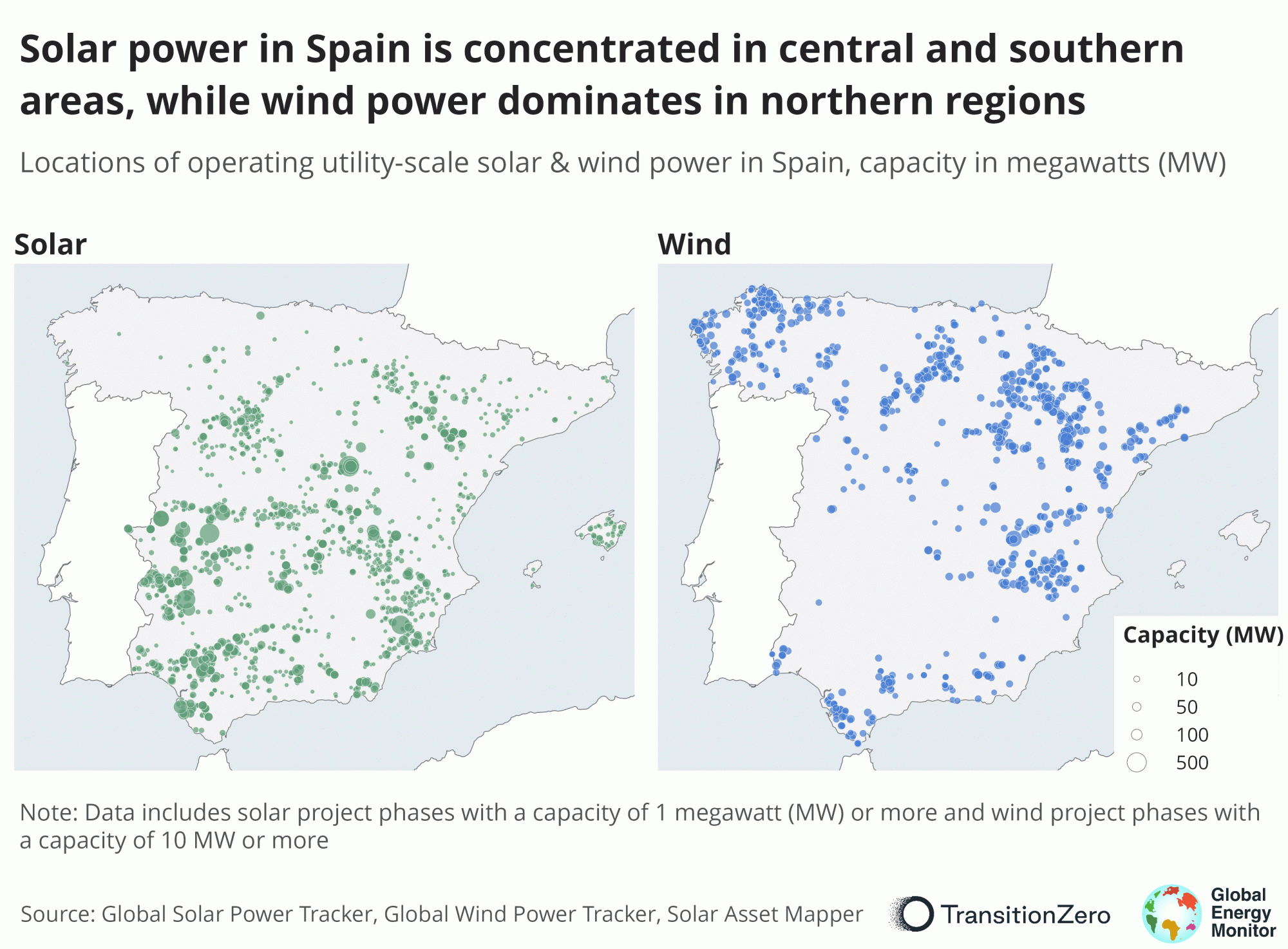
Location and concentration of solar power plants in Spain (left).

After milliseconds, the power system self-stabilized and began to recover. However, after a second and a half, a second wave of generation power loss occurred. Representatives of the operator did not specify whether the first wave provoked the second.

Three and a half seconds later, the instability of the energy system of the Iberian Peninsula reached a level that led to a malfunction at the interconnector with France, the power supply capacity of which was then 1 GW.

Immediately after that, another power loss of green power plants hit the power grid. The operator did not specify why this happened.

Further, the cascading power drop further destabilized the Spanish power grid, forcing every remaining power plant to be disconnected from the grid — nuclear power plants, gas and hydroelectric power plants. As a result, the generation in Spain entering the network has dropped to zero. The data shows that out of 25 GW, 10 GW remained, but the operator reported that for a brief moment the power dropped to zero.

Red Electrica stated that the presented series of events is preliminary, and so far the operator cannot make a final conclusion due to a lack of data.

This information is confirmed by the data of the operator itself and the European ENTSO-E platform. The capacity of solar power plants at 12.25−12.30 amounted to 17.8 GW — 55% of the total generation in the country. And by 12.40 it had almost tripled to 6 GW. At the same time, from 11.00 the capacity of solar power plants changed dramatically and one-time fluctuations reached 700 MW.

The operator’s data differ from the original version of EADaily about the failure of the interconnector with France and temperature changes, but coincide with the key reason for the blackout — green energy.

The problem of solar and wind power plants is that, unlike coal and gas generation, they do not provide synchronous inertia that stabilizes the frequency in the network. And when the frequency in the network dropped, solar power plants could not compensate for the imbalance. Their operation depends on inverters, which automatically turn off when the frequency deviates from the norm, aggravating the collapse.

The electrical system obeys the laws of physics. This obvious fact was not always taken into account when politicians took measures affecting the country’s electricity generation and transport networks. In Spain, for example, over the past decade there has been a revolution in electricity generation, which has led to the fact that renewable technologies (primarily photovoltaic and wind) now occupy a large part of the energy balance,” wrote former president of Red Electrica Jordi Sevilla in El Pais.

He noted that there is a technical problem: solar and wind energy are not synchronous energy sources, while transmission and distribution networks are designed to operate only with minimal voltage in the energy they transmit. Therefore, a sudden jump in the production of renewable generation can lead to sharp voltage fluctuations in the network, which will lead to a loss of generation and, as a result, to power outages.

“Our energy system needs investments to adapt to the technical realities of the new generation, which, in turn, should also continue to improve its own technologies and storage systems. This is a requirement of the sector (and the system operator), to which the government does not listen. The PNIEC project was developed in the office with excessive messianism regarding renewable energy sources and without taking into account the technical problems associated with such a significant change in the Spanish energy balance and its compliance with the energy system,” concluded the ex—head of the Spanish energy system operator.

Meanwhile, the Spanish Prime Minister made a new statement about the blackout.

“In his third speech in 24 hours, Pedro Sanchez clearly pointed out the ‘responsibility of private operators’ for the largest power outage in the history of Spain. He did not name names because the investigation is still ongoing, but the chief executive has thus taken the first step in a huge legal and economic battle that will begin in the coming months,” El Pais writes.

As the building notes, Pedro Sanchez seeks to neutralize attempts by the People’s Party (PP) and other conservative circles to blame the blackout on renewable energy sources.

“Sanchez claims that there is nothing to indicate that this is an explanation for what happened, and even more so that nuclear energy is the solution. Other right-wing European countries are returning to nuclear power, but Sanchez and Ogesen insist on the opposite,” El Pais noted.

At the same time, Prime Minister Sanchez himself still does not completely rule out the cyberattack version, and the government turned to Incibe (Cybersecurity Institute).

“Doubts remain. The government is not sure, but Sanchez still claims that the system is one of the best in the world, and adds that the public has behaved exemplary. At the moment, the system, restored to 99%, will work according to a safe formula, and if everything goes well, the usual formula will start working tomorrow,” El Pais writes.

Javier Blas  @JavierBlas comments:
Let’s see if I understood Spanish PM:
– we should not eliminate any hypothesis, but he has unilaterally ruled out any link to renewables;
– nuclear power plants are bad;
– we should wait to expert reports, but he contradicts the preliminary findings from the experts at the grid.
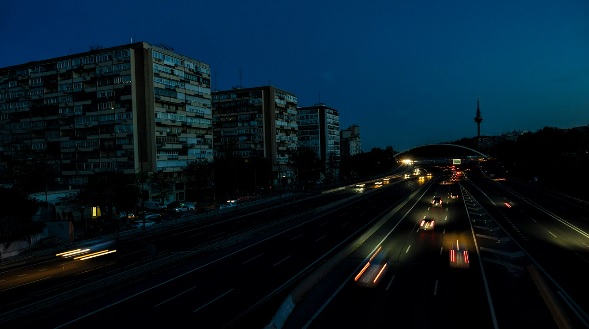
As reported by EADaily, after noon on April 28, millions of Spaniards faced problems that they did not even know about. The blackout stopped trains, planes and even buses. The extinguished traffic lights provoked chaos on the roads, and the lack of electricity in stores led to the fact that bank cards were not accepted and supermarkets were closed. Mobile communications disappeared, and hospitals served only patients in critical condition. 30 thousand police officers were brought into the capital of the country to ensure order. Spain could not even imagine such a thing.


via Science Matters

https://ift.tt/m7xqSuO

April 30, 2025 at 01:01PM

President Trump Explains The Stock Market

Three months ago it was Trump’s Stock Market, but now it is Biden’s Stock Market

About Tony Heller

Just having fun

This entry was posted in Uncategorized. Bookmark the permalink.

via Real Climate Science

https://ift.tt/VIdP3UX

April 30, 2025 at 12:20PM

Climate Activists Look to China to Give Them “Leadership”

Essay by Eric Worrall

Don’t forget the money…

The world needs climate change leadership – it’s time for China to step up

Published: April 29, 2025 10.26pm AEST
Yixian Sun
Associate Professor in International Development, University of Bath

The second Trump administration has announced various anti-climate policies under its “America first” strategy. Leaving the Paris agreement, kicking off a trade war, shutting down USAid and drilling for more oil and gas will not only undermine the US’s international reputation but will undermine the global effort to combat climate change.

With the US in retreat from climate action and Europe preoccupied by security challenges, new leadership is urgently needed. China may be poised to fill this gap. 

…

But more than 60% of the electricity generated in the country still comes from coal, and it remains unclear how fast the government plans to phase out fossil fuels. Meanwhile, some provincial governments are still issuing permits to add new coal-fired power plants.

…

China was one of the many countries that missed a February deadline for submitting its targets (only 15 countries were on time). Until now, Beijing’s strategy has been to “wait and see” given the turbulence caused by the new Trump administration. 

…

China should also play a major role in reforming the global financial system to make it aligned with the Paris agreement. As a strong supporter of green finance, it can influence upcoming international talks such as the Financing for Development conference in Seville, as well as the UN’s negotiations on international tax cooperation. As co-chair of the G20’s sustainable finance working group, China also has the opportunity to push for more funding to support net zero.

…

Read more: https://theconversation.com/the-world-needs-climate-change-leadership-its-time-for-china-to-step-up-252698

The activists might have quite a wait for China to provide more money. China is sitting on a stagflation and banking / government liquidity crisis which makes the 2007-8 GFC look like a mild hiccup. Toxic debt is weighing down all sectors of the Chinese economy, but every time Beijing tries to pump in a little stimulus, inflation surges and threatens to destroy what is left of their economy. On top of this, Trump’s new tariffs are likely going to crush China’s export sector, one of the few remaining healthy sectors of the Chinese economy.

I’m not sure how handing loads of money to foreign activist scientists and poor country tyrants who play the climate pauper game figures in China’s list of priorities, but I’m guessing its not at the top of their list.


Discover more from Watts Up With That?

Subscribe to get the latest posts sent to your email.

via Watts Up With That?

https://ift.tt/GqhIJBO

April 30, 2025 at 12:05PM

Battle to Open Closed-Minded Universities

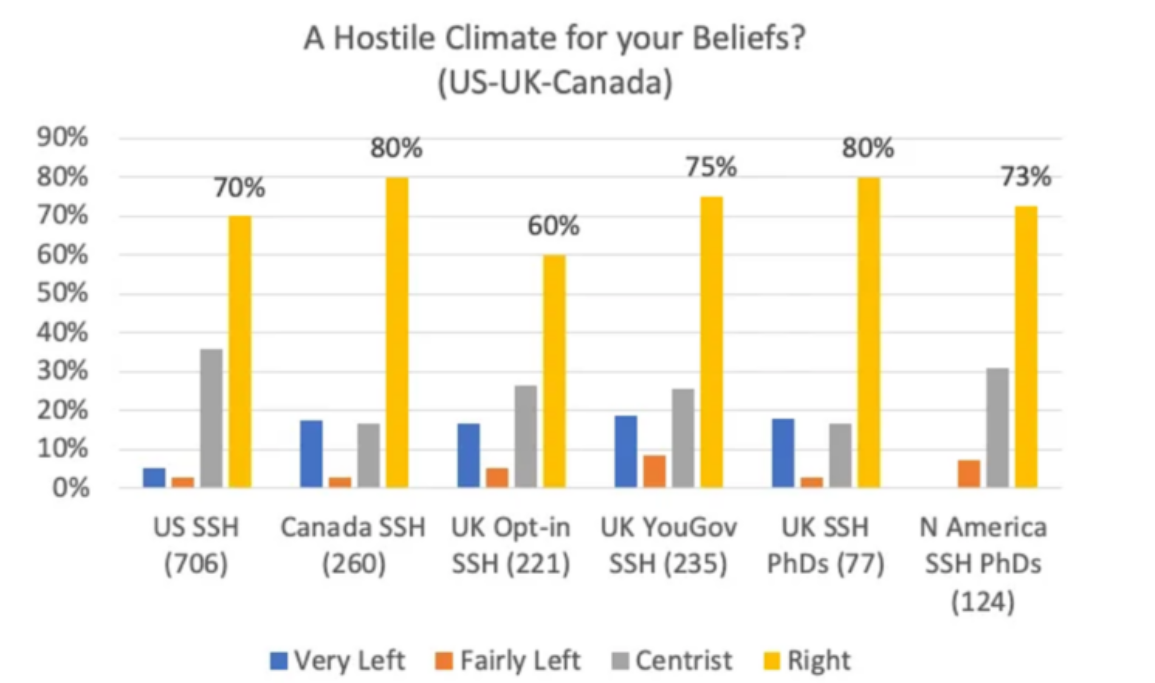
Research by U.K. politics professor Eric Kaufmann (top left) showed that 80 percent of Canada’s right-leaning academics report a hostile environment for their beliefs. The proportion was the same in the UK and was 70 percent in the U.S. In all three countries, the percentage of “very left” academics reporting hostility towards their beliefs was less than 20 percent.

James Piereson writes at City Journal Trump Is Likely to Win His Fight with Universities.  Excerpts in italics with my bolds and added images.

The administration holds many cards,
and it seems determined to play them all.

The universities have compromised themselves with the alliance they have formed with the Democratic Party and their dependency on taxpayer funds provided by Democrats, Independents, and Republicans alike. Universities should not have let themselves become so attached to any political party or ideological point of view, lest they compromise the intellectual integrity of their institutions or jeopardize the taxpayer funding that they badly need. But that is precisely what has happened at Harvard, Columbia, Northwestern, and other leading institutions. It is something the Trump administration hopes to change.

Trump has said that he wants to use the lever of federal funding to force university leaders to confront several issues: the lack of intellectual diversity on their campuses, with upward of 80 percent of faculty members identifying as liberals or progressives, and less than 2 percent as conservatives; the refusal to enforce race- and gender-blind civil rights laws, and the continued use of preferences in admissions and employment, in violation of the 2023 Supreme Court decision in Students for Fair Admissions v. Harvard University; the failure to protect the rights of Jewish students amid demonstrations on campus of anti-Semitism and hatred of Israel; administrative “bloat,” reflected in how college campuses today employ more administrators than professors teaching courses; tuition increases that far outpace inflation, leading to ever more student borrowing and debt underwritten by federal loan programs; and the continued presence of ideological departments and programs on campuses that do not allow for diversity of intellectual approaches.

The Trump administration has tried to influence institutions by freezing payment of federal funds, but there is a more effective way to do this—one less likely to cause mayhem in scientific programs and medical schools and less prone to being overturned by the courts: Trump should use the leverage of prospective grants to induce institutions to abide by federal law and begin reforming their internal operations.

These institutions will come back to the federal government every year with proposals for new funding. The Trump administration is not required to make new awards to these institutions. These can be made on the condition that the institutions are taking concrete steps to reform themselves. If they thumb their noses at Trump, then the administration can decide that grants and contracts that have gone to Harvard, Columbia, and Johns Hopkins in the past might be given in the future to the University of Alabama, Ohio State, or the University of Montana. Such a redistribution of federal funds might even bring about a useful realignment in the scientific prestige of American universities, as some move down and others move up the reputational ladder.

Some of Trump’s goals in regard to higher-education reform are already subsumed under grant participation agreements that institutional representatives must sign before federal departments can sign off on grants and awards. Those agreements oblige recipients to comply with provisions of the Civil Rights Act (1964), the Title IX educational amendments (1972), and other regulations in regard to discrimination by age and handicap status. In light of the Supreme Court decision in the SFFA  v.  Harvard case, along with Trump’s executive orders in regard to civil rights, those agreements oblige recipient institutions to abandon all preference programs, including DEI programs created to advance preferences in university life. More than a few institutional representatives will have a hard time signing these agreements going forward because of lingering preference programs on their campuses. In any case, the administration can supplement those agreements with addenda that include other issues it wants universities to address.

The questions asked of institutional representatives might include:

Does the institution pledge to abide by federal civil rights laws that forbid group preferences in admissions and employment?

Has the institution taken steps to guarantee the rights of Jewish students against attacks arising out of anti-Semitism or hatred of Israel?

What steps has the institution taken to create greater intellectual diversity on its campus?

Has the institution adopted measures to reduce the number of administrators on campus and to eliminate administrative departments that try to enforce group preferences in violation of federal law?

Has the institution limited tuition increases to the level of inflation in order to reduce expenses for students?

These questions should clarify the choice Trump is asking these institutions to make:
either change current practices or forgo federal research funds
.

Over the four years of this second Trump administration, such an approach might have genuine and constructive consequences for the operation of American universities. Will Johns Hopkins University spurn $3.3 billion in federal grants next year in order to preserve its DEI bureaucracy? Will NYU give up $879 million in research grants next year in order to maintain its gender studies programs, or programs in the law school that advocate for group preferences? Universities may have to make hard choices between future federal funding and ideological programs currently in place.

This is precisely what liberals, feminists, and other activists did in the 1970s when they forced universities to sign “affirmative action” pledges, which soon turned into agreements to enforce group preferences in faculty hiring and employment. That approach evolved into the campaign for diversity later in that decade, when the Supreme Court ruled that preferences might be used to advance diversity in colleges and universities, and more recently into the DEI crusade that emerged in the wake of the George Floyd incident. That crusade proved to many that the entire enterprise had gone way too far. After five decades, with much academic mischief to show for it, the approach has hit a wall with the Trump administration.

Harvard and other universities are likely to find that they
are fighting a losing battle against the federal government.

Harvard has an endowment of $53 billion, by far the largest among the nation’s universities, but that’s little more than a rounding error in the government’s $7 trillion budget. Here the government negotiates from a strong position because, while federal grants loom large in university budgets, they are only a small fraction of the government’s budget.

The government has other weapons at its disposal. There is the tax exemption, for starters, which, if lost, will mean that schools cannot receive tax-deductible donations.. The government can stop the flow of international students to the schools, a move that would be costly in terms of foregone tuition payments. Trump can also ask Congress to slap a hefty tax on university endowments, another step his administration is already considering. At some point, Harvard and other elite institutions will have to sue for peace rather than continue an argument they cannot win.

In any case, the Trump administration holds many cards in this showdown with the universities, and it seems ready to play them all.

via Science Matters

https://ift.tt/Fwcs2pW

April 30, 2025 at 11:25AM