German Droughts Were Much More Common Back In The Old Days, Before 1980!

Central Europe has been experiencing a bout of dry weather since February. Germany’s DWD national weather service reported in a recent press release that just 19 liters per square meter (l/m²) fell in March compared to the approx. 60 liters that normally fall in the month. This made last March one of the driest since measurements began in 1881.

“The pronounced drought, which had already lasted in some regions since the beginning or middle of February, was caused by high-pressure areas that repeatedly settled over Central Europe or in the surrounding area,” reports the DWD.

Not surprisingly, the media are making alarmist claims of unprecedented drought, and all hinting it’s due to climate sins by mankind.

Driest years overwhelmingly before 1980

So is drought in rainy Germany something new that we have only begun to experience, like the media and pols suggest?

The historical data show that the answer is clearly NO.

Four of the 5 driest years on record in Germany occurred before 1960. Eight of the top 9 occurred before man-made climate change was ever an issue (before 1980).

Annual precipitation of the 9 driest years since 1881. Hat-tip: Stefan Homburg 

And when we look at Germany’s long-term precipitation trend since data began to be recorded, we see the trend is in fact becoming wetter:

Chart: DWD.

Yet, green politicians in Germany have begun calling for a “masterplan” for water-saving and, not surprisingly, more restrictions on how we use water.

Dr. Stefan Homburg summarizes at the end of his video: “I just can’t get my head around it, ladies and gentlemen. I personally don’t understand as a final evaluation why we allow politicians to really ignore real, existing problems and instead invent problems that don’t exist at all in order to derive restrictions on our lives and, above all, to make life more and more expensive through CO2 taxes certificates and so on.”

Donate – choose an amount

via NoTricksZone

https://ift.tt/2891VHE

April 23, 2025 at 07:44AM

Be Part of the Climate Resilience Conversation – Last Change to Register

Before climate science became ‘settled science’, there were various theories suggesting that because the amount of carbon dissolved in the Earth’s oceans exceeds that in the atmosphere by about a factor of 60, the atmospheric CO₂ content must be dictated by the chemical state of the oceans. We don’t hear so much any more about the massive storage of carbon in sedimentary rocks like limestone, and the role of oceans in facilitating carbonate formation via marine organisms. In fact, who would be such a heretic as so to suggest Earth has a low atmospheric C02 content because of all the hoarding in the oceans over the millennia. I am hoping to make this a topic for a future zoom webinar.

In the meantime, in just over 24 hours, the focus will be less on ocean storage and more about ocean degassing of C02. This discussion will be with Bud Bromley who actually lives in Hawaii, which is where atmospheric levels of C02 are measured and reported as the definitive global trend.

This is your last chance to register for this my fourth Zoom meeting/webinar in the new series Towards a New Theory of Climate Resilience, also variously titled How Climate Works. I am very grateful to the 62 individuals who have already registered. It is not too late if you want to be a part of this event that is at 2pm on Friday Brisbane time that is 6pm the day before/Thursday evening in Hawaii.

Click this link to register:
https://us02web.zoom.us/webinar/register/WN_QrVa8XEzSPS_GvUWnXkX0Q

After that I am planning to pivot, at least briefly, to consider the actual framing of this concept of a New Theory of Climate Resilience. I am planning three sessions that will be more philosophical for Saturday 24th May, across three time zones. I will have links to register for all, or at least one of these webinars, in the next week or two.

I am grateful for the many conversations that I have had by email, and phone, since I first proposed a New Theory of Climate Resilience. I am particularly grateful for the thoughtful commentary from Christopher Game in which he has continued to caution about the use of language with a particular distain for the word ‘equilibrium’ as a ‘seductive lure to muddled thinking’ and a suggestion that we use the mathematics of dynamical systems theory including because it gives time scales for various processes and mechanisms. More recently in a blog thread Christopher has written, and I agree, that:

There are at least two ways of trying to describe such complex phenomena as the earth’s energy transport process. One way might be described as ‘curve fitting to past data’. Another way might be described as ‘modeling the dynamics of the process’. It seems that the present discussion is about modeling the dynamics of the process.

Given the importance of process and language, I suggest we even begin compiling a new dictionary of climate science, as opposed to climate-craft*. For sure there must also be some agreement in terms of what is meant by particular words and also time frames.

At some point it might also be useful to consider the concept of entropy versus balance, and even the relevance of these concepts, or not, to the Great Barrier Reef as the largest coral reef system to have ever existed on planet Earth and one, that I dare say is hoarding carbon.

All of this is perhaps more relevant for my planned fifth Zoom Webinar that will be on Saturday 24th May. For sure to get a notification do subscribe for my Tuesday e-news, link here: https://jennifermarohasy.com/subscribe/

In the meantime, to be able to put all the pieces of the puzzle together, don’t miss my discussion with Bud Bromley about ocean degassing of C02 that will be this Friday afternoon Brisbane time, and Thursday evening in Hawaii which is where Bud lives.

* Climate-craft is defined in a fun book, entitled ‘The Devil’s Dictionary of Climate Change: Wicked words to impress your friends and upset your enemies’ that you can still buy on Amazons and other places. Paperback – 19 June 2018 by Mr George Lexicon. And it includes a note on the backcover:

Of all the threats and dangers in our age of false facts, the most concerning is surely CLIMATE-CRAFT. Devised and driven by global warming and climate alarmists, this new black art has deceived many credulous minds and academies. It now has followers everywhere, from the highest office of the Vatican to the lowest carbon cowboy. CLIMATE-CRAFT is corrupting the language and integrity of enquiry that gave us real knowledge of the world for centuries. It is a master of obfuscation on a grand scale. It promulgates pernicious beliefs and apocalyptic prophecies. Yet the self-styled merchants of doom promoting it do not have infallible insight into the forces that control the Earth’s thermostat, weather or climate. Don’t be duped by the CLIMATE-CRAFT movement. Discover its shocking secrets, stratagems and much more in this sensational new dictionary.

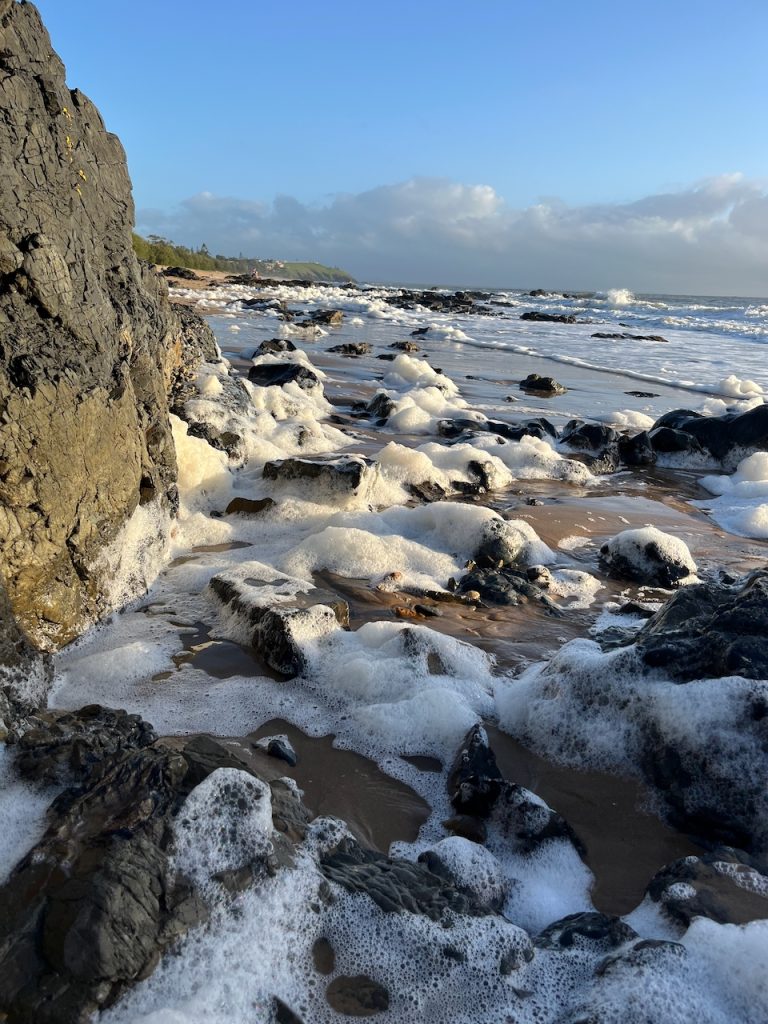
And for anyone wondering about the relevance of the photograph at the very top of this note, well I like to mix things up and I might also be asking Bud how many sharks he has seen underwater. Bud Bromley is not only a chemist, interested in ocean chemistry, but he is also a keen scuba diver.

Oh, and the photograph just above the climate-craft note was taken at my local beach, Lammermoor Beach just the other day. I am into taking photographs of ocean foam at the moment, it reminds me of fizz and how Ivan Kennedy poured vinegar into his beer at the end of my second Zoom webinar, to make a point about chemistry generally and ocean chemistry more specifically.

via Jennifer Marohasy

https://ift.tt/okHa3IQ

April 23, 2025 at 05:50AM

Summertime Reality Twisted Into Climate Exasperation

By Vijay Jayaraj

Growing up in the sun-scorched plains of Southern India, where summer temperatures often flirt with 104 degrees Fahrenheit, I learned early that extreme heat is not an anomaly but a seasonal reality to be expected. Yet, all of us confront the metaphorical heat of relentless rhetoric from climate alarmists who insist our planet is overheating beyond the point of salvaging.

In Bengaluru (formerly Bangalore), the city I now call home, climate narratives often echo global hysteria. Headlines scream of “record-breaking heat” and “unlivable cities,” yet the data – raw, unfiltered and grounded in reality – tell a different story, one that challenges the hyperbole regularly sweeping over the public.

On average, a Bengaluru March experiences 17 days where temperatures reach or exceed 93 degrees. This year has been no different. We recorded exactly 17 days of 93 degrees or above in March – right on par with the 15-year average. Far from the apocalyptic predictions of endless heatwaves, this summer has been, in a word, normal.

Over the past 15 years, from 2010 to 2024, temperature records for the months of February through May show us that there is no summer crisis. The entire summer of 2018, for instance, had only 23 days above 93 degrees, whereas 2023 had 30 days. In contrast, 2016 had 76 days. Does this indicate an existential crisis? Or does it simply affirm that climate fluctuates? It is the latter.

Climate Alarmism: A Manufactured Crisis?

It is not just temperatures. The broader climate narrative is laced with outlandish predictions that fail to materialize. The “end of snow” prophecy, the vanishing of Arctic ice by 2013, and the frequent claims of “hottest year ever” – all have proven misleading at best, deceptive at worst.

Consider rainfall patterns in India, which have a major influence on the livelihood of 1.3 billion people. There is a significant year-to-year variability in precipitation, which is typical of India because of the unpredictable nature of monsoons.

The average annual rainfall between 2000 and 2023 shows us that there is no crisis. The early 2000s experienced several significantly wet years, with 2003 recording nearly 49 inches of precipitation. From the mid-2000s to the early 2010s, there was a notable decline in rainfall, with 2009 being especially arid. The latter segment of the dataset, spanning from 2019 to 2022, indicates a duration of consistently elevated rainfall levels.

There is no discernible linear trend of increasing or decreasing precipitation throughout the period. The data reveal fluctuations between wetter and drier years. This variability underscores the intricate nature of India’s monsoon system and its susceptibility to diverse climatic factors.

Now, imagine asking the city’s 14 million residents to relinquish their ambitions for an uninterrupted power supply based on coal as a fuel in favor of unreliable “green” technologies such as wind turbines to address a fabricated climate crisis.

Sadly, such requests are made by activists and media outlets that peddle worst-case scenarios as inevitabilities, ignoring historical weather records and honest science. The result? A public psyche primed to view every warm day as a portent of apocalypse.

Individuals are not only subjected to feelings of guilt regarding the supposed degradation of the Earth’s climate, but they are also deceived into thinking that erratic wind and daytime solar energy can supply baseload electricity required by their urban and industrial centers.

The truth is summers are hot, particularly in the middle latitudes of my city. And there is nothing the climate industrial complex can, or should, do about it.

This commentary was first published at California Globe on April 21, 2025.

Vijay Jayaraj is a Science and Research Associate at the CO2 Coalition, Arlington, Virginia. He holds an M.S. in environmental sciences from the University of East Anglia and a postgraduate degree in energy management from Robert Gordon University, both in the U.K., and a bachelor’s in engineering from Anna University, India.


Discover more from Watts Up With That?

Subscribe to get the latest posts sent to your email.

via Watts Up With That?

https://ift.tt/6ZsNDgF

April 23, 2025 at 04:04AM

Net zero leaders want to shutter California’s only zero-emissions electricity-generating plant

California should keep the Diablo Canyon Power Plant.

via CFACT

https://ift.tt/g9SCt10

April 23, 2025 at 03:37AM