Socialism Couldn’t Save The Glaciers

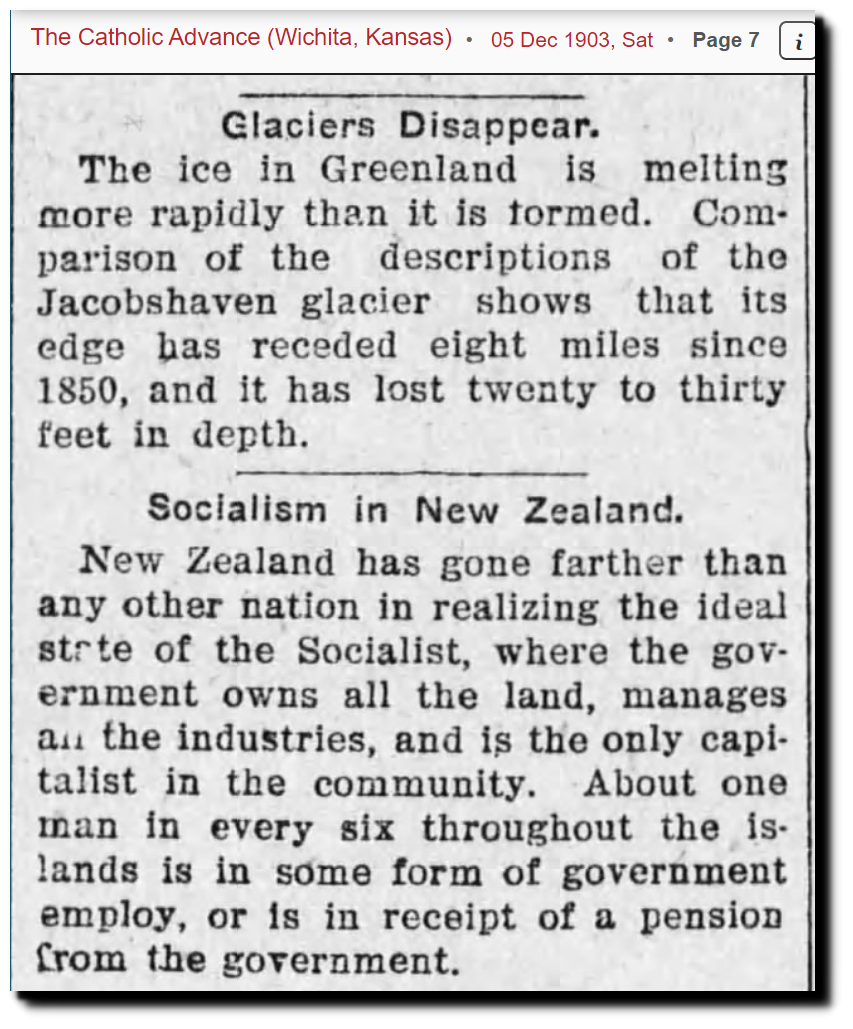
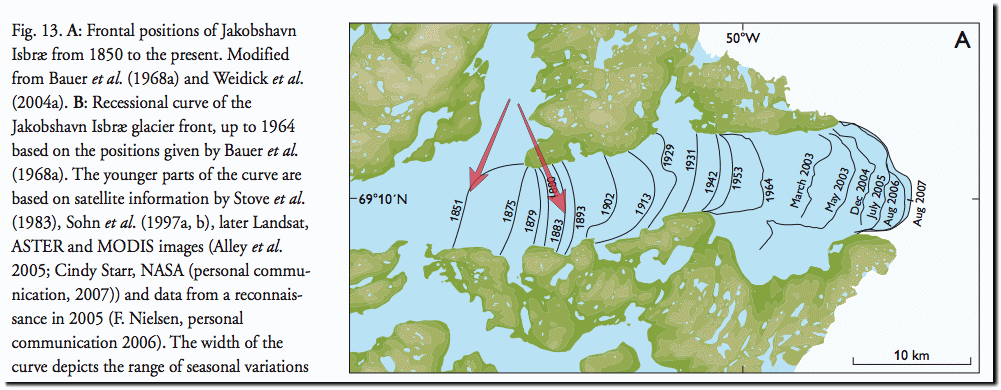
By 1903, glaciers were rapidly disappearing around the world and New Zealand had gone full socialist.  According to the IPCC and Michael Mann, the second half of the 19th century was the coldest fifty years of the last millennium.

05 Dec 1903, Page 7 – The Catholic Advance at Newspapers.com

Geological Survey of Denmark and Greenland Bulletin 14, 14-25

Climate Change 2001: The Scientific Basis

Before the IPCC rewrote history in 2001, NOAA knew about the warming from 1981 to 1919.

“Analysis of warming since 1881 shows most of the increase in global temperature happened before 1919 — before the more recent sharp rise in the amount of carbon dioxide in the atmosphere, said Thomas Karl, of the National Oceanic and Atmospheric Administration’s National Climatic Data Center in Asheville, N.C. While global climate warmed overall since 1881, it actually cooled from 1921 to 1979, Karl said.””

Dec 07, 1989, page 2 – The Post-Crescent at Newspapers.com

This entry was posted in Uncategorized. Bookmark the permalink.

via Real Climate Science

https://ift.tt/A5gw1EP

April 20, 2025 at 01:47PM

Record Slow Ice Melt

Arctic sea ice extent is about the same now as it was when the Berlin Wall was still standing in 1989.  Seasonal melt over the past month has been the slowest on record. N_19890419_extn_v3.0.png (420×500)  N_20250419_extn_v3.0.png (420×500) https://ift.tt/RMdoa2h

via Real Climate Science

https://ift.tt/c9sQtYR

April 20, 2025 at 12:42PM

The Impact Of The Ukraine War On UK Energy Costs

By Paul Homewood


I want to follow up on Ed Miliband’s claim about the impact of the Ukraine war on energy prices and the cost of living, something he says still “stalks families today”.

It goes without saying that gas prices shot through the roof during 2022, as gas supplies became in short supply.

The OBR assessed the cost to the government of its energy support packages to consumers:
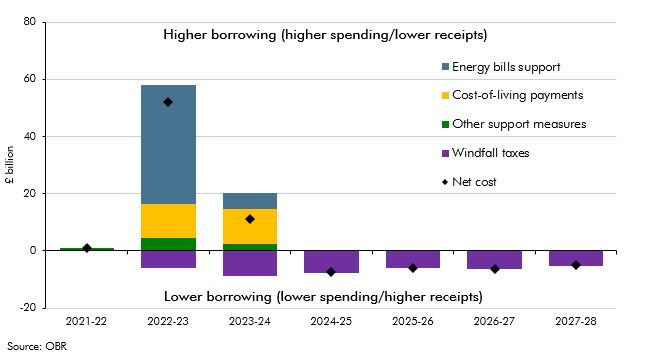
Chart 3A: The net cost of the UK Government’s energy and cost-of-living support

https://obr.uk/box/an-international-comparison-of-the-cost-of-energy-support-packages/

They said these cost £78.2 billion over the two year period, of which £72.0 billion was covered the various household and business support packages. The rest included the freeze on fuel duties –  irrelevant, as they been frozen since 2011 anyway-  and the bailout of Bulb Energy. Although high gas prices might have been the catalyst, the real cause for that was poor financial regulation.

Against the £72.0 billion, the government collected £39.9 billion in windfall taxes on energy companies. The two things are, of course, directly related. It was not a case of robbing Peter to pay Paul. It was giving Paul back the money he had had to pay Peter in the first place!

So we arrive at a net cost of £32.1 billion. A lot of money, of course, but less than two years worth of renewable subsidies. If Miliband regards this as a market meltdown, what would he call the £96 billion bill for those subsidies in the next five years?

https://notalotofpeopleknowthat.wordpress.com/wp-content/uploads/2025/03/image-79.png

Even after the government energy support packages, the energy cap still remained higher than before the Ukraine war, and continues to:
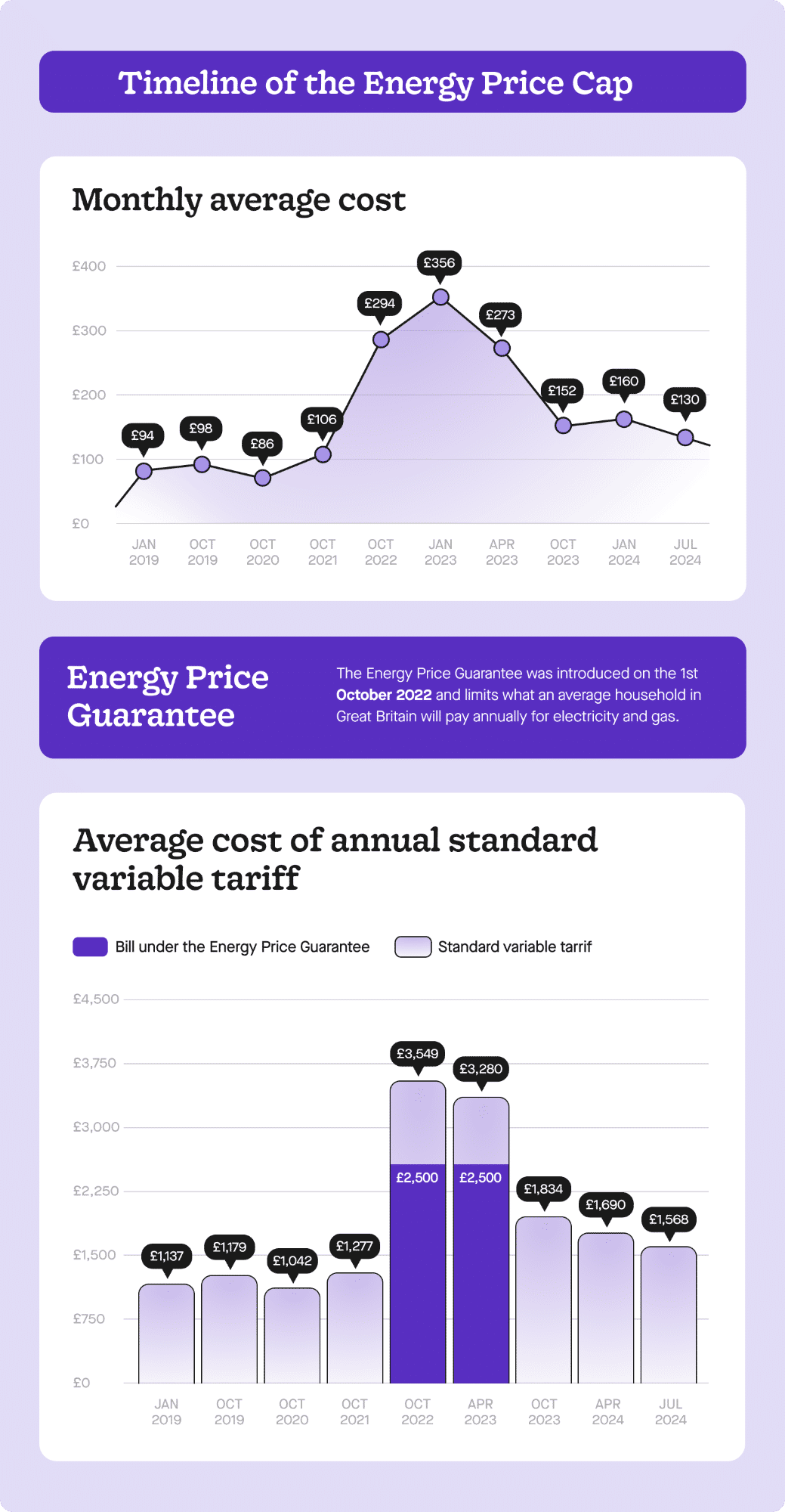
History of OFGEM Energy Price Cap

https://heatable.co.uk/boiler-advice/history-of-ofgems-energy-price-cap

Since October 2021, the annual energy cap has risen from £1277 to £1849, an increase of £572, some of which is due to normal inflation. Of this £572, about half, £288, is on gas.

But if you had switched from gas to electricity, whatever colour, as Miliband wants, you would have been much worse off; electricity is more than four times the price of gas.

The amount you are currently worse off in terms of power prices alone is £284 a year, half of which is accounted for by general inflation anyway.

And as we know, most of the increase in electricity prices in the last few years is due to increasing environmental levies, not wholesale costs.

In short, Miliband’s claim that his green transition would have saved consumers money is pure bunkum.

via NOT A LOT OF PEOPLE KNOW THAT

https://ift.tt/TAXjz65

April 20, 2025 at 12:13PM

Back-Breaking Taxes

Guest Post by Willis Eschenbach (Yeah, I’m still wrongly blocked on X. See here for updated details.)

One of the greatest joys in my life is learning. Today, to my dismay, I learned that there are US tax credits for the meaningless job of removing CO2 from the air. Here’s a summary from perplexity.ai:


Summary of the U.S. 45Q Tax Credits

Overview
The U.S. Section 45Q tax credit is a federal incentive designed to support carbon capture, utilization, and storage (CCUS) projects. It provides a performance-based tax credit for capturing and either securely storing or reusing carbon oxides (including CO₂ and CO) from industrial, power, and direct air capture (DAC) facilities 1 2 3 5.

Credit Amounts (as of 2025, with prevailing wage requirements met):

Project Type Credit per Metric Ton CO₂
Secure geologic storage (industry/power) $85
Carbon reuse (fuels, chemicals, products) $60
Secure geologic storage (oil/gas fields) $60
Secure geologic storage (DAC) $180
Carbon reuse/EOR (DAC) $130
  • Lower base rates apply if prevailing wage requirements are not met (e.g., $17/ton for industrial storage, $36/ton for DAC storage) 3.

Eligibility and Requirements

  • The owner of the carbon capture equipment claims the credit 1 2 3.
  • The captured carbon must be securely stored in approved geologic formations or reused in qualifying products (e.g., fuels, chemicals, building materials) 1 3.
  • Projects must meet minimum annual capture thresholds (e.g., 1,000 tons/year for DAC, 12,500–18,750 tons/year for other facilities) 3.
  • Credits are available for 12 years after the facility is placed in service 2 5.
  • If stored carbon is later released, the credit must be repaid (credit recapture) 2 4.

Recent Enhancements

  • Lowered annual capture thresholds, expanding eligibility 1.
  • Credits can be transferred to other taxpaying entities or claimed as a direct payment for certain tax-exempt and government entities 1 3 4.
  • Construction must begin by January 1, 2026, to qualify 2 5.

Purpose and Impact

  • The 45Q credit aims to reduce the cost and investment risk for CCUS, encouraging broader deployment in hard-to-decarbonize sectors such as cement, steel, and power generation 1 5.

Key Takeaways

  • 45Q is a major federal incentive for CCUS, offering up to $180/ton for DAC and $85/ton for industrial storage when prevailing wage conditions are met.
  • The credit is flexible, transferable, and designed to spur private investment and accelerate decarbonization across multiple sectors 1 3 5.

(Note-each individual digit of the links shown above goes to a different source for the statement in question.)


Based on that, here’s a quick back-of-the-envelope calculation:

The US emits around 4.8 billion metric tonnes of carbon dioxide per year.

Average cost of the U.S. 45Q tax credits is on the order of $130 per tonne.

So to offset the US emissions using carbon capture would cost us a mere 625 billion dollars per year.

This is just under a third of the Federal Income Tax Revenue, so to offset it, our Federal Income Tax payments would have to increase by 50%!!

Can I contact DOGE by calling 911? Because this is assuredly an emergency …

w.

Yeah, you’ve heard it before: When you comment, please quote the exact words you are discussing. It avoids endless misunderstandings.


Discover more from Watts Up With That?

Subscribe to get the latest posts sent to your email.

via Watts Up With That?

https://ift.tt/wxq8JVC

April 20, 2025 at 12:01PM