New Study: Corals Thrived When Global Sea Levels Were Meters Higher Than Today 6000 Years Ago

Coral reefs expand and thrive as sea levels rise, whereas they undergo millennia of growth hiatuses and “turn-off” or “mass mortality” phases when sea levels fall.

According to a new global sea level reconstruction (Feldman et al., 2025), global sea levels were meters higher than today 7000 to 5000 years ago. Global sea levels fell thereafter throughout the late Holocene.

From approximately 4500 years ago until 640 years ago, previously thriving coral reefs endured “mass mortality” and “turn-off” phases due to incrementally declining accommodation space in the Red Sea region.

This millennial-scale “turn-off” reef growth period was not just limited to this study area, but coral cover decline has been a global phenomenon associated with global sea level fall throughout the late Holocene.

“A global hiatus in coral reef development […] was largely driven by eustatic sea level drop during the late Holocene and caused a lack of vertical accommodation space…”

“In this study, we propose not just a local sea level condition causing specific reef turn-offs or hiatuses, but rather a global phenomenon of sea level fall.”

“A reduction in accommodation space through receding sea levels resulted in mass mortality or sea level constrained corals.”

Considering rising sea levels are advantageous to corals and falling sea levels largely eliminate the potential for growth, future sea level rise may lead to a “significant increase in coral cover”.

“Future sea level rise could provide additional accommodation space for currently sea level-constrained reef systems, potentially leading to a significant increase in coral cover.”

i

Image Source: Feldman et al., 2025

via NoTricksZone

https://ift.tt/KczFOLj

April 3, 2025 at 06:48AM

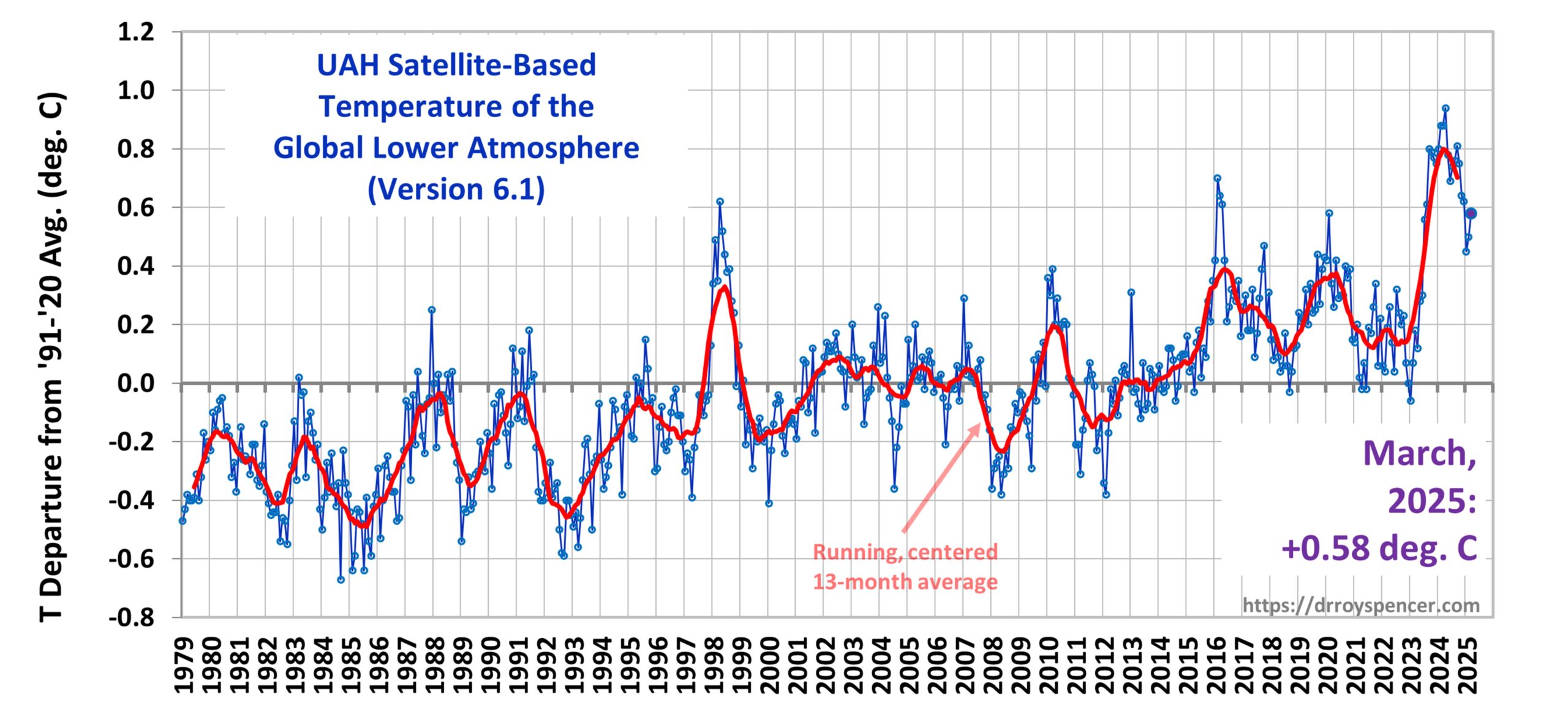
UAH v6.1 Global Temperature Update for March, 2025: +0.58 deg. C

The Version 6.1 global average lower tropospheric temperature (LT) anomaly for March, 2025 was +0.58 deg. C departure from the 1991-2020 mean, up from the February, 2025 anomaly of +0.50 deg. C.

The Version 6.1 global area-averaged linear temperature trend (January 1979 through March 2025) remains at +0.15 deg/ C/decade (+0.22 C/decade over land, +0.13 C/decade over oceans).

The following table lists various regional Version 6.1 LT departures from the 30-year (1991-2020) average for the last 15 months (record highs are in red).

YEAR MO GLOBE NHEM. SHEM. TROPIC USA48 ARCTIC AUST
2024 Jan +0.80 +1.02 +0.58 +1.20 -0.19 +0.40 +1.12
2024 Feb +0.88 +0.95 +0.81 +1.17 +1.31 +0.86 +1.16
2024 Mar +0.88 +0.96 +0.80 +1.26 +0.22 +1.05 +1.34
2024 Apr +0.94 +1.12 +0.76 +1.15 +0.86 +0.88 +0.54
2024 May +0.78 +0.77 +0.78 +1.20 +0.05 +0.20 +0.53
2024 June +0.69 +0.78 +0.60 +0.85 +1.37 +0.64 +0.91
2024 July +0.74 +0.86 +0.61 +0.97 +0.44 +0.56 -0.07
2024 Aug +0.76 +0.82 +0.69 +0.74 +0.40 +0.88 +1.75
2024 Sep +0.81 +1.04 +0.58 +0.82 +1.31 +1.48 +0.98
2024 Oct +0.75 +0.89 +0.60 +0.63 +1.90 +0.81 +1.09
2024 Nov +0.64 +0.87 +0.41 +0.53 +1.12 +0.79 +1.00
2024 Dec +0.62 +0.76 +0.48 +0.52 +1.42 +1.12 +1.54
2025 Jan +0.45 +0.70 +0.21 +0.24 -1.06 +0.74 +0.48
2025 Feb +0.50 +0.55 +0.45 +0.26 +1.04 +2.10 +0.87
2025 Mar +0.58 +0.74 +0.41 +0.40 +1.25 +1.23 +1.20

The full UAH Global Temperature Report, along with the LT global gridpoint anomaly image for March, 2025, and a more detailed analysis by John Christy, should be available within the next several days here.

The monthly anomalies for various regions for the four deep layers we monitor from satellites will be available in the next several days at the following locations:

Lower Troposphere

Mid-Troposphere

Tropopause

Lower Stratosphere

via Roy Spencer, PhD.

https://ift.tt/oh4CNHY

April 3, 2025 at 05:28AM

New Strike Prices Confirm Offshore Wind Is Much Dearer Than Gas

By Paul Homewood


The Low Carbon Contracts Company has updated all CfD strike prices for indexation to the 1st April:


 image

https://register.lowcarboncontracts.uk/

Of particular interest are the contracts offered in last summer’s AR6 round. Offshore wind, for example, has been uplifted to £84.97/MWh.

You will recall the OBR’s latest projection for wholesale power prices. Although they reckon it will average £101.50/MWh this year, they also say it will drop in years to come.

image

By the time East Anglia Two begins operations in 2028, its strike price will, depending on inflation rates, likely be at least £90/MWh, which is well above the projected wholesale price of £75.20.

In fact the OBR has almost certainly overstated prices this year. Catalyst Energy report that power prices have already fallen well below the £100 mark and are clearly still on a downward trend. This is on the back of a similar fall in gas prices:

image

image

Catalyst Energy

https://www.catalyst-commercial.co.uk/works/mar25-energy-market-brief/

If this trend continues, it will inevitably mean that CfD subsidies end up being much higher than the OBR are predicting – probably double the £1.3 billion projected.

It seems likely that the energy price cap will fall for the next quarter, and no doubt Ed Miliband will claim the credit! He certainly won’t reveal that it is due to the falling international price of gas.

The real problem however is that retail prices won’t fully reflect the fall in gas prices, as this will be partly offset by increasing CfD and other subsidies.

As the OBR chart above shows, we will be locked into much higher prices for years to come. By 2029/30, the third of our electricity  on CfD contracts will cost £98.90/MWh even at today’s prices.

On top of that, Renewable Obligation subsidies will increase again from this month to around £75/MWh. ROC subsidies cover about a quarter of generation.

People complain that when gas prices go up, their electricity bills do too; but when gas prices fall, they never seem to see the benefit!

This is why!

via NOT A LOT OF PEOPLE KNOW THAT

https://ift.tt/kDyl9Z1

April 3, 2025 at 04:30AM

Trump’s Climate Policy Shift Could Save American Farmers from Disaster

By Vijay Jayaraj

While news about President Trump’s tariffs and crackdowns on the questionable financial management of federal agencies has dominated media reports in recent weeks, a quiet transformation has been under way in agricultural policy.

An order to remove climate change references from U.S. Department of Agriculture websites signals a departure from the red tape of climate regulations on domestic farming practices and strings attached to U.S. support of agriculture abroad.

Through the U.S. Agency for International Development, the federal government poured millions of dollars into climate-focused programs that could have no positive effect on the climate — promoting “green” orthodoxy over agricultural productivity.

Some of these programs have been intertwined with other activities in rural agrarian communities. USAID and the U.S. International Development Finance Corporation, for example, joined in a “$55 million credit guarantee to address the economic impact of COVID-19 by supporting loans to farmer-producer organizations, ag-tech companies, and companies engaged in clean energy solutions for the agriculture sector.” A $1.5 million program aimed at “empowering” female climate activists in northern Kenya.

USAID also partnered with organizations like the Research Program on Climate Change, Agriculture and Food Security, which operates in developing countries and focuses on so-called research themes that include “low-emissions” development, climate services and safety nets, scaling “climate-smart” agriculture, and gender and social inclusion.

All these expenditures came under the umbrella of USAID’s 2022-2030 climate strategy, a $150 billion “whole-of-agency approach” to establish an “equitable world with net-zero greenhouse gas emissions.”

USAID’s financial support for farmers and businesses has been contingent on adherence to an absurd climate agenda and perverse views of human nature that have nothing to do with feeding hungry people.

The administration’s freeze on this funding cuts off money to hundreds of such programs that interfered with the employment of sensible farming practices in places like Africa, Asia, and Latin America.

It’s not just farmers abroad who will benefit from the dismantlement of USAID’s climate initiatives. Among the first casualties of the current policy shift will be the unscientific $3.1 billion program to promote the reduction of greenhouse gas emissions on farms across 55 U.S. states and territories through 135 projects.

Imagine a program intended to help crops grow but that robs them of the carbon dioxide that enables photosynthesis. CO2 is necessary for plant life — and ultimately all life.

NASA credits the greening of much of the planet over the past 100 years to the increase in atmospheric CO2. Programs that seek to lower carbon dioxide levels are destructive — period.

Without President Trump’s bold moves, U.S. farmers likely would have fallen under the constraints of externally imposed climate frameworks that have, in many cases, stifled innovation and reduced U.S. farmers’ competitiveness on the world stage.

The USDA targets greenhouse gas emissions under the Climate Smart Agriculture and Forestry program. These initiatives include forcing U.S. farmers to employ lower-pressure irrigation systems to decrease fossil fuel energy use. Other measures are aimed at manipulating the quantity and quality of dietary nutrients to reduce methane emissions from animal digestive tracts. It was probably just a matter of time before critically important nitrogen fertilizers were targeted as a source of greenhouse gas emissions — as they have been in some other countries.

By contrast, countries such as China and India have prioritized productivity and food security over such practices. They have invested heavily in fossil fuel-based agricultural technologies and products, achieving record crop yields for their massive populations.

Adding insult to injury, the climate money these nations received purportedly for “climate justice” may have financed fossil fuel projects. Too often, American taxpayers have paid the bill for overseas projects that do little if any good.

The highly politicized, fabricated climate crisis, which is based on erroneous climate models and exaggerations of a so-called greenhouse effect, should not overshadow the immediate economic and operational concerns of farmers in the U.S. and elsewhere.

Trump’s withdrawal from international climate initiatives, including the U.N.’s Paris Climate Accords, marked a win for American farmers and taxpayers. His decision ended U.S. participation in costly and unrealistic mandates — such as the Net Zero agenda — that have strained global economies and fueled unrest among farmers and the broader public.

This commentary was first published at Blaze Media on March 29, 2025.

Vijay Jayaraj is a Science and Research Associate at the CO2 Coalition, Arlington, Virginia. He holds an M.S. in environmental sciences from the University of East Anglia and a postgraduate degree in energy management from Robert Gordon University, both in the U.K., and a bachelor’s in engineering from Anna University, India.


Discover more from Watts Up With That?

Subscribe to get the latest posts sent to your email.

via Watts Up With That?

https://ift.tt/rQDBO2g

April 3, 2025 at 04:05AM