Outdoor temperatures in some parts of England will be almost as warm as indoors. “People have been warned to protect themselves in the heat” UK weather to be hotter than Spain as Brits to bask in 20C heat all week … Continue reading →
All that stuff about a 1 in 100 year flood, they have no idea
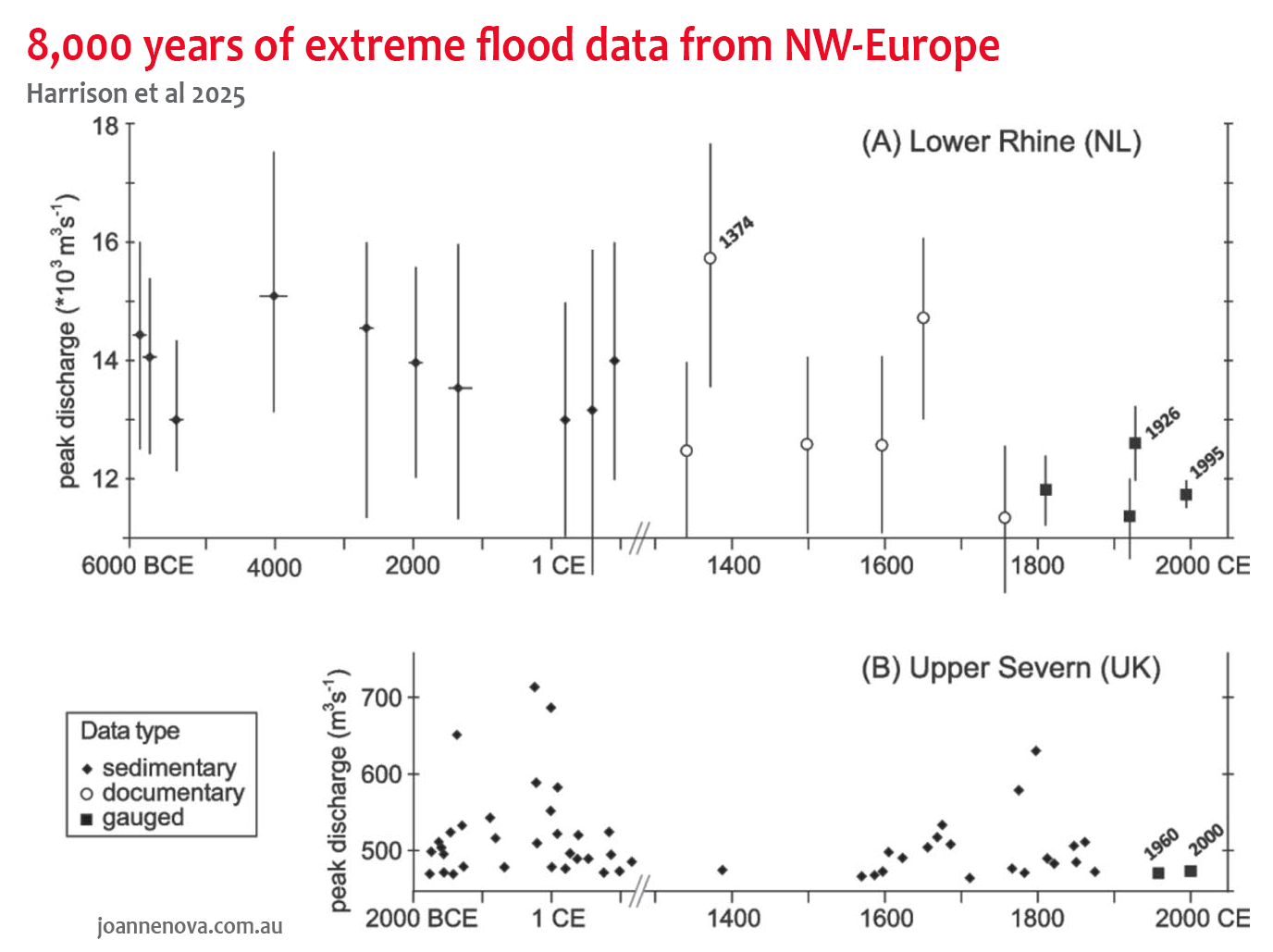
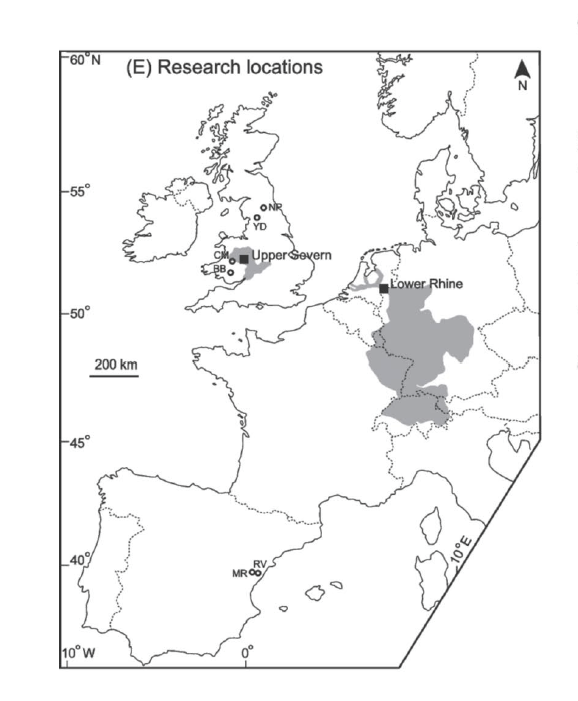
It turns out the worst flood on the Rhine was not in 2024 but in 1374. On the Severn, in England the worst year for “climate change” was 250 BC. Obviously neither of them were due to man-made oil and gas.
A thousand news headlines have said modern floods were unprecedented, or were 1 in 1000 year events, or were caused by “climate change” and they were all based on just 120 years of data (or less), and they were all very misleading.
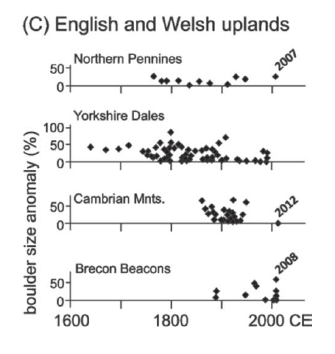
For some reason, even though climate change is the most important thing on Earth, hardly any researchers were looking for evidence of long term extreme flood events. When researchers finally studied the sediments left at many sites — they found evidence that many ancient floods were just as bad or even worse. At least 12 times, ancient peak river flows were bigger than anything we’ve seen in the instrumental record. (And they’re just the ancient floods we know about, imagine if we put more teams onto fluvial sediments?).
The only thing unprecedented about modern floods is the gall of scientists who ignore the last 8,000 years. They say that Storm Blah was 8.3 times more likely, and enhanced 42% by beefsteaks and Renaults. But all those attribution calculations assume that they know what “normal” flooding is.
If floods were worse 1,000, 2,000 or 4,000 years ago, nature is sometimes much meaner and nastier than most of us know. We could be hit with something terrible and be caught unprepared. But likewise, if we think these latest floods were due to coal-fired power plants, we might squander a civilization trying to stop floods with electrical Voodoo, which apparently we are.
— Daily Mail
Study author Professor Stephan Harrison at the University of Exeter said recent floods are not exceptional if we look further into the past.
‘In recent years, floods around the world – including in Pakistan, Spain and Germany – have killed thousands of people and caused enormous damage,’ he said.
‘Such floods are seen as “unprecedented” – but if you look back over the last few thousand years, that’s not the case.
‘In fact, floods we call unprecedented may be nowhere near the most extreme that have happened in the past.’
It’s definitely not a hockeystick
In the worst flood of the Upper Severn river around 250BC, fifty percent more water was flowing at the peak, than in the floods of the year 2000AD.
The more important question is why we spent so many trillions on pointless weather controlling talismen instead of hiring a few scientists to look at paleoclimate data. We could have saved so much money and suffering, and ended so much grift and graft.
Harrison et al looked at found that most of the worst floods were in the warmest era’s — like the Holocene optimum and the Roman warming times — which is what we’d expect. Warmer times evaporate more water off the oceans and into the sky. But the worst flood was in 1374 and was due to snow and ice melting, proving that no climate is perfect, and we really need to learn to predict it.
Harrison et al say the climate modelers of attribution and detection studies were wrong. And that this it is “the first time” anyone has put all these longer studies together. But all those sediments were there in 2010, just like they were there in 1990, but no one was studying them. That’s a scandal.
REFERENCE
Harrison, S., Macklin, M.G., Toonen, W.H.J. et al. Robust climate attribution of modern floods needs palaeoflood science. Climatic Change178, 71 (2025). https://ift.tt/OsEmn1u
54.93515 -2.73488 Met Office CIMO assessed Class 5 Temperature data from 14/1/2001
In recently reviewing Aboyne I referred to the large numbers of poor quality Met Office sites with 87% having known inaccuracy unsuitable for inclusion the national historic temperature record. As I am approaching the half way point of reviewing all 384 Climate reporting sites it is worth noting that there are still a staggering 48 Class 5 junk sites (“Class 5 (additional estimated uncertainty added by siting up to 5 °C)” to be covered. Brampton No 3 is one of them.
Weather station sites are selected to ensure that the observations are representative of the wider area around the station and not unduly influenced by local effects.
Ideal site
Level ground.
No trees; buildings, or steep ground nearby that might influence the measurements.
Undesirable site
Top of a hill or steep escarpment where winds will be unrepresentative of the wider area.
Warming effect of buildings on the measurement of temperature
Sheltering or shading effects of trees on the measurement of sunshine and wind.
Frost hollow where overnight temperatures on still clear nights may be far lower than at neighbouring locations.”
Leaving aside the specifics of the CIMO regulations, the Met Office acknowledges that “Top of a hill” is “undesirable” and that there should not be any trees around to “influence the measurements”. Well rather obviously the screen is in an area enclosed to all four compass points by hedging. Less immediately obvious is that it is also at the very apex of “Capon Hill” at 117 metres with the land falling away to every compass point.
The next issue is that this site is a domestic back garden. The Met Office from the same link makes the point that
“Observations from amateur stations and those not part of the Met Office’s official network cannot be considered for entry into the official records as they’re not subject to the same internationally agreed standards that are required for the official records.”
The reality is, though, that Brampton, and many other “Official” sites are in fact amateur sites that have simply had their readings accepted by the Met Office. Amongst numerous other examples are Frittenden, Baintown and Maulds Meaburn. It appears that if an amateur station owner persists long enough the Met office will accept their site’s readings no matter how low grade the site may actually be. It is also noticeable how often some of these “adopted” sites achieve either daily regional or even national “extremes”.
As I highlighted at Maulds Meaburn there is also this potentially questionable situation where the owners also have separate automatic reporting instruments not in Stevenson screens alongside. In the review of Whitechurch I included a clip of an online interview with the owner of the site where he points out no longer having to be outside in all weathers at 9:00 am to take readings since site automation was a great boon. Again at Brampton no 3 there is the automated private unit alongside the “official” site.
How are the general public to be certain that readings from the private unit are not simply written onto the DLY3208 to avoid the trip outside in adverse weather or for any of myriad reasons? The manual recording of this site appears impeccable but what assurances can there be other than trust. Given the evident lack of good site husbandry at so many locations it is hard to feel convinced that adequate Met Office oversight occurs. What exactly does “Davis VP2 Automatic Weather Station, providing additional data to the Met office Climat Station 7076” mean?
From the CIMO regulations standpoint, the screen is much too close to the hedging and subject to shading from the tree to the south as shown below with a 10 metre radius shown.
In summary Brampton No 3 may well be excellently maintained by its private owner but even as a no doubt well intentioned amateur we have no guarantee of that. The site clearly meets no regulated standards as there effectively are none for Class 5 other than not meeting Class 4. With all due respect to the owner, this site is junk and should not be used for climate reporting purposes i.e typical of the vast majority of Met Office sites.
We have covered in earlier articles how the UK has the highest electricity prices in the developed world and very high gas prices compared to international competitors like the US and Canada.
The problem of high energy prices has become mainstream with even the Energy Security and Net Zero Select Committee in Parliament launching inquiry into high energy costs. [Note that I have submitted written evidence to the inquiry, but cannot publish it until they have, so watch this space]. Readers will be dismayed to learn that the Government is now consulting on its latest cunning wheeze to further increase our energy bills by charging the cost of their cherished green hydrogen plans to our gas bills using the Gas Shipper Obligation (GSO).
Green Hydrogen Plans
Of course, hydrogen is a colourless and odourless gas, but hydrogen is assigned different colours according to the method of production. We covered the hydrogen rainbow in an earlier article. Green hydrogen is produced by electrolysis powered by renewables like wind and solar. Blue hydrogen is produced from natural gas and the resulting carbon dioxide emissions are captured and stored.
The last Conservative Government launched its hydrogen delivery roadmap back in December 2023. This called for “up to” 10GW of hydrogen production capacity by 2030 made up of 6GW of green hydrogen and 4GW of blue hydrogen.
The first tranche of this capacity was also announced in December 2023, with 11 projects totalling 0.125GW of capacity being announced in the first hydrogen allocation round (HAR1) at a strike price of £175/MWh (in 2012 prices) or about £244/MWh in 2024 money. By way of comparison, today’s elevated gas price is ~99p/therm or £34/MWh. Green hydrogen will cost about seven times the current UK gas price or ~23 times US gas prices. The Government gleefully announced that these projects would receive over £2bn of revenue support from the Hydrogen Production Business Model (HPBM). The 125MW of contracts awarded in HAR1 is only the tip of the iceberg though because HAR2 is aiming to support seven times that with 875MW of capacity under consideration.
In 2023, then energy secretary Grant Shapps appeared to rule out paying for this very expensive hydrogen though energy bills. But now, the new Government, with Ed Miliband at the helm of DESNZ has launched a consultation on what they term the Gas Shipper Obligation (GSO) to fund the HPBM.
Cost of Gas Shipper Obligation
The Government estimates the cost of HAR1 projects funded by the GSO will add £2.60-£4.50 per annum to domestic gas bills from 2028 to 2037. Industrial gas users can expect their gas bills to go up by 2%.
If we scale this up to cover the ambitions of HAR2 as well, then that could add £20.80-£36 to our gas bills and 16% to that of industrial users. If they are mad enough to deliver the whole 6GW of green hydrogen, then the cost to domestic consumers could be a whopping £124.8-£216 per year and industrial users could see their gas costs almost double.
Of course, there will be a complex system put in place to manage this new charge with attendant administrator which will also increase costs and complexity.Upgrade to paid
Are There Exemptions to the Charge?
In the consultation, the Government raises the prospect of exemptions from the GSO charge, but it is clearly unwilling to grant exemptions for some users because then the charge will have to be spread over fewer users pushing up bills for those people even further. The only exemption they appear to be keen on is for gas used to produce blue hydrogen. They are concerned that pushing up the cost of the feedstock for blue hydrogen will make it uncompetitive.
This means that costs for gas-fired electricity generation will go up too, pushing up our electricity bills as well as our gas bills. Interestingly, they do not discuss the possibility of an exemption for gas-fired electricity with carbon capture and storage (CCUS), so even that form of electricity will cost more too.
Why Are They Doing This?
The introduction to the consultation reads as though it was written by an Extinction Rebellion activist and probably was because one of Miliband’s SPADs was once the coordinator of their legal strategy team. They wax lyrical about fixing the non-existent climate and nature crisis and what a huge opportunity it is to transition to a low-carbon energy system. They even claim to be tackling the cost-of-living crisis, even though the consultation admits that these proposals will increase our energy bills.
We can perhaps look at the latest missive from the Climate Change Committee to get closer to the truth. As Figure 1 shows, they want to reduce the ratio of electricity to gas prices. They can do this by pushing up the price of gas and of course this proposal does exactly that.
Figure 1 – CCC Forecast of Ratio of Electricity to Gas Prices
However, there are lots of reasons not to do this, not least the collapse of many green hydrogen projects across the world. For instance, the Aurora Green Hydrogen project in Norway was terminated in 2022, citing lack of demand. McPhy’s green hydrogen project in Central Europe was abandoned just seven days after it was announced after the customer withdrew last autumn. Earlier this month, BP withdrew from the HyGreen project as part of its strategic repositioning. Hygreen was supposed to deliver a 500MW plant on Teesside when fully operational. Interestingly, BP’s 1.2GW H2Teesside blue hydrogen project appears to be still going ahead.
In addition, the CCC ruled out hydrogen for home heating and surface transport in its latest Carbon Budget. They also see only a very small role for hydrogen in electricity generation in line with the NESO Clean Power 2030 plan. Industry is not going to volunteer to use hydrogen when there are much cheaper alternatives. It seems the Government expects the market for this extremely expensive hydrogen to bootstrap itself into existence.
Conclusions
We already have the highest electricity prices in the developed world and UK and European gas prices are many times higher than those in the US and Canada. We simply cannot afford any more whacky projects that push up energy costs even more. In fact we should be going in the opposite direction and declaring an energy emergency to bring energy costs down.
The green hydrogen market is collapsing, because nobody wants to use such expensive fuel when natural gas is a much cheaper source of heat or electricity. Yet our Government is still pressing on with its ideological Soviet-style five-year target for a product with no market and wants us to pay for it.
We cannot afford such flights of fancy and need to change course on energy policy now. The focus should be on cheap and abundant energy to save what remains of our industry from total destruction and give relief to families struggling with energy bills.
This Substack now has well over 3,800 subscribers and is growing fast. This growth has meant the Substack is gaining recognition in other media, so keep an eye on the Multi-Media section if you want to see recent media appearances. If you enjoyed this article, please share it with your family, friends and colleagues and sign up to receive more content.
Discover more from Watts Up With That?
Subscribe to get the latest posts sent to your email.