(11) The Honest Broker on X: “DC Court reduces Michael Mann’s defamation award from $1,000,000 to $5,000 I wonder if Science, NYT, Wash Post and others who celebrated the original verdict will cover this at all Mann was ordered by … Continue reading →
Using a detailed atmospheric radiative transfer model, we derive macroscopic relationships of downwelling and outgoing longwave radiation which enable determining the partial derivatives thereof with respect to the explanatory variables that represent the greenhouse gases. We validate these macroscopic relationships using empirical formulae based on downwelling radiation data, commonly used in hydrology, and satellite data for the outgoing radiation. We use the relationships and their partial derivatives to infer the relative importance of carbon dioxide and water vapour in the greenhouse effect.
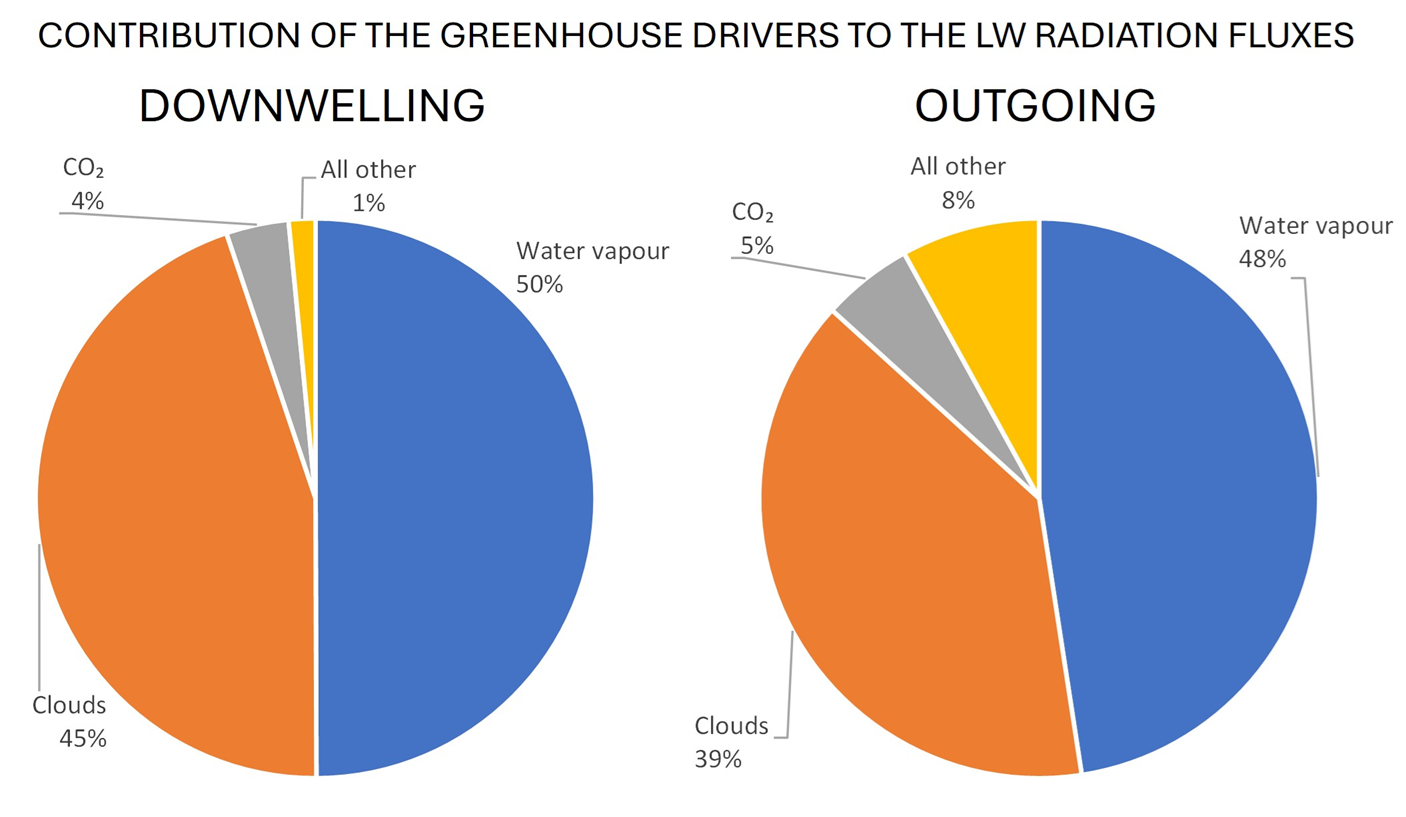
The results show that the contribution of CO₂ is 4% – 5%, while water and clouds dominate with a contribution of 87% – 95%. The minor effect of carbon dioxide is confirmed by the small, non-discernible effect of the recent escalation of atmospheric CO₂ concentration from 300 to 420 ppm. This effect is quantified at 0.5% for both downwelling and outgoing radiation. Water and clouds also perform other important functions in climate, such as regulating heat storage and albedo, as well as cooling the Earth’s surface through latent heat transfer, contributing 50%. By confirming the major role of water on climate, these results suggest that hydrology should have a more prominent and more active role in climate research.
Robin Horsley draws the implications from this and other recent papers. Transcript in italics with my bolds and added images.
For decades, we’ve been told that human generated CO2 emissions are the single most dangerous threat to our planet. Politicians, celebrities, and the mainstream media have united to amplify this alarm, warning of an impending climate catastrophe unless we act now.
But what if the story’s wrong? What if the very foundation of the theory, the idea that CO2 is the principal driver of global warming, Is flawed? What if the science we’ve been told is settled is actually far from settled?
This week I’ve been digging into this very provocative question looking at an extremely interesting recent report on the subject. And what I found might make you rethink a lot of what you thought you knew about climate change.
What If Everything You Thought About CO2 Was Wrong
For years we’ve been fed a simple story: Humans burn fossil fuels, releasing carbon dioxide – CO2 – Into the atmosphere. CO2 traps heat causing the planet to warm. The Greenhouse Effect as it’s known. The solution? Reduce CO2 to save the planet. But what if this narrative is overly simplistic or even fundamentally wrong?
At the recent international Clintel science conference in Prague leading climate experts gathered toscrutinise the dominant narratives around climate change. One of the most striking contributions came from Professor Demetris Koutsoyiannis, a highly regarded climate scientist from the University of Athens. His research challenges the very core of our understanding of CO2’s role in the climate system. Professor Koutsoyiannis presented groundbreaking findings that question the long held belief that rising CO2 levels cause global temperatures to increase.
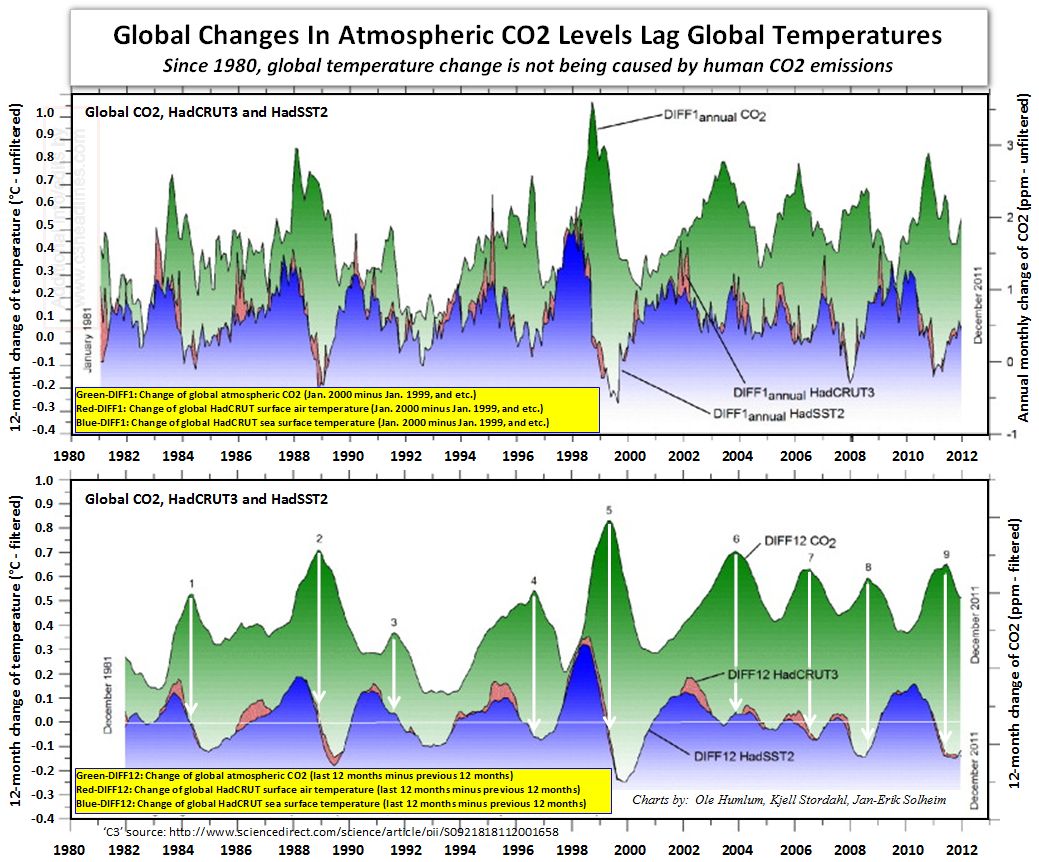
► Changes in global atmospheric CO2 are lagging 11–12 months behind changes in global sea surface temperature. ► Changes in global atmospheric CO2 are lagging 9.5–10 months behind changes in global air surface temperature. ► Changes in global atmospheric CO2 are lagging about 9 months behind changes in global lower troposphere temperature. ► Changes in ocean temperatures explain a substantial part of the observed changes in atmospheric CO2 since January 1980. ► Changes in atmospheric CO2 are not tracking changes in human emissions.
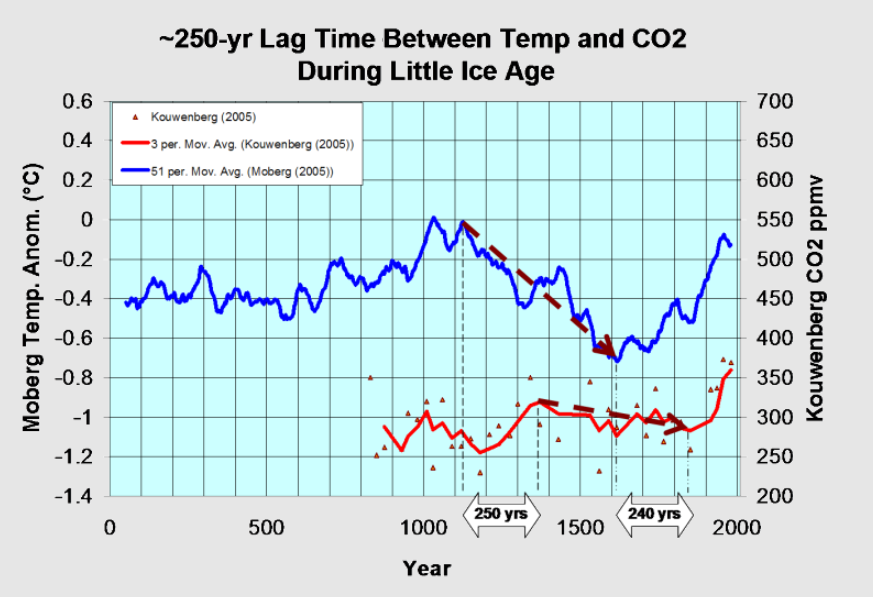
Instead, his research suggests it’s the other way around. Global temperature increases drive higher atmospheric CO2 levels. This isn’t an entirely new idea. For decades, scientists like Dr. Patrick Moore, a co-founder of Greenpeace have pointed to evidence showing that historically rises in CO2 levels have followed, not preceeded, global temperature increases. Ice core data, spanning millions of years, apparently supports this claim.
If true, this challenges the foundation of the mainstream climate narrative.
Why would rising temperatures cause an increase in CO2
But why would rising temperatures cause an increase in CO2 levels? Professor Koutsoyiannis explains that when temperatures rise, the natural world responds. Plants and oceans release more CO2 than they otherwise would. Warmer temperatures lead to a thriving environment.
Now, I think this needs some explanation, because plants absorb CO2 and produce oxygen. Not release CO2, don’t they? Well, yes, plants sustain themselves and grow through the process of photosynthesis, which turns sunlight, water and CO2, which plants absorb, into glucose which enables plants to grow and which produces oxygen as a by-product which we and animals need to breathe.
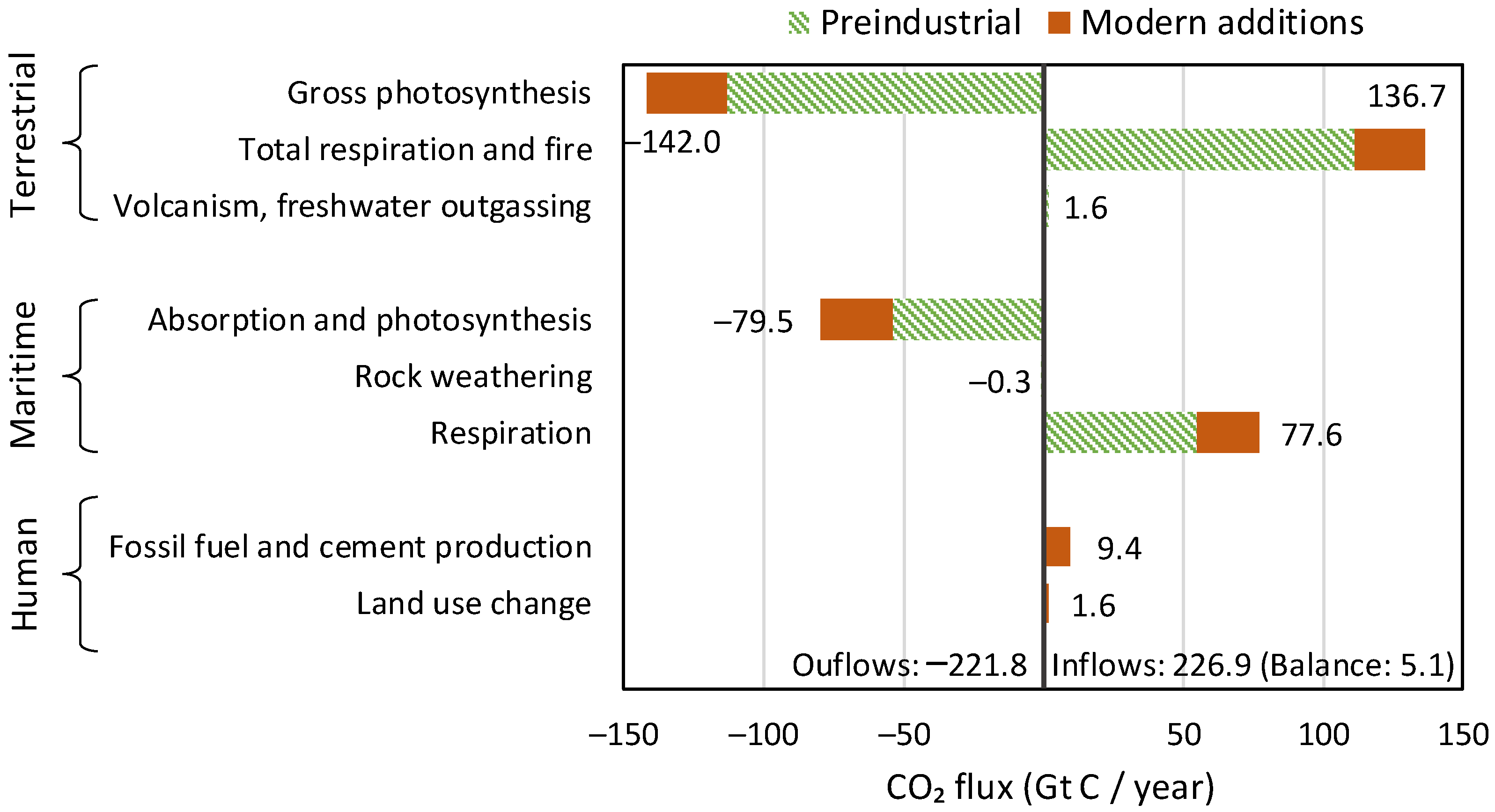
Figure 22. Annual carbon balance in the Earth’s atmosphere, in Gt C/year, based on the IPCC estimates (Figure 5.12 of [30]). The balance of 5.1 Gt C/year is the annual accumulation of carbon (in the form of CO2) in the atmosphere (reproduced from [5].).
However Plants also release CO2 as part of a process known as cellular respiration during the day, and particularly at night, when due to a lack of sunlight, photosynthesis cannot occur. On balance photosynthesis typically outweighs respiration. So living plants typically absorb more CO2 than they release. But when that increasing number of plants die and decompose, micro-organisms break down the organic matter releasing retained CO2.
Oceans also release CO2 into the atmosphere when the water is warmer than the surrounding air. Warmer water holds less dissolved CO2. These natural processes account for the majority of CO2 emissions. In fact, Koutsoyiannis argues that Nature contributes 96% of CO2 emissions leaving just 4% attributable to human activity.
Nature contributes 96% of CO2 emissions
Yes, burning fossil fuels adds CO2 to the atmosphere. However, the professor’s research suggests that human contributions are a mere drop in the ocean compared to natural emissions. Crucially, his data shows that the dominant greenhouse gases aren’t CO2. But water vapour and clouds. CO2, it seems, plays a much smaller role than we’ve been led to believe.
Additionally, the study challenges the claim that CO2 lingers in the atmosphere for thousands of years. Instead, it finds that CO2 is rapidly cycled through the atmosphere oceans and land with an average cycle of just 4 years.
Figure 26: Contribution of (left) the three mechanisms responsible for the cooling of Earth’s surface and (right) the four mechanisms responsible for the warming of Earth’s atmosphere, based on the global energy balance by Trenberth et al. (2009). Koutsoyiannis (2024)
The paper also concludes based on the data gathered over the last hundred years, when the amounts of CO2 in the atmosphere increased from around 300 parts per million to just over 400 parts per million, that this increase has had no discernible effect on the greenhouse effect. It’s that small a factor.
If this research is accurate It doesn’t mean climate change isn’t real. But it does suggest we need a better understanding of what drives it.
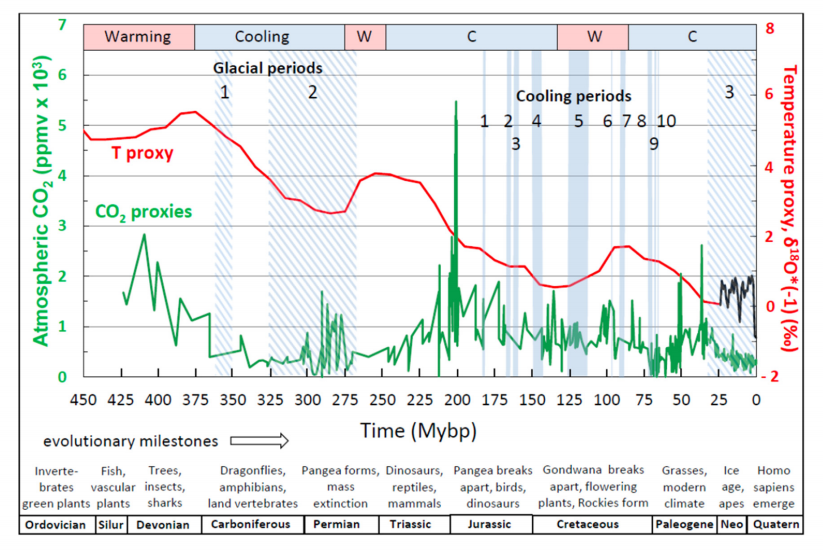
The professor asks a number of pertinent unanswered questions at the end of his paper. The earth is currently, when viewed over hundreds of millions of years, going through a relatively cool period. What caused the huge increases in earth’s temperature in the past? The professor asks.
It wasn’t industrialisation, was it? These are crucial questions especially as Governments implement sweeping policies in the name of achieving net zero emissions by 2050. Policies that impact everything from energy prices to housing and transportation. Even the food that we eat.
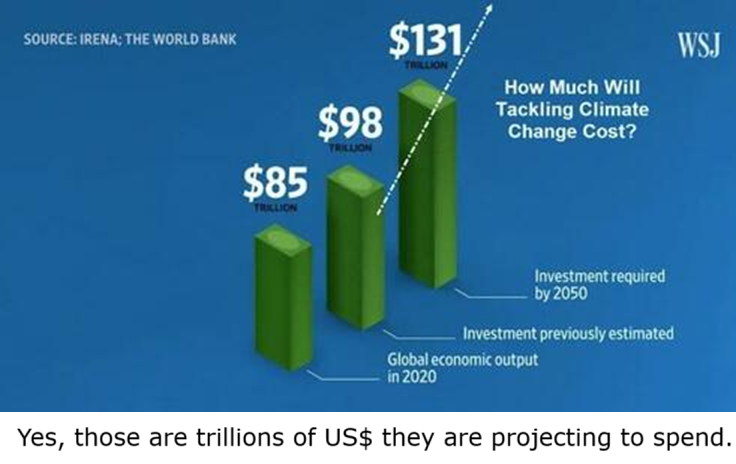
The global cost of the Net Zero 2050 agenda is projected to be between $100 and $150 trillion dollars by 2050. Meanwhile, the world bank estimates that eradicating extreme poverty globally would cost just three to four trillion. Universal health care and education, defeating diseases such as malaria on a global basis would cost less.
What if we’re funding trillions into solving something that isn’t actually the main source of the problem? What if we should be spending more on other things that can limit global warming? What if we should instead be spending more money on mitigating the effects rather than trying to prevent it?
Shouldn’t we demand more scrutiny of the science driving these decisions? Could it be that the climate crisis narrative isn’t just about science but also about power, control and profit? Entire industries are heavily invested in the CO2 narrative. And millions of people, and much of the mainstream media are emotionally invested in the quest to reduce CO2 to save the planet.
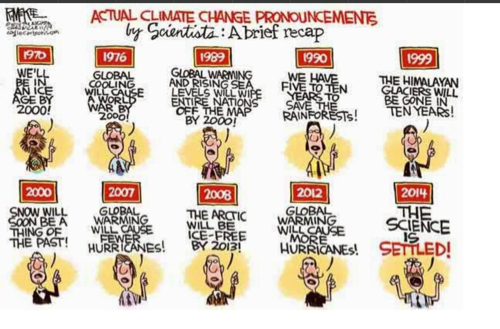
But is that what we’re actually doing? Science thrives on debate and scrutiny. Science is never settled as such. It’s constantly evolving, particularly in complex areas such as global climate. Yet the CO2 science on which we’re proceeding is decades old, and many of the models on which it is based have failed to make accurate predictions.
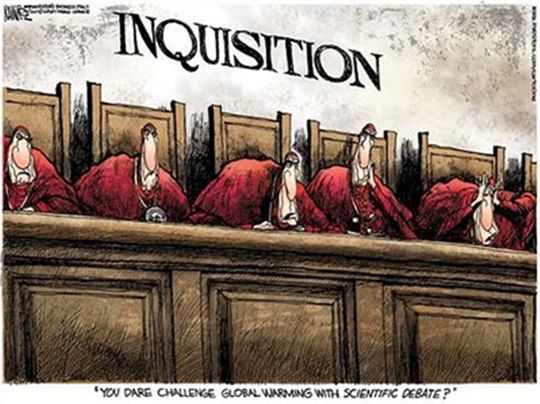
Yet those who challenge the mainstream climate narrative are often dismissed as ‘deniers’ or attacked personally. But shouldn’t the truth welcome scrutiny? Shouldn’t we demand transparency and evidence that can stand up to rigorous examination?
This isn’t about denying climate change. It’s about questioning whether we’re focusing on the right solutions. As more scientists speak out, surely it’s time to demand open debate. And consider whether the trillions we’re spending on Net Zero might be better used elsewhere.
Now, I’m not a climate scientist. Perhaps this report is flawed. Perhaps it is complete nonsense even. But the professor who wrote it is not the only one who’s pointing out the first fundamental point that the mainstream narrative is fundamentally wrong, that by burning fossil fuels we’re producing CO2 that is warming the planet.
An increasing number of others are breaking ranks and saying exactly the same thing. That increasing CO2 is largely a consequence of increasing global temperatures not the cause. Yet we’re told that we’re facing a climate emergency. We must cast aside all caution. We must listen to Greta Thunberg, the climate change messiah.
To ask questions is heresy! Really? What do you think? Should we blindly follow the mainstream narrative, or should we dig deeper and ask tougher questions? Please let me know your thoughts in the comments below. Thank you for watching.
Today, we raise a cheer for reason, justice, and the unyielding spirit of free expression! Today, the Superior Court of the District of Columbia delivered a resounding blow to overreach in the long-running defamation lawsuit brought by climate scientist Michael Mann against conservative commentator Mark Steyn. In a Final Judgment Order, Judge Alfred S. Irving, Jr. reduced Steyn’s punitive damages from an astronomical $1 million to a modest $5,000—vindicating Steyn, protecting open debate, and sending a powerful message about the limits of legal bullying.
This decision marks a triumphant turn in a 12-year legal saga that began with Steyn’s 2012 blog post criticizing Mann’s iconic “hockey stick” graph, a cornerstone of climate change narratives. Back in February 2024, a D.C. jury awarded Mann a symbolic $1 in compensatory damages and slapped Steyn with a jaw-dropping $1 million in punitive damages, alongside a similar $1,000 penalty for Rand Simberg of the Competitive Enterprise Institute (CEI). The awards, disproportionate and chilling, threatened to silence critics of Mann’s work and set a dangerous precedent for free speech.
But justice has prevailed! The court’s ruling not only slashes Steyn’s punitive damages to a reasonable $5,000 but also declares the original $1 million award unconstitutional—too excessive, too punitive, and out of step with the actual harm (or lack thereof) Mann suffered. This isn’t just a win for Steyn; it’s a victory for every skeptic, scientist, and citizen who dares to question orthodoxy in the public square. The $5,000 figure, aligned with the jury’s nominal $1 compensatory award, restores proportion and reaffirms that robust debate—however sharp—remains protected under the First Amendment.
Adding to the celebration, Mann has been ordered to pay over $500,000 in legal costs to National Review, Steyn’s co-defendant in the case. This award, rooted in D.C.’s Anti-SLAPP (Strategic Lawsuit Against Public Participation) law, recognizes the frivolous nature of Mann’s decade-long legal crusade against those who challenged his research.
For years, skeptics have watched this case with bated breath, fearing it could muzzle honest inquiry into climate science. Mann’s “hockey stick” graph, central to his reputation, has long been a lightning rod—challenged by statisticians, researchers, and commentators like Steyn for its methodological flaws and data handling. Steyn’s post, while biting, was an opinion, not a factual falsehood, and the jury’s initial $1 million penalty seemed less about justice and more about punishing dissent. Today’s ruling overturns that injustice, ensuring that critics of public figures like Mann can speak without fear of financial ruin.
This moment isn’t just about numbers—it’s about principle. The reduction to $5,000 sends a clear signal: courts won’t tolerate weaponizing defamation lawsuits to silence debate. It’s a rebuke to Mann’s “lawfare” tactics, which have drained resources from Steyn, National Review, and CEI while raising millions in crowdfunding from supporters rallying for free speech. Now, those supporters can celebrate a hard-fought victory, knowing their voices helped tip the scales.
Steyn himself has weathered this storm with grit, representing himself in court and refusing to back down. His resilience, paired with the court’s wisdom, has preserved a critical space for scientific skepticism and public discourse. Meanwhile, the over $500,000 in legal costs awarded to National Review—and the potential for CEI file for and secure similar relief—underscores the absurdity of Mann’s claims and the toll they’ve taken on his opponents.
Let’s raise a glass to this triumph! The slashing of Steyn’s penalty to $5,000 isn’t just a legal correction—it’s a beacon for free speech, a shield for honest inquiry, and a reminder that truth emerges from open debate, not courtroom battles. The fight for reason continues, but today, we celebrate a monumental step forward.
HT/Stephen McIntyre
Discover more from Watts Up With That?
Subscribe to get the latest posts sent to your email.