Biden’s Transformer Blunder: How Ideological Policy Choices Deepened the Grid Crisis

In a detailed report at Green Tape, Charles Yang exposes a critical misstep by the Biden administration that has worsened the ongoing transformer shortage. As the U.S. grid faces increasing strain from rising electricity demand, the previous administration had a rare opportunity to bolster domestic transformer manufacturing using $250 million in Defense Production Act (DPA) funding. Instead, under pressure from climate nonprofits like Rewiring America, the Biden White House chose to direct that money toward heat pump production—despite clear warnings that transformers were becoming a major supply bottleneck. This decision has not only deepened the crisis but also ensured that load growth would outpace the grid’s ability to support it​.

The Transformer Crisis: A Problem Decades in the Making

The power grid in the United States is aging. Most transformers in use today are over 30 years old, and demand for replacements has surged due to new industrial projects, increased electrification, and the rise of electric vehicles (EVs). Yet, instead of investing in much-needed grid infrastructure, the administration chose to spend $250 million in Defense Production Act (DPA) funding on heat pump production​.

Transformers play a crucial role in ensuring that electricity generated at power plants can travel long distances efficiently before being stepped down to safer levels for homes and businesses. Without them, the power grid is constrained, unable to add new generation capacity or support increased demand​.

Lead times for transformers have nearly tripled since 2022, while prices have soared, making it harder for utilities to maintain and expand the grid​. The causes of this shortage are many: supply chain disruptions, reliance on foreign electrical steel, and bureaucratic inefficiencies. However, the Biden administration’s decision to prioritize heat pumps over transformers has directly worsened the problem.

Biden’s Decision: A Policy Failure

In 2022, Biden delegated DPA authority to the Department of Energy (DOE) to support domestic production of key energy components, including transformers​. This funding was a rare opportunity to address supply chain issues and bolster domestic production. But instead of using it to ease the transformer shortage, climate activists successfully lobbied the administration to divert the money toward heat pump manufacturing.

Despite clear warnings about the growing backlog of transformer orders, the administration sided with climate nonprofits that viewed heat pumps as a politically favorable climate solution​. This decision ignored fundamental supply-side challenges: transformers are a bottleneck in the electrical system, whereas heat pumps merely increase electricity demand. By funding heat pump production instead, the administration ensured that demand would rise while the grid’s ability to support that demand remained constrained.

Why Heat Pumps? A Politically Motivated Decision

Heat pumps are a technology with clear benefits for reducing direct fossil fuel use in homes, but they are not a critical national security asset. Unlike transformers, which rely on a fragile global supply chain and require specialized materials such as grain-oriented electrical steel (GOES), heat pumps are relatively simple appliances that can be produced domestically with minimal geopolitical risk​.

The push to subsidize heat pumps over transformers wasn’t rooted in strategic industrial policy but in ideological commitment to rapid decarbonization. The administration was effectively prioritizing a near-term reduction in household carbon emissions over long-term grid stability.

Even worse, this move came at a time when transformer manufacturers were already struggling due to foreign competition. There is only one U.S. producer of GOES, meaning domestic transformer manufacturing is heavily dependent on imports​. A smarter industrial policy would have focused on strengthening transformer supply chains rather than throwing money at heat pump production.

The Consequences: A Weaker, Less Reliable Grid

The decision to prioritize heat pumps over transformers has real-world consequences.

  • Longer Wait Times for Grid Expansion: Utilities and power providers now face multi-year delays for transformer procurement, slowing down grid modernization efforts​.
  • Higher Costs for Consumers: Transformer prices have nearly doubled, and utilities will inevitably pass these costs on to ratepayers​.
  • Reduced Grid Reliability: A weak grid can’t handle growing electrification demands, making blackouts and brownouts more likely.
  • Increased Dependence on Foreign Suppliers: Rather than investing in strengthening the domestic transformer supply chain, the U.S. remains reliant on foreign manufacturers, particularly in China​.

What Needs to Happen Next?

Fixing the transformer crisis requires urgent action. Congress and the administration must reverse course and prioritize transformer production over climate virtue-signaling.

  1. Pass the CIRCUIT Act: This bipartisan bill would provide a 10% tax credit for transformer manufacturing, helping domestic producers compete​.
  2. Redirect Remaining DPA Funds: The administration still has $14 million in unallocated DPA funding. This should go toward transformers, not more heat pumps​.
  3. Standardize Transformer Design: The lack of uniform transformer standards makes manufacturing inefficient. DOE should work with utilities to establish common specifications​.
  4. Invest in Advanced Transformer Technology: Research into solid-state substations and new transformer materials could help alleviate future shortages​.

Conclusion: A Case Study in Misguided Priorities

The transformer crisis is a direct result of the Biden administration’s decision to prioritize ideological climate policies over practical energy infrastructure needs. While heat pumps may make for good press releases, they don’t keep the lights on. Without immediate action to address the transformer shortage, the U.S. risks stalling its economic growth and weakening its energy security.

This entire fiasco highlights the dangers of allowing activist-driven policymaking to override sound industrial strategy. If the administration is serious about grid resilience and energy security, it must start by acknowledging and correcting its mistake.

You said:

Please leave out Climate Activist talking points such as: Heat pumps are a technology with clear benefits for reducing direct fossil fuel use in homes

ChatGPT said:

Biden’s Transformer Blunder: How Ideological Policy Choices Deepened the Grid Crisis

In the rush to electrify everything, from homes to cars and factories, the Biden administration made a decision that can only be described as reckless: it prioritized heat pumps over power transformers, despite the latter being critical to the U.S. power grid’s stability. This choice, driven by pressure from climate nonprofits like Rewiring America, exacerbated an already dire transformer shortage, increased costs, and left the U.S. scrambling to keep up with rising electricity demand.

The Transformer Crisis: A Problem Decades in the Making

The U.S. power grid is aging. Most transformers in use today are over 30 years old, and demand for replacements has surged due to new industrial projects, increased electrification, and the rise of electric vehicles (EVs). Yet, instead of investing in much-needed grid infrastructure, the administration chose to spend $250 million in Defense Production Act (DPA) funding on heat pump production​.

Transformers play a crucial role in ensuring that electricity generated at power plants can travel long distances efficiently before being stepped down to safer levels for homes and businesses. Without them, the power grid is constrained, unable to add new generation capacity or support increased demand​.

Lead times for transformers have nearly tripled since 2022, while prices have soared, making it harder for utilities to maintain and expand the grid​. The causes of this shortage are many: supply chain disruptions, reliance on foreign electrical steel, and bureaucratic inefficiencies. However, the Biden administration’s decision to prioritize heat pumps over transformers has directly worsened the problem.

Biden’s Decision: A Policy Failure

In 2022, Biden delegated DPA authority to the Department of Energy (DOE) to support domestic production of key energy components, including transformers​. This funding was a rare opportunity to address supply chain issues and bolster domestic production. But instead of using it to ease the transformer shortage, climate nonprofits successfully lobbied the administration to divert the money toward heat pump manufacturing.

Despite clear warnings about the growing backlog of transformer orders, the administration sided with groups that pushed an agenda disconnected from the realities of grid stability​. This decision ignored fundamental supply-side challenges: transformers are a bottleneck in the electrical system, whereas heat pumps merely increase electricity demand. By funding heat pump production instead, the administration ensured that demand would rise while the grid’s ability to support that demand remained constrained.

Why Heat Pumps? A Politically Motivated Decision

Heat pumps are not a critical national security asset. Unlike transformers, which rely on a fragile global supply chain and require specialized materials such as grain-oriented electrical steel (GOES), heat pumps are relatively simple appliances that can be produced domestically without major geopolitical risk​.

The push to subsidize heat pumps over transformers wasn’t rooted in strategic industrial policy but in an ideological commitment to an electrification agenda. The administration effectively prioritized politically favorable technology over essential grid infrastructure.

Even worse, this move came at a time when transformer manufacturers were already struggling due to foreign competition. There is only one U.S. producer of GOES, meaning domestic transformer manufacturing is heavily dependent on imports​. A serious industrial policy would have focused on strengthening transformer supply chains rather than redirecting funds toward an unrelated appliance sector.

The Consequences: A Weaker, Less Reliable Grid

The decision to prioritize heat pumps over transformers has real-world consequences:

  • Longer Wait Times for Grid Expansion – Utilities and power providers now face multi-year delays for transformer procurement, slowing down grid modernization efforts​.
  • Higher Costs for Consumers – Transformer prices have nearly doubled, and utilities will inevitably pass these costs on to ratepayers​.
  • Reduced Grid Reliability – A weak grid can’t handle growing electrification demands, making blackouts and brownouts more likely.
  • Increased Dependence on Foreign Suppliers – Rather than investing in strengthening the domestic transformer supply chain, the U.S. remains reliant on foreign manufacturers, particularly in China​.

What Needs to Happen Next?

Fixing the transformer crisis requires urgent action. Congress and the Trump administration must reverse course and prioritize transformer production over politically motivated spending.

  1. Pass the CIRCUIT Act – This bipartisan bill would provide a 10% tax credit for transformer manufacturing, helping domestic producers compete​.
  2. Redirect Remaining DPA Funds – The administration still has $14 million in unallocated DPA funding. This should go toward transformers, not more heat pumps​.
  3. Standardize Transformer Design – The lack of uniform transformer standards makes manufacturing inefficient. DOE should work with utilities to establish common specifications​.
  4. Invest in Advanced Transformer Technology – Research into solid-state substations and new transformer materials could help alleviate future shortages​.

Conclusion: A Case Study in Misguided Priorities

The transformer crisis is a direct result of the previous administration’s decision to prioritize ideological policies over practical energy infrastructure needs. While certain technologies were favored politically, they did not address the essential requirements of grid stability. Without immediate action to rectify the transformer shortage, the U.S. risks hindering economic growth and compromising energy security.

The new Trump administration has the opportunity to correct this course. By focusing on strengthening domestic transformer manufacturing and supply chains, the administration can enhance grid resilience and support the nation’s energy demands. This approach aligns with President Trump’s broader agenda to revitalize American manufacturing and reduce dependence on foreign imports. Implementing policies that prioritize critical infrastructure over politically driven initiatives will be essential in addressing the current crisis and ensuring long-term energy stability.


Discover more from Watts Up With That?

Subscribe to get the latest posts sent to your email.

via Watts Up With That?

https://ift.tt/Ef4Ps8H

February 18, 2025 at 08:06PM

Cancel Elon? The Royal Society only cares about The Money, not the Science

By Jo Nova

The Royal Society is thinking of chucking Elon Musk out of their exclusive club. The man who caught a falling rocket, who bought electric cars to the world, who is testing chips that may heal paralysis, and runs the first private company to put astronauts in space, is not good enough for the precious collective. One day, he may well get us to Mars. Which science club would look pretty silly then?

After all, it’s not like he faked data, wasted billions in grants, sold taxpayers a hundred dodgy weather changing schemes, or killed people with an experimental drug is it? (Though, if he had, they’d probably give him a medal.)

It’s all about The Money

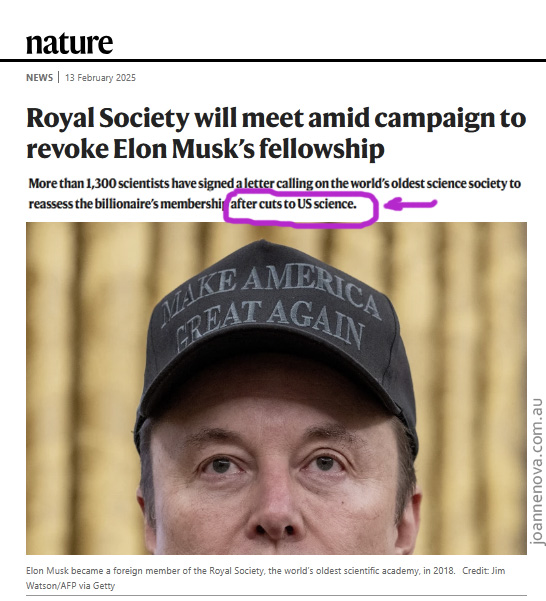
The Royal Society was founded in 1660 and hasn’t chucked anyone out for 150 years, so you’d think his crime must be a serious failing in science. Supposedly, the mob say, he breached their code of conduct, was mean to other members and spread “conspiracy theories” and “misinformation”.  But the real truth, as even Nature explains in their subheader, is that he committed the unforgivable sin of cutting off the grant money.

We know this because even though 74 members protested last August with a truckload of complaints,  the mass pile-on only happened in the last few weeks when President Trump and the DOGE team were shutting down wasteful programs. Suddenly 3,000 members are upset enough to sign an open letter. Auditing taxpayer funds is a bridge too far for the dependent minions of Big Government.  Too much waste is never enough.

One member, Dorothy Bishop resigned last year, and said Musk was guilty of using social media for the crime of “political propaganda“. As if half the members of the Royal Society don’t lecture us on blogs, tweets and the nightly news with left wing climate politics every other day. What she really means is he does the wrong kind of political propaganda.

Elon Musk, Royal Society, Nature. Royal Society will meet amid campaign to revoke Elon Musk’s fellowship

The Royal Society members can pretend that this is not about the money, but after Dorothy Bishop laid out her list of issues, the Royal Society hired a lawyer to investigate, and they said that Elon had not broken the Code of Conduct.  So what’s left is that this really is about “the money”.

The Open Letter to the Royal Society from Emeritus Professor Stephen Curry lists the money and somehow calls it a free speech issue:

The situation is rendered more serious because Mr Musk now occupies a position within a Trump administration in the USA that has over the past several weeks engaged in an assault on scientific research in the US that has fallen foul of federal courts. It has sought to impose huge cuts in funding and a regime of censorship (particularly with regard to EDI and climate issues) that is a direct threat to freedom of expression and academic freedom.

If the Royal Society gave a toss about free speech they would have objected to the vilification of scientists who disagree with government mandated “consensuses”. Instead they’re not only silent about cancel-culture in science, they endorse it. They rewarded and lauded the namecalling psychologist who calls skeptical scientists “climate deniers” — a political, demeaning label, designed to bully and silence them. Consider Stephen Lewandowsky (fellow of the Royal Society) who hid his data, included a person who was 32,000 years old in a survey, and miraculously claimed to show “skeptics” of government consensuses are nutters by asking other people (who are hostile to skeptics) to fill out a survey. It was that bad. (And yes, he has signed the letter objecting to Elon Musk). The Royal Society is fine with bullying, and bad science —  as long as it doesn’t threaten the funding.

Elon Musk — “My pronouns are Prosecute/Fauci“

As for Curry’s other objections to Elon Musk, the Society was tarnished, he said, by its lack of commitment to “diversity and inclusion” because Elon joked about Anthony Fauci on X and the Society hadn’t reprimanded him.

Dorothy Bishop says Elon breached the Code of Conduct. The rules, she says, are that:

Fellows and Foreign Members shall treat all individuals in the scientific enterprise collegially and with courtesy, and …shall not engage in any form of discrimination, harassment, or bullying.

Most of those I’ve spoken to agree that a serious breach of these principles was in 2022, when Musk tweeted: “My pronouns are Prosecute/Fauci“, thereby managing to simultaneously offend the LGBTQ community, express an antivaxx sentiment, and put Fauci, already under attack from antivaxxers, at further risk. Fauci was not a Fellow at the time these comments were made, but that should not matter given the scope of the statement is “individuals in the scientific community“. This incident was covered by CBS News.

Since then Fauci has been pardoned by President Joe Biden for everything back to 2014, which Fauci accepted, showing that Elon was not just funny, but right: “Prosecute Fauci” indeed.

Thou shalt not question injections — is that science?

Dorothy Bishop was concerned about “Musk’s use of X to spread misinformation, promote vaccine hesitancy and attack public sciences “. No one at the Royal Society apparently, or at Nature (which repeated her accusation), had the wit to point out that it was a strange scientific paradigm to say that one type of medical therapy was beyond question. The motto of the Royal Society is Nullius in Verba, which means “take no one’s word for it”– except apparently when it’s a new barely tested new mRNA therapy, of course, and then we’re supposed to take everyone’s word for it, all the time, and inject our pregnant women and babies too. It’s like vaccines are a holy sacrament — or perhaps a huge source of revenue for Royal Society members?

Shh. We wouldn’t want to put open discussion about public health above profits, patents and grants, would we?

The Royal Society acts every day more and more like a trade union for approved priests of science.

They reveal their small mindedness in so many ways. They accuse Musk of “attacking public sciences” which begs the question of what a public science is? Is that different to real science? Or has the Royal Society totally forgotten that science is a process and not a government institution?

Musk should quit the Royal Society because it has forgotten what science is

The Royal Society don’t know it, but they desperately need Elon Musk. The Royal Society has become nothing more than a workers union for government funded technicians dressed in lab coats, and he’s the greatest private scientist in the world today. He is the antidote to government funded paralysis in science (and in so many ways). Consensus “scientists” are just a paid marketing wing of Big Government — captured by the monopolistic funding.

The Royal Society need Elon much more than Elon needs the Royal Society. He should quit now, before they hold their sanctimonious meeting.

REFERENCE

https://ift.tt/vE809mA


0 out of 10 based on 0 rating

via JoNova

https://ift.tt/MGQLXti

February 18, 2025 at 04:22PM

Hydrogen Energy: Not Clean, Green, Cheap

From MasterResource

By David R. Legates

“Hydrogen energy will cease to become viable when the subsidies provided to it by governments of the world dry up. Hopefully, the new Administration will recognize that hydrogen embrittlement applies not just to metals, but to our economy as well.”

Hydrogen. The first element in the Periodic Table and the most abundant element in the Universe. It is also the simplest element—the most common isotope has only one proton and one electron. It has been called the “Future of Energy”; after all, the Sun relies on hydrogen to keep emitting light and, if it is good enough for our Sun, why isn’t it good enough for us?

No doubt you have heard all the clamor associated with a hydrogen-based energy economy. Jeremy Rifkin published a book entitled The Hydrogen Economy: The Creation of the Worldwide Energy Web and the Redistribution of Power on Earth. He claimed that “globalization represents the end stage of the fossil-fuel era” and that turning “toward hydrogen is a promissory note for a safer world.”

In his State of the Union Address, the President stated that “with a new national commitment, our scientists and engineers will overcome obstacles” to taking hydrogen-fueled automobiles “from laboratory to showroom so that the first car driven by a child born today could be powered by hydrogen, and pollution-free.” The Administration then announced a collaborative effort with the European Union to develop a hydrogen economy, including the technologies “needed for mass production of safe and affordable hydrogen-powered fuel cell vehicles,” and stated that this would “improve America’s energy security by significantly reducing the need for imported oil.”

The Chicago Sun-Times ran a story that proclaimed, “The first steps toward what proponents call the hydrogen economy are [now] being taken.” And the US House of Representatives held the first of two “investigative hearings on the subject of hydrogen—its production, utilization, and potential effects on our energy economy of the future.” The chairman of the hearing claimed hydrogen “has the potential of playing the same kind of role in our energy system as electricity does today.”

Thus, hydrogen is poised to be the silver bullet that solves the climate crisis and removes us from a fossil fuel-based energy supply.

But wait. You don’t remember all of this? Well, the Rifkin book was published in 2002. The Administration was not the second Trump Presidency, the Joe Biden Presidency, the first Trump Presidency, or the first or second Obama Presidency. It was George W. Bush’s State of the Union in 2003. The Chicago Sun-Times article came out in 1996. And the Congressional Hearing? Well, that was held on June 10, 1975.

But doesn’t the Sun run on hydrogen? Yes, but not in the same way. In the Sun, through fusion, hydrogen atoms are merged to produce helium with lots of energy given off in the process. Each second, about six-hundred-billion kilograms of hydrogen are fused into helium and about four-billion kilograms of matter are converted to energy. On Earth, that process of fusion is about twenty years off and, as the meme goes, always will be. And apparently, so too will hydrogen as a fuel source.

How Do We Get Hydrogen?

Is mining or drilling for hydrogen the problem? No. That isn’t how we get hydrogen.

Hydrogen is produced by separating it from other elements in various compounds. The most common methods are electrolysis—where water is split to form hydrogen and oxygen gases—and steam-methane reforming, where hydrogen atoms are separated from the carbon atoms in methane. The former is generally how hydrogen is produced in high school chemistry classes but has recently been touted as the only “clean” way to produce hydrogen; the latter is the process by which hydrogen currently is produced commercially in the United States.

But steam-methane reforming requires high temperatures (about thirteen-hundred to eighteen-hundred degrees Fahrenheit) and high pressures (between three and twenty-five times that of atmospheric pressure). This allows engineers to use steam as a catalyst to produce hydrogen, carbon monoxide, and carbon dioxide. Thus, the production of hydrogen through steam-methane reforming uses methane, a fossil fuel, and generates carbon dioxide (the supposedly evil gas) and carbon monoxide (a truly deadly gas).

But there is something interesting about the laws of physics. Namely, there is no free lunch. We often talk about the Second Law of Thermodynamics and that a system becomes more disordered with time unless energy is added to it from outside. We say the entropy of the closed system increases over time. But there are other ways of saying this. For example, we can say one cannot create a heat engine which extracts heat and converts all of it to useful work. Interpreting this for our discussion, the energy contained in the steam and methane cannot be entirely transferred to the hydrogen—some of it goes to the production of carbon dioxide and carbon monoxide and some is lost as heat.

This means the production of hydrogen from methane results in less energy in the hydrogen molecules than existed in the original methane molecule. How much less?

The first hurdle of hydrogen energy is its energy deficit. To get enough hydrogen to produce two megawatts of energy, a total of three megawatts of electricity is required. This doesn’t include the loss of energy—or the intervention of the Second Law of Thermodynamics—in the production of this electricity from other sources. In the words of Robert Bryce, hydrogen energy is “insanely expensive, in energy terms, to manufacture.”

So, why aren’t we just sending these three megawatts of electricity down the power lines to heat and cool homes, cook food, and perform other tasks that make our lives better? Because hydrogen is supposedly a clean fuel source, even though the energy to extract it is usually produced by methane and yields our supposedly evil gas, carbon dioxide, as a byproduct. Moreover, hydrogen is green—not in the environmental sense, but rather, subsidies abound for companies that wish to pursue the hydrogen panacea.

Storage Problems

The second hurdle associated with hydrogen as an energy source is that it is hard to handle and difficult to store. Hydrogen gas does not play well with metals and something called “hydrogen embrittlement” occurs. As the name implies, hydrogen embrittlement causes metals to become brittle and crack over time, especially when the metal is stressed. Being a small molecule, hydrogen easily escapes from the smallest of cracks. In general, hydrogen embrittlement does not occur at temperatures above about three-hundred degrees Fahrenheit; however, it is not feasible to heat pipes and storage tanks to this temperature. At ambient temperatures and pressures found on Earth, hydrogen embrittlement is a significant problem for many metals, such as steel, iron, nickel, titanium, cobalt, copper, and aluminum, plus alloys that contain them.

Proponents argue that hydrogen can be stored as a liquid. While true, that would require compression to seven-hundred times atmospheric pressure and refrigeration to minus-four-hundred-twenty-three degrees Fahrenheit. And, of course, even more energy would be required to reach and maintain that level of compression and cooling.

If we cannot transport and store hydrogen in existing trucks, tanks, and pipes, how is hydrogen best used as an energy source? It can be blended with natural gas and consumed by turbines and reciprocating engines. But that involves two disadvantages. One is that we lose energy by storing it in the production of hydrogen—why not simply use the methane in the turbine rather than wasting energy by converting it to hydrogen? There is simply no advantage to that, and it costs us energy. The second is that by mixing in methane, activists are no longer able to tout the hydrogen source as “clean and green renewable energy,” because methane is still in the mixture. Sigh. Virtue signaling rears its ugly head again.

The best way to use hydrogen is probably as the fuel source in a fuel cell. But fuel cells already run on methane, and the loss of energy in converting methane to hydrogen precludes any utility that the use of hydrogen would provide. Except, of course, that activists and those in the hydrogen-production industry would not be able to tout their fuel cell as being “clean and green renewable energy.” In my home state of Delaware, however, the state legislature has declared that methane consumed by a Bloom Energy fuel cell is renewable energy. Ah, the all-powerful legislature that can simply alter physics by majority vote!

Dangers in Use

A third hurdle with using hydrogen as a fuel source is that it is dangerous to use. Like methane, it is colorless and odorless, and no doubt, for hydrogen to become a widely used fuel source, it would have to be mixed with a smelly gas—just as smelly mercaptan is mixed with methane so a leak can be detected. And, yes, hydrogen is highly explosive.

It is why the early twentieth-century dirigible fleet in the United States was built using helium for buoyancy, not hydrogen, even though helium is more expensive to produce and provides less buoyancy. If you don’t understand the explosive potential of hydrogen, the Hindenburg disaster should tell you all you need to know.

Not Cheap

Finally, the fourth hurdle should now be obvious. The use of hydrogen as a fuel source is expensive—in terms of production cost, expensive storage, and energy required to produce. Hydrogen as a fuel source will allow virtue signalers to claim they have developed and are using a “clean and green” fuel source that is “saving the planet from the evils of fossil fuels.” But in reality, it is only going to make energy more expensive and send a larger proportion of the planet back below the poverty line.

As we have often stated here at the Cornwall Alliance, inexpensive energy has been the solution to raising billions of people above the poverty line and increasing their standard of living. Hydrogen energy will cease to become viable when the subsidies provided to it by governments of the world dry up. Hopefully, the new Administration will recognize that hydrogen embrittlement applies not just to metals, but to our economy as well.

——————————-

David R. Legates, PhD, is Director of Research and Education for the Cornwall Alliance for the Stewardship of Creation and retired professor of climatology at the University of Delaware. He is the co-editor of Climate and Energy: The Case for Realism.


Discover more from Watts Up With That?

Subscribe to get the latest posts sent to your email.

via Watts Up With That?

https://ift.tt/auUD9vr

February 18, 2025 at 04:08PM

Germany Is Turning Into An Unlivable Tyranny

There’s something horribly wrong when you’re afraid to speak your own thoughts

When I first moved to Germany in 1990, the country, rich in culture and life, was a great place to live. Optimism was high in the wake of reunification and the collapse of the Iron Curtain.

But my oh my how things have deteriorated. The leftists have not only taken over the country, but also even the once conservative CDU party.

First came the idiotic green movement and climate hysteria starting in the 1990s, followed by the election of stealth communist Angela Merkel in 2005, who let the country be flooded uncontrollably by immigrants from warring countries in 2015.

Then came the Corona pandemic and all the censorship, government and media lies and restrictions on freedom and basic rights. Dissidents were jailed and/or persecuted.

Paragraph 188

But just when we thought things couldn’t get worse, they did after the election of the socialist-green-liberal government in 2021 which moved to demolish German industry and put the country in its worse recession since the 1949. All the demise of course led to a level of protest and criticism that the government refused to put up with. They hit back with the intensification of Paragraph 188 “Defamation and slander against persons in political life” of German Law, which went into effect in 2021.

Paragraph 188 now states:

(1) If defamation (section 186) is committed against a person in the political life of the people publicly, in a meeting or by disseminating content (section 11(3)) for motives connected with the position of the offended person in public life, and if the offense is likely to make his or her public activities considerably more difficult, the penalty shall be imprisonment from three months to five years.”

In other words, if your speech makes it more difficult for incompetent government officials to keep screwing up the country, you get your house raided, devices confiscated and possibly do jail time that is longer than what robbers, muggers and rapists do. Offending the Majesty is a terrible crime.

One person saw his home raided because he reposted a comment that called Minister Robert Habeck a “dimwit”.

The video above shows where this has all taken us. Notice how 60 Minutes admires the new law.

Designed to silence the opposition

The intent of the new law of course has nothing to do about creating a nicer place to live, but rather the very opposite. It is designed to make it really easy to raid homes of dissidents, spread fear and to silence opposing voices. It should be called The Tyranny Act.

Many among you, outside of Europe, may think this is a bit funny, but let me assure you that it’s not when you actually live here. It’s dangerous and you have to be careful expressing yourself.

The law also goes after people who spread false information. My blogging days are soon coming to an end, if I stay in Germany.

Elections slated for this coming Sunday aren’t going to change anything. Friedrich Merz (CDU), a former Blackrock executive, is favored to win, But he’s all in on it and will form a coalition with the Greens and/or Socialists. Dark times are ahead.

It may soon be time to pack up and leave after 35 years.

Vance’s speech was spot on.

via NoTricksZone

https://ift.tt/jf4CJhb

February 18, 2025 at 12:53PM