Clean Power 2030 Plan Will Cost £242 Billion

By Paul Homewood


Sometimes simple is best!

NESO have conveniently listed their estimates of the capital expenditure needed for Ed Miliband’s Clean Power 2030 mission:

image

image

image

https://www.neso.energy/document/346781/download

Over the five years, they reckon a total cost of £242 billion.

Mere chicken feed!

As we will still need a full fleet of gas power stations, the only offsetting savings will be the fuel savings for them.

Government projections say that the price of natural gas will be around 70p/therm in the next decade, equivalent to £24/MWh. Given fuel efficiency of 53% at a CCGT, the fuel cost would therefore be about £45/MWh of electricity generated.

Currently they say generate about 84 TWh of gas power a year and the Clean Power plan will knock this down to 15 TWh. The annual fuel saving will therefore be £3.1 billion. However the operating costs of offshore wind are estimated at £19/MWh, meaning that the net saving would only be £1.8 billion.

image

https://www.gov.uk/government/publications/fossil-fuel-price-assumptions-2024

And we have not even looked at the cost of capital – ROC of, say, 8% would cost £19 billion a year.

The current fleet of CCGTs won’t last forever, of course, but Miliband will still need to pay to replace these anyway, whether like for like, or with CCS gas power or hydrogen. And in twenty years time, we would be facing another £200 billion to replace the worn out wind turbines and solar panels.

It does not take a genius to work out that these numbers don’t stack up! Even if gas prices were to double, the equation would not alter.

via NOT A LOT OF PEOPLE KNOW THAT

https://ift.tt/FEYkNhu

February 14, 2025 at 12:20PM

Live at 1 p.m. ET: EPA Returns ‘Gold Bars’ to Taxpayers – The Climate Realism Show #145

The Heartland Institute

The good news for climate realists and better governance in the Trump administration is piling up so fast it is difficult to keep up. As we covered on this show on December 6, a bit of undercover journalism by Project Veritas exposed a left-wing staffer at the Environmental Protection Agency admitting that he and others were trying to get billions of our tax money “out as fast as possible” before the Trump administration arrived in January and put a stop to it.

“It truly feels like we’re on the Titanic and we’re throwing gold bars off the edge,”

laughed Brent Efron, former “special advisor for implementation” at EPA. Well, new EPA Administrator Lee Zeldin announced this week that he has jumped into his submersible and snatched the gold bars ($20 billion) out of the hands of unaccountable lefty nonprofit “NGOs” and returned them to the treasury. The endless flow of our tax money going to environmental extremists groups who advocate against America’s interest seems to be coming to an end.

The Heartland Institute’s Anthony Watts, Sterling Burnett, Linnea Lueken, and Jim Lakely, will also talk about how the Paris Climate Agreement seems to be breaking apart, provide a media “Climate Fact Check” for January, check in on the continuing failure of EVs, show you what a “dying coyote” climate protest looks and sounds like, and more.

Join us LIVE at 1 p.m. ET and join us in the chat where we will share your comments and answer our questions.


Discover more from Watts Up With That?

Subscribe to get the latest posts sent to your email.

via Watts Up With That?

https://ift.tt/s6nueAP

February 14, 2025 at 11:34AM

SEC Chair Revokes Illegal Climate Disclosure Rule

Jon McGowan reports at Forbes Acting SEC Chair Says Climate-Related Disclosure Rule Is Illegal.  Excerpts in italics with my bolds and added images.

Background

Following the Paris Agreement in 2015, a series of global initiatives were pursued to reduce the impacts of climate change and reduce overall greenhouse gas emissions to “net zero” by 2050. The goal included a significant reduction in GHG emissions, but also utilized “offsets” that, through technology and protection of natural resources, would result in overall emissions being at a net of zero. This resulted in a carbon credit market that allowed high GHG emitting countries and businesses to purchase credits from underdeveloped countries that produce little emissions.

On the financial side, a multi-prong approach was used to influence and regulate businesses. Large investment firms, like BlackRock, used their influence to drive ESG and sustainability. By 2021, it was standard practice for businesses to release annual ESG and sustainability reports. However, there was no standardization of the practice. Claims were unregulated and content was unclear. As a result, reports were focused on what the business thought mattered to investors and were little more than marketing pieces.

This became problematic in the highly regulated financial industry. Funds that claim to be ESG, green, climate friendly, or sustainable must back up those claims with data. As a result of demand and Paris Agreement based initiatives, international regulators began drafting standards for reporting, marketing, and investments relating to climate change and other green initiatives.
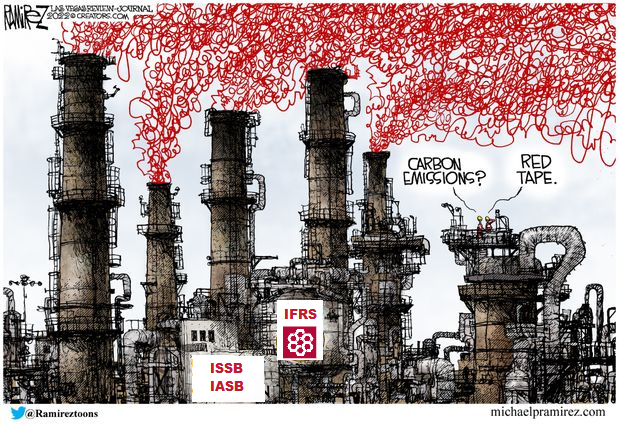
In 2021, the International Sustainability Standards Board drafted the International Financial Reporting Standards Foundation’s Sustainability Disclosure Standards. IFRS is an independent, nonprofit organization that develops financial reporting standards, including international accounting standards. IFRS is not used in the U.S., who uses generally accepted accounting principles, also known as GAAP, but is used in 132 jurisdictions. The IFRS Standards were adopted in June 2023 as the global standard for sustainability and climate change reporting, including greenhouse gas emissions.

The US Securities Exchange Commission Story Regarding ESG

In the U.S., the SEC proposed the development of climate-related reporting standards in March 2022. The final rule, adopted on March 6, 2024, required large publicly traded companies to disclose climate action, GHG emissions, and the financial impacts of severe weather events. The Climate-Related Disclosure Rule was initially set to go into effect in 2026. However, it was immediately met with legal challenges and the SEC delayed implementation indefinitely while the cases worked through the judicial process. Now it appears the delay will become permanent.

Rough Seas for Captains of Industry

Under the leadership of Gary Gensler, the U.S. Securities and Exchange Commission saw a wave of regulatory and enforcement actions relating to environmental, social, and governance; sustainability; and climate change. It was clear that his exit, effective the day President Trump took office, would significantly alter the SEC’s approach to those topics.

On February 11, acting SEC Chair Uyeda, a Biden appointee, effectively ended the Climate-Related Disclosure Rule. In the statement, Uyeda said,

“The Rule is deeply flawed and could inflict significant harm on the capital markets and our economy.”

“Both Commissioner Peirce and I voted against the Rule’s adoption. Commissioner Peirce said that then-existing disclosure rules were sufficient and that the ‘[R]ule’s anticipated benefits do not outweigh the costs.’ She argued that ‘only a mandate from Congress should put us in the business of facilitating the disclosure of information not clearly related to financial returns.’ I stated that the Commission was ‘without statutory authority or expertise’ to address climate change issues and that ’this [R]ule is climate regulation promulgated under the Commission’s seal.’”

“The Commission’s briefs previously submitted in the cases consolidated in the Eighth Circuit do not reflect my views… I also question whether the agency followed the proper procedures under the Administrative Procedure Act to adopt the Rule.”

As a result, Acting Chair Uyeda has asked the court for a delay in the proceedings while the SEC takes action to rollback the Climate-Related Disclosure Rule. As a result, climate reporting at the national level is effectively dead. The focus now turns to the states and international actions.
 

via Science Matters

https://ift.tt/VepzAjP

February 14, 2025 at 11:04AM

Milford Haven Conservancy Board WMO 03604 – another “Slab” removal ignoring major problems.

51.70883 -5.05338. Met Office CIMO Assessed Class 4. Installed 1/1/1951 Temperature records from 1/1/1964.

Milford Haven Conservancy Board site (hereafter MHCB) is not Class 4 by any stretch of the imagination. It is an unsuitable Class 5 site whatever the Met Office may try to claim. It is unsatisfactory not only for addition of its readings to the national historic temperature record and almost certainly not very useful for much local meteorology of any type. That the Met office is evidently “tinkering around the edges” of the problems at this site is becoming a recurring theme of their poor maintenance of sites.

MHCB is at the extreme south west of Wales. This whole area is meteorologically important in forecasting terms in being (along with Cornwall and Devon) the first points for westerly frontal systems reaching the mainland of Great Britain. Along with its neighbouring sites it is in a very poor position. Margam No 2 is Class 5 and with a dismally bad observations record, Pembrey Sands is Class 5S and unacceptably mounted over concrete, Whitechurch is Class 4 in a domestic back garden and (yet to be reviewed) Scolton Country Park is also Class 4 and located in sheltered scenic gardens. With MHCB also Class 4 this is not a good combination particularly as it is hard to accept this latter’s rating.

My first question to the Met office is – why on earth locate this station just to the east of the biggest artificial prevailing-wind break they could find in the area? Hubbertson Fort (the curved structure in the headline image) is a very large construction unquestionably creating wind shielding and other effects downwind of westerlies/south westerlies. Did nobody stop to think this might not make the leeward side not a good location?

Examining the site from the most recent street view imagery clearly indicates unacceptable levels of tall shrubbery (in excess of 2 metres high in places) completely surrounding all the compound bar the small access path. All previous images dating back to 2003 indicate similar overgrowth. Note the chimneys of the Fort in the background. The numerous vehicles in the flat and tarmac surfaced car park sit at 37 metres amsl whilst the screen is quoted at 44 metres and the top of the banking to the fort is a further 6 metres higher. This is effectively a terraced site and not uniformly level as required.

However, just as at Nottingham:Watnall, the Met Office has seen fit to tinker around the edges of major problems and remove only the single slab within the enclosure immediately in front of the screen to “reduce heat sources”.

Are such minor modifications in the face of such major defects indicative of diligent pursuit of reliable readings both representative of the wider area and useful for weather forecasting, or of a lack of competence in the basics? I suggest this site is really only Class 5 and completely unacceptable for its readings inclusion in the compilation of the UK historic temperature record.

via Tallbloke’s Talkshop

https://ift.tt/AoWt2Uh

February 14, 2025 at 10:53AM