With the Greenhouse scare turning thirty this month, we remember the conference that launched it onto the global stage as the flagship cause of the Sustainable Development movement.
Humanity is conducting an unintended, uncontrolled, globally pervasive experiment whose ultimate consequences could be second only to a global nuclear war. —Changing Atmosphere Conference Statement, Toronto, 30 June, 1988.
Before Paris there was Kyoto, but before Kyoto there was Toronto. Most climate activists today would be too young to recall where it all began thirty years ago this month. It was at the Changing Atmosphere conference, Toronto, 27-30 June 1988, that ‘greenhouse’ warming exploded onto the global stage, with demands for an immediate policy response. So successful was this event that the ‘Toronto Target’ remained the benchmark for any government response to the climate emergency until the ‘protocol’ finally agreed in Kyoto, 1997.

A report from the opening of the Toronto conference in The Guardian, 28 June 1988
In the old days before the warming scare, convention deemed that local weather observations could not pronounce on local climate until the ledgers ran down a continuous 30 years. And perhaps this could be our measure of global climate scares. Compare the cooling scare: launched in 1972, it was all over by the end of the decade. That was pretty much when the build-up to the warming scare began. But this one stuck around. It grew and prospered while the promised signs of catastrophe remained ever deferred.
If some sceptics are now sounding its death knells, then we do well to remember their premature ringing many times before. This horseman may be riding for an apocalyptic fall, but ride on he does; and with tremendous institutional inertia in the science, the science funding and energy policy. That this scare continues to evolve is all too evident when we consider that there has never been a greater impact on energy policy for major economic players like Germany, Britain and Australia. And this impact is in direct opposition to what would be our agreed economic, political and security interests if there were no scare. Make no mistake, this is a major social phenomenon, the full power of which we are only coming to appreciate as it arises stronger from every successive blow to its credibility.
The first summer of the warmers
The opening weeks of the summer of 1988 was when greenhouse warming arrived as a geo-political phenomenon. In the USA, the foundation event is usually seen to be NASA scientist James Hansen’s congressional testimony on 23 June, where he called for immediate action based on a 99% statistical certainty that the warming is already happening now. Hansen’s performance was a well-orchestrated part of the Dukakis presidential campaign. But Dukakis was defeated. And so perhaps more important was the responding commitment to greenhouse action by the presidential victor, George Bush (senior). Late in his campaign, Bush famously suggested that he would combat the greenhouse effect with the ‘White House Effect’.
Once elected, Bush proved an enthusiast for climate action, although a treaty would have to wait; he agreed with that other conservative enthusiast, Margaret Thatcher, that treaty talks should only commence after completion of an assessment by an UN intergovernmental panel, the IPCC. The British and US diplomats had to fight hard against the impatience for immediate action that arose like a thunderous tide in the wake of Toronto.
Before Toronto, while enthusiasm for global environmentalism was peaking, greenhouse warming was no leading concern. Air pollution had long been on the campaign agenda and the Toronto conference was called to address those pollutants of global consequence. It was only during the conference that greenhouse came to the fore.
The majority of the folks invited to Toronto were scientists, only a handful of whom had raised concerns previously. The environmental NGOs also sent delegations, but it would be some time before greenhouse warming was raised high on the agenda for any of them.
What first brought media interest to this Canadian conference was the strong ministerial representation among the delegations from 46 countries. The 29 government ministers included the two Prime Ministers who opened the conference: Canada’s Brian Mulroney and Norway’s Gro Brundtland. Brundtland had been returned to power after completion of the UN Sustainable Development report that bears her name.
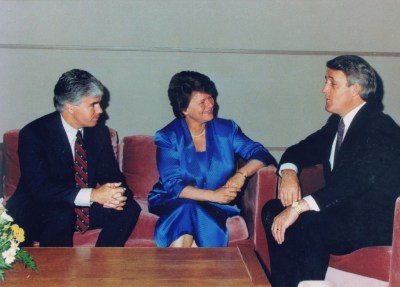
Canada’s Minister for the Environment Tom McMillan (left) with the two prime ministers who opened the Toronto conference, Gro Brundtland (Norway) and Brian Mulroney (Canada).
The Brundtland Commission submitted its report to the UN General Assembly with much fanfare in 1987. Our Common Future, as it was titled, included calls to shift towards Sustainable Development on all its complex and varied fronts. The Canadian government’s special interest was air pollution, and so it organised their ‘Changing Atmosphere’ conference in a collaboration with the UN Environment Programme to specifically address the management of the atmosphere as a global ‘common’. At the time, Brundtland and others were calling for a general ‘law of the air’.
via The Global Warming Policy Forum (GWPF)
https://ift.tt/2tI24S1
June 27, 2018 at 04:31AM


 Iowa Climate Science Education
