Month: June 2018

Update: JunkScience struggles with NYTimes op-ed page — wins grudging correction, exposes flagrant hypocrisy

I went back and forth yesterday with NYTimes op-ed page staff over Swamp King Trent Lott’s failure to disclose his conflicts of interest in his NYTimes op-ed advocating for a carbon tax. What an experience.
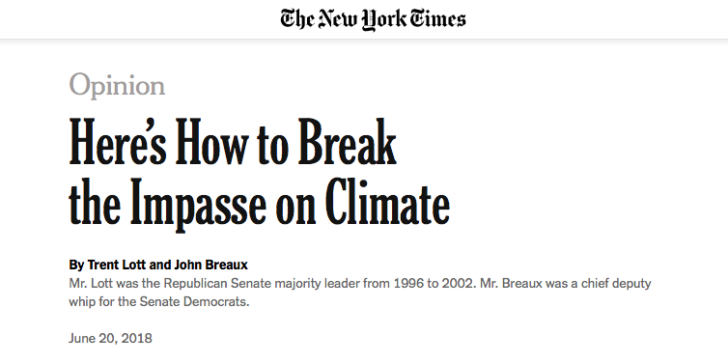
Read yesterday’s post for background.

After I posted yesterday’s piece, I came across this PRNewswire media release about Lott’s new group, Americans for Carbon Dividends.
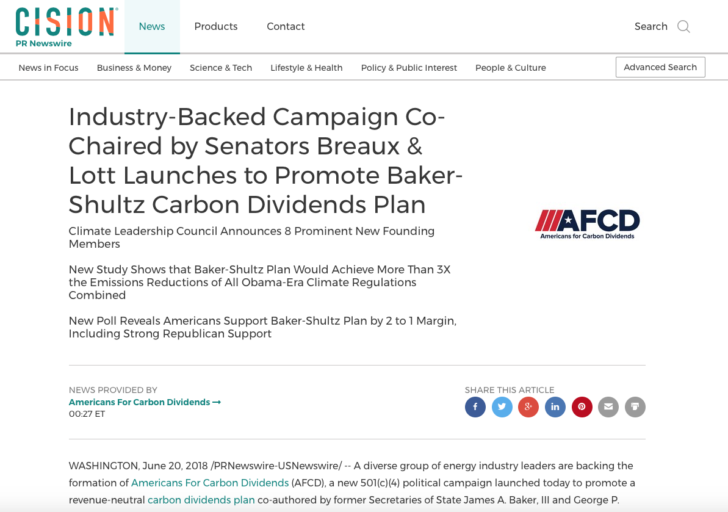
Here’s the disclosure of corporate funding that was offered in the media release:

None of this disclosure was made in yesterday’s NYTimes op-ed. None. Zero. Despite NYTimes policy (check out yesterday’s post for details).

So I alerted the NYTimes op-ed page. Basically, the NYTimes had a difficult time understanding that Lott being paid by the solar, wind and nuclear industries to lobby for a CO2 tax was a conflict of interest that should have been disclosed according to NYTimes policy. You can read the e-mail exchange here. It’s worth the click.

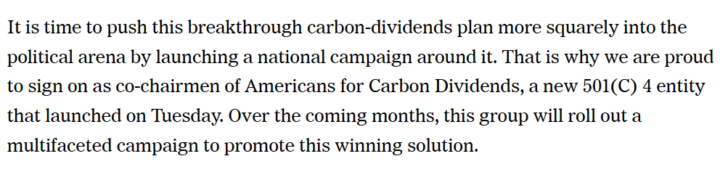
In the end, I won this correction:

BEFORE:
AFTER:
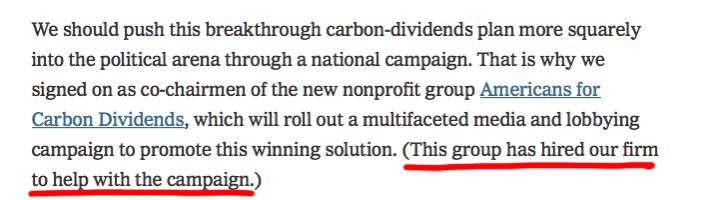
Yes, that is a pretty lame correction. Not only does it fail to mention that Lott was hired by the wind, solar and nuclear industries, Lott and co-author John Breaux have not been hired as mere behind-the-scenes lobbyists, but they have been hired to be the public face of the group.

There was also a related NYTimes news article yesterday about Lott’s group.
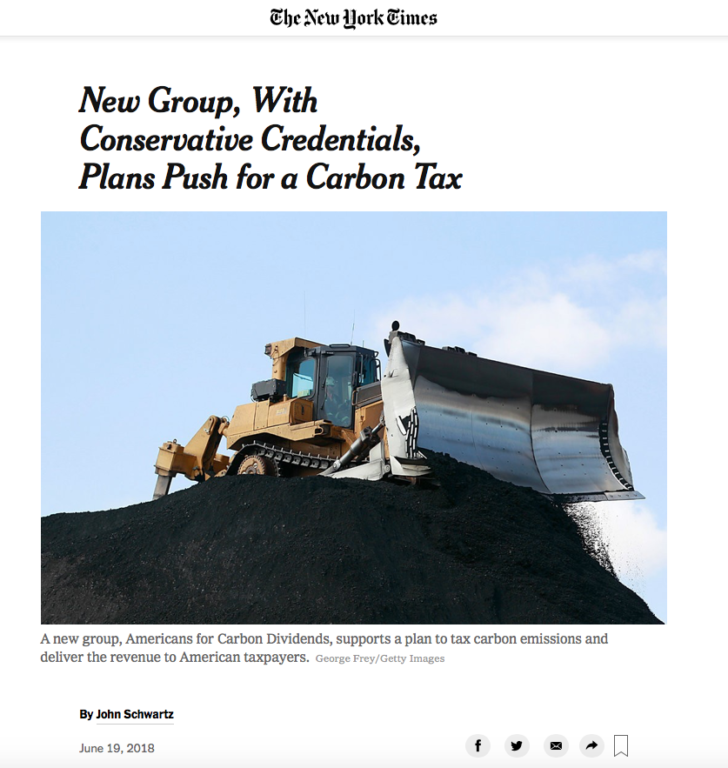
Not only is there no mention of the group’s nuke/solar/wind funding, the article misled readers by implying funding support from Big Oil:
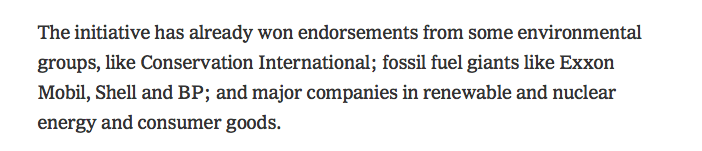
When I contacted NYTimes reporter and article author John Schwartz about the problem, his response was to attack me:

Ironically, the NYTimes saw fit to make this correction to Schwartz’s article:
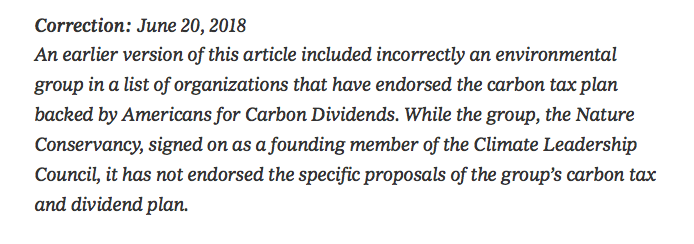
So the NYTimes is careful about the sensitivities of the Nature Conservancy. But no so much about the reality of the rentseekers behind “Americans for Carbon Dividends.”

As I remarked to the NYTimes op-ed page:

Well… imagine that that op-ed opposed a CO2 tax and imagine the unlikely case that the NYTimes ran it… would you let them get away without mentioning that they were being paid by big corporations to advocate against a CO2 tax?


via JunkScience.com

https://ift.tt/2JVHwk4

June 21, 2018 at 08:08AM

GWPF Podcast: 30th Anniversary Of James Hansen’s Global Warming Testimony

David Whitehouse & Benny Peiser discuss the 30th anniversary of James Hansen’s global warming testimony to the US Senate, new research from the Antarctic, the pause and other recent developments in climate science.

click on image to listen to the podcast

via The Global Warming Policy Forum (GWPF)

https://ift.tt/2tsDe8E

June 21, 2018 at 06:05AM

The Shale Revolution Is A Uniquely American Story

The story of the shale revolution is not just the scuttled claims that we’re running out of energy resources. It is also an important lesson about American exceptionalism and the conditions that made this breakthrough possible.

The shale revolution likely could not have emerged and resiliently endured in any country other than the U.S. The still young energy miracle is an achievement of technological innovation, determination, and economic freedom operating within a country that respects free enterprise and competitive markets.

President Trump’s reform agenda to stimulate economic growth and to eliminate excessive, burdensome regulations is igniting the roaring productivity of the American shale fields. Unleashed by supportive energy policy and rebounding from the collapse of oil prices in 2014, shale producers keep setting record output while cutting costs with Texas leading the pack.

Instead of nationally owned oil companies, cartels, and multinational corporations, the shale revolution is the work of small to medium-sized energy companies in the only country in the world that recognizes private property rights in subsurface minerals.

The shale of the shale revolution is what petroleum geologists call the “source rock” — a kind of cradle in which crude oil and natural gas are formed over millions of years deep within the Earth. Geologists were long aware of these prolific shale resources, thought to be forever locked in rock.

Then, determined and creative geologists developed the technologies that broke the code and made shale resources accessible. The shale producers are continuing to refine these technologies. In so doing, they are accelerating natural geologic processes by hundreds of millions of years — no small feat!

The Energy Information Administration forecasts that shale oil from the Permian Basin in Texas alone will account for 50 percent of all new global oil production over the next five years. As Bloomberg noted: “The fate of U.S. oil and ultimately a large slice of the total additional output for the entire world is all predicated on aggressive forecasts from one place: the Permian Basin.”

Driven by record-breaking production levels, Texas’ economy grew faster than any state in 2017, two and half times faster than Obama-era GDP.

Last year, output from shale oil and natural gas in Texas literally fueled growth in manufacturing, which significantly outpaced the national average. Mainstream economists rarely recognize this synergy between manufacturing and the abundant, concentrated, versatile energy in fossil fuels. And the jobs created by this growth pay well, to say the least.

A study by PricewaterhouseCoopers showed that U.S. oil and natural gas industries supported 10.3 million jobs in 2015. In 2016, Texas shale industries accounted for more than 325,500 direct jobs with an average annual wage of $130,000.

Such “shared prosperity” extends beyond employees and interest owners to property owners, investors, schools, local, state, and federal coffers as well as the many service companies in the supply chain supporting upstream oil and gas extraction. Add to those economic benefits the expanding petrochemical industries. As of August 2017, 134 new projects totaled investments of $71 billion. Pipelines under construction or planned account for an investment of $6 billion according to the leading industry association in Texas.

Rapidly growing exports of domestic crude oil, petroleum products, and liquefied natural gas have already begun to reduce the U.S. trade deficit. The U.S. is now a net exporter of natural gas, exporting more natural gas than is imported for the first time since 1957, says the Department of Energy.

Crude oil output is expected to average 10.7 million barrels of oil per day in 2018, exceeding the highest average on record. The U.S. is already the world’s largest producer of natural gas and is forecast to surpass Russia and Saudi Arabia as the world’s largest producer of crude oil in the near future. After seven former presidents unsuccessfully vowed to achieve energy independence, the U.S. is now finally on track to become energy independent and dominate global markets. By some measures, U.S. output already has earned the top spot.

Full post

via The Global Warming Policy Forum (GWPF)

https://ift.tt/2yARxOy

June 21, 2018 at 05:04AM

Norway tests tiny electric plane, sees passenger flights by 2025

Avinor’s electric plane [image credit: inhabitat.com]

It’s tiny, hard to get into and battery weight is still a major problem, but the latest ‘green’ toy has got off the ground. However, Norway is also one of the world’s leading oil and gas exporters. Crude oil and natural gas accounted for 40% of the country’s total export value in 2015.

OSLO (Reuters) — Norway tested a two-seater electric plane on Monday and predicted a start to passenger flights by 2025 if new aviation technologies match a green shift that has made Norwegians the world’s top buyers of electric cars.

Transport Minister Ketil Solvik-Olsen and Dag Falk-Petersen, head of state-run Avinor which runs most of Norway’s airports, took a few minutes’ flight around Oslo airport in an Alpha Electro G2 plane, built by Pipistrel in Slovenia.

“This is … a first example that we are moving fast forward” toward greener aviation, Solvik-Olsen told Reuters. “We do have to make sure it is safe – people won’t fly if they don’t trust it.”

He said plane makers such as Boeing and Airbus were developing electric aircraft and that battery prices were tumbling, making it feasible to reach a government goal of making all domestic flights in Norway electric by 2040.

Asked when passenger flights in electric planes could start, Falk-Petersen, the pilot, said: “My best guess is before 2025 … It should all be electrified by 2040.”

Continued here.

via Tallbloke’s Talkshop

https://ift.tt/2tdcgCW

June 21, 2018 at 03:58AM