
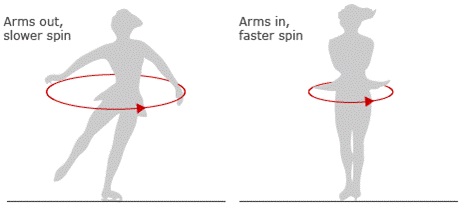
Conservation of angular momentum – ice skater
The title says it all. Another in the author’s series of intriguing brain-teasers for followers of climate theory to explore, this time with a particularly topical theme.
1. The Madden Julian Oscillation (MJO)
The Madden Julian Oscillation (MJO) is the dominant form of intra-seasonal (30 to 90 days) atmospheric variability in the Earth’s equatorial regions (Zang 2005). It is characterized by the eastward progression of a large region of enhanced convection and rainfall that is centered upon the Equator.
This region of enhanced precipitation is followed by an equally large region of suppressed convection and rainfall. The precipitation pattern takes about 30 – 60 days to complete one cycle, when seen from a given point along the equator (Madden and Julian 1971, 1972).
At the start of the enhanced convection phase of an MJO, a large region of greater than normal rainfall forms in the far western Indian Ocean and then propagates in an easterly direction along the equator.
This region of enhanced rainfall travels at a speed of ~ 5 m/sec across the Indian Ocean, the Indonesian Archipelago (i.e. the Maritime Continent) and on into the western Pacific Ocean. However, once it reaches the central Pacific Ocean, it speeds up to ~ 15 m/sec and weakens as it moves out over the cooler ocean waters of the eastern Pacific.
Wheeler and Hendon (2004) have developed a Real-time Multivariate MJO (RMM) Index that tracks the strength and movement of the enhanced-convection phase of MJOs.
This index is based upon the first two Empirical Orthogonal Functions (EOFs) of the combined fields of the equatorially averaged (15°S to 15°N) outgoing longwave radiation (OLR), 850 hPa zonal wind and 200 hPa zonal wind data for the period from 1979 to 2001.
Continued here.
via Tallbloke’s Talkshop
November 20, 2018 at 04:00AM
 Iowa Climate Science Education