Fianna Fáil has warned it will not support any carbon tax increases in the budget unless the money raised is reinvested in affected communities and measures to help the poorest.
Negotiations were continuing overnight on finalising a report for the Oireachtas All-Party Climate Action Committee, with the level of carbon taxes a stumbling block.
Barry Cowen, the party’s public expenditure spokesman, said his party would not agree to any increase in the tax unless it was allocated to fund plans to help areas that may rely on fossil fuel-related employment, as well as those at risk of fuel poverty.
The next budget, if one is passed, is likely to be the last before a general election…
Party sources said Fianna Fáil was in favour of the target to have increased carbon taxes from their current level of €20 per tonne to €80 per tonne by 2030, as recommended by the Government’s Climate Change Advisory Council.
However, the view at its frontbench this week was that this target – and specified annual increases – should not be set down in legislation.
The Democrat Party must be the political arm of the Venezuela-zation of these United States of America. Guest ridiculing by David Middleton The Republican party is the political arm of the fossil fuel industry Kate Aronoff Wed 27 Mar 2019 10.48 EDT Last modified on Wed 27 Mar 2019 15.02 EDT Republicans are doing everything…
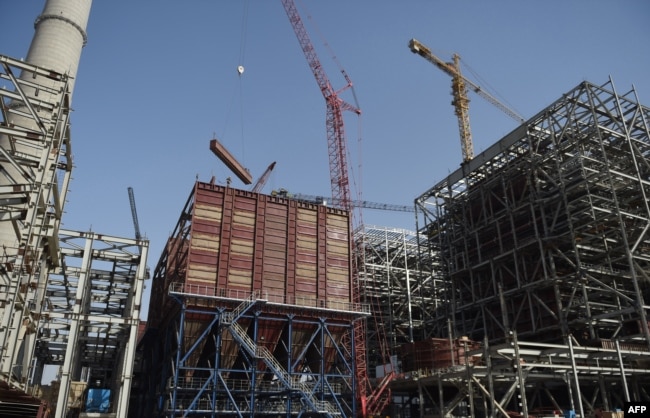
SHANGHAI — China restarted construction on more than 50 gigawatts (GW) of suspended coal-fired power plants last year, bucking a global shift away from fossil fuels, a new study showed Thursday.
A general view of a Chinese-backed power plant under construction, May 23, 2018, in Islamkot in the desert in the Tharparkar district of Pakistan’s southern Sindh province.
China has repeatedly pledged to reduce its reliance on coal, a major source of smog and climate-warming greenhouse gases, and it has cut coal’s share of its total energy mix to 59 percent, down from 68.5 percent in 2012.
But satellite images show China “quietly resumed” construction in 2018 on dozens of previously shelved plants, making it a “glaring exception to the global decline,” said a joint report by environmental groups Global Energy Monitor, Greenpeace and the Sierra Club.
The report warned that China could build an additional 290 GW of capacity, more than the whole of the United States’ coal capacity, and still remain within the 1,300-GW cap for national coal-fired power generation proposed by the China Electricity Council, an influential industry group.
China’s National Development and Reform Commission and its National Energy Administration did not immediately respond to faxed requests to comment on the conclusions of the report.
Lauri Myllyvirta, analyst with Greenpeace’s Global Air Pollution Unit, said Chinese firms are now “pushing for hundreds of additional coal-fired power plants.”
“Another coal power construction spree would be near impossible to reconcile with emission reductions needed to avoid the worst impacts of global warming,” he said.
Worldwide, the number of newly completed coal projects fell 20 percent in 2018 and plant retirements continued at a record pace, the study said.
China and coal
But China’s relationship with the dirtiest of fossil fuels remains ambivalent.
The domestic coal power capacity under construction rose 12 percent in 2018, though it was still a third lower than what was being built in 2015. Beijing has also cut back dramatically on new project permits.
While China has vowed to cap consumption nationally and even make cuts in regions like Beijing, Hebei and Henan, overall coal-fired generation has increased, particularly from new “coal bases” in the nation’s northwest.
This article explains that the Greenland glacier in question is affected by the cooler ocean currents that are in turn a result of a change in the North Atlantic Oscillation (NAO). This is a reminder that much of our climate goes in natural cycles that are driven by the ocean currents such as the NAO. We are only just beginning to understand their behaviour, which is why computer climate models are so unreliable, but the scientists who construct them don’t want to admit this for obvious reasons.

 Iowa Climate Science Education