Month: March 2019

What Is Pushing China Back To Coal?

Data released by the Chinese energy bureau this week shows that the country added a whopping 194 million tonnes of coal mining capacity over the course of 2018. These newly released numbers deal a crushing blow to any optimism about decreasing global emissions and even the overall effectiveness of the Paris climate agreement.

This revelation comes in direct contrast with China’s widely publicized promises to reduce their dependence on fossil fuels, especially dirty coal, as well as specific avowals to do away with excess mining capacity.

By the end of last year, according to numbers from the National Energy Administration, China’s total coal mining capacity had gone from 3.34 billion tonnes at the end of 2017 to 3.53 billion. These numbers do not even take into account a further 1.03 billion tonnes per year of already-approved coal capacity currently under construction, nor do they include another 370 million tonnes per year that are currently being extracted as part of a trial operation. What’s more, China’s National Energy Administration has already greenlighted an additional seven coal mining operations which altogether would have a capacity of million tonnes per year within a period of time which already started at the beginning of 2019.

According to data published by China’s National Bureau of Statistics, Chinese mines produced 3.55 billion tonnes of coal last year, a 5.2 percent increase as compared to 2017. The bureau also reported that in 2018 the country generated a total of 4.979 trillion kilowatt-hours of electricity from coal-fired power plants, 6 percent higher than the same measure in 2017.

While coal mining capacity has seen an overall increase, however, the total number of coal mines in China has actually declined. At the end of 2018, the Chinese National Energy Administration reported 3,373 domestic coal mines, down from 3,907 in 2017. The majority of the coal mines that have been shuttered recently were small and ineffective operations in eastern China. At the same time, production in the west has seen considerable expansion in capacity.

This increase in Chinese coal capacity has attracted negative attention from the international community, with critics voicing concern that this development goes directly against the nation’s promise to decrease the amount of coal used in their total energy mix, and therefore will prevent the world’s second-largest economy from meeting its committed goal of capping their carbon emissions by 2030.

In fact, according to a report released by the International Energy Agency this week, not only are global carbon dioxide emissions continuing to climb, but ever-increasing energy demand around the world has led to record-high emissions from particularly dirty coal-fired plants. Last year the world’s energy demand grew by 2.3 percent, and 70 percent of that demand was met by fossil fuels, with a large contribution from relatively young coal-fired plants in Asia. Thanks in large part to these plants, global emissions from coal-fired power plants surpassed 10 billion tons of carbon dioxide for the first time in history.

These newly released numbers deal a crushing blow to any optimism about decreasing global emissions and even the overall effectiveness of the Paris climate agreement.

Full post

The post What Is Pushing China Back To Coal? appeared first on The Global Warming Policy Forum (GWPF).

via The Global Warming Policy Forum (GWPF)

https://ift.tt/2FEotXS

March 27, 2019 at 12:35PM

How can farmers plant?

Look at this video of Eastern Nebraska flooding!

Thanks to Adoni for this video

The post How can farmers plant? appeared first on Ice Age Now.

via Ice Age Now

https://ift.tt/2UUtpNk

March 27, 2019 at 12:01PM

Again Reality Goes In Opposite Direction Of Climate Models…”Confidence In Models Correspondingly Low”

Yesterday we posted on how rainfall across southern Europe has risen over the past couple of decades, thus going in the opposite direction of what was projected by climate models. And once again the models are shown to be woefully faulty and an unreliable tool for policymaking, as the following example shows.
====================================================


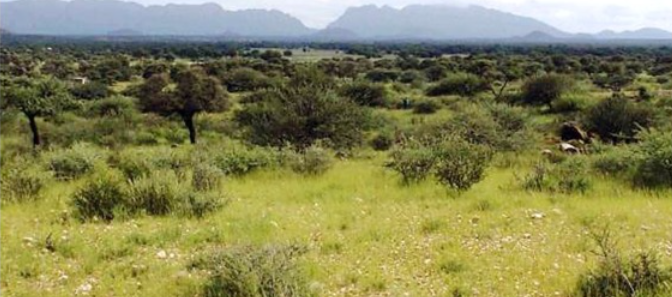
Southern Africa vegetation expanding, images show. Source: here.

Real vegetation development in southern Africa takes a very different course than claimed by climate models

By Die kalte Sonne
(German translated by P Gosselin)

Climate models provide answers to all conceivable questions about the future. Political decision-makers are grateful for this information because they can make their plans accordingly.

But are the forecasts derived from models correct at all?

A research team led by Timm Hoffman has now compared the model projections with real vegetation development in southern Africa using historical photos. The sobering result: Nature has mostly developed quite differently than assumed by the models. In contrast to the model assumptions, no significant long-term trend in precipitation could be observed. Vegetation belts, which were supposed to shrink, ended up expanding. Confidence in the models is correspondingly low.

Political planning or even CO2 damage calculations based on the simulations are not possible. Here is the abstract of the work published in the journal Anthropocene in March 2019:

Rethinking catastrophe? Historical trajectories and modelled future vegetation change in southern Africa
Most projections of climate change for southern Africa describe a hotter and drier future with catastrophic consequences for the environment and socio-ecological sustainability of the region. This study investigated whether evidence of the projections for the climate and vegetation of the subcontinent is already evident. Analysis of the climate record indicate that the historical trend of increasing temperature is consistent with future projections for the region. Rainfall, however, apparently has not changed significantly. Results from analysis of 1321 repeat historical photographs indicate broad trends in vegetation trajectories in the major biomes of southern Africa. The Savanna biome has experienced a rapid increase in woody plant at rates un-anticipated by the models. Contrary to early projections for the Succulent Karoo biome, biomass and cover have increased, largely in response to changes in land-use practices. Cover in the fire-adapted Fynbos biome has remained stable or increased over time with unanticipated expansion of forest species, particularly in localities protected from fire for long periods. The shrub-dominated Nama-karoo biome has increased in grass cover. Rather than contracting, as suggested in the early models, the Grassland biome has apparently expanded westwards into former Nama-karoo biome sites. The Savanna biome has experienced a rapid increase in woody plants at rates not anticipated by the models. The broad trends in historical trajectories illustrate how land-use management has influenced vegetation change in the past. They also provide a useful context for evaluating future changes and developing mitigation strategies for some of the worst impacts of climate change in the future.”

via NoTricksZone

https://ift.tt/2CFi5Ob

March 27, 2019 at 11:40AM

Full podcast of TV interview with Andrew Bolt in Australia talking about polar bears

This 10 minute television interview aired a few hours ago on The Bolt Report (Sky News Australia, 26 March 2019). A short excerpt was made available as a tweet but a link to the full length podcast is below.

Bolt report interview intro_26 March 2019

Ironically, despite the huge effort made by polar bear specialists and climate change activists to silence and discredit me over the last year or so, all it’s done is made more people willing to listen to what I have to say. My new book is selling phenomenally well and getting great reviews: if you haven’t ordered your ebook or paperback copy, you can do so here.

Polar bears are multiplying, despite global warming: Zoologist

26/03/2019|10min Full interview, watch here

Zoologist and author Dr Susan Crockford says polar bears have continued to increase their numbers since sea ice levels have decreased, with the current population hovering at about 39,000. This figure is a rise from an estimated 5,000 to 15,000 in the 1960s, and 25,000 in 1993, meaning a 50 per cent growth over the past 25 years. Dr Crockford says this shows that global warming activists and experts were wrong in their predictions for the vulnerable species. Dr Crockford says the hunting ban on polar bears has helped the species multiply, and that bears are stronger at swimming, finding food and relocation than experts ‘gave them credit for’.

———-

Short excerpt, watch below:

via polarbearscience

https://ift.tt/2Uf0pmo

March 27, 2019 at 11:17AM