
By Paul Homewood
Timera take a closer look at Europe’s rapidly increasing capacity deficit:

Irreversible momentum is building behind European power sector decarbonisation. This is a tough but achievable goal. But the popular ‘renewables + storage’ narrative oversimplifies the challenge ahead. Europe requires much broader investment in flexibility.
Decarbonisation is driving a seismic shift towards renewables and away from coal. Many countries are in parallel closing nuclear fleets.
Renewables targets have recently been boosted with over 340GW of new wind and solar capacity now projected by 2030. But the analysis we set out in this article shows that renewables investment is not enough to plug the coal and nuclear capacity gap.
Substantial investment in flexible capacity will also be required, we estimate at least €25bn by 2025 and €55 bn by 2030.
The parallel closure of coal & nuclear
In this blog article, we focus on analysis of 7 key liberalised markets that are closing large nuclear & coal fleets and rapidly deploying renewables. We refer to these as the E-7 countries (Germany, France, UK, Belgium, Netherlands, Italy & Spain).
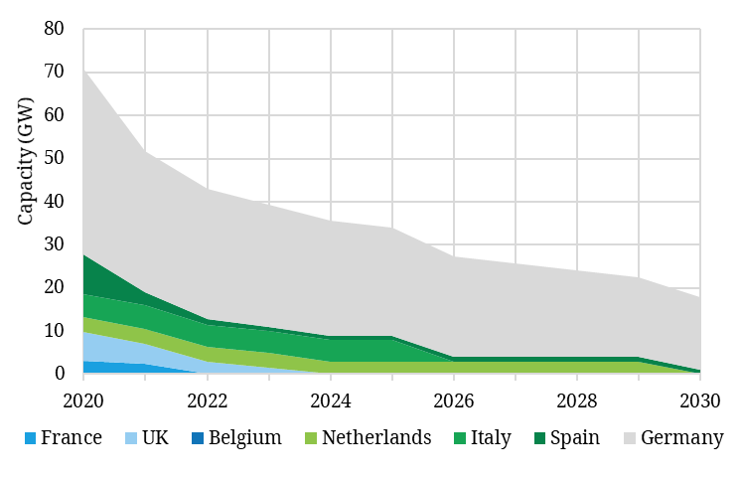
All E-7 countries have now either closed their coal fleet (Belgium) or announced legislation to close coal. That will result in at least 30GW of coal closures by 2023 and more than 50GW by 2030.
Chart 1 shows the rapid drop in E-7 coal capacity by 2030, based on announced coal closures and legislated coal exit dates.
Chart 1: Installed coal capacity E-7
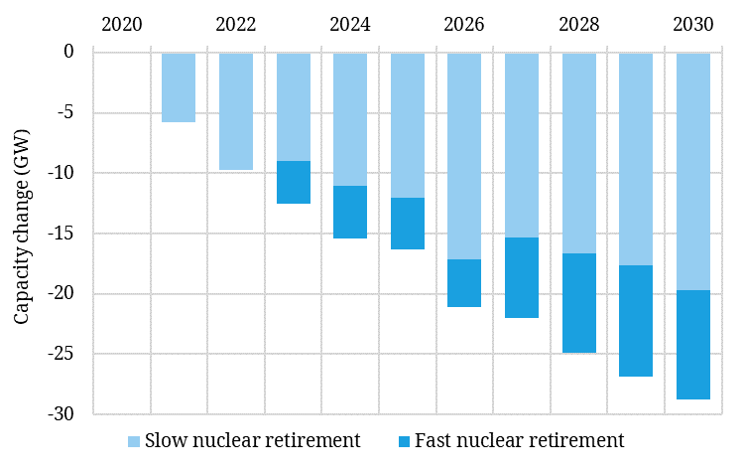
In parallel to coal closures, nuclear capacity is also falling fast. Germany will close its entire nuclear fleet by 2022, Belgium by 2025. Even the traditionally pro-nuclear France has set a target to reduce its nuclear fleet by 2035.
In our view, France will likely water down proposals on nuclear capacity closures over time, particularly given their negative impact on decarbonisation efforts.
The “Slow nuclear retirement” scenario in Chart 2 represents a more conservative view on E-7 nuclear closures. This scenario is used for the rest of the analysis in this article. The “Fast nuclear retirement” scenario shows the additional capacity deficit if nuclear plants are closed based on announced policy schedules.
Chart 2: Nuclear capacity changes E-7
Source: Timera Energy
Full post here.
Chart 4 is particularly noteworthy:

New solar and wind capacity are introduced, but only at de-rated values of 2% and 12% (offshore wind) respectively. Increased demand for electricity, for instance for cars, appears as a reduction in capacity.
The chart shows a substantial capacity deficit opening up across the 2020s, with a net 30GW decline in E-7 de-rated capacity by 2023, growing to 60GW by 2030. These numbers are much larger if all European countries are included (vs the E-7 countries we analyse today).
On top of these scheduled coal & nuclear closures, an additional 20-30GW of gas plant closures are likely across UK, ES & IT. These are plants (e.g. built in the 1990s or earlier) that will reach the end of their operational life and require repowering or major capex to continue to operate.
In other words, there could be a capacity deficit of 90GW by 2030, compared to current demand of 230GW.
Timera then go on to outline ways in which this deficit can be filled:
Europe needs 4 types of flex
Analysis in our pan-European power market model shows transformational shifts in flexibility requirements across this decade. By 2030, E-7 renewables may swing up to 215GW within-day (compared to current power demand of around 230GW). More than 100GW swings may take place in the space of minutes as wind & solar conditions change.
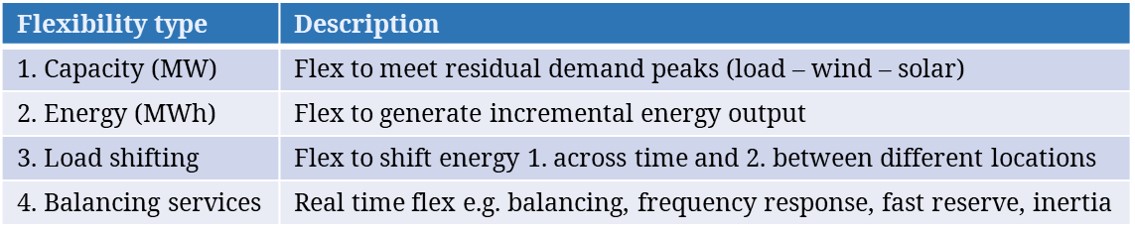
Not all flexibility is created equal. Keeping the lights on will require ramping, storage, load shifting and balancing services at unprecedented scale. We summarise 4 quite different categories of flexibility required to support decarbonisation in Table 1.
Table 1: 4 types of flex required
Batteries & DSR: These are two key sources of new low carbon flexibility, with a primary focus on system balancing and shifting load across intraday time windows. But both sources make a zero or net negative energy contribution, as well as having practical duration limitations. This means other flex is needed, particularly to address sustained periods of energy deficit or surplus.
Interconnectors: Interconnectors are important in allowing access to flex in neighbouring markets. Their primary role is shifting energy from lower to higher value locations, but as with batteries & DSR they do not create energy (consuming small amounts via line losses). They also have limited impact in correlated high/low solar & wind events across Europe.
Hydro: Hydro scores highly on all flexibility metrics, however the scope for further hydro developments in Europe is limited by planning & cost constraints.
Hydrogen: Hydrogen fired generation may provide clean and flexible back-up generation capacity, however the production of green hydrogen (via electrolysis) is a net drain on energy.
Gas peakers & CCGT: That leaves gas-fired generation, which is very flexible, but has the obvious challenge of a carbon footprint. That footprint is relatively low for gas peakers (given low load factors) and it will decline over time for CCGTs as load factors fall.
Gas plant utilisation will be supported in the 2020s by the fact that nuclear & coal closures outpace renewables build. Our modelling shows no realistic alternative to gas, even under the most optimistic scenarios of storage, DSR & interconnector development. Gas plant load factors are set to decline in the 2030s as their role transitions towards providing backup flex. But it is difficult to construct a scenario where gas flex will not be required until at least 2050.
As I have repeatedly pointed out, batteries and DSR may be fine for intraday smoothing, but are next to useless for covering longer shortages.
Meanwhile, hydro is limited and hydrogen simply not feasible at scale during this timeframe, while interconnectors will not help when the shortages are Europe-wide.
Which brings us back to gas fired generation, which, according to Timera, will still be crucial at least until 2050.
via NOT A LOT OF PEOPLE KNOW THAT
March 3, 2020 at 09:46AM

