
By Kirye (photo right)
and Pierre Gosselin
This is how alarmists operate today: Find one single extreme weather event and immediately behold it as proof of an impending climate change catastrophe. Never mind such events have happened earlier when CO2 was much lower.
“Record” heat at Verhojansk
Earlier this week, for example, teenage activist Greta Thunberg tweeted over at the now highly censored Twitter of a record warm reading recorded in Verhojansk, Siberia.
Verhojansk north of the Arctic Circle in Siberia recorded +38°C today… https://t.co/qla2lfvxeh
— Greta Thunberg (@GretaThunberg) June 20, 2020
Siberia has continental climate, temps range from -70°C to +40°C
What is supposed to be alarming about the reading is that it was recorded at the Arctic circle, which currently runs at 66°33′48.1″ north of the Equator. It’s supposed to be icy up there, with polar bears, so many people believe.
But that is of course not the case in the summertime. Hot temperature near 40°C near the Arctic circle have happened time and again in the past. The new record recorded at Verhojansk still needs to be confirmed by the World Meteorological Organization (WMO), and if it stands, it will break the old record set back on July 25, 1988, when the town hit 37.3°C. But this is nothing unusual because records get broken all the time.
Arctic circle heat not uncommon in the summertime
High temperatures up in the Arctic occurred also much earlier in the past. For example meteorologist Chris Martz tweeted how 105 years ago Anchorage and Fort Yukon climbed to 100°F (37.8°C).
On June 20, 1915, Anchorage, Alaska (Merrill Field) hit 100°, which set the state’s hottest temperature on record. Seven days later, Fort Yukon also hit 100° which is the hottest temperature ever recorded within the Arctic Circle.
— Chris Martz Weather (@ChrisMartzWX) June 21, 2020
100°F for one week in 1957
Reader Don Penim then added how the Chicago Tribune reported on July 14, 1957, that the temperature at Vorkuta, Russia, “inside the Arctic circle”, reached 100°F for en entire week!
What about 100 degree temperatures "EVERY DAY FOR A WEEK" inside the Arctic circle?
Chicago Tribune – July 14, 1957 pic.twitter.com/DXHUcsX7jf
— Don Penim (@Don_Penim) June 22, 2020
Siberia temperatures fell as CO2 rose
Next we look at NASA GHCN Version 3 and Version 4 mean annual temperature data for the weather station located at Verhojansk, Russia:
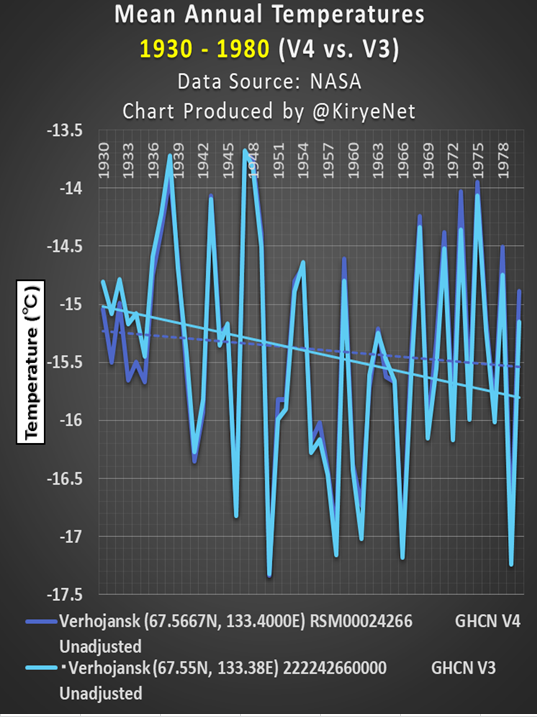
Data source: NASA GISS
Note how the mean annual temperature trend fell 50 years long while CO2 emissions climbed. Clearly CO2 is not driving the temperature in Siberia, and many experts question the claimed large atmospheric warming effect that CO2 has on the globe.
Climate blogger Tony Heller also tweeted how the Arctic above 80° north is at normal temperature, and has not risen above normal in the summertime for 20 years!
Temperatures north of 80N were slightly below normal yesterday, and summertime temperatures in the high Arctic have been consistently below normal for the past twenty years.
"Zero emissions" means massive job loss, suffering, misery and genocide.https://t.co/xp37wkT2wc pic.twitter.com/HmY0YZ9dIe
— Tony Heller (@Tony__Heller) June 22, 2020
Donate – choose an amount
via NoTricksZone
June 27, 2020 at 09:51AM

