A new study demonstrates how a prolonged warming pause or even global cooling may happen in coming years despite increasing greenhouse gases — caused by natural climatic variability.
Natural climatic variability has always been a topic that contains a lot of unknowns, but it has been rare that how little we know about it has been explicitly stated. Such variability has been habitually underplayed as it was “obvious” that the major driver of global temperature was the accumulation of greenhouse gasses with natural variability a weaker effect.
But the global temperature data of this century demonstrate that natural variability has dominated in the form of El Ninos. ‘Doesn’t matter’, came the reply, ‘just wait and the signal of greenhouse warming will emerge out of the noise of natural climatic variability.’ How long will we have to wait for that signal? Quite a long time, according to some researchers as more papers acknowledge that natural climatic variability has a major, if not a dominant, influence on global temperatures.
With the usual proviso concerning climatic predictions there does seem to be a growing number of research papers suggesting that the global annual average temperature of at least the next five years will remain unchanged, and the reason, natural climatic variability.
Only last week the UK Met Office produced figures suggesting that there is only a 1 in 34 chance that the 1.5°C threshold will be exceeded for the next five years. Now a new paper by climate modellers extends such predictions, suggesting that because of natural climatic variability the average global temperature up to 2049 could remain relatively unchanged – even with the largest increase in greenhouse gas emissions.
Using two types of computer models in a first of its kind study, Nicola Maher of the Max Planck Institute for Meteorology, Hamburg, Germany, and colleagues writing in Environmental Research Letters looked at the 2019-2034 period concluding that,
We first confirm that on short-term time-scales (15-years) temperature trends are dominated by internal variability. This result is shown to be remarkably robust.”
Looking even further they say that natural variability is still important,
… even out to thirty years large parts of the globe could still experience no-warming due to internal variability,” they add.
The researchers demonstrate internal variability and its importance in driving the climate that we observe, with a series of maps to visualise both the maximum and minimum global and future trends that could occur on short and mid-term timescales. They demonstrate clearly the cooling that could occur under increasing greenhouse gases, caused by internal variability.
In percentages, the role of internal climatic variability. Source: Maher et al., 2020
The researchers say,
In the short-term all points on the globe could individually experience cooling or no warming, although in a probabilistic sense they are much more likely to warm.”
Looking beyond the short-term they add,
We find that even on the mid-term time-scale a large proportion of the globe could by chance still not experience a warming trend due to internal variability, although this result is somewhat model dependent.”
In the past climate extremists have grasped natural El Ninos and enlisted them as examples of rapid greenhouse global warming. It’s a disingenuous approach that may become harder and harder to do if research like this is any indication.
The best context for understanding decadal temperature changes comes from the world’s sea surface temperatures (SST), for several reasons:
The ocean covers 71% of the globe and drives average temperatures;
SSTs have a constant water content, (unlike air temperatures), so give a better reading of heat content variations;
A major El Nino was the dominant climate feature in recent years.
HadSST is generally regarded as the best of the global SST data sets, and so the temperature story here comes from that source, the latest version being HadSST3. More on what distinguishes HadSST3 from other SST products at the end.
The Current Context
The cool 2020 Spring was not just your local experience, it’s the result of Earth’s ocean cooling off after last summer’s warming in the Northern Hemisphere. The chart below shows SST monthly anomalies as reported in HadSST3 starting in 2015 through June 2020. A global cooling pattern is seen clearly in the Tropics since its peak in 2016, joined by NH and SH cycling downward since 2016. In 2019 all regions had been converging to reach nearly the same value in April.
Then NH rose exceptionally by almost 0.5C over the four summer months, in August exceeding previous summer peaks in NH since 2015. In the 4 succeeding months, that warm NH pulse reversed sharply. Now NH temps are warming to a lower 2020 summer peak, while the SH and Tropics are cooling sharply. Thus the Global anomaly has steadily decreased since March, presently matching last Autumn
Note that higher temps in 2015 and 2016 were first of all due to a sharp rise in Tropical SST, beginning in March 2015, peaking in January 2016, and steadily declining back below its beginning level. Secondly, the Northern Hemisphere added three bumps on the shoulders of Tropical warming, with peaks in August of each year. A fourth NH bump was lower and peaked in September 2018. As noted above, a fifth peak in August 2019 exceeded the four previous upward bumps in NH.
And as before, note that the global release of heat was not dramatic, due to the Southern Hemisphere offsetting the Northern one. The major difference between now and 2015-2016 is the absence of Tropical warming driving the SSTs, along with SH anomalies nearly the lowest in this period.
A longer view of SSTs
The graph below is noisy, but the density is needed to see the seasonal patterns in the oceanic fluctuations. Previous posts focused on the rise and fall of the last El Nino starting in 2015. This post adds a longer view, encompassing the significant 1998 El Nino and since. The color schemes are retained for Global, Tropics, NH and SH anomalies. Despite the longer time frame, I have kept the monthly data (rather than yearly averages) because of interesting shifts between January and July.
To enlarge, open image in new tab,
1995 is a reasonable (ENSO neutral) starting point prior to the first El Nino. The sharp Tropical rise peaking in 1998 is dominant in the record, starting Jan. ’97 to pull up SSTs uniformly before returning to the same level Jan. ’99. For the next 2 years, the Tropics stayed down, and the world’s oceans held steady around 0.2C above 1961 to 1990 average.
Then comes a steady rise over two years to a lesser peak Jan. 2003, but again uniformly pulling all oceans up around 0.4C. Something changes at this point, with more hemispheric divergence than before. Over the 4 years until Jan 2007, the Tropics go through ups and downs, NH a series of ups and SH mostly downs. As a result the Global average fluctuates around that same 0.4C, which also turns out to be the average for the entire record since 1995.
2007 stands out with a sharp drop in temperatures so that Jan.08 matches the low in Jan. ’99, but starting from a lower high. The oceans all decline as well, until temps build peaking in 2010.
Now again a different pattern appears. The Tropics cool sharply to Jan 11, then rise steadily for 4 years to Jan 15, at which point the most recent major El Nino takes off. But this time in contrast to ’97-’99, the Northern Hemisphere produces peaks every summer pulling up the Global average. In fact, these NH peaks appear every July starting in 2003, growing stronger to produce 3 massive highs in 2014, 15 and 16. NH July 2017 was only slightly lower, and a fifth NH peak still lower in Sept. 2018.
The highest summer NH peak came in 2019, only this time the Tropics and SH are offsetting rather adding to the warming. Since 2014 SH has played a moderating role, offsetting the NH warming pulses. Now in January 2020 last summer’s unusually high NH SSTs have been erased. (Note: these are high anomalies on top of the highest absolute temps in the NH.)
What to make of all this? The patterns suggest that in addition to El Ninos in the Pacific driving the Tropic SSTs, something else is going on in the NH. The obvious culprit is the North Atlantic, since I have seen this sort of pulsing before. After reading some papers by David Dilley, I confirmed his observation of Atlantic pulses into the Arctic every 8 to 10 years.
But the peaks coming nearly every summer in HadSST require a different picture. Let’s look at August, the hottest month in the North Atlantic from the Kaplan dataset. The AMO Index is from from Kaplan SST v2, the unaltered and not detrended dataset. By definition, the data are monthly average SSTs interpolated to a 5×5 grid over the North Atlantic basically 0 to 70N. The graph shows warming began after 1992 up to 1998, with a series of matching years since. Because the N. Atlantic has partnered with the Pacific ENSO recently, let’s take a closer look at some AMO years in the last 2 decades. This graph shows monthly AMO temps for some important years. The Peak years were 1998, 2010 and 2016, with the latter emphasized as the most recent. The other years show lesser warming, with 2007 emphasized as the coolest in the last 20 years. Note the red 2018 line is at the bottom of all these tracks. The black line shows that 2020 began slightly warm, then set records for 3 months before dropping below 2016 and 2017.
Summary
The oceans are driving the warming this century. SSTs took a step up with the 1998 El Nino and have stayed there with help from the North Atlantic, and more recently the Pacific northern “Blob.” The ocean surfaces are releasing a lot of energy, warming the air, but eventually will have a cooling effect. The decline after 1937 was rapid by comparison, so one wonders: How long can the oceans keep this up? If the pattern of recent years continues, NH SST anomalies may rise slightly in coming months, but once again, ENSO which has weakened will probably determine the outcome.
Footnote: Why Rely on HadSST3
HadSST3 is distinguished from other SST products because HadCRU (Hadley Climatic Research Unit) does not engage in SST interpolation, i.e. infilling estimated anomalies into grid cells lacking sufficient sampling in a given month. From reading the documentation and from queries to Met Office, this is their procedure.
HadSST3 imports data from gridcells containing ocean, excluding land cells. From past records, they have calculated daily and monthly average readings for each grid cell for the period 1961 to 1990. Those temperatures form the baseline from which anomalies are calculated.
In a given month, each gridcell with sufficient sampling is averaged for the month and then the baseline value for that cell and that month is subtracted, resulting in the monthly anomaly for that cell. All cells with monthly anomalies are averaged to produce global, hemispheric and tropical anomalies for the month, based on the cells in those locations. For example, Tropics averages include ocean grid cells lying between latitudes 20N and 20S.
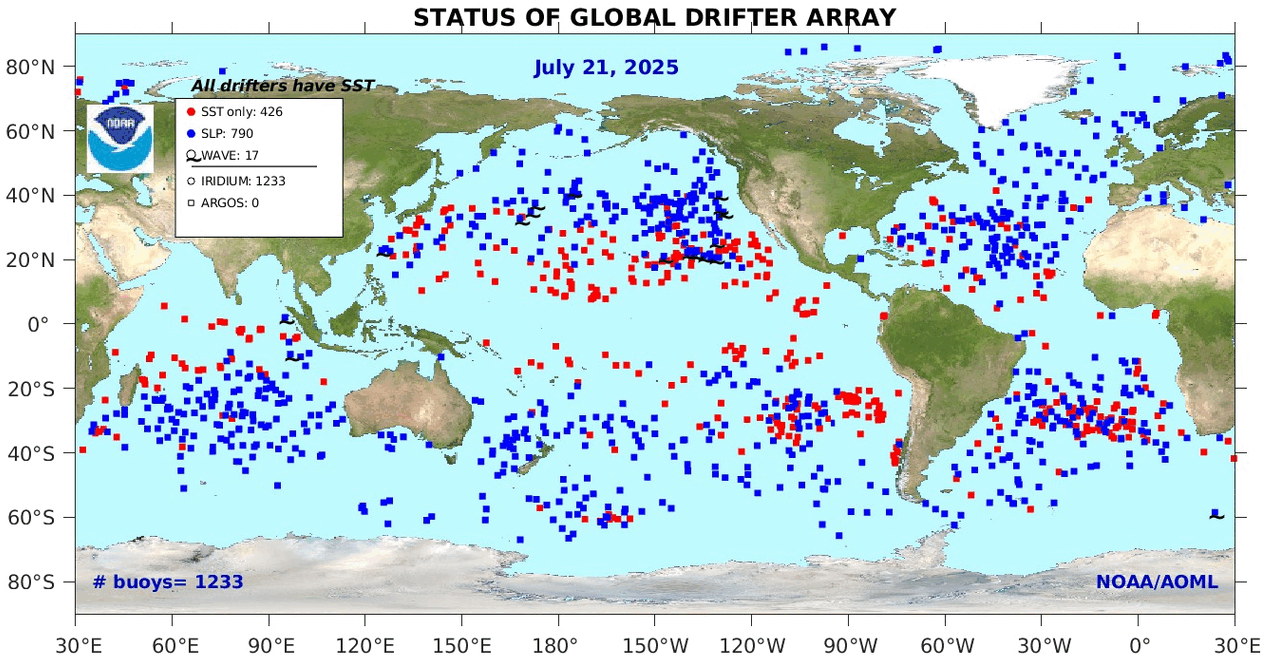
Gridcells lacking sufficient sampling that month are left out of the averaging, and the uncertainty from such missing data is estimated. IMO that is more reasonable than inventing data to infill. And it seems that the Global Drifter Array displayed in the top image is providing more uniform coverage of the oceans than in the past.
USS Pearl Harbor deploys Global Drifter Buoys in Pacific Ocean
(I wrote a white paper for the CO2 Coalition, providing more details and references to peer reviewed science regards how marine life counteracts ocean acidification. That paper can be downloaded here )
Search the internet for “acid oceans” and you’ll find millions of articles suggesting the oceans are becoming more corrosive due the burning of fossil fuels, and “acid oceans” are threatening marine life. Although climate modelers constantly claim the oceans’ surface pH has dropped since the 1800s, that change was never measured, as the concept of pH was not created until the early 1900s by beer-makers.
In 2003 Stanford’s Dr. Ken Caldeira coined the term “ocean acidification” to generate public concern about increasing CO2 . As New Yorker journalist Elizabeth Kolbert reported, “Caldeira told me that he had chosen the term ‘ocean acidification’ quite deliberately for its shock value. Seawater is naturally alkaline, with a pH ranging from 7.8 to 8.5—a pH of 7 is neutral—which means that, for now, at least, the oceans are still a long way from actually turning acidic.” Nonetheless Caldeira’s term “ocean acidification” evoked such undue fears and misunderstandings, we are constantly bombarded with catastrophic media hype and misdiagnosed causes of natural change.
For example, for nearly a decade the media has hyped the 2006-2008 die-off of larval oysters in hatcheries along Washington and Oregon. They called it a crisis caused by rising atmospheric CO2 and the only solution was to stop burning fossil fuels. But it was an understanding of natural pH changes that provided the correct solutions. Subsurface waters at a few hundred meters depth naturally contain greater concentrations CO2 and nutrients and a lower pH than surface waters. Changes in the winds and currents periodically bring those waters to the surface in a process called upwelling. Upwelling promotes a burst of life but also lowers the surface water pH. Not fully aware of all the CO2 dynamics, the hatcheries had made 3 mistakes.
First, they failed to recognize not all oyster species are well adapted to the low pH of upwelled water. The larvae of native Olympia oysters naturally survive intense upwelling events along the Washington coast because that species “broods” its larvae. The larvae initiate their shells protected inside their parents’ shells where pH is more controlled. However, the Olympia oysters were over-harvested into near extinction in the 1800’s.
So, fishermen imported the Japanese oyster, which is now the mainstay of the Washington and Oregon fisheries. Japanese oysters did not evolve within an intense upwelling environment similar to Washington’s coast. Each Japanese oyster simply releases over 50 million eggs into the water expecting their larvae to survive any mild changes in pH during initial shell formation. Hatcheries didn’t realize the Japanese oyster’s larvae had a 6-hour window during which the larvae’s initial shell development and survival was vulnerable to low pH.
Second, because cooler waters inhibit premature spawning, hatcheries pumped cool water from the estuary in the early morning. As measured in coral reefs, photosynthesis raises pH during the day, but nighttime respiration drops pH significantly. By pumping early morning water into their tanks, they imported estuary water at its lowest daily pH. Finally, they failed to recognize natural upwelling events transport deeper waters with naturally low pH into the estuary, further lowering the pH of water pumped into their tanks.
Now, hatcheries simply pump water from the estuary later in the day after photosynthesis has raised pH. Scientists also developed a metering device that detects intrusions of low pH waters, so hatcheries avoid pumping water during upwelling events. As for most shellfish, once the shell is initiated, a protective layer prevents any shell corrosion from low pH conditions. Problem easily solved and crisis averted!
The simplistic idea that burning fossil fuels is causing the surface ocean to become more acidic is based on the fact that when CO2 interacts with water a series of chemical changes results in the production of more hydrogen ions which lowers pH. Unfortunately, all catastrophic analyses stop there. But living organisms then reverse those reactions. Whether CO2 enters the surface waters via the atmosphere or from upwelling, it is quickly utilized by photosynthesizing plankton which counteracts any “acidification”. A percentage of the organic matter created in the sunlit waters sinks or is actively transported to depths, further counteracting any surface “acidification’. Some organic matter sinks so rapidly, CO2 is trapped at depths for hundreds and thousands of years. The dynamics that carry carbon to ocean depths largely explains why the oceans hold 50 times more CO2 than the atmosphere.
To maintain marine food webs, it is essential that upwelling bring sunken nutrients back into the sunlight to enable photosynthesis. Upwelling also brings stored CO2 and low pH water to the surface. Wherever upwelling recycles nutrients and lowers surface pH, the greatest abundance and diversity of marine life is generated.
Climate change has long been blamed for decline in seabird populations, despite abundant evidence that commercial fishing is devastating their feeding grounds.
I cam across this 2014 study by the British Trust for Ornithology, which points the finger at the latter:
New research led by the BTO shows that the UK’s internationally important seabird populations are being affected by fishing activities in the North Sea. Levels of seabird breeding failure were higher in years when a greater proportion of the North Sea’s sandeels, important prey for seabirds, was commercially fished.
The UK’s seabirds are under pressure from human activities, such as resource extraction and fishing, as well as climate change. Under the European Marine Strategy Framework Directive, the UK is legally bound to make sure human activities are kept at levels consistent with “clean, healthy and productive” seas, and as top predators, monitoring seabirds can give insights into the state of the wider marine environment. In many species, counts of breeding individuals reflect population-level impacts of environmental pressures, but this is not necessarily the case with seabirds. This is because seabirds are long-lived and can delay breeding for several years after they reach maturity, or skip breeding seasons when conditions are poor.
Scientists at the BTO and JNCC have now shown monitoring seabird breeding performance to be the way forward. The study, using long-term datasets from the JNCC’s Seabird Monitoring Programme for nine seabird species, showed the knock-on effects of fishing activities in the North Sea on seabird breeding at colonies on the east coast of England and Scotland. Sandeels are typically fished for use in animal feed and fertilizer. There is a large fishery on Dogger Bank, which is within the foraging range of many seabirds. In years when a greater proportion of the North Sea’s sandeels was fished, rates of seabird breeding failure rose.
The study also found that seabirds breeding on the UK’s western colonies are faring better than those on the North Sea coast. Population declines and elevated breeding failures were found for eight out of nine species at North Sea colonies (with Kittiwakes particularly badly affected), compared to three out of nine on the west coast. The results demonstrate that seabird breeding can show how these key species are responding to environmental pressures before such changes become evident at the population level. Detecting such impacts as early as possible is a priority, as the management of the marine environment is changing, with expansion of offshore developments, the introduction of marine protected areas, and modification of fishing discards policy.
I have long pointed out that, while puffins on the North Sea coast have been struggling in recent years, they have been flourishing on Skomer Island off the Pembroke coast. Clearly the difference between the two populations cannot be climate change, but the simple fact that their favourite food, the sandeel, is commercially fished in the North Sea.
The BTO study confirms that this fishing is also having a heavy impact on many other seabirds, notably the Kittiwake.


 The best context for understanding decadal temperature changes comes from the world’s sea surface temperatures (SST), for several reasons:


 Iowa Climate Science Education