Month: July 2020

Peter Ridd Challenge Goes To The Heart Of A Free Society

Peter Ridd has decided to fight last week’s decision in favour of James Cook University, and the case is of such public importance that the High Court simply must allow the appeal to be heard.

The Ridd case is much more than a mere workplace relations dispute between an academic and his employer. It is even bigger than a dispute about climate change.

It is about the free speech crisis at our universities, and goes to the heart of the “cancel culture” epidemic engulfing the Western world.

Ridd is a Townsville-based marine geophysicist and Great Barrier Reef expert, whose 30-year academic career effectively ended when he started disputing the conventional wisdom that climate change was “killing” the reef. He subsequently took the university to court, winning $1.2m in compensation for his unlawful sacking. Last week, the Federal Court overturned that win in a 2-1 decision.

In deciding whether to grant special leave for the appeal, the High Court will consider whether the case involves “a question of law that is of public importance”. The Ridd matter easily meets this threshold. It would be the first time the High Court has been called upon to consider the meaning of “academic and intellectual freedom”, which is used in enterprise agreements covering staff at almost all Australian universities.

The court’s decision will therefore have very real consequences in terms of university governance, and the extent to which administrators tolerate controversial (and, often, commercially inconvenient) opinions from the professoriate.

Should “intellectual freedom” be limited by the whims of university administrators, as JCU is arguing? Or should it be wide enough to allow for the kind of controversial, but honestly held opinions for which Ridd was ultimately sacked?

The Federal Court’s answer to that question is deeply disturbing. In its judgment last week, the majority seemed to suggest that free speech on campus is past its use-by date.

“There is little to be gained in resorting to historical concepts of academic freedom,” scoffed justices Griffiths and Derrington. For good measure, the majority judgment quoted — arguably out of context — from an academic textbook outlining “a host of new challenges”, like “the rise of social media” and “student demands for accommodations such as content warnings and safe spaces”.

If nothing else, the Federal Court has exposed just how much our public institutions have been corroded by modern cancel culture. The free speech crisis at our universities has been apparent for years, but now the hypersensitivity of woke undergraduates is being taken seriously by our penultimate court. It sets a precedent, and a dangerous one. While The Australian does not suggest the judges acted improperly, it is worrying that the idea the boundaries of free speech should be defined by self-appointed cultural arbiters and anonymous Twitter mobs is on the verge of formal legal recognition.

This is not about the polite notion of so-called “acceptable limits” to free speech. It is a radical departure from how our society treats knowledge. Former opinion editor Bari Weiss recognised this dynamic in her sensational resignation from The New York Times recently: “I was always taught that journalists were charged with writing the first rough draft of history,” Weiss wrote. “Now, history itself is one more ephemeral thing moulded to fit the needs of a predetermined narrative.”

You could replace the words “journalism” and “history” with almost any intellectual discipline. Woke revisionism has trashed the humanities faculties almost beyond repair. Now it is creeping into the “hard sciences”. That is how we have arrived at a situation in which a respected academic such as Ridd is put through hell for offering a critique of the “settled science” of climate change.

If our judicial system lets JCU get away with it, every academic in the country — present and future — will be forced to choose between speaking the truth and putting bread on the table.

Full post ($)

The post Peter Ridd Challenge Goes To The Heart Of A Free Society appeared first on The Global Warming Policy Forum (GWPF).

via The Global Warming Policy Forum (GWPF)

https://ift.tt/39AT1qB

July 28, 2020 at 02:39PM

The Last Time I Saw Paris

On July 18, 2020, Michelle Stirling, Communications Manager for Friends of Science Society, gave a presentation entitled “The Last Time I Saw Paris” at the FreedomTalk Conference in Calgary, Alberta. … Continue reading

via Friends of Science Calgary

https://ift.tt/3hNgyI2

July 28, 2020 at 02:16PM

BBC Climate Documentary: “How they Made Us Doubt Everything”

Guest essay by Eric Worrall

I’ve just listened to the entire BBC radio series “How They Made Us Doubt Everything”, which compares climate skepticism to rejecting the link between tobacco and cancer.

Episodes 1-5, all I heard was details of how the tobacco industry sowed doubt about lung cancer – interesting but largely irrelevant to the climate debate.

Episode 6 starts with a few details of Ben Santer’s custody battle for his son, then segues straight into saying how his life is also tough because he is a climate scientist. The episode then dives into Myron Ebell’s battle against the Kyoto Protocol, claiming Ebell’s plan to oppose Kyoto was just like the “white coat” campaign against tobacco regulation.

It is worth pausing for a moment to reflect on some of the reasons why Ben Santer has encountered a few frustrations in his career. Ben Santer became a Climategate star because of his email fantasy of perpetrating violent assault against Pat Michaels, but this is not all that Santer did. Ben Santer also seems to have spent a fair bit of time thinking up excuses to fend off requests for data referenced by his published papers, while writing angry emails to colleagues about the persecution he was enduring. “Can any competitor simply request such datasets via the US FOIA before we have completed full scientific analysis of those datasets?” (Climategate Email 1231257056.txt). Stephen McKintyre describes Santer refusing a polite request for data on the Climate Audit website.

Of course none of this was mentioned by the BBC.

Episode 7 contains a quote from science communicator Susan Hassall, who seems to think ordinary people don’t understand the word “uncertainty”.

Episode 8 talks about Jerry Taylor. Jerry used to be a climate skeptic, but changed his mind after talking to Joe Romm in the changing room after a live debate about James Hansen’s work. Jerry discussed what Joe Romm said with Pat Michaels, about Hansen producing more than one scenario, but was unsatisfied with Pat’s response; Jerry left with the impression he had been “duped” by climate skeptics.

I’m not sure why Jerry feels he was misled; according to our Willis, Hansen’s Scenario A underestimated CO2 emissions by 25%, but predicted double the observed global warming. The other Hansen scenarios were a better fit for the observed temperature trend, but drastically underestimated CO2 emissions. Hansen got it wrong.

Episode 8 also mentions the BBC advising their journalists “we do not need a denier to balance the debate“.

Episode 9 focuses on smearing Dr. Willie Soon. In my opinion the BBC attempted to make funding for Soon’s research look like Dr. Soon received a million dollar bribe from the fossil fuel industry. The part the BBC leaves out of this grossly misleading attack is the grant was paid over a period of ten years. Lord Monckton estimates Willie Soon received less than $60,000 / year after the Smithsonian took their cut – not exactly life changing money.

WUWT published Willie Soon’s excellent response to the BBC’s biased questions, which Soon received from BBC producer Phoebe Keane a few weeks ago.

Episode 10, “Leaving the Tribe”, discusses former Republican representative Bob Inglis being dumped by his district after he embraced climate alarmism, though looking at other sources it is unclear whether climate alarmism was the primary reason Inglis was dumped – Inglis did plenty of other things which likely upset his supporters.

Producer Phoebe Keane then complains in episode 10 that when Willie Soon responded to her biased questions, she also received angry emails from other people Dr. Soon copied into his response. Keane then wastes listeners time discussing her disdain for the people who wrote to her, but doesn’t actually present what Dr. Soon said in his response.

What can I say – this is not the BBC I grew up listening to and watching. In my opinion “how they made us doubt everything” is an innuendo heavy smear, rather than a genuine attempt to enlighten BBC listeners.

The BBC “How they made us doubt everything” series spent two episodes of their 10 episode series vilifying Dr. Willie Soon, then failed to present Dr. Soon’s response to their attacks.

Regardless of whether you think Dr. Soon is right or wrong, Dr. Willie Soon deserves better than this one sided gutter press assault on his reputation from the BBC. Even dictators and murderers are often given an opportunity to argue their case on the BBC. But this is a courtesy the BBC “How they made us doubt everything” series has so far failed to extend to a mild mannered law abiding climate scientist, who was unfortunate enough to be a prime target of their latest ugly smear campaign.

Like this:

Like Loading…

Related

via Watts Up With That?

https://ift.tt/30PoAJq

July 28, 2020 at 12:52PM

Kenyan Biologist: Nature Conservation Is “New Colonialism”…Africa “A Place For White Elitists To Enjoy”

The ugly face of environmentalism exposed…

“Nature conservation is the new colonialism,” Kenyan ecologist Mordecai Ogada told German magazine GEO.

A Kenyan biologist thinks white Europeans and Americans are using “nature conservation” for “self promotion” and have created nothing but failure in Africa.

He accuses NGOs and nature conservation organizations of creating a “permanent crisis” to justify their work and transform Africa into a place for white people to enjoy.

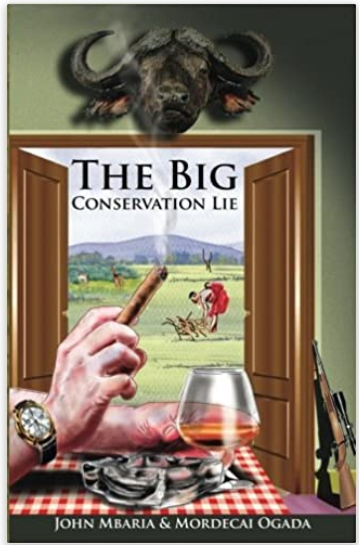
Image: Amazon.

Dr. Ogada, who is author of “The Big Conservation Lie“, called nature conservation in the GEO interview “elitist, violent and often racist” and that it is a “right-wing agenda enforced with money from the left”.

Instrument of power over Africa

He also refers to nature conservation scientists as “prostitutes” and NGOs as “pirates”.

“Environmental protection in Africa is above all a mendacious instrument of power for him,” commented GEO.

In his book, Ogada, who has worked as a biologist for NGOs for more than 18 years, compared nature conservation in Africa to apartheid because “projects are run by whites” who make all the decisions and use black researchers as window dressing, adding: “you suddenly realize that decisions are forced on you by people who are less qualified and often white.”

Rules of colonial times

Dr. Ogada told GEO: “Nature conservation in Africa still follows the rules of colonial times: keep black people away from nature so that white people can enjoy it.”

“White saviors” and nature conservation above all

In Kenya, because of the religious nature conservation fervor by elitists, no crime is as grave as poaching and it is the only one that leads to an immediate death penalty.”

“In Kenya, we arrest robbers, kidnappers, murderers and bring them to justice. But we shoot poachers. Sometimes it happens to someone who is just walking through a protected area,” he told GEO. “Nature conservation organizations spend millions to bring their romantic message to the people: the story of white saviors who save the wildlife in Africa – from the Africans.”

Six gorillas more important than hundreds of Africans

Ogada also illustrates how western values are gravely out of whack, using the example of six poached gorillas at Virunga that made western headlines but not widescale killing and raping of women and children: “But the worst thing about it was that at the same time Virunga was considered one of the world’s worst rape scenes. Hundreds of women were raped every day, children were killed. And none of it made the news. Just the six dead gorillas. And that is so fundamentally wrong.”

NGOs in it for money, power…”no angels”

Ogada also doubts that the millions of dollars protect animals at all: “No. That money makes some people very rich. These organizations pay high salaries. They buy guns, ammunition, helicopters. They build up a kind of parallel government, including security agencies.”

Dr. Ogada claims big nature conservation organisations create crisis to justify their work. “Nature conservation is the only area where we reward failure. They have done nothing or the wrong thing for 40 years.” He tells GEO: “Nature conservation is a business. And environmentalists are no angels.”

Goodall, Fossey: In it for “self-promotion”

Ogada also thinks very little of conservationists like Jane Goodall or Dian Fossey and that it’s about “self-promotion above all else”, adding: Dian Fossey’s militias killed people they suspected of being poachers. She was murdered in revenge for violating other people’s rights.”

Donate – choose an amount

via NoTricksZone

https://ift.tt/306nF85

July 28, 2020 at 12:10PM