H/T Palmer Foundation (here) for transcript synopsis, printed in italics with my bolds.
A Nigerian-born and trained physician, Dr Stella Emmanuel, is trending on social media after delivering an impassioned COVID-19 speech in the U.S.
That was until U.S. President Trump retweeted it. Now the video is being removed from all over the internet. Facebook has gone so far as to completely remove her account.
Speaking at a news conference in Washington, Emmanuel claimed that antimalarial drug, hydroxychloroquine, zinc, and antibacterial drug, Zithromax, were effective cures for the virus.
She said she had successfully treated no fewer than 350 patients with hydroxychloroquine, zinc, and Zithromax.
The following are excerpts of Emmanuel’s speech:
“Hello, I’m Dr Stella Emmanuel. I’m a primary care physician in Houston, Texas.
“I went to medical school in West Africa, Nigeria, where I took care of malaria patients, treated them with hydroxychloroquine and stuff like that.
“So I’m used to these medications. I’m here because I have personally treated over 350 patients with COVID-19. Patients that have diabetes, patients that have high blood pressure, patients that have asthma, old people … I think my oldest patients are 92 … 87-year-olds.
“And the result has been the same. I put them on hydroxychloroquine, I put them on zinc, I put them on Zithromax, and they’re all well. For the past few months, after taking care of over 350 patients, we’ve not lost one. Not a diabetic, not a somebody with high blood pressure, not somebody who asthma, not an old person.
“We’ve not lost one patient. And on top of that, I’ve put myself, my staff, and many doctors that I know on hydroxychloroquine for prevention because by the very mechanism of action, it works early and as a prophylaxis.
“The study that made me start using hydroxychloroquine was a study that they did under the NIH in 2005 that says it works.
“I know you’re going to tell me that you treated 20 people, 40 people, and it didn’t work. I’m a true testimony. So I came here to Washington DC to tell America nobody needs to get sick.
“This virus has a cure. It is called hydroxychloroquine, zinc, and Zithromax. I know you people want to talk about a mask. Hello? You don’t need a mask. There is a cure.
“I tell all of you doctors that are sitting down and watching Americans die. You’re like the good Nazi … the good one, the good Germans that watched Jews get killed and you did not speak up.
“If they come after me, they threaten me. They’ve threatened to … I mean, I’ve gotten all kinds of threats. Or they’re going to report me to the bots.
“I say, you know what? I don’t care. I’m not going to let Americans die. And if this is the hill where I get nailed on, I will get nailed on it. I don’t care.
“And today I’m here to say it, that America, there is a cure for COVID-19. All this foolishness does not need to happen. There is a cure for COVID-19.
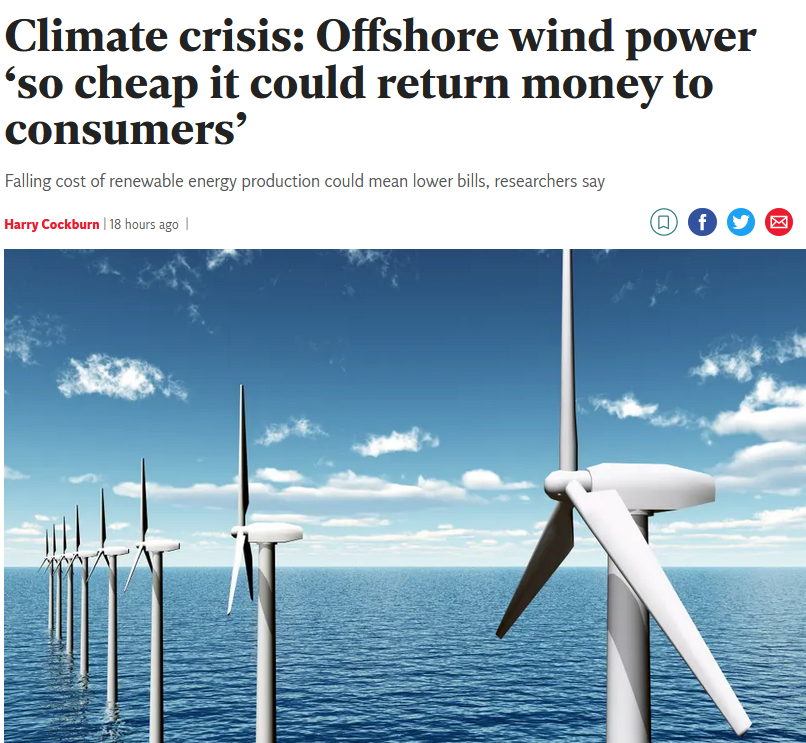
A grossly misleading headline from the “Independent”:
Renewable energy is on course to become the cheapest kind of power to produce in the UK, meaning household electricity bills could fall if savings are passed on to consumers.
In the past, government subsidies for energy projects have pushed energy bills up, but as the cost of installing and running wind and solar energy projects has fallen, renewables are set to undercut fossil fuels to the extent they could operate with “negative subsidies” – paying money back to the government.
According to research by a team at Imperial College London, households could benefit when the latest round of offshore wind farms in the UK start producing power in the mid-2020s.
Lead researcher Dr Malte Jansen, from the Centre for Environmental Policy at Imperial, said: “Offshore wind power will soon be so cheap to produce that it will undercut fossil-fuelled power stations and may be the cheapest form of energy for the UK.
“Energy subsidies used to push up energy bills, but within a few years, cheap renewable energy will see them brought down for the first time. This is an astonishing development.”
The research examined wind power for five countries in Europe, including the UK, and focused on a series of government auctions for offshore wind farms between February 2015 and September 2019.
Companies that want to build wind farms bid by stating the price at which they will sell the energy they produce to the government.
If a company’s bid is higher than the wholesale electricity price on the UK market once the wind farm is up and running, then the company will receive a subsidy from the government to top up the price.
However, if the stated price is less than the wholesale price, then the company will pay the government back the difference. This payback is then passed through to consumers’ energy bills, reducing the amount that homes and businesses will pay for electricity.
A UK auction made headlines in September 2019 as winning companies said they could build offshore wind farms for about £40 per megawatt-hour (MWh) of power. This was a record set by these wind farms, with bids 30 per cent lower than just two years earlier.
It may be true that auction prices for offshore wind have been dropping from the obscene levels seen a few years ago. But that does not mean that households will be better off, as I will explain.
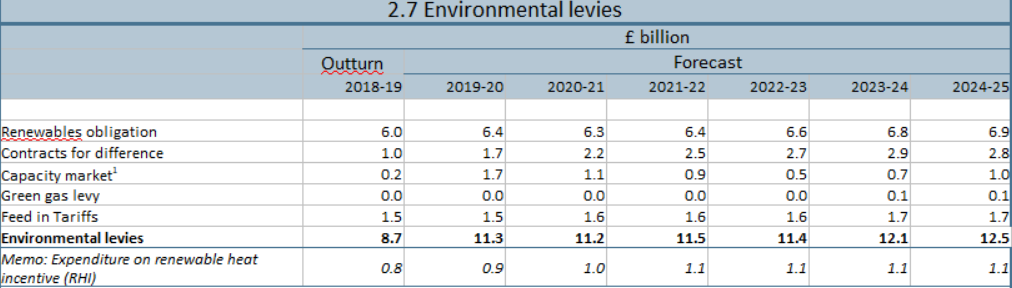
Let’s start with the OBR’s forecast of Environmental Levies, that is the cost of green subsidies added to our energy bills:
As we can see, subsidy costs will carry on rising at least until 2024-25, from £11.3bn last year, to £12.5bn. This is because there are many offshore wind and other low carbon schemes which have not come on stream yet, all of which have heavily subsidised contracts.
Things will get much worse when Hinkley Point C begins operation in the late 2020s, which will add about £1.8bn to energy bills.
Even the much vaunted CfD auction last year, which the Independent claims brought prices of £40.MWh, won’t save consumers money. That £40/MWh price is actually at 2012 prices, and currently sits at £45.83/MWh, still higher than the market price.
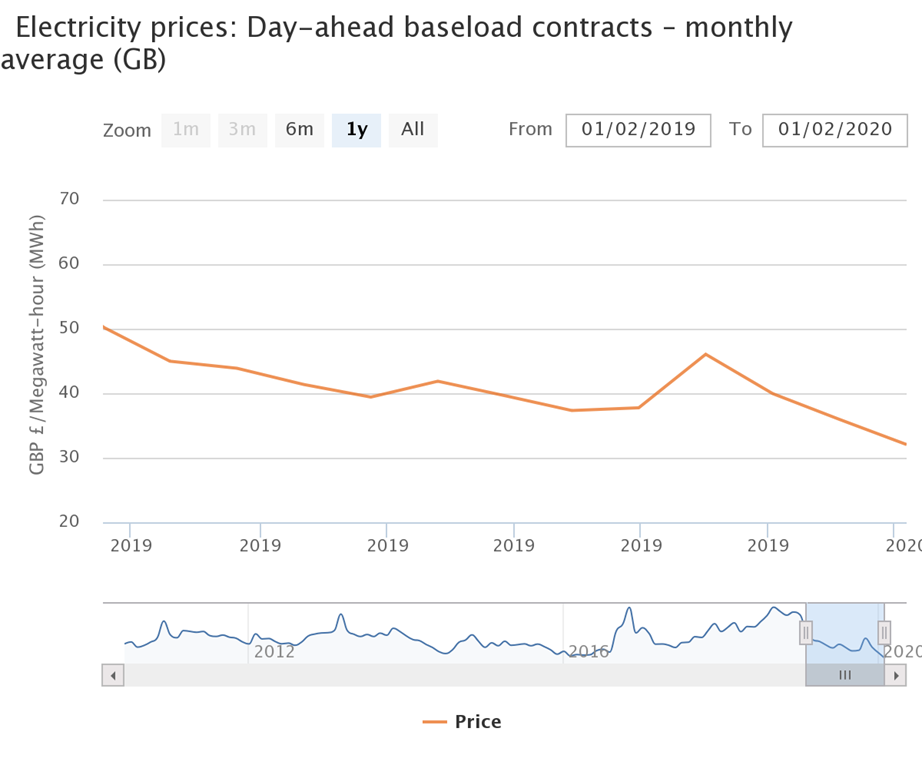
Currently wholesale electricity prices are around £25/MWh, depressed as a result of coronavirus. However, even before the current problems, market prices were hovering around £40/MWh.
In the meantime, the subsidies already being paid by consumers will continue well into the 2030s. Renewable Obligation and FIT subsidies are available throughout the life of the asset.
Whilst CfDs only last for 15 years (other than Hinkley Point), the first project only came on stream in 2017. Consequently huge amounts in CfD subsidies will still be generated well into the 2030s.
The claim that offshore wind will return money to consumers is akin to a burglar stealing £1000 from you, and then giving you £10 back!
Recently a federal district judge found that the Bureau of Land Management (BLM, sorry it was their acronym first) arbitrarily relied on an aggressively scaled-back social cost of greenhouse gases metric to justify a rollback of methane standards for oil and gas equipment. This post summarizes the decision, the reaction of the trade press, and a discussion on the background of the issue.
Background
The General Accounting Office (GAO) published a report to Congressional requesters, Social Cost of Carbon: Identifying a Federal Entity to Address the National Academies’ Recommendations Could Strengthen Regulatory Analysis, that provides good background information on the current controversy regarding the valuation of greenhouse gas emission climate impacts used by Federal agencies. The Social Cost of Carbon (SCC) is the metric most commonly used and represents the long-term net economic damages associated with an incremental increase in carbon dioxide or other greenhouse gas emissions in a given year. In 2009, the Office of Management and Budget and the Council of Economic Advisers convened the Interagency Working Group on Social Cost of Carbon (IWG) to develop government-wide estimates of the social cost of carbon for federal agencies to use in conducting regulatory cost-benefit impact analyses for rulemaking. The IWG issued updates to the Technical Support Document that included revised estimates of the social cost of carbon in 2013, minor technical corrections in 2015, and enhanced discussion of uncertainties around the estimates in 2016.
In 2016, the BLM promulgated a rule to reduce waste of natural gas from venting, flaring, and leaks during oil and natural gas production activities on onshore Federal and Indian leases. The benefits out-weighed the costs primarily because the social cost of methane, same idea as the social cost of carbon, IWG values showed benefits. On March 28, 2017, President Trump issued Executive Order 13783, “Promoting Energy Independence and Economic Growth,” directing the BLM to review the 2016 rule and, if appropriate, to publish proposed and final rules suspending, revising, or rescinding it. An interim SCC value was prepared as part of the Executive Order The BLM reviewed the 2016 rule and determined that it would have imposed costs exceeding its benefits based on the interim SCC values and on September 28, 2018 rescinded the rule after determining that it would have imposed costs exceeding its benefits.
The GAO report was prepared to explain the differences between the IWG values and the interim values. It found “Although both the prior and current estimates were calculated using the same economic models, two key assumptions used to calculate the current estimates were changed: using (1) domestic rather than global climate change damages (see table) and (2) different discount rates (3 and 7 percent rather than 2.5, 3, and 5 percent). As a result, the current federal estimates, based on domestic climate damages, are about 7 times lower than the prior federal estimates that were based on global damages (when both prior and current estimates are expressed in 2018 US dollars and calculated using a 3 percent discount rate).”
The litigation in question only focused on the adequacy of the Rescission, and not the 2016 Rule itself. In this regard, Judge Yvonne Gonzalez Rogers of the U.S. District Court for the Northern District of CA found “that the rulemaking process resulting in the Rescission was wholly inadequate”. I am only going to focus on one aspect of the decision – the cost benefit calculation. The Court analyzed whether BLM acted in an arbitrary and capricious manner in using a new model, the “interim domestic” social cost of methane, for its analysis in enacting the Rescission, instead of using the previous social cost of methane model that was developed and used for the 2016 rule.
Trade Press Reaction
The environmental trade press discussed the flaws Rogers used for her decision. Bloomberg Law said the judge “rebuked the Bureau of Land Management for eliminating Obama-era restrictions on releases of the potent greenhouse gas from oil and gas infrastructure on public and tribal lands” and that “Her opinion included a detailed assault on how the land agency used a metric called the social cost of methane, calling the approach ‘riddled with flaws’”. The Hill quoted parts of the decision: “In its haste, BLM ignored its statutory mandate under the Mineral Leasing Act, repeatedly failed to justify numerous reversals in policy positions previously taken, and failed to consider scientific findings and institutions relied upon by both prior Republican and Democratic administrations” and “In its zeal, BLM simply engineered a process to ensure a preordained conclusion” In the decision’s conclusion she said: “Where a court has found such widespread violations, the court must fulfill its duties in striking the defectively promulgated rule.” Energy & Cleantech Counsel discussed the implications of the rejection of BLM’s redefinition of the social cost of methane on other rules.
The environmental activist trade press, not surprisingly, thought the decision was good. One headline crows: Court Slaps Down Trump Administration’s Rollback Of Methane Rule and another article states “Since the first day they came into office, the Trump administration has sought and failed to undermine the Methane Waste Prevention Rule at every turn – in Congress, through the regulatory process, and in the courts. Today’s ruling shows their efforts are illegal, and provides for the reinstatement of common sense protections that are in the best interest of the American public,” said EDF senior attorney Rosalie Winn.”
Decision Rationale Discussion
In the Costs Exceeded Benefits section of the decision there is a sub-section giving the Court’s background description. For this discussion, the following is the relevant text, absent footnotes and the legal references:
“In 2016, to estimate the benefits of reducing methane emissions, BLM drew upon the conclusions of an Interagency Working Group (“IWG”) founded under the Administration of George W. Bush. The IWG was specifically organized to develop a single, harmonized value for greenhouse gas emissions for federal agencies to use in their regulatory impact analyses for rulemaking under Executive Order 12866. The IWG’s approach, known as the social cost of greenhouse gases, estimates the present value of the damages caused from each additional ton of greenhouse gas emitted at a point in time, or conversely, the present value of the benefits from reducing a ton of greenhouse gas emissions. As the IWG stated in 2015, these damages must be considered globally “because emissions of most greenhouse gases contribute to damages around the world and the world’s economies are now highly interconnected.” This approach was developed over several years through robust scientific and peer-reviewed analyses and public processes, and represents the best available science on this issue. (Notably, federal agencies have relied on the IWG’s valuation of the impacts of greenhouse gas emissions in rulemaking since 2009, and courts have upheld this approach.”
Firstly, a clarification note. This paragraph refers to the social cost of greenhouse gases rather than the social cost of carbon. Carbon dioxide is not the only greenhouse gas and this regulation specifically addressed methane. The IWG ”Addendum Valuing Methane and Nitrous Oxide Emission Changes in Regulatory Benefit-Cost Analysis” argues that using directly calculated societal cost values for methane and other non-CO2 greenhouse gases rather than global warming potential values (i.e. converting them to CO2 equivalents) is more appropriate.
The simplistic argument that the social cost of greenhouse gases must be considered globally because it is a global problem overlooks the fact that the rationale for the IWG work was to evaluate costs and benefits of regulations in the United States. The Federal requirements for these analyses all call for assessments based on national, not global impact. See, for example, discussion by Gayer and Viscusi.
The paragraph notes “This approach was developed over several years through robust scientific and peer-reviewed analyses and public processes, and represents the best available science on this issue”. While this sounds impressive and scientific the reality is different. In 2016, when the IWG was preparing their analyses, they noted that “new estimates of the social cost of non-CO2 GHG emissions have been developed in the scientific literature, and a recent study by Marten et al. (2015) provided the first set of published estimates for the social cost of CH4 and N2O emissions that are consistent with the methodology and modeling assumptions underlying the IWG SC-CO2 estimates”.
During the earlier iteration of the IWG work the US Environmental Protection Agency (EPA) realized that a social cost of gases other than CO2 were needed and found that there was a “paucity of peer-reviewed estimates of the social cost of non-CO2 gases in the literature”. In response the EPA National Center for Environmental Economics developed estimates of the social cost of methane and nitrous oxide consistent with the methodology and modeling assumptions underlying the IWG SCC estimates. Their work was published in two papers: Marten, A.L., and S.C. Newbold. 2012. Estimating the social cost of non-CO2 GHG emissions: methane and nitrous oxide Energy Policy 51: 957-972 (paywalled) and Marten, A.L., Kopits, E.A., Griffiths, C.W., Newbold, S.C., and A. Wolverton. 2015. Incremental CH4 and N2O Mitigation Benefits Consistent with the U.S. Government’s SC-CO2 Estimates. Climate Policy. 15(2): 272-298 (published online, 2014). (Paywalled)
I suspect that I am not the only one suspicious when an agency prepares a study that forms the basis of the regulatory metric proposed by other agencies. I question the independence of the results in that approach. Ultimately, the work and findings of agency work go through political appointees before they are released and there is no question that process motivates particular outcomes. In anticipation of such cynicism the Addendum states:
“The methodology and estimates described in this addendum have undergone multiple stages of peer review and their use in regulatory analysis has been subject to public comment. With regard to peer review, the study by Marten et al. (2015) was subjected to a standard double-blind peer review process prior to journal publication. In addition, the application of these estimates to federal regulatory analysis was designated as Influential Scientific Information (ISI), and its external peer review was added to the EPA Peer Review Agenda for Fiscal Year 2015 in November 2014. The public was invited to provide comment on the peer review plan, though EPA did not receive any comments. The external peer reviewers agreed with EPA’s interpretation of Marten et al.’s estimates; generally found the estimates to be consistent with the approach taken in the IWG SC-CO2 estimates; and concurred with the limitations of the GWP approach, finding directly modeled estimates to be more appropriate. All documents pertaining to the external peer review, including a white paper summarizing the methodology, the charge questions, and each reviewer’s full response is available on the EPA Science Inventory website.”
I had no idea that the EPA Science Inventory website existed so I looked up this reference. According to the peer review plan: a contractor picked three reviewers, the public, including scientific or professional societies was not asked to nominate peer reviewers, no public nominations were allowed through the Peer Review Agenda, the Agency did not provide significant and relevant public comments to the peer reviewers before they conducted their review, the review was not a public panel, and public comments were not allowed at the panel review. The fact that no comments were received from the public suggests that this was not well publicized and I am annoyed that the papers are paywalled when my tax dollars paid for the work. Having to pay for the privilege to review their work is not inclusive.
EPA asked the three external reviewers recommended by a contractor to provide comments: Karen Fisher-Vanden, Professor of Environmental and Resource Economics, Director, Institute for Sustainable Agricultural, Food, and Environmental Science (SAFES), and Co-Director, Program on Coupled Human and Earth Systems (PCHES) at Penn State College of Agricultural Sciences; John Reilly, Senior Lecturer, Sloan School of Management and Co-Director, MIT Joint Program on the Science and Policy of Global Change at the Massachusetts Institute of Technology; and Steven Rose, Energy and Environmental Analysis Research Group, Electric Power Research Institute. All three are well-qualified to review the work but I have this nagging concern that the reviewers from academia would be reluctant to provide negative feedback lest it affect review of future funding.
The request for peer review focused on the mechanics of vetting the Addendum. The Science Inventory includes a peer review report that describes the process. EPA developed a white paper, Valuing Methane Emissions Changes in Regulatory Benefit-Cost Analysis, that described the problem, the two different approaches for estimating societal valuation of impacts, the limitations of the global warming potential approach (GWP), and then developed its estimate of the direct estimation social costs. The reviewers were asked seven questions about the white paper and the primary Marten et al. reference. The peer review report includes the responses from the three reviewers and concludes with a summary and response description:
“EPA recently conducted a peer review of the application of the Marten et al. (2014) non-CO2 social cost estimates in regulatory impact analysis (RIA). Three reviewers considered seven charge questions that covered issues related to the EPA’s interpretation of the estimates, the consistency of the estimates with the social cost of carbo estimates used in RIAs, EPA’s characterization of the limits of the alternative GWP approach to approximate the social cost of non-CO2 GHGs, and the appropriateness of using the Marten et al. estimates in RIAs. The reviewers agreed with EPA’s interpretation of Marten et al.’s estimates; generally found the estimates to be consistent with the social cost of carbon estimates; and concurred with the limitations of the global warming potential approach, finding directly modeled estimates to be more appropriate.”
Judge Rogers claimed that the approach used was “developed over several years through robust scientific and peer-reviewed analyses and public processes”. I do not accept that the social cost of methane developed by one group, published in two papers, and peer-reviewed by three people is robust science.
If you are interested in the social cost of GHG emissions metric, the peer review report is a worthwhile read. It explains the metric and problems well and the comments from the experts indicate that there are significant issues that need to be resolved.
Conclusion
When judges make decisions based on the “science”, the results generally reflect more their biases than the science itself. The opinion by Judge Rogers reversed the recission because it “failed to consider scientific findings and institutions relied upon by both prior Republican and Democratic administrations” and “In its zeal, BLM simply engineered a process to ensure a preordained conclusion.” Based on a review of the specific scientific findings used to develop the social cost of methane the same conclusions could be said for the metric developed by the IWG.
The bigger problem in my opinion, is an inappropriate reliance on peer review in the regulatory process. Peer review focuses on the veracity of a specific scientific problem. Even if the validity of the analysis is not subject to the value judgements of the use of certain parameters and assumptions, peer review does not address the needs of the public affected by the regulation.
The social cost of greenhouse gas emissions is a particularly important metric for any emission reduction program related to global warming. Although there have been some attempts to describe the parameter and how it is used, the thing that is missing is an explanation of the impacts of the input parameters for the layman. Consider the choice whether the benefits should be considered globally or nationally. While climate change is a global problem, I am sure the public generally does not understand that the money that they have to spend for emission reductions provide minimal direct benefits to themselves or their families because most of the benefits are elsewhere on the globe. I am positive that they don’t understand that the calculations of the benefits extend out 300 years and that the majority of expected benefits occur in the later years. Surely there is a limit to how much they would be willing to pay for such a low payback on their investments?
Roger Caiazza blogs on New York energy and environmental issues at Pragmatic Environmentalist of New York. This represents his opinion and not the opinion of any of his previous employers or any other company he has been associated with.
Don’t blame journalists for overhyping science – it’s often the fault of scientists themselves
That many scientific fields are rife with error, bias and outright fraud may be unsurprising given the succession of news stories about prominent psychologists faking results and pop-psychology gurus fooling gullible Conservative politicians into ‘power posing’ at party conferences. But Stuart Ritchie’s Science Fictions: Exposing Fraud, Bias, Negligence and Hype in Science, published this month, demonstrates that similar problems exist throughout virtually all the sciences, including ‘hard’ sciences such as chemistry or medicine that can end up with deadly consequences.
Psychology, Ritchie’s own field, has been particularly badly hit. A so-called ‘replication crisis’ has hit the field, with psychologists unable to repeat the results of key experiments, including a famous one on the ‘priming effect’, where researchers were apparently able to influence people’s behaviour simply by showing them the right words – subjects shown words associated with elderly people (old, grey, wise, knits, and Florida) were reported as having walked more slowly out of the lab than the control group. The Stanford Prison Experiment, the well-known role-play experiment which purportedly showed people’s willingness to abuse power, was recently exposed as being virtually fraudulent, with its designer egging on the guards to act into their roles, rendering the results of the whole exercise useless.
Studies like these formed the basis for some of the most hyped-up social science of the 21st century. Two of the most popular and influential books of the past twenty years, Thinking, Fast and Slow by Nobelist Daniel Kahneman and Nudge by Cass Sunstein and Nobelist Richard Thaler, both cite dozens of papers that either failed to replicate or should have been too small to count as real evidence in the first place. The fact that behavioural economics sits on a throne of lies – weak, unreplicable or even downright fraudulent research – has not yet reached many policymakers, who still think of things like priming effects and ‘choice architecture’ as the hottest show in town.
But psychology, by now, is a soft target. Ritchie’s four cardinal sins – fraud, bias, negligence and hype – are found across the sciences. Fraud is staggeringly common: of all papers retracted for any reason, more than half are retracted for consciously unethical behaviour like fraud or plagiarism, rather than because some accidental error has been found. Bias – which leads researchers to cherry-pick their data and contort their hypotheses to generate interesting results – is such a problem that only 13% of studies in the five highest-impact medical journals reported everything they had said they would in advance.
Negligence with things like data and samples has led errors to pervade entire fields. One example is the study of cell lines, cultures of animal cells that can be used in place of primary cells for biological and medical research, which are essentially immortal and can thus be the basis for experiments over long periods of time. Here, mislabeled samples and cluttered labs have led to thousands of errors, with scientists thinking they were working with, say, human bone cancer cells when they were actually working with cells from a pigs’ colon. This problem has been so widespread that a 2017 analysis found that a whopping 32,755 studies had been published using so-called imposter cells, and over half a million further studies published that cited those misidentified experiments.
The most surprising thing about Ritchie’s fourth sin, hype, is that it is the scientists themselves – not journalists – who are often responsible. These scientists are frequently heavily involved in writing the press releases about their own papers, and researchers have found that if the press release hyped up a finding there was a much greater chance of the media exaggerating them too. Press releases that gave advice (for example, about what foods to avoid to lower your risk of cancer), that made causal claims about a correlational finding, or that reported findings generated in lab rats as having clear implications for humans were vastly more likely to be ‘sexed up’ in the media than press releases that were more circumspect. For once, it is not the journalists who are to blame.
As Ritchie is a friend of mine, I will not commit one of the sins he identifies (scientists referring their papers to their friends for peer review) by trying to review the book neutrally. In my own, biased opinion, it is an enjoyable, informative and important book about the problems faced by modern science. As well as the book’s devastating assessment of the sciences, it is extremely useful: Ritchie takes the time to clearly explain the concepts and jargon used in debates about scientific accuracy so that any intelligent layperson can understand them – p-values, statistical power, h-indexes – and lays out with clear, simple diagrams how to visualise and understand problems like p-hacking and publication bias. The book even includes a short appendix, ‘How to read a scientific paper’, that should be required reading for every student and media pundit.
But the problems Ritchie identifies require more than people simply understanding them. They are endemic to the whole structure of science, driven in large part, he says, by the ‘publish or perish’ culture in academia that gives even well-intentioned, truth-seeking scientists incentives to cook the books.



 Iowa Climate Science Education