Month: July 2020

Farmers Fightback: Rural Americans Sick & Tired of Wind Developer Lies, Trickery & Deceit

The wind industry was built on lies and runs on subsidies. The people that pay the subsidies are growing sick and tired of the lies.

Which is why the wind industry has never had it so tough: subsidies are being slashed, destroying their ‘business’ model and rural communities are in full-scale revolt, sick of being treated as ‘roadkill’.

No matter where the wind industry plies its subsidy-soaked trade, rural folk soon turn hostile. The German wind industry is at a standstill, not only because subsidies have been wound down, but also as a result of furious rural residents – fed up with being driven nuts in their homes, or being driven out of them, altogether by incessant low-frequency noise and infrasound – blocking projects and taking developers to court.

Whether it’s Germany, Australia, Scotland, Ontario or the USA, the lies relied upon by wind developers are universal. So, too, is the animosity towards those that peddle them. Here’s the view from the USA.

Lies, Tricks, and Politics: Big Wind’s assault on the truth
WindAction
Lisa Linowes
29 June 2020

In 2004, the residents of Lyman, New Hampshire stood in near-unison against a wind developer’s[1] request to erect a 158-foot met tower atop the prominent Gardner Mountain Range. Lyman’s land use regulations prohibited structures taller than 35-feet with a few exceptions for agriculture uses (barns, silos, etc), so a variance was needed. The residents of the small farming community (pop. 500) quickly recognized the met tower for what it was – an invitation to flatten the peak and construct massive wind towers in a linear array along the ridgeline.

Every tactic attempted by the developer to win approval fell short.

First, they claimed wind energy was an agricultural use and, thus, allowed under the town’s exceptions clause. When that didn’t work, they insisted the use was temporary and not subject to the regulations, but the ordinance, as minimal as it was, included a legal definition of ‘temporary’ that didn’t apply. They forcefully argued that the tower carried no negative impacts but that failed after a trusted realtor explained how a single met tower could completely collapse Lyman’s real estate market. “Merely the possibility of an unknown [development on the mountain] would have buyers looking elsewhere,” he said. Finally, they promised riches beyond what this small New England community could imagine – a panacea for Lyman’s cash burdens and limited tax base. But that too was rejected when residents offered to pay more than their share in property taxes. No legal, emotional or financial case could justify waiving the regulations, and the variance was rejected.

Similar debates have occurred in communities across the U.S. The specific arguments might change depending on the circumstances, but the sentiment is always the same. This should not surprise anyone, especially the wind industry.

Volumes of academic papers dating back to the 1980’s examine public opposition to wind turbines and the barrier it poses to widespread deployment. Samples include Thayer and Freeman (1987) in California, Walker (1995) in the US, D Bell et.al (2005) in the UK, and A. Jobert et.al. (2007) in France and Germany.

Researchers have been baffled for decades over why general positive attitudes toward wind energy have not translated into community acceptance of projects. Yet, a review of existing research suggests less focus on understanding opposition and more on reinforcing wind industry narratives.

Authors characterize opponents as a minority of uninformed agitators ‘grounded in self-interest’ or jealous of their neighbors’ good fortune to have land for lease. They wonder how a select few could wield such influence over decision makers. Visual blight is cited as the primary complaint while noise, shadow flicker, safety risks, and harms to the natural environment are dismissed as non-issues. Pasqualetti (2001) points to California’s San Gorgonio Pass, one of the highest concentrations of wind turbines worldwide, and touts how “[o]nly 20 years into the modern development of wind power, many of the sources of worry and disapproval have already been addressed successfully.” He goes on to say that “the challenges of turbine size, color, finish, spacing, noise, efficiency, reliability, safety, and decommissioning all have been remedied or conceptually solved by developers, equipment manufacturers, and regulatory authorities.”

This picture of the San Gorgonio Pass is what Pasqualetti calls success:

His blustering about wind power’s advances is just that, bluster. The impacts of wind power have not been resolved. On the contrary, they’ve expanded to a point where often the only safe option is to not build at all. Since 2001, U.S. wind energy has increased 25-fold to 107,319 MW and turbines have more than tripled in size reaching well over 600-feet in height. Distance is the only certain mitigation for protecting adjacent properties yet more people are living closer to turbines than ever before.

In January 2019, Liberty Utilities president David Swain personally signed agreements with Barton and Jasper county commissioners in Missouri to locate 604-foot tall turbines just five hundred feet from the nearest property lines of non-participating landowners and 1.1x total tip height (664-feet) from occupied residential homes. Liberty’s setbacks are not even representative of what the wind industry considers ‘standard’ and Swain knows it. County residents raised safety concerns with the Missouri PSC, but by time Liberty revealed the project layout, the deal was done. (The agreements signed by Swain appear as attachments to the letter.)

Liberty Utilities preaches the “We Care” motto on its website and cites its mission “to become an outstanding member of the local community,” but Swain and the utility are uninterested in the health and safety complaints their turbines are certain to produce. Is this what caring and community cooperation looks like?

Wind developers have no interest in being good neighbors and will never concede the social and environmental harms caused by turbines.

Instead, biased experts using dubious methodologies rapidly produce studies that counter known impacts. To them, methods do not matter as long as the right conclusions supporting their bias are reported. These studies, in turn, form the foundation for multi-million dollar government and wind industry funded literature reviews that show turbines are safe, while legitimate reports quantifying real impacts on communities are often dismissed as outliers.

When big wind’s unrelenting campaign to conceal reality meets opposition, the industry exercises its political clout to shift the balance in its favor. There’s no clearer example of this than in New York where Governor Cuomo (King Cuomo to the locals) rammed through his Accelerated Renewable Energy Growth and Community Benefit Act as part of the state’s 2020-21 budget. The new law removes any requirement for evidentiary proceedings which means no cross-examination of expert testimony and no opportunity for equal consideration for an impacted public.

Over the next year, the newly formed Office of Renewable Energy Siting will “establish a set of uniform standards and conditions for the siting, design, construction and operation” of major renewable energy facilities. Until that process is started, we cannot assess how effective the state will be in terms of protecting communities and wildlife, but we might guess from the legislative priority which is to expedite review, reduce burdensome conditions on developers, and meet Cuomo’s carbon mandates. The importance of public involvement cannot be overstated. Under this new regime, Apex Clean Energy would have succeeded in its deceitful actions to hide eagle activity at NY’s Galloo Island wind site in 2018. It took an engaged public to reveal the truth. For New York, the public is now largely silenced.

Correcting the lies, yes LIES, proffered by big wind has worn down a generation of people working to raise awareness about turbine impacts, but Americans are tough, principled, and above all, abhor deceitfulness in any form. An extensive, well-connected network of those fighting wind has grown exponentially in the last two decades as the public learned more.

In 2004, Lyman residents understood intuitively what millions know today and what alludes researchers: People oppose their communities becoming the dumping ground for wind projects made up of grotesque flashing, loud-whooshing, bird-bat busting icons revered by green new deal followers.
Wind Action

[1] The developer was UPC Wind who later changed its name to First Wind. First Wind was sold to Sun Edison/TerraForm in 2014 for $2.4 billion. Less than two years after acquiring First Wind, Sun Edison filed for bankruptcy protection.

Like this:

Like Loading…

Related

via STOP THESE THINGS

https://ift.tt/3f6XD9c

July 28, 2020 at 02:30AM

Older children may spread Coronavirus even faster than adults do

New research shows that families with teenage children were three times more likely to get Covid  (odds of spread , 18%) than families with children under ten (5%). It appears that it’s more dangerous to live with teens than to live with adults (12%). It may be that teens are more likely to be asymptomatic which means people don’t realize they need to isolate from them.

The question of opening primary schools is potentially very different to high schools. Quite possibly puberty affects immune systems in ways that make teens effectively young adults.

Older Kids May Transmit COVID-19 as Much as Adults Do, New Evidence Shows

ScienceAlert

The results also showed up something unexpected, however. When index patients were categorised by age (0–9, 10–19, 20–29, 30–39, 40–49, 50–59, 60–69, 70–79, and >80 years), households with older children (index patients of 10–19 years) had the highest rate of infection spread to household contacts, with 18.6 percent of household contacts later showing the infection.

By contrast, young children (index patients 0–9 years of age) seemed to confer the least amount of spread of the virus, with just 5.3 percent of household contacts contracting the infection, which […]

Rating: 0.0/10 (0 votes cast)

via JoNova

https://ift.tt/3359EcP

July 28, 2020 at 02:12AM

Wind and Solar Ramp-up Problematic (mainstream recognition of grassroots environmentalism)

The multi-million-view documentary Planet of the Humans has educated millions about the dark, dirty side of so-called green energy. Producer Jeff Gibbs makes these points about wind power, solar power, and biomass in particular (verbatim):

  • … there is no “green,” “sustainable” version of growth.
  •  There is no technology that does not come from a profound cost to our Mother Earth.
  • The mining, smelting, manufacturing, mountain dissolving, forest clearing, pit digging, air polluting, water poisoning, human exploiting, and fossil fuel burning necessary to bring us our “green” energy are no small matter.
  • No “breakthroughs” in green technology will eliminate their significant and growing impact on the living planet.
  • Fairy tales of green technology saving the planet protect us from the full weight of just how bad things are and from making a real plan to save ourselves and a planet worth living on. 
  • Biomass and biofuel remain the largest portion of what’s defined as green energy around the world.
  • Millions of square miles of technology plastered across the planet is the wrong kind of “magic.”

Gibbs’s takeaways are filled with Malthusian limits-to-growth bullets, but he is spot-on that “green” technologies are eco-sinful, something I documented in my 1997 study, “Renewable Energy: Not Cheap, Not ‘Green.‘”

The Guardian Acknowledges ….

The Guardian is one of the world’s leading organs of climate alarmism. Each climate story ends with an appeal for reader donations premised on now-or-never planetary doom:

100 days to save the Earth … because that is when the US withdraws from the Paris climate accord, on 4 November…. [President Trump] is playing politics with the climate crisis – the most defining issue of our time…. The [2020] election will be a referendum on the future of democracy, racial justice, the supreme court and so much more…. If you can, support the Guardian from as little as $1 – and it only takes a minute. Thank you.

In a recent Guardian article, “Biden plots $2tn green revolution but faces wind and solar backlash,” author Oliver Milan acknowledges a strong undercurrent working against a major scale-up of wind and solar projects in particular.

He blames fossil-fuel interests, but the problem is really on-the-spot, grassroots citizens who have to live with (or despite) “green” energy. Excerpts from his article, subtitled ‘Enormous overhaul will have to defeat opposition from fossil-fuel lobbyists and residents unhappy with nearby turbines,’ follow (subtitles added).

Joe Biden’s $2tn plan to eliminate all greenhouse gas emissions from the US electricity grid within 15 years has been applauded by climate campaigners, but the enormous overhaul will have to pick its way through a minefield of community as well as lobbyist opposition.

… A Biden presidency would aim to spur tens of thousands of new wind turbines and millions of new solar panels across the US to rapidly scale up zero-carbon energy. [But] … the sheer scale of the energy transformation risks a backlash from communities unhappy with the nearby placement of new solar and wind infrastructure.

Green” Tradeoffs

“We must decarbonize, but that’s not the only metric. We need to care about other environmental and social impacts too,” said David Keith, a climate and energy expert at Harvard.

In 2018, Keith co-authored research that found America’s transition to solar and wind would require up to 20 times more land area than previously thought. Land development was particularly significant for wind, which has an average power density – measured in watts per meter squared – that is 10 times less than solar.

“Wind turbines are wonderfully efficient and we shouldn’t abandon them, but we should take their footprint seriously,” Keith said. “You should tilt the energy system towards low land footprints, which means focusing on solar, nuclear and carbon capture and storage, with wind at the margins.”

“Green” Protests, Arrests

An incoming Biden administration would not only have to help navigate concerns over the placement of clean energy infrastructure, but also a massive new network of transmission lines required to bring solar and wind energy from remote areas to power homes and businesses.

Biden will need to be clear there will be local decisions people won’t like. We can’t pretend this is going to be easy.

“If there’s a seriousness about a Green New Deal and deep cuts in emissions there will need to be federal legislation that states’ rights people won’t like where decisions are made quickly,” said Keith. “It will need leadership to admit there will be tradeoffs for a shared national goal. Biden will need to be clear there will be local decisions people won’t like. We can’t pretend this is going to be easy.” ….

But protests have also started to flare around some clean energy projects, such as a Virginia community opposed to a huge solar farm 60 miles south of Washington DC, or demonstrations in the Hawaiian island of Oahu over new wind turbines that led to more than 100 arrests late last year.

“It’s not fair that AES [the company behind the wind project] can just build these monsters in our backyards, rake in all the money from them and leave us to live with the eyesore and all the side-effects,” said Kryssa Stevenson, one of the Oahu protesters, in December.

Objections to wind and solar projects range from complaints they are an eyesore and harmful to property values, to largely debunked claims they are dangerous to public health. Trump has attacked “windmills” for causing a “bird graveyard” for flying animals.

There are also broader environmental concerns over the land consumed for solar arrays or wind turbines. For example, conservationists have raised objections to the development of solar energy in the Mojave desert due to the threat posed to the desert tortoise, a creature that can live up to 80 years.

The US has repeatedly seen renewable energy infrastructure “sited and constructed in places that have led to a significant loss of biodiversity”, said Rebecca Hernandez, co-author of a recent University of California, Davis study that found the development of the Mojave imperils cacti and other desert plants. “We need land for energy, food and conservation – how will we make sure we allocate enough for each on an increasingly hot and full Earth? We make prudent decisions about where we put our renewable energy.”

Climate Alarmism for Green Pain

Ultimately, however, the impacts of a surge in renewable energy construction may have to be weighed against an alternative where emissions are not cut and the US is roiled by unbearable heatwaves, failed crops and increasingly powerful storms.

“It’s important that the Biden plan is technology neutral, so communities can pick their path to zero emissions,” said Melissa Lott, senior research scholar at Columbia University’s Center on Global Energy Policy. “A portion of the country will oppose this but that’s the case for anything that is built. On balance, are these impacts better than a carbon-intensive grid that will cut thousands of lives short? The answer is an unequivocal yes.

“Getting to zero carbon for the power sector by 2035 is ambitious, it’s difficult, but it’s achievable with policy support. Every year we wait will make it harder to do. We have a narrow window in the next nine or 10 years to get everything running, and fast.”

Comment

The climate industrial complex simply cannot and will not face up to the here-and-now deficiencies of political correct energies. Instead, they resort to smears and fabrication, as documented in yesterday’s post on renewable energy educator and critic, Kevon Martis.

Fact is, the climate alarm is exaggerated. Capitalist adaptation has been and will be the first line of defense against uncertain problematic weather from any source, natural or anthropogenic.

And never forget: dense, mineral energies offer the environmental advantages that dilute, intermittent “green” technologies do not. As Peter Huber classically noted:

The greenest fuels are the ones that contain the most energy per pound of material that must be mined, trucked, pumped, piped, and burnt. … [In contrast], extracting comparable amounts of energy from the surface would entail truly monstrous environmental disruption…. The greenest possible strategy is to mine and to bury, to fly and to tunnel, to search high and low, where the life mostly isn’t, and so to leave the edge, the space in the middle, living and green. [1]

————————

[1] Huber, Hard Green: Saving the Environment from the Environmentalists (New York: Basic Books, 1999), pp. 105, 108.

The post Wind and Solar Ramp-up Problematic (mainstream recognition of grassroots environmentalism) appeared first on Master Resource.

via Master Resource

https://ift.tt/3f4p57t

July 28, 2020 at 01:09AM

New evidence that an extraterrestrial collision 12,800 years ago triggered an abrupt climate change for Earth

The muck that’s been accumulating at the bottom of this lake for 20,000 years is like a climate time capsule. Christopher R. Moore, CC BY-ND

Christopher R. Moore, University of South Carolina

What kicked off the Earth’s rapid cooling 12,800 years ago?

In the space of just a couple of years, average temperatures abruptly dropped, resulting in temperatures as much as 14 degrees Fahrenheit cooler in some regions of the Northern Hemisphere. If a drop like that happened today, it would mean the average temperature of Miami Beach would quickly change to that of current Montreal, Canada. Layers of ice in Greenland show that this cool period in the Northern Hemisphere lasted about 1,400 years.

This climate event, called the Younger Dryas by scientists, marked the beginning of a decline in ice-age megafauna, such as mammoth and mastodon, eventually leading to extinction of more than 35 genera of animals across North America. Although disputed, some research suggests that Younger Dryas environmental changes led to a population decline among the Native Americans known for their distinctive Clovis spear points.

Conventional geologic wisdom blames the Younger Dryas on the failure of glacial ice dams holding back huge lakes in central North America and the sudden, massive blast of freshwater they released into the north Atlantic. This freshwater influx shut down ocean circulation and ended up cooling the climate.

Some geologists, however, subscribe to what is called the impact hypothesis: the idea that a fragmented comet or asteroid collided with the Earth 12,800 years ago and caused this abrupt climate event. Along with disrupting the glacial ice-sheet and shutting down ocean currents, this hypothesis holds that the extraterrestrial impact also triggered an “impact winter” by setting off massive wildfires that blocked sunlight with their smoke.

The evidence is mounting that the cause of the Younger Dryas’ cooling climate came from outer space. My own recent fieldwork at a South Carolina lake that has been around for at least 20,000 years adds to the growing pile of evidence.

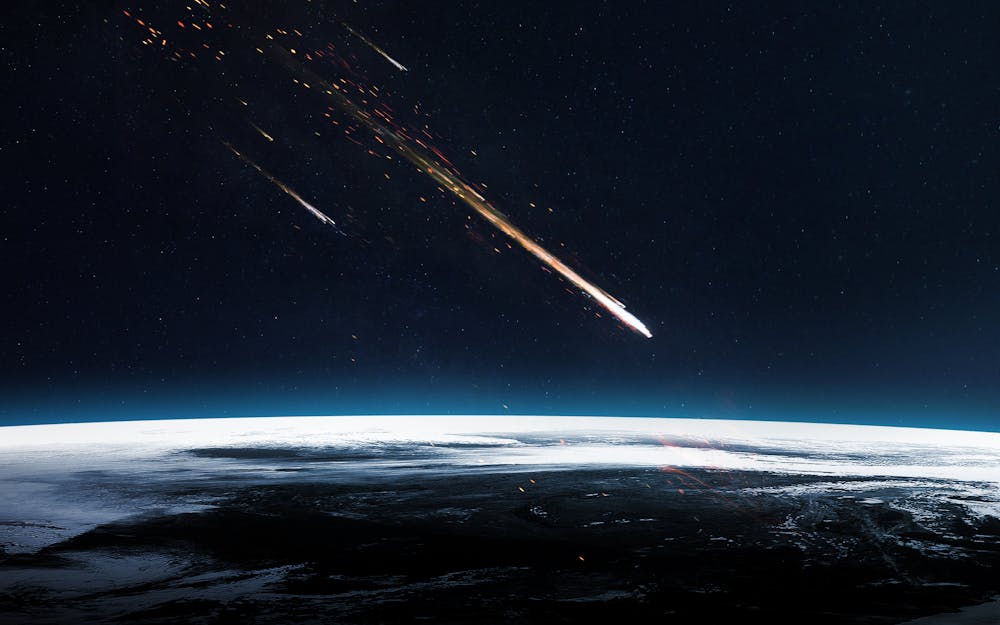
A collision from space would leave its mark on Earth. Vadim Sadovski/Shutterstock.com

What would an Earth impact leave behind?

Around the globe, scientists analyzing ocean, lake, terrestrial and ice core records have identified large peaks in particles associated with burning, such as charcoal and soot, right at the time the Younger Dryas kicked in. These would be natural results of the cataclysmic wildfires you would expect to see in the wake of Earth taking an extraterrestrial hit. As much as 10% of global forests and grasslands may have burned at this time.

Looking for more clues, researchers have pored through the widely distributed Younger Dryas Boundary stratigraphic layer. That’s a distinctive layer of sediments laid down over a given period of time by processes like large floods or movement of sediment by wind or water. If you imagine the surface of the Earth as like a cake, the Younger Dryas Boundary is the layer that was frosted onto its surface 12,800 years ago, subsequently covered by other layers over the millennia.

In the last few years, scientists have found a variety of exotic impact-related materials in the Younger Dryas Boundary layer all over the globe.

These include high-temperature iron and silica-rich tiny magnetic spheres, nanodiamonds, soot, high-temperature melt-glass, and elevated concentrations of nickel, osmium, iridium and platinum.

While many studies have provided evidence supporting the Younger Dryas impact, others have failed to replicate evidence. Some have suggested that materials such as microspherules and nanodiamonds can be formed by other processes and do not require the impact of a comet or asteroid.

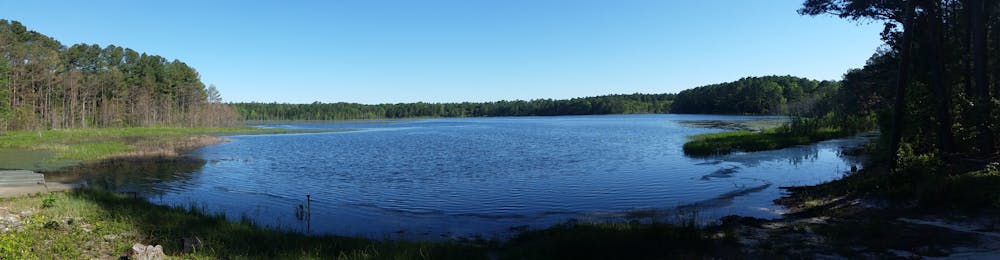
White Pond has been part of this landscape for 20,000 years or more. Christopher R. Moore, CC BY-ND

A view of 12,800 years ago from White Pond

In the southeastern United States, there are no ice cores to turn to in the quest for ancient climate data. Instead, geologists and archaeologists like me can look to natural lakes. They accumulate sediments over time, preserving layer by layer a record of past climate and environmental conditions.

White Pond is one such natural lake, situated in southern Kershaw County, South Carolina. It covers nearly 26 hectares and is generally shallow, less than 2 meters even at its deepest portions. Within the lake itself, peat and organic-rich mud and silt deposits upwards of 6-meters thick have accumulated at least since the peak of the last ice age more than 20,000 years ago.

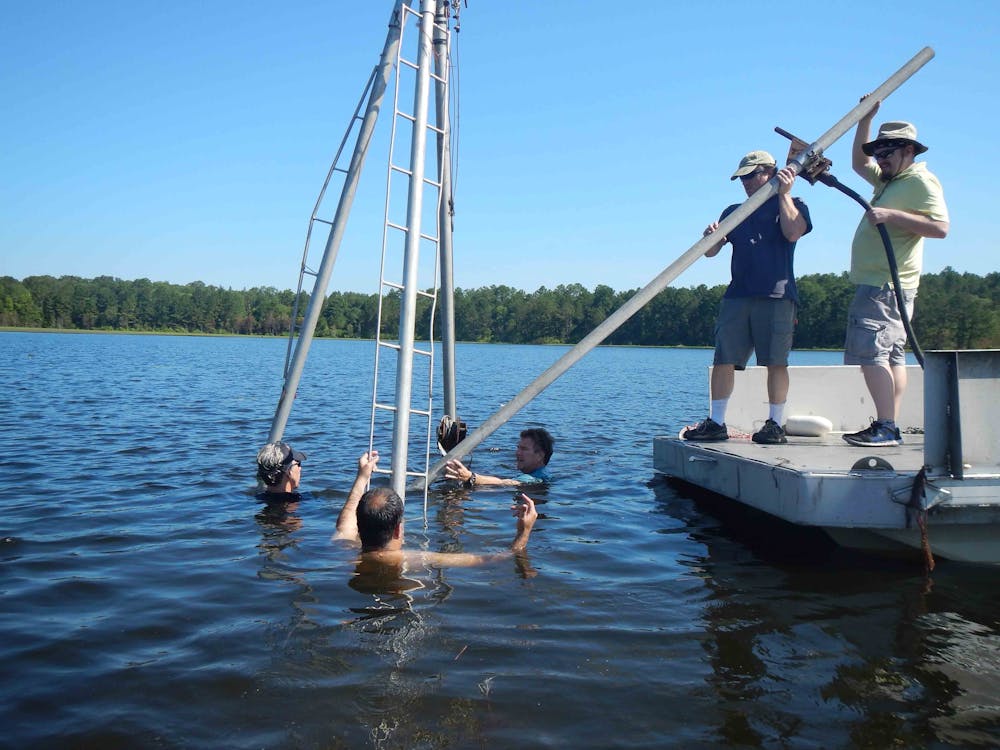
Collecting sediment cores from White Pond in 2016. Christopher R. Moore, CC BY-ND

So in 2016, my colleagues and I extracted sediment from the bottom of White Pond. Using 4-meter-long tubes, we were able to preserve the order and integrity of the many sediment layers that have accumulated over the eons.

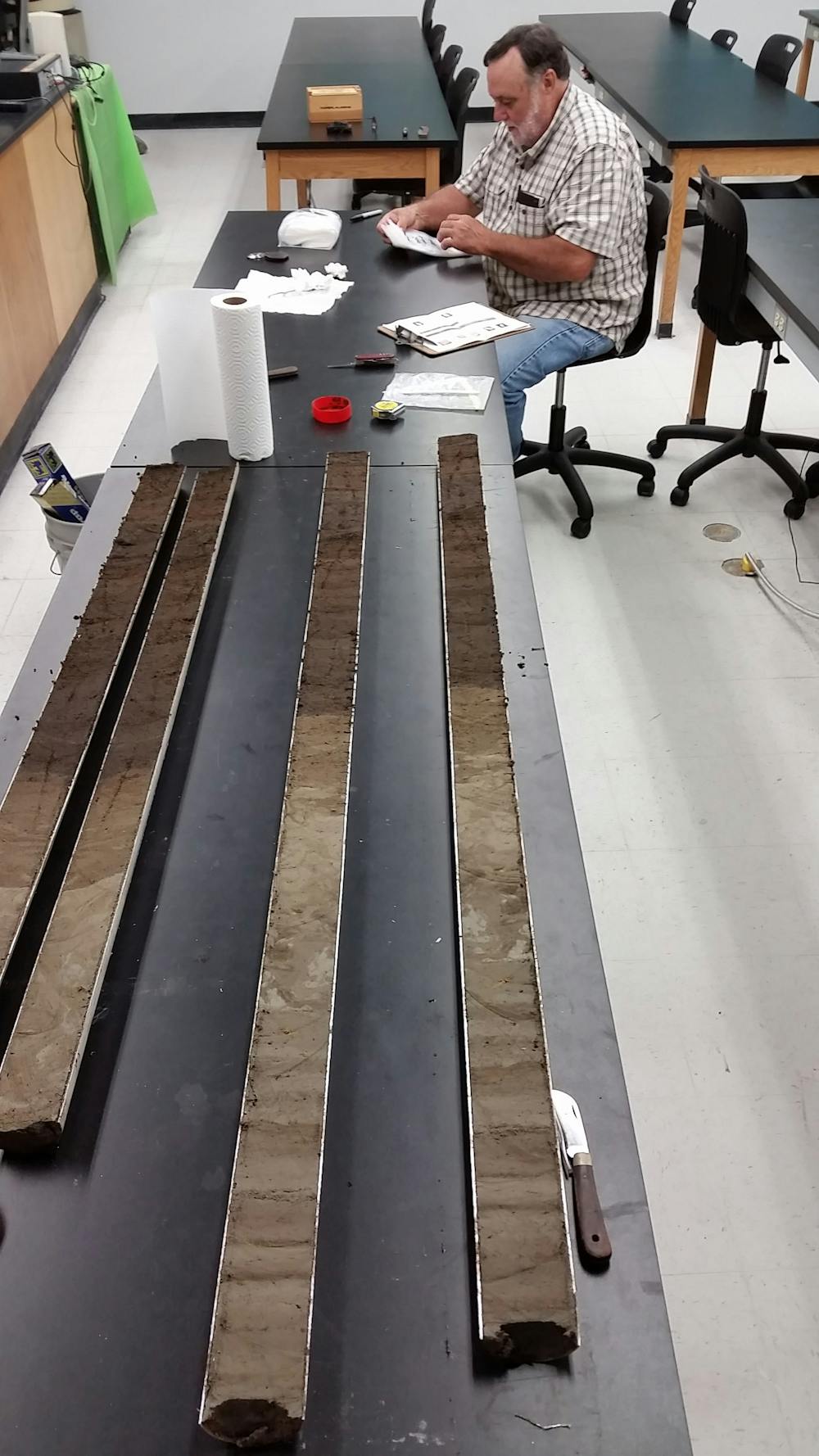
The long sediment cores are cut in half in order to extract samples for analysis. Christopher R. Moore, CC BY-ND

Based on preserved seeds and wood charcoal that we radiocarbon dated, my team determined there was about a 10-centimeter thick layer that dated to the Younger Dryas Boundary, from between 12,835 and 12,735 years ago. That is where we concentrated our hunt for evidence of an extraterrestrial impact.

We were particularly looking for platinum. This dense metal is present in the Earth’s crust only at very low concentrations but is common in comets and asteroids. Previous research had identified a large “platinum anomaly” – widespread elevated levels of platinum, consistent with a global extraterrestrial impact source in Younger Dryas layers from Greenland ice cores as well as across North and South America.

Most recently, the Younger Dryas platinum anomaly has been found in South Africa. This discovery significantly extends the geographic range of the anomaly and adds support to the idea that the Younger Dryas impact was indeed a global event.

Volcanic eruptions are another possible source of platinum, but Younger Dryas Boundary sites with elevated platinum do not have other markers of large-scale volcanism.

More evidence of an extraterrestrial impact

In the White Pond samples, we did indeed find high levels of platinum. The sediments also had an unusual ratio of platinum to palladium.

Both of these rare earth elements occur naturally in very small quantities. The fact that there was so much more platinum than palladium suggests that the extra platinum came from an outside source, such as atmospheric fallout in the aftermath of an extraterrestrial impact.

My team also found a large increase in soot, indicative of large-scale regional wildfires. Additionally, the amount of fungal spores that are usually associated with the dung of large herbivores decreased in this layer compared to previous time periods, suggesting a sudden decline in ice-age megafauna in the region at this time.

Photomicrograph of Sporormiella – fungal spores associated with the dung of megaherbivores – from White Pond. Angelina G. Perrotti, CC BY-ND

While my colleagues and I can show that the platinum and soot anomalies and fungal spore decline all happened at the same time, we cannot prove a cause.

The data from White Pond are, however, consistent with the growing body of evidence that a comet or asteroid collision caused continent-scale environmental calamity 12,800 years ago, via vast burning and a brief impact winter. The climate change associated with the Younger Dryas, megafaunal extinctions and temporary declines or shifts in early Clovis hunter-gatherer populations in North America at this time may have their origins in space.

A White Pond sediment core is like a timeline of the stratigraphic layers. What researchers found in each layer provides hints of climate and environment at that time. Shutterstock.com/Allen West/NASA/Sedwick C (2008) PLoS Biol 6(4): e99/Martin Pate/Southeast Archaeological Center, CC BY-ND

[ Insight, in your inbox each day. You can get it with The Conversation’s email newsletter. ]

Christopher R. Moore, Archaeologist and Special Projects Director at the Savannah River Archaeological Research Program and South Carolina Institute of Archaeology and Anthropology, University of South Carolina

This article is republished from The Conversation under a Creative Commons license. Read the original article.

Like this:

Like Loading…

Related

via Watts Up With That?

https://ift.tt/303ZuqT

July 28, 2020 at 12:35AM