
Weekend Unthreaded
…
0 out of 10 based on 0 rating
via JoNova
April 1, 2022 at 09:06AM
…
0 out of 10 based on 0 rating
via JoNova
April 1, 2022 at 09:06AM
UNIVERSITY OF WASHINGTON
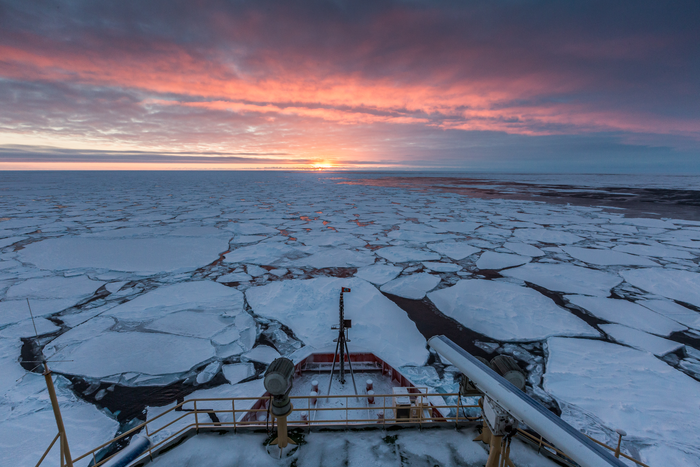
In the Southern Hemisphere, the ice cover around Antarctica gradually expands from March to October each year. During this time the total ice area increases by 6 times to become larger than Russia. The sea ice then retreats at a faster pace, most dramatically around December, when Antarctica experiences constant daylight.
New research led by the University of Washington explains why the ice retreats so quickly: Unlike other aspects of its behavior, Antarctic sea ice is just following simple rules of physics.
The study was published March 28 in Nature Geoscience.
“In spite of the puzzling longer-term trends and the large year-to-year variations in Antarctic sea ice, the seasonal cycle is really consistent, always showing this fast retreat relative to slow growth,” said lead author Lettie Roach, who conducted the study as a postdoctoral researcher at the UW and is now research scientist at NASA and Columbia University. “Given how complex our climate system is, I was surprised that the rapid seasonal retreat of Antarctic sea ice could be explained with such a simple mechanism.”
Previous studies explored whether wind patterns or warm ocean waters might be responsible for the asymmetry in Antarctica’s seasonal sea ice cycle. But the new study shows that, just like a hot summer day reaches its maximum sizzling conditions in late afternoon, an Antarctic summer hits peak melting power in midsummer, accelerating warming and sea ice loss, with slower changes in temperature and sea ice when solar input is low during the rest of the year.
The researchers investigated global climate models and found they reproduced the quicker retreat of Antarctic sea ice. They then built a simple physics-based model to show that the reason is the seasonal pattern of incoming solar radiation.
At the North Pole, Arctic ice cover has gradually decreased since the 1970s with global warming. Antarctic ice cover, however, has seesawed over recent decades. Researchers are still working to understand sea ice around the South Pole and better represent it in climate models.
“I think because we usually expect Antarctic sea ice to be puzzling, previous studies assumed that the rapid seasonal retreat of Antarctic sea ice was also unexpected — in contrast to the Arctic, where the seasons of ice advance and retreat are more similar,” Roach said. “Our results show that the seasonal cycle in Antarctic sea ice can be explained using very simple physics. In terms of the seasonal cycle, Antarctic sea ice is behaving as we should expect, and it is the Arctic seasonal cycle that is more mysterious.”
The researchers are now exploring why Arctic sea ice doesn’t follow this pattern, instead each year growing slightly faster over the Arctic Ocean than it retreats. Because Antarctica’s geography is simple, with a polar continent surrounded by ocean, this aspect of its sea ice may be more straightforward, Roach said.
“We know the Southern Ocean plays an important role in Earth’s climate. Being able to explain this key feature of Antarctic sea ice that standard textbooks have had wrong, and showing that the models are reproducing it correctly, is a step toward understanding this system and predicting future changes,” said co-author Cecilia Bitz, a UW professor of atmospheric sciences.
Other co-authors are; Edward Blanchard-Wrigglesworth, a UW research assistant professor in atmospheric sciences; Ian Eisenman at Scripps Institution of Oceanography; and Till Wagner at the University of Wisconsin-Madison. Roach is currently a research scientist with the NASA Goddard Institute for Space Studies. This work was funded by the National Science Foundation, the National Oceanic and Atmospheric Administration and the U.K.-based Scientific Committee on Antarctic Research.
###
JOURNAL
Nature Geoscience
DOI
SUBJECT OF RESEARCH
Not applicable
ARTICLE TITLE
Asymmetry in the seasonal cycle of Antarctic sea ice driven by insolation
ARTICLE PUBLICATION DATE
28-Mar-2022
HT/Zoltan
via Watts Up With That?
April 1, 2022 at 09:00AM
Analyzing two minutes of Biden doublespeak, lies, misinformation and propaganda. Biden’s April Fools Joke
via Real Climate Science
April 1, 2022 at 08:51AM

The numbers don’t add up – another problem for climate models, and for supposedly ‘well-established’ science, as one researcher describes it. Existing predictions must once again be called into question.
– – –
Virginia Tech researchers, in collaboration with Pacific Northwest National Laboratory, have discovered that key parts of the global carbon cycle used to track movement of carbon dioxide in the environment are not correct, which could significantly alter conventional carbon cycle models, says Phys.org.
The estimate of how much carbon dioxide plants pull from the atmosphere is critical to accurately monitor and predict the amount of climate-changing gasses in the atmosphere.
This finding has the potential to change predictions for climate change, though it is unclear at this juncture if the mismatch will result in more or less carbon dioxide being accounted for in the environment.
“Either the amount of carbon coming out of the atmosphere from the plants is wrong or the amount coming out of the soil is wrong,” said Meredith Steele, an assistant professor in the School of Plant and Environmental Sciences in the College of Agriculture and Life Sciences, whose Ph.D. student at the time, Jinshi Jian, led the research team. The findings are to be published Friday in Nature Communications.
“We are not challenging the well-established climate change science, but we should be able to account for all carbon in the ecosystem and currently cannot,” she said. “What we found is that the models of the ecosystem’s response to climate change need updating.”
Jian and Steele’s work focuses on carbon cycling and how plants and soil remove and return carbon dioxide in the atmosphere.
To understand how carbon affects the ecosystems on Earth, it’s important to know exactly where all the carbon is going. This process, called carbon accounting, says how much carbon is going where, how much is in each of Earth’s carbon pools of the oceans, atmosphere, land, and living things.
For decades, researchers have been trying to get an accurate accounting of where our carbon is and where it is going. Virginia Tech and Pacific Northwest National Laboratory researchers focused on the carbon dioxide that gets drawn out of the atmosphere by plants through photosynthesis.
When animals eat plants, the carbon moves into the terrestrial ecosystem. It then moves into the soil or to animals. And a large amount of carbon is also exhaled—or respirated—back into the atmosphere.
This carbon dioxide that’s coming in and going out is essential for balancing the amount of carbon in the atmosphere, which contributes to climate change and storing carbon long-term.
However, Virginia Tech researchers discovered that when using the accepted numbers for soil respiration, that number in the carbon cycling models is no longer balanced.
“Photosynthesis and respiration are the driving forces of the carbon cycle, however the total annual sum of each of these at the global scale has been elusive to measure,” said Lisa Welp, an associate professor of earth, atmospheric, and planetary sciences at Purdue University, who is familiar with the work but was not part of the research. “The authors’ attempts to reconcile these global estimates from different communities show us that they are not entirely self-consistent and there is more to learn about these fundamental processes on the planet.”
What Jian and Steele, along with the rest of the team, found is that by using the gross primary productivity of carbon dioxide’s accepted number of 120 petagrams—each petagram is a billion metric tons—the amount of carbon coming out through soil respiration should be in the neighborhood of 65 petagrams.
By analyzing multiple fluxes, the amount of carbon exchanged between Earth’s carbon pools of the oceans, atmosphere, land, and living things, the researchers discovered that the amount of carbon soil respiration coming out of the soil is about 95 petagrams. The gross primary productivity should be around 147. For scale, the difference between the currently accepted amount of 120 petagrams and this is estimate is about three times the global fossil fuel emissions each year.
According to the researchers, there are two possibilities for this. The first is that the remote sensing approach may be underestimating gross primary production. The other is the upscaling of soil respiration measurements, which could be overestimating the amount of carbon returned to the atmosphere.
Whether this misestimate is a positive or negative thing for the scientifically proven challenge of climate change is what needs to be examined next, Steele said.
The next step for the research is to determine which part of the global carbon cycling model is being under or overestimated.
Full article here.
via Tallbloke’s Talkshop
April 1, 2022 at 05:13AM
 Iowa Climate Science Education