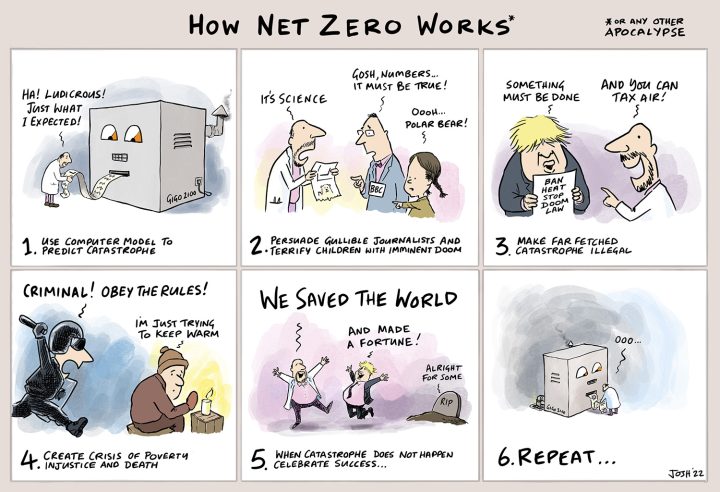
There’s nothing better than climate science with a confirmation bias attached, and a computer model predicting doom in 2100. Powered by coal of course. Our resident cartoonist, Josh, has the NetZero Science to MSM to Politics to Poverty Causality Loop down pat.
For the first time, researchers have spotted short-term, regional fluctuations in atmospheric carbon dioxide (CO2) across the globe due to emissions from human activities.
Using a combination of NASA satellites and atmospheric modeling, the scientists performed a first-of-its-kind detection of human CO2 emissions changes. The new study uses data from NASA’s Orbiting Carbon Observatory-2 (OCO-2) to measure drops in CO2 emissions during the COVID-19 pandemic from space. With daily and monthly data products now available to the public, this opens new possibilities for tracking the collective effects of human activities on CO2 concentrations in near real-time.
Previous studies investigated the effects of lockdowns early in the pandemic and found that global CO2 levels dropped slightly in 2020. However, by combining OCO-2’s high-resolution data with modeling and data analysis tools from NASA’s Goddard Earth Observing System (GEOS), the team was able to narrow down which monthly changes were due to human activity and which were due to natural causes at a regional scale. This confirms previous estimates based on economic and human activity data.
The team’s measurements showed that in the Northern Hemisphere, human-generated growth in CO2 concentrations dropped from February through May 2020 and rebounded during the summer, consistent with a global emissions decrease of 3% to 13% for the year.
The results represent a leap forward for researchers studying regional effects of climate change and tracking results of mitigation strategies, the team said. The method allows detection of changes in atmospheric CO2 just a month or two after they happen, providing fast, actionable information about how human and natural emissions are evolving.
The COVID-19-related lockdowns granted scientists an unexpected and detailed glimpse as to how human activities impact atmospheric composition. Two recent studies, one focusing on nitrogen oxide and the other examining CO2 concentrations, were able to detect the atmospheric ‘fingerprint’ of the lockdowns in unprecedented detail. Credits: NASA / Katie Jepson NASA Tracks COVID-19’s Atmospheric Fingerprint
Discerning subtle changes in Earth’s atmosphere
Carbon dioxide (CO2) is a greenhouse gas present in the atmosphere and its concentration changes due to natural processes like respiration from plants, exchange with the world’s oceans, and human activities like fossil fuel combustion and deforestation. Since the Industrial Revolution, the concentration of CO2 in the atmosphere has increased nearly 49%, passing 400 parts per million for the first time in human history in 2013.
When governments asked citizens to stay home early in the COVID-19 pandemic, fewer cars on the road meant steep drops in the amount of greenhouse gases and pollutants released into the atmosphere. But with CO2, a “steep drop” needs to be put in context, said Lesley Ott, a research meteorologist at NASA’s Global Modeling and Assimilation Office at Goddard Space Flight Center in Greenbelt, Maryland. This gas can last in the atmosphere for up to a century after it is released, which is why short-term changes could get lost in the overall global carbon cycle – a sequence of absorption and release that involves natural processes as well as human ones. The lockdowns of early 2020 are one small part of the total CO2 picture for the year.
“Early in 2020, we saw fires in Australia that released CO2, we saw more uptake from plants over India, and we saw all these different influences mixed up,” Ott said. “The challenge is to try to disentangle that and understand what all the different components were.”
Up until recently, measuring these kinds of changes wasn’t possible with satellite technology. NASA’s OCO-2 satellite has high-precision spectrometers designed to pick up even smaller fluctuations in CO2, and combined with the comprehensive GEOS Earth system model, were a perfect fit to spot the pandemic-related changes.
“OCO-2 wasn’t designed for monitoring emissions, but it is designed to see even smaller signals than what we saw with COVID,” said lead author Brad Weir, a research scientist at Goddard and Morgan State University. Weir explained that one of the OCO-2 mission research goals was to track how human emissions shifted in response to climate policies, which are expected to produce small, gradual changes in CO2. “We hoped that this measurement system would be able to detect a huge disruption like COVID.”
The team compared the measured changes in atmospheric CO2 with independent estimates of emissions changes due to lockdowns. In addition to confirming those other estimates, the agreement between emissions models and atmospheric CO2 measurements provides strong evidence that the reductions were due to human activities.
GEOS contributed important information on wind patterns and other natural weather fluctuations affecting CO2 emission and transport. “This study really is bringing everything together to attack an enormously difficult problem,” Ott said.
Taking a closer look at greenhouse gases
The team’s results showed that growth in CO2 concentrations dropped in the Northern Hemisphere from February through May 2020 (corresponding to a global emissions decrease of 3% and 13%), which agreed with computer simulations of how activity restrictions and natural influences should affect the atmosphere.
The signal wasn’t as clear in the Southern Hemisphere, thanks to another record-breaking climate anomaly: The Indian Ocean Dipole, or IOD. The IOD is a cyclical pattern of cooler-than-normal oceans in Southeast Asia and warmer-than-normal oceans in the eastern Indian Ocean (“positive” phase) or the reverse (“negative” phase). In late 2019 and early 2020, the IOD experienced an intense positive phase, yielding a plentiful harvest season in sub-Saharan Africa and contributing to the record-setting Australian fire season. Both events strongly affected the carbon cycle and made detecting the signal of COVID lockdowns difficult, the team said – but also demonstrated GEOS/OCO-2’s potential for tracking natural CO2 fluctuations in the future.
GEOS/OCO-2 data power one of the indicators in the COVID-19 Earth Observing Dashboard, a partnership between NASA, the European Space Agency, and the Japan Aerospace Exploration Agency. The dashboard compiles global data and indicators to track how lockdowns, dramatic reductions in transportation, and other COVID-related actions are affecting Earth’s ecosystems.
The GEOS-OCO-2 assimilated product is available for free download, making it accessible to researchers and students who want to investigate further.
“Scientists can go to this dashboard and say, ‘I see something interesting in the CO2 signal; what could that be?’” said Ott. “There’s all kinds of things we haven’t gotten into in these data sets, and I think it helps people explore in a new way.”
In the future, the new assimilation and analysis method could also be used to help monitor results of climate mitigation programs and policies, especially at the community or regional level, the team said.
“Having the capability to monitor how our climate is changing, knowing this technology is ready to go, is something we’re really proud of,” Ott said.
By Jessica Merzdorf Evans NASA’s Goddard Space Flight Center, Greenbelt, MD
Last Updated: Mar 31, 2022 Editor: Jessica Merzdorf
Avian Extinction Rebellion is a new wing of the environmental protest group that has been set up to oppose wind farms because of the danger they pose to birds. This is a sudden and unexpected sea change in XR’s attitude to wind power: what happened?
AXR’s founder, who goes by the nom de guerre Lavender Tuesday, tells me she saw the light on a day trip to Bempton Cliffs last July.
“This white-cis male of a certain age had one of those devices you look through to make faraway things look closer, and he let me have a go with it,” Lavender says. “He pointed out some of the birds that were there, razorbills and puffins, you know, but I only had eyes for the kittiwakes. How beautiful they were!”
The white-cis male of a certain age who was the owner of an Optolith spotting scope told the XR member to enjoy them while she could.
“They’re dying out because of Climate change,” Lavender remembers replying.
The birdwatcher smiled a sad smile and said, “In a manner of speaking.” When she asked him to explain himself, he first said, “The wind farms,” and when pressed further, he explained: “Between the ones we already have and those that are planned so far, offshore wind farms will cover 12,000 square kilometres of the sea around the UK. You won’t be able to see the big ones from here. They’ll be out there. Out of sight from most of us. But we know they will kill kittiwakes.”
In a dour commuter town on a misty day in late March where I am interviewing the spokesperson for Avian Extinction Rebellion over an oatmilk latte, the fear of kittiwakes flying into the blades of offshore wind turbines seems a very abstract one. But the fear was very real for Lavender Tuesday on that July day last year.
“I was stunned,” she tells me. “I wandered a little further along the cliff, then I just stopped walking and let the sun warm my face for a while. I could hear the cries of the seabirds all around me – they seemed to be accusing me of bearing witness to their peril but doing nothing to help them. Especially the kittiwakes. They have such a beautiful call, not like one of those gulls that steal your chips… I stood there so long I managed to pick a hole in my woolly jumper. This one kittiwake just kept staring at me with her beady eye, and from nowhere I began to cry. I was overcome by my connection with Nature, and I fell onto my knees in the dry grass and cried out to Mrs Kittiwake that I was so so sorry for being a human, so so sorry for being a part of what was destroying them.”
That was when the idea of Avian Extinction Rebellion was hatched. At the next regional XR strategy meeting, Tuesday raised the idea of opposing the expansion of offshore wind farms. She recalls playing the group a sound clip of a kittiwake’s call.
“They all just stared at me for ages. I could tell how deeply moved they were.”
The group was immediately receptive to her worries. One member came up with their new campaign slogan with his very next words: “One bird killed is one too many.”
Someone else came up with a logo on the inside of a packet of sugar-free mints a few seconds later. Asked if the result looks like a bird flying into a wind turbine and being sliced in half, Tuesday wrinkles her nose. “No. It looks like a free bird flying high in the sky, at one with Gaia.”
But AXR had another problem. Without offshore wind, how would Net Zero be achievable? Where would the people of the UK get their electricity? Coal and gas were forbidden. Onshore wind was no better than offshore wind. Solar – even with progress in the new science of neutrino-opaque materials – was all but useless. Biomass had fallen out of favour for the wholesale destruction of forests someone had finally noticed it caused. There was only one thing left.
“It was a choice between the lights going out – and one or two did argue for that – or embracing nukes,” Tuesday tells me.
Nukes! I was surprised by that, but Lavender Tuesday was deadly serious. I pointed out that environmental groups had opposed nuclear power for decades.
“That’s because they link it with nuclear weapons,” she explained. “We need to get rid of the impression that there is such a link. Civilian nuclear is perfectly safe, and the amount of energy obtainable from a tiny amount of matter is just incredible. It’s a limitless carbon-free source of power!”
AXR are planning a campaign of direct action to run alongside their parent group’s summer of disobedience. “We’re going to block lorries from taking blades and towers to these death mills. Obviously it’s a bit harder for us to block the barges from taking blades and towers to the offshore farms, but we’ve been in touch with Sea Shepherd to see if they will help with that.”
“One bird killed is one too many,” Lavender repeats her mantra again. Then she brightens. “But we won’t be miserable! We want it to be a party! There will be singing and vegan barbecues, poetry, juggling and puppet shows. We’re going to have a mass die-in of dolphins too. Did you know that the vibration of offshore turbines can confuse the navigation systems of cetaceans, leading them to beach themselves in despair? Without the support of the water, their bodies just collapse.”
I ask whether the usual XR Red Widows will be at the protests.
“Yes,” she says with a smile, “but they’ll be dressed as kittiwakes from now on.”
Something similar was also detected on Mars a few years ago. One researcher commented: “The sudden intensification of a ring current causes the main phase of a magnetic storm.” Coronal mass ejections from the sun were identified as a cause.
– – –
An international team of scientists has proved that Mercury, our solar system’s smallest planet, has geomagnetic storms similar to those on Earth, says Science Daily.
Their finding, a first, answers the question of whether other planets, including those outside our solar system, can have geomagnetic storms regardless of the size of their magnetosphere or whether they have an Earth-like ionosphere.
The research by scientists in the United States, Canada and China includes work by Hui Zhang, a space physics professor at the University of Alaska Fairbanks Geophysical Institute.
Their finding, a first, answers the question of whether other planets, including those outside our solar system, can have geomagnetic storms regardless of the size of their magnetosphere or whether they have an Earth-like ionosphere.
The research was published in two papers in February. Zhang is among the co-authors of each paper.
The first of those papers proves the planet has a ring current, a doughnut-shaped field of charged particles flowing laterally around the planet and excluding the poles. The second proves the existence of geomagnetic storms triggered by the ring current.
A geomagnetic storm is a major disturbance in a planet’s magnetosphere caused by the transfer of energy from the solar wind. Such storms in Earth’s magnetosphere produce the aurora and can disrupt radio communications.
The geomagnetic storms finding was published Feb. 18 in the journal Science China Technological Sciences. QiuGang Zong of the Institute of Space Physics and Applied Technology at Peking University and the Polar Research Institute of China is the author.
That paper built on a finding published one day earlier that verified through data observation earlier suggestions that Mercury has a ring current. Earth also has a ring current.
The ring current paper, published in Nature Communications, is authored by Jiutong Zhao, also of the Institute of Space Physics and Applied Technology at Peking University.
Seven of the 14 scientists involved worked on both papers.
“The processes are quite similar to here on Earth,’ Zhang said of Mercury’s magnetic storms. “The main differences are the size of the planet and Mercury has a weak magnetic field and virtually no atmosphere.”

 Iowa Climate Science Education