Month: April 2022

Earth’s Albedo Puzzle – A Question Of Balance

You only have to look at a globe of the Earth to realise what a lop-sided planet we live on, most of the land is in the Northern hemisphere (NH), most of the ocean in the Southern hemisphere (SH). Since we were able to make space-based measurements of the Earth’s reflectance – its albedo – that dichotomy has become a puzzle as for some reason, despite their differences, the Northern and Southern hemispheres reflect the same amount of sunlight to within observational uncertainties!

It gets curiouser. Despite the NH and SH having an overall symmetry its clear-sky and overcast components are highly asymmetric! The greater clear-sky reflection of the NH is countered by more abundant and brighter clouds in the SH. How does the Earth pull off this balancing trick, and what does it mean for climate studies?

Some have suggested that the reason is due to the land being brighter than the oceans and there is some observational evidence to support this view, namely that the NH is brighter in the near-IR reflections from land and vegetation. If this is the case then due to the slow motion of continental drift the NH should stay like this for millions of years.

Recent research suggests this is not the whole picture. There are more sunlight-reflecting aerosols in the NH and their amount has increased with industrialisation. In a new study scientists from the University of Colorado also point out that the traditional explanation for the asymmetry does not include any influence from the cryosphere.

They conclude that far from being stable over geological timescales the clear-sky asymmetry might be more changeable and would need to be a factor included in climate models as a changing clear-sky ratio would have unknown effects on global climate. If no one knows how the Earth maintains this curious balance then no one knows what will happen if it changes.

The researchers speculate that one of the Earth’s adjustment strategies cold involve changes in the Intertropical Convergence Zone which would affect precipitation globally. There could also be changes in large- scale ocean circulation that will affect heat uptake in the southern oceans which is an important component of global warming. They conclude by stating that finding out the cause of this hitherto little appreciated global balancing act and its implications under various emissions scenarios should be a priority.

Feedback: david.whitehouse@netzerowatch.com

via Net Zero Watch

https://ift.tt/4uaf2Qk

April 25, 2022 at 06:16PM

American “Climate Refugees”?

Guest “I couldn’t make this sort of schist up, if I was trying” by David Middleton

Americans are fleeing climate change — here’s where they can go
PUBLISHED THU, APR 21

Lindsey Jacobson

Millions of Americans are living in communities with precarious climate conditions, in houses that feel overpriced.

There is a solution for many of these people, though: Move to one of the so-called climate havens.

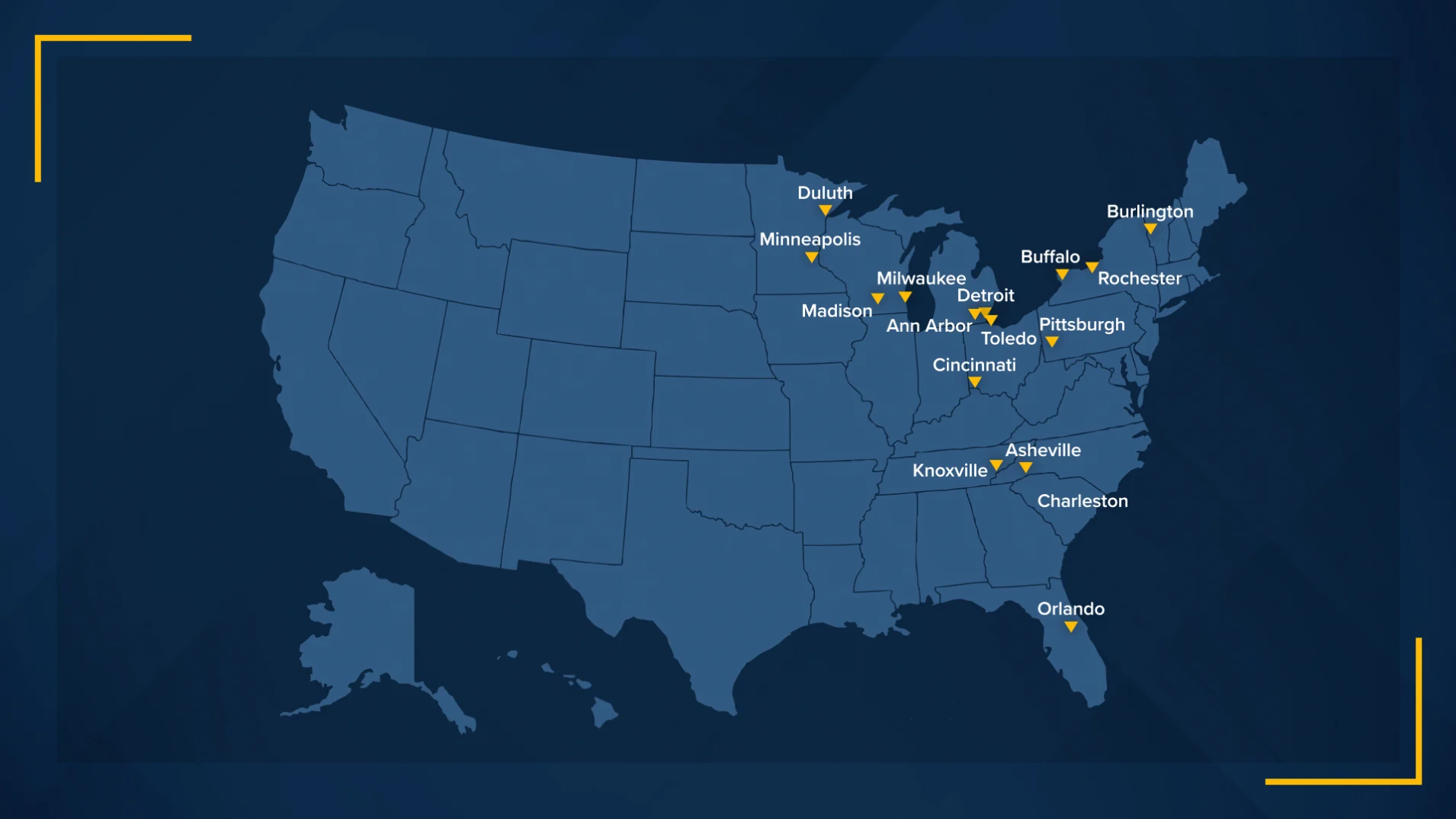
Climate havens or climate destinations are situated in places that avoid the worst effects of natural disasters and have the infrastructure to support a larger population. Many of these legacy cities are located in the Northeast.

Jesse Keenan, associate professor of real estate at Tulane University, named the following cities as possible climate havens…

[…]

Anna Marandi, who served as the program manager of climate resilience and sustainability at the National League of Cities, added two other places to the safe haven list: Ann Arbor, Michigan and perhaps surprisingly, Orlando, Florida.

Orlando makes the cut, Marandi said, because the city has introduced measures to decarbonize.

[…]

CNBC

Where do I start? Maybe with the headline:

Americans are fleeing climate change — here’s where they can go

The CNBC “journalist” has a BA in sociology, anthropology and film & media studies and seems to either think that Americans are literally fleeing climate change or she is making the standard alarmist assumption that something predicted by climate models, is already happening.

Any Americans who *are* currently fleeing climate change, probably should have known where they were going before they started to flee.

The academic geniuses, cited in the article, suggest that these places are good climate refugia:

Possible Climate Havens CNBC

One would think that the “associate professor of real estate at Tulane University” might have checked to see the actual patterns of and reasons for population migration. Maybe he could have checked with U-Haul or another major relocation company, like North American Moving Services.

According to the map above, people are “fleeing” the red states (that mostly vote blue) to refugia in the blue states (that mostly vote red). Note three quarters of the “climate haven” cities are in states that are hemorrhaging population.

So… It is clear that “Americans are fleeing” something, but it doesn’t appear to be climate change.

From what terrors are Americans fleeing? Where are they seeking refuge?

This is why they are fleeing:

1.) Desire for a lower cost of living
2.) Moving closer to family
3.) Increased work flexibility
Other important factors for moving Americans include:
4.) Looking for new job opportunities
5.) Better schools
6.) Better safety regarding the pandemic

Where Are Americans Moving in 2021?

So… Americans actually aren’t “fleeing” anything. They are seeking out “better” everything than what they currently have.

The esteemed professor of real estate and “climate resilience and sustainability” expert think Americans should be moving to cities that are decarbonizing and reducing “urban sprawl” by packing people into small areas, where they can’t have personal automobiles (AKA: Agenda 21).

Orlando makes the cut, Marandi said, because the city has introduced measures to decarbonize. While the natural environment, such as being a noncoastal city, is an advantage, cities can “earn” the designation by working to provide benefits like affordable housing and being committed to economic sustainability.

“I see climate migration as an opportunity for these cities to avoid the mistakes of urban sprawl,” Marandi said. “They often have a vibrant, walkable downtown that might just need a little bit of revitalization.”

CNBC

If climate change is a real problem, it’s a global problem. Local decarbonization measures don’t “earn” anything in the climate refugia department. While Charleston SC isn’t mentioned in the article, it appears to be on the map. It’s fracking sinking into the Atlantic Ocean. Why is it on the map as a possible climate haven? Did they “earn” climate haven status due to their junk lawsuit against “big oil”?

Real people seem to be seeking out “urban sprawl”…

Americans are moving to these states in particular for a few likely reasons:

1.) Desire for More Space – Neighbor.com found that half of those who are moving in 2021
desire more space in their new home.

With home space also being such a major factor, states with lower median housing prices such
as Arizona and Tennessee have become top destinations while California, New Jersey and New
York have far higher median home prices.

[…]

2.) Remote Work Opportunities – With no obstacles to living anywhere in the United States due to remote work, millions of Americans have taken the opportunity to live in a city where they will have more disposable income.

[…]

3.) Taxes – New York (12.7%), New Jersey (12.2%), Illinois (11.0%) and California (11.0%) all
rank among the top five states with the highest local and state tax combinations based on
research by the Tax Foundation.

Although taxes are not the only factor people consider when deciding where to live, they can
certainly be a major consideration.

Meanwhile, the states with the highest number of inbound Americans are some of the most
tax-friendly states in the US including Arizona with a 1.8% and Tennessee with no income ta
while South Carolina has a graduated income tax from 0 to 7%.

[…]

Where Are Americans Moving in 2021?

Americans appear to be moving away from Agenda 21 utopias and “climate havens.”

Conclusions

  1. Climate change didn’t make the cut on the list of reasons Americans are moving.
  2. These items weren’t cited as desirable:
    • Avoiding “urban sprawl.”
    • Local decarbonization measures.
    • Cities with “a vibrant, walkable downtown.”
    • Sustainability.
    • Cities “located in the Northeast.”

People seem to be seeking out places in the suburbs and beyond, where they can have more property, larger homes and bigger carbon footprints.

via Watts Up With That?

https://ift.tt/AMvoxaF

April 25, 2022 at 04:07PM

Elon Musk gets Twitter: A Grandmaster Chess move for Free Speech, or a high stakes bet against Monster Funds?

The deal everyone is talking about, that has just gone through:

Elon Musk taking Twitter private in $44 billion deal

Reuters

Big Tech, Twitter, Apple, Google, Microsoft, Facebook

NEW YORK, April 25 (Reuters) – Elon Musk clinched a deal to buy Twitter Inc (TWTR.N) for $44 billion cash on Monday in a transaction that will shift control of the social media platform populated by millions of users and global leaders to the world’s richest person.

It is a seminal moment for the 16-year-old company that emerged as one of the world’s most influential public squares and now faces a string of challenges.

“Free speech is the bedrock of a functioning democracy, and Twitter is the digital town square where matters vital to the future of humanity are debated,” Musk said in a statement.

Sundance explained the bind the Twitter Board might have been in:

Keep in mind that Twitter is slated to report first-quarter earnings this Thursday, and originally the board was going to wait until after that earnings announcement to respond to the bid. Something changed.

My suspicion is the financials of the Q1 earnings report will not support the $54.20 high end evaluation offer originally proposed by Musk. If the low Q1 earnings rumors are accurate; and if Twitter had declined or fought the offer; the board would have been in the position of declining a deal that was substantially higher than the company market value, a tenuous position legally. Thus, a deal was made.

Which raises the question of how Twitter makes money?

Twitter has struggled to be profitable. Will it become profitable and maintain the high shareprice, and pay off the debts Musk is taking on to buy it? Does Musk expect to make it profitable, or did he just buy it as an act of philanthropy “for free speech” or as a challenge because he damn well could.

Twitter is obviously a political tool, as the one sided censorship shows. Like all forms of media, it’s more about the power than the shareholder returns — which raises the question of why the current sellers would sell. Speaking of which, the four current largest shareholders of Twitter are the infamous Vanguard Group, Morgan Stanley, Blackrock Inc, and State Street, — the who’s who of dark asset managers. As Wikipedia describes Blackrock — it’s the biggest of the big, and with tentacles in every pot:

“BlackRock is the world’s largest asset manager, with US$10 trillion in assets. …[it] has sought to position itself as an industry leader in environmental, social and corporate governance (ESG). The company has faced criticism for worsening climate change, its close ties with the Federal Reserve System during the COVID-19 pandemic, anticompetitive behavior, and its unprecedented investments in China.

Arguably, these monster fund managers could “afford” to lose money on Twitter in order to boost profits in all their other areas. Like, for example that Blackrock owns 7% of a certain pharmaceutical company called Pfizer, and Vanguard owns 8% of the same company. If they were using (or rather abusing) Twitter to suppress any news that hurt their other investments, or elect governments that help them, that rather raises the stakes. They wouldn’t sell Twitter for the profit of selling it unless they thought they had no legal choice, or they thought they could neutralize or sabotage the Free-Speech-Twitter after the sale.

What would stop the Octopus-Funds from abusing their social media pet corporations? Corporate Law.

Arguably, the Twitter Board are accountable to the Twitter shareholders, and are supposed to be making profits for them, not for other shareholders. It’s a legal bomb that Ron De Santis, Governor of Florida has pressed the button on. As he sees it, the Pension Fund of the State of Florida owns shares of Twitter, and the way the Twitter board was behaving looks like an injury to the fund.

“We’re going to be looking at ways that the state of Florida can hold the Twitter Board accountable for breaching their fiduciary duties...”

….

It’s a very big game of chess. Has Elon Musk just outsmarted the Twitter Board and caught them at their own game, or will the same machine that used Twitter, sell it, and then sabotage it with cancel culture, and leave him holding the debt?

Because, let’s face it, the Haters are not coping well already

It won’t be impossible for Groupthinker cults to poison-the-well. Here’s one projecting his hate already for fear that Elon Musk might let people like Donald Trump back on Twitter.
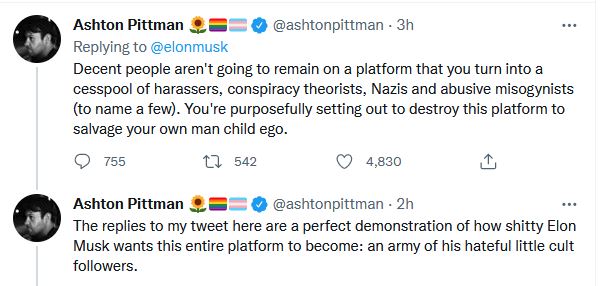
Plenty of Musk Hate on Twitter

….

Soon, supporting Twitter or being seen on it, might be a crime people lose their job for.

h/t RicDre

 

AUSTIN, TX—According to the latest reports, inflation has hit a 40-year high affecting the prices of many consumer goods. However, one consumer staple is actually at an all-time high. Speech, which as recently as earlier this year was free, is now valued at $43 billion.

“The free exchange of ideas has been under attack, causing massive inflation under the Biden presidency,” explained Joe Squawk of CNBC. “It used to be that people could argue about all kinds of things on Twitter, a bastion of free speech. Then liberals started saying a lot of dumb things, and conservatives started making fun of them. So, the liberals started crying a lot, and the people working at Twitter just started kicking the conservatives off so no one would laugh at them for being dumb.”


Musk, who has more than 83 million followers on Twitter, began amassing shares in the company in January, disclosing a 9% stake earlier this month. That position got him invited to join Twitter’s board, an offer he ultimately rejected, only to turn around on April 14 with an unsolicited bid to buy the company and take it private.

Late last week, Musk gave more details on his financing plans, saying in a securities filing that he had lined up Morgan Stanley and other lenders, which were offering $13 billion in debt financing plus another $12.5 billion in loans against his stock in Tesla, as well as pledging to contribute an additional $21 billion of his own money through equity financing. It’s unclear whether Musk, who heads Tesla and Space Exploration Technologies Corp., would consider selling part of his stake in one of his prized companies to acquire Twitter.

He has said his main motivation in buying Twitter is to ensure the principles of free speech, which he says is “essential to a functioning democracy.”

Elon has also talked about making Twitter’s algorithm open source … meaning we’d be able to see why things trend the way they do, and why exactly we’re seeing certain tweets on our timeline versus others. Essentially … more transparency on how Twitter operates internally.

The financial implications on The Wall Street Journal —

… Mr. Musk, who said of his own Twitter campaign that it “is not a way to make money” in an onstage interview at the Ted conference, on the same day of the filing describing his financial support. But more than half of that backing comes in the form of debt, from Morgan Stanley and “certain other financial institutions,” according to the filing. That means Mr. Musk will need to preserve Twitter’s cash flow—and ideally grow it—to service the debt. Some of that debt is in the form of margin loans backed by Mr. Musk’s Tesla shares.

Twitter Revenue:
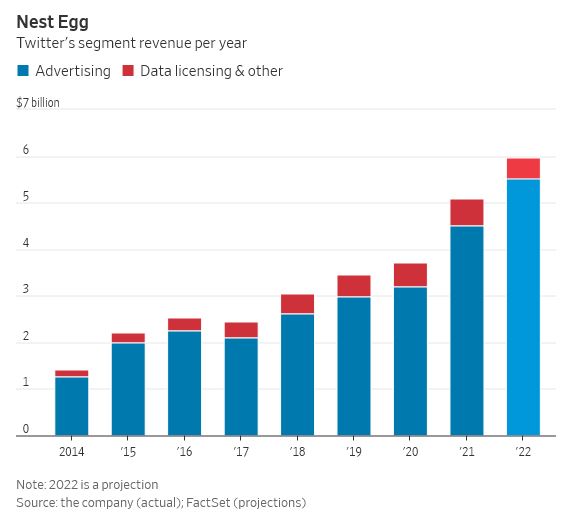
Twitter Ad Revenue

From Ronin:

Jeff Bezos buys Washington Post = good,

Elon Musk wants to buy Twitter = heaps bad. LOL

From  Catherine:

Seen on Substack:
‘Media figures everywhere are openly complaining that they dislike the Musk move because they’re terrified he will censor people less.’

“For democracy to survive, it needs more censorship”! A professional journalist who opposed free speech was not long ago considered a logical impossibility.


h/t Catherine, another Ian, Scott of the Pacific, Rick Dre. Old Ozzie, Jill.  Forrest Gardiner. David Maddison.

0 out of 10 based on 0 rating

via JoNova

https://ift.tt/h3LJHZO

April 25, 2022 at 03:16PM

Dessler Shut Down By His Chinese Funders

Climate fraudster Andrew Dessler has been shut down because his Chinese funders stopped sending him money. Texas A&M Shut Down a Major Climate Change Modeling Center in February After a ‘Default’ by Its Chinese Partner – Inside Climate News Donald … Continue reading

via Real Climate Science

https://ift.tt/7yQdi2r

April 25, 2022 at 03:12PM