Month: January 2023

Green EU: The Massive Gas Field Nobody will Touch

Essay by Eric Worrall

Fear of earthquakes is preventing Netherlands from pumping gas from a reservoir big enough to insulate Europe from the consequences of their green energy policy failure and Russian energy geopolitics.

The Massive Gas Field That Europe Can’t Use

Earthquake risks in the Netherlands have locals unwilling to plug the Russia-related energy shortfall.

By Cagan Koc and Diederik Baazil
6 October 2022 at 14:01 GMT+10

Beneath the windmill-dotted marshlands of the Netherlands lies Europe’s largest natural gas reserve. The sprawling Groningen field has enough untapped capacity to replace, as soon as this winter, much of the fuel Germany once imported from Russia.

Instead the field is in the process of shutting down, and the Netherlands is rebuffing calls to pump more, even as Europe braces for perhaps its toughest winter since World War II. The reason: Drilling has led to repeated earthquakes, and Dutch officials are loath to risk a backlash from residents by breaking promises.

…

Locals, though, say the continent needs to look elsewhere. Wilnur Hollaar, 50, who’s lived in Groningen for almost two decades, is still seething over the way officials ignored his concerns. “When I bought this house in 2004, it was a palace,” Hollaar says of his home, which was built in 1926 and features stained-glass windows and detailed stonework. But like thousands of homes in the area, it’s been damaged by quakes; it’s full of cracks and the facade is sinking. “My house has turned into a ruin,” he says.

…

European Union Internal Market Commissioner Thierry Breton said in a recent speech that the Netherlands should reconsider its decision to close Groningen, and Vijlbrief has been pressed by counterparts from other EU nations as well, but the country is holding the line for now. Prime Minister Mark Rutte won’t entirely rule out using Groningen to bolster supplies, but “only in an extreme case if everything goes wrong,” he says, and it isn’t needed right now.

…

Read more: https://www.bloomberg.com/news/articles/2022-10-06/dutch-close-europe-s-biggest-gas-field-despite-energy-crisis

The Earthquake risk in this case appears to be real. Houses in the area being extracted have suffered 1.5ft of subsidence to date, caused by the land compacting into the depleted reservoir. The gas field is that big.

Induced Earthquakes from Long-Term Gas Extraction in Groningen, the Netherlands: Statistical Analysis and Prognosis for Acceptable-Risk Regulation

Charles Vlek

Recently, growing earthquake activity in the northeastern Netherlands has aroused con- siderable concern among the 600,000 provincial inhabitants. There, at 3 km deep, the rich Groningen gas field extends over 900 km2 and still contains about 600 of the original 2,800 billion cubic meters (bcm). Particularly after 2001, earthquakes have increased in number, magnitude (M, on the logarithmic Richter scale), and damage to numerous buildings. The man-made nature of extraction-induced earthquakes challenges static notions of risk, com- plicates formal risk assessment, and questions familiar conceptions of acceptable risk. Here, a 26-year set of 294 earthquakes with M & 1.5 is statistically analyzed in relation to increasing cumulative gas extraction since 1963. Extrapolations from a fast-rising trend over 2001–2013 indicate that—under “business as usual”—around 2021 some 35 earthquakes with M & 1.5 might occur annually, including four with M & 2.5 (ten-fold stronger), and one with M & 3.5 every 2.5 years. Given this uneasy prospect, annual gas extraction has been reduced from 54 bcm in 2013 to 24 bcm in 2017. This has significantly reduced earthquake activity, so far. However, when extraction is stabilized at 24 bcm per year for 2017–2021 (or 21.6 bcm, as judi- cially established in Nov. 2017), the annual number of earthquakes would gradually increase again, with an expected all-time maximum M $ 4.5. Further safety management may best fol- low distinct stages of seismic risk generation, with moderation of gas extraction and massive (but late and slow) building reinforcement as outstanding strategies. Officially, “acceptable risk” is mainly approached by quantification of risk (e.g., of fatal building collapse) for test- ing against national safety standards, but actual (local) risk estimation remains problematic. Additionally important are societal cost–benefit analysis, equity considerations, and precau- tionary restraint. Socially and psychologically, deliberate attempts are made to improve risk communication, reduce public anxiety, and restore people’s confidence in responsible experts and policymakers.

…

The 900-km2 large Groningen gas field has been depleted from the original 2,800 bcm to less than 700 bcm by the end of 2016. This went along with a reservoir pressure reduction of originally 350 bar to less than 100 bar in 50 years’ time. Extensive gas extraction and the resulting reservoir compaction have caused almost 50 cm (1.5 ft) of soil subsidence and an increasing number of gradually more harmful earthquakes with M & 1.5 to 3.6 after 1990 and so far up to 2014.1 A critical double question for numerous Groningers and the national government in The Hague is: What seismic activity is likely to occur when substantial gas extraction would continue for the next several decades, and how would environmental safety be restored and upheld?

…

Read more: https://onlinelibrary.wiley.com/doi/pdf/10.1111/risa.12967

I’m sympathetic to the residents, but the EU is in such a desperate situation, thanks to their green energy policy failures, I suspect the Netherlands government will have no choice but to cave and allow extraction to continue.

via Watts Up With That?

https://ift.tt/qIK6QaZ

January 6, 2023 at 08:09AM

Podcast Report: The Cobalt Free Battery

There is a viral video clip going around of Joe Rogan interviewing an author named Siddharth Kara. He has a new book coming out this month called Cobalt Red. He tells Rogan about the horrific conditions in the cobalt mines in the Democratic Republic of the Congo. He says three quarters of the world’s cobalt supply comes from this region and that there is an expansion of this mining mostly driven by the rise of electric cars. In passing he mentions that all the big cobalt mines are controlled by the Chinese. There’s another shorter lesser viewed clip where they go into more detail about China. By an uncanny coincidence this country was also the scene of a major colonial period of exploitation for rubber a century ago instigated by King Leopold II of Belgium. The horrors and genocide are chronicled in Adam Hochschild’s book King Leopold’s Ghost.

In following the topic of cobalt I started running across claims that half of Teslas new cars are being made with lithium-ion batteries that contain no cobalt. I also found claims that teardowns of Tesla’s new 4680 batteries introduced on battery day contain nickel and cobalt in their cathodes just like they always have. So are there lithium-ion batteries that do not contain cobalt? The answer is an unequivocal yes and they are being used in some of Tesla’s cars. They are called lithium iron phosphate batteries and are often designated LFPs (for Lithium Ferris Phosphate). Tesla’s old batteries can be dubbed NCAs (for the Nickel Cobalt Aluminum in their cathodes). Others are dubbed NMC (Nickel Manganese Cobalt). Tesla started using LFP batteries probably about a year ago in their model 3s made in China as described in this Now You Know Clip. They are made in Tesla’s giga-factory in China by two Chinese companies. They are also being imported and installed in Model 3s made in the U.S. They have a different form from Tesla’s ribbon batteries which are rolled into cylinders. They are called prismatic and are box shaped. There is another lithium-ion form called pouch which GM uses.

This video gives a very detailed and fairly comprehensible description of the chemistry involved. It’s long, but gives very clear explanations of the advantages and disadvantages between LFPs and NCAs. I’ll list some highlights:

2-6 minutes: A description of the crystal structures of the cathodes of LFPs and NCAs with very clear graphics that show intricate details.

6 minutes: It’s shown how carbon coating and doping with magnesium greatly raise the capacity of LFP.

7 minutes: Explains the effect of LFP’s lower voltage.

8-9 minutes: LFP’s flat voltage curve is explained. This makes it hard to measure the level of charge.

10 minutes: Low particle size, carbon coating and magnesium doping made LFP viable.

11-12 minutes: Shows how LFPs crystal structure is more stable.

13-14 minutes: Describes how LFP is more fire resistant.

15-16 minutes: Shows tables of the gravimetric and volumetric differences in energy densities. The differences in the pack densities can be reduced since LFPs need less robust packing material.

17-19 minutes: Shows tables explaining how vehicles are affected.

20-22 minutes: Discusses LFP poor low temperature performance and remedies.

23-26 minutes: Discusses LFP’s potential for longer cycle life..

27-28 minutes: Discusses costs and mineral constraints.

29 minutes: Shows a summary table.

30-31 minutes: Expresses enthusiasm for LFPs.

I’m left with the impression that LFPs have a very bright future. LFPs are going to have a lower energy density of around 20% gravimetric and 30% volumetric at the pack level, but they will not be subject to nickel and cobalt bottlenecks or the stigma of cobalt mining practices. Their cathodes will certainly be cheaper. They also appear to have important fire resistance advantages. Nickel and cobalt batteries will probably still have a place in high end, high performance vehicles.

Most of my research for this posts is from various YouTube channels and I’m finding a lot of enthusiasm for LFP batteries. There also appears to be lots of plans by car makers to switch to LFPs. Here’s a video about Ford’s plan to use LFPs that also gives a good brief overview of the technology:

There’s no Moore’s Law for batteries, but there’s lots of enthusiasm and entrepreneurship that is similar to the microcomputer and internet revolutions. Lots of car companies are introducing new electric models as are motorcycle and semi truck makers. I suspect in the short run they are all headed on a collision course with a brick wall of commodities inflation. What I would like to suggest for policy makers is that making batteries is an industrial activity that requires lots of energy and materials (particularly minerals) and that they should take a hard look at where these come from. They likely have romanticized notions about free electricity coming from wind and solar with batteries smoothing out the intermittency. Industrial activity requires huge amounts of reliable energy. Lithium-ion batteries amount to expensive and limited backup for wind and solar. They would also compete for lithium and the various ions needed for EV batteries. Fracked gas would make a better industrial backup and even primary source of energy for battery factories. Trucks and mining equipment are going to need lots of diesel fuel to supply these battery factories. The decision to cancel Keystone should be reviewed. Wind and solar use lots more materials that batteries compete for than does nuclear. Nuclear is a long term, clean, carbon free energy source and that it takes a long time to build means it won’t be rapidly requiring a lot of those materials and energy that battery factories will be in the same market for. In the long run, nuclear plants provide huge amounts of constantly available electricity, which is something a lot of EVs are going to need.

As for cobalt, it is not intrinsically evil. It’s a vital mineral used for lots of things besides consumer electronics and EV batteries. The main problem is a lack of development and political chaos that’s left the Democratic Republic of the Congo vulnerable to warlords and exploitation by a totalitarian regime.

via Climate Scepticism

https://ift.tt/sl86U0B

January 6, 2023 at 06:49AM

Lord Deben Repeats Pakistan Floods Lie–BBC Fail To Challenge

By Paul Homewood

h/t frankobaysio


 image

image

https://www.bbc.co.uk/sounds/play/m001glbs

I see Lord Deben has been up to his tricks again. At about 18.30 mins into this series broadcast on Radio 4, he makes the following statement:

“Those terrible floods in Pakistan. The poor Pakistanis have not contributed at all really to climate change, but there there was a third of the nation under water”.

The claims of a third of the country originated from Pakistan’s Climate Minister at the time, as reported by the BBC here.

The claims were quickly rubbished, both by NASA and the UN agency OCHA, which suggested the true figure was about 8%:

image

https://notalotofpeopleknowthat.wordpress.com/2022/09/05/pakistan-floods-is-a-third-really-submerged/

Ironically the BBC itself admitted their earlier reports were false, after their radio programme More or Less investigated the matter here. They came to similar conclusions, with an estimate of 10%.

There was no reason therefore why Deben was not challenged in his claim that a third of the country had been under water. The fact that he is a man of authority should have made it even more important that he be challenged.

This is not the first time that Deben has been allowed to get away with outright falsehoods on a BBC programme. In 2018, during an interview with John Humphreys, he was not challenged when he made the palpably false claim that there was a ban on onshore wind farms in England. The BBC’s Executive Complaints Unit found that Deben should have been challenged to ensure listeners were not left with a materially misleading impression.

I will be filing another complaint with the BBC!

via NOT A LOT OF PEOPLE KNOW THAT

https://ift.tt/yOJKp9b

January 6, 2023 at 05:55AM

Sky’s Extreme Weather Lies

By Paul Homewood

h/t Ian Magness


Visions of apocalypse from Sky News:


image

The UK has recorded an average annual temperature of more than 10C (50F) for the first time, the Met Office has said.

The mean temperature across the 12 months of 2022 was 10.03C, beating the previous all-time high of 9.88C in 2014.

The national weather service also said 2022 was the country’s hottest on record, confirming provisional figures that the year would set a new record.

Hot temperatures throughout the year fuelled prolonged drought, threatened crops and drove hundreds of excess deaths.

Such a freakishly hot year is now likely to happen every three to four years, the Met Office warned, whereas once it would have struck just once in 500 years, had humans not polluted and warmed the climate.

Met Office Climate Attribution Scientist, Dr Nikos Christidis, said a UK average temperature of 10C "could occur almost every year" by the end of this century, if the planet warms by around 2.7C as is currently projected.….

Scores of other records were smashed all around the globe last year, which also saw Europe’s worst drought in 500 years, savage heat in India, and multibillion dollar losses from Hurricane Ian in Florida and from flooding in Pakistan.

Burning fossil fuels, intensive animal farming and slashing down forests are contributing to the rising global temperature, which in turn is driving costly, violent and extreme weather.

"Human-caused climate change explains the unprecedented nature of the summer heatwave in the UK as well as the sustained warmth seen throughout most of 2022, " said climate science professor Richard Allan from Reading University.

Higher temperatures in the UK are driving more severe heatwaves, droughts, wildfires and flooding, he said.

"And these impacts will become progressively worse until global temperatures are stabilized by cutting global carbon emissions to net zero."

https://news.sky.com/story/uk-average-annual-temperature-was-10c-or-more-for-first-time-in-2022-met-office-says-12780281


Despite the claims made by the Met Office that “a UK average temperature of 10C could occur almost every year by the end of this century”, their own data shows that warming in the UK stopped two decades ago. Average temperatures did rise by a degree during the late 80s and 90s, so we are now living with a new, higher temperature baseline. Annual temperatures may now hit 11C in CET, but this is only 0.5C higher than other years before the 1990s warm up. Hardly catastrophic! Indeed it is the relative absence of extremely cold years nowadays which is most responsible for the rise in average temperature.

https://notalotofpeopleknowthat.files.wordpress.com/2023/01/image-20.png

https://notalotofpeopleknowthat.files.wordpress.com/2023/01/image-20.png 


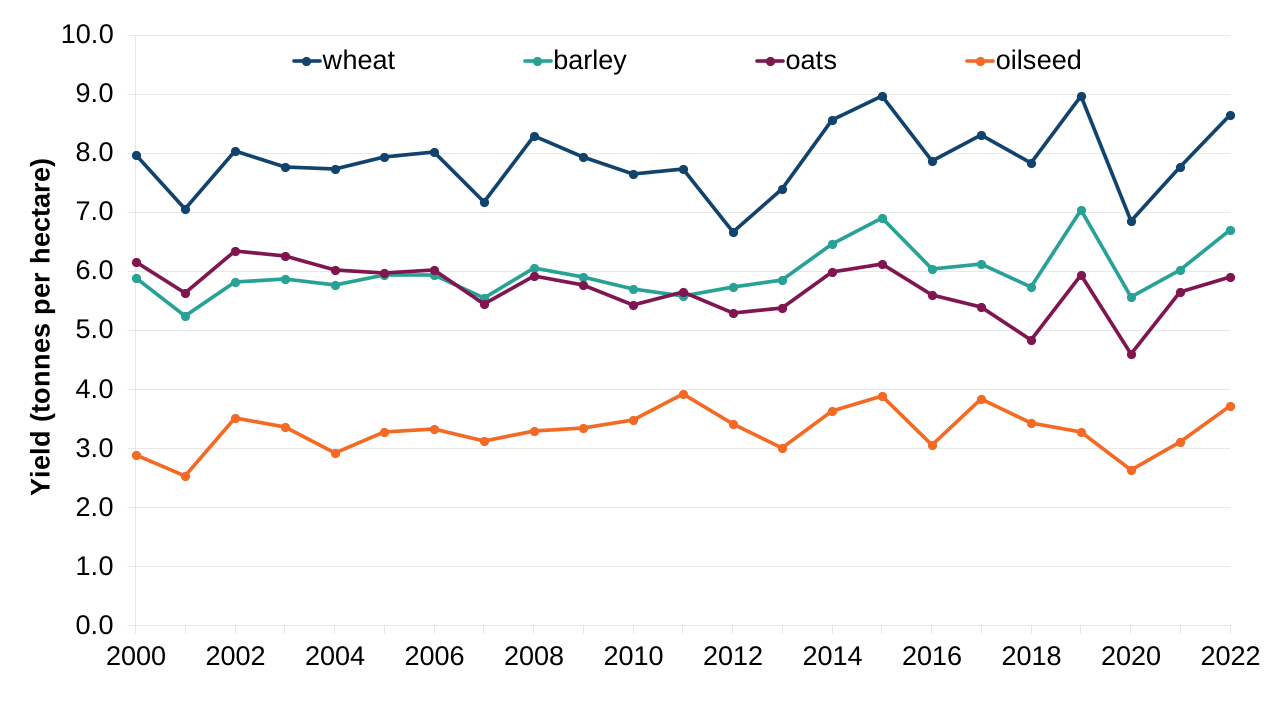
But what about these claims of extreme weather? According to Sky, “Hot temperatures throughout the year fuelled prolonged drought, threatened crops and drove hundreds of excess deaths.”

For a start, hot temperatures do not fuel drought. The reverse is true – dry, sunny weather leads to higher temperatures. As for “threatened crops”, maybe Sky should have got the actual data from DEFRA:


image

https://www.gov.uk/government/statistics/cereal-and-oilseed-rape-production/provisional-cereal-and-oilseed-production-estimates-for-england-2022


Cereal production was up by 9.4% last year, on the back of much higher yields, which were the third highest on record. Apparently wheat prefers sunny weather! Who would have guessed?

And as we already know, excess deaths could not have been driven by the hot weather, because they have been running at a high level ever since May, with no spikes at all in the summer:

https://notalotofpeopleknowthat.files.wordpress.com/2022/11/image-42.png

https://notalotofpeopleknowthat.wordpress.com/2022/11/12/jenny-harries-caught-lying-about-heatwave-deaths/


What about the claims of global extreme weather – droughts, floods, hurricanes?

Once again, Sky’s claims are contradicted by the facts.

The number of deaths from disasters, for instance, were close to record lows last year:


natural-disasters

natural-disasters(1)

https://ourworldindata.org/natural-disasters 


Hurricanes, and particularly major ones, were close to the lowest on record in 2022:


global

global(1)

http://tropical.atmos.colostate.edu/Realtime/index.php?arch&loc=global 


And although global cereal production was marginally down last year solely because of the war in Ukraine, it was still one of the highest on record, making a nonsense of Sky’s claims of catastrophic droughts:


.

https://www.fao.org/worldfoodsituation/csdb/en/


All of this rubbish begs the question of who is actually directing this torrent of Goebbels-like propaganda? It is not only the BBC and Sky who continually propagate these lies; it is pretty much the whole of the media here and in the western world as a whole.

via NOT A LOT OF PEOPLE KNOW THAT

https://ift.tt/r1KdRIs

January 6, 2023 at 05:10AM