Month: May 2023

EVs Will Increase Tyre Toxin Pollution

By Paul Homewood


h/t Paul Kolk

From The Telegraph:


 image

Drivers of electric cars are unwittingly releasing more toxic tyre particles into the air than those driving petrol vehicles, experts have warned.

Scientists, analysts and regulators are growing increasingly concerned about the amount of potentially harmful tiny particles coming off tyres, especially those from heavier cars such as electric vehicles, due to the number of toxic petrochemicals that they are made from.

This comes as the Government is attempting to reduce carbon emissions under its “net zero” drive by encoruaging drivers to use electric cars. Motorists with older petrol vehicles in London also face fresh charges to enter Sadiq Khan’s Ultra-low emission zone (Ulez), which is expanding to cover all London boroughs from August.

Ministers have also been considering a “tyre tax” to cut harmful emissions.

However, experts have warned that non-exhaust pollution will rise when more electric cars are on the road.

Professor Roy M. Harrison, at the School of Geography, Earth & Environmental Sciences at the University of Birmingham, said: “The non-exhaust emissions from road traffic in developed countries now exceed the exhaust emissions, so that is a problem. And it’s a problem that will get slightly worse as we go into a battery electric fleet and also as traffic volumes probably increase additionally.”

Modern tyres contain around 400 organic compounds, many of which are derived from crude oil. Some of these are highly toxic chemicals such as naphthalene, toluene, and isoprene, as well as heavy metals like zinc and lead.

Every time someone drives, tiny bits of their tyres break away, releasing a range of these toxic chemicals, both in larger pieces and nanoparticles. The bigger pieces will be carried off the road by rain into rivers and sewage, where they may seep into the earth or flow into the sea. The smaller particles will filter into the air and be breathed in by humans and animals, reaching deep into the lungs.

Nick Molden, chief executive at Emissions Analytics, which studies the pollution caused by tyres, said: “We’re going diametrically in the wrong direction at the moment by making our vehicles heavier.

“SUVs and electric cars are shedding an awful lot of tiny but nasty chemicals – some of which are highly carcinogenic – which we’re partly inhaling but are also getting into our water and food.”

Emissions Analytics conducted a test last year that concluded almost 2,000 times more particle pollution is produced by tyre wear than what is pumped out of the exhausts of modern cars.

“If you’re worried about burning fossil fuels in your car engine, you should be as worried about the wear from tyres”, Molden said. “Tailpipe emissions really only affect the air, whereas tyre wear affects air, soil and water.”

This is an issue for the UK and other nations as they move towards having more electric cars. The heavier a vehicle, the greater wear a tyre will face. Electric vehicles weigh an average of 200kg to 300kg more than a petrol car, due to the battery pack. They also need higher torque – the twisting power that launches a car from a standing start – than internal combustion engines, which also puts more pressure on the tyres.

The tyre manufacturer Michelin said conventional tyres wear out around 20pc faster in an electric vehicle, while Goodyear said they can wear out as much as 50pc faster.

In February, researchers at Imperial College London called for more research into the potentially harmful impact of toxic tyre particles on health and the environment. It said six million tonnes of tyre wear particles are released globally each year, and in London alone, 2.6 million vehicles emit around nine thousand tonnes of tyre wear particles annually.

The weight of electric vehicles is already causing concern from some engineers that they will put some multi-storey car parks built in the 1960s and 70s under such pressure they will be at the risk of collapse, The Telegraph reported in April. Government ministers have also urged councils to check how much weight bridges in their area can hold.

This may become even more of an issue in the future as electric cars are set to carry more weight. Rather than battery packs getting lighter as technology advances, electric car manufacturers like Tesla are actually opting for heavier iron-based batteries that do not use the expensive, scarce materials of nickel and cobalt.

https://www.telegraph.co.uk/money/consumer-affairs/heavy-electric-cars-toxic-tyre-particles-petrol-vehicles/

I’m sure a tyre tax will solve the problem!!

We have known about the greater tyre wear on EVs for years, with its implications for particulate matter pollution. But the issue of toxic chemicals is now an added problem.

Interestingly, Michelin comment that tyre wear could be 20% higher. Tyre replacement for my car is the biggest maintenance cost for me, so along with extra brake pad wear the claim that EVs are cheaper to maintain sounds like hogwash.

via NOT A LOT OF PEOPLE KNOW THAT

https://ift.tt/DM0ao5N

May 27, 2023 at 01:28AM

More Carbon Credit Fraud Uncovered: CEO of Verra Resigns

CEO of biggest carbon credit certifier to resign after claims offsets worthless

The Guardian did a joint investigation and helped uncover large amounts of malfeasance.

It comes amid concerns that Verra, a Washington-based nonprofit, approved tens of millions of worthless offsets that are used by major companies for climate and biodiversity commitments, according to a joint Guardian investigation earlier this year.

https://www.theguardian.com/environment/2023/may/23/ceo-of-worlds-biggest-carbon-credit-provider-says-he-is-resigning?CMP=share_btn_tw

The announcement follows a difficult period for Verra, which has seen the environmental integrity of their carbon standard satirised by the comedian John Oliver and journalistic exposés about the integrity of their carbon credit certification process.

In January, a nine-month investigation by the Guardian, the German weekly Die Zeit and the investigative group SourceMaterial found Verra rainforest credits used by Disney, Shell, Gucci and other big corporations were largely worthless, often based on stopping the destruction of rainforests that were not threatened, according to independent studies. It also found evidence of forced evictions at a flagship scheme co-operated by Conservation International in Peru.

https://www.theguardian.com/environment/2023/may/23/ceo-of-worlds-biggest-carbon-credit-provider-says-he-is-resigning?CMP=share_btn_tw

Scientists have called for the unregulated system to be urgently reformed to finance climate mitigation and forest conservation despite current concerns about integrity.

https://www.theguardian.com/environment/2023/may/23/ceo-of-worlds-biggest-carbon-credit-provider-says-he-is-resigning?CMP=share_btn_tw

Good for the Guardian. You can read the story in its entirety here.

via Watts Up With That?

https://ift.tt/jVSxNGD

May 27, 2023 at 12:22AM

Saturday

0 out of 10 based on 0 rating

via JoNova

https://ift.tt/zC7eHKp

May 26, 2023 at 10:47PM

The Holocene CO2 Dilemma

Guest Post By Renee Hannon

This post evaluates the relationship of global CO2 with regional temperature trends during the Holocene interglacial period. Ice core records show that CO2 is strongly coupled with local Antarctic temperature and slightly lags temperature over the past 800,000 years (Luthi, 2008). Whereas the emphasis has been on CO2 and temperature lags/leads, this study focuses on Holocene millennium trends in different latitude-bounded regions.

The Contrarian Antarctic

The Holocene is fortunate to have hundreds of proxy records analyzed by Marcott, 2013, and more recently Kaufman, 2020, to establish regional and global temperature trends. The Holocene interglacial occurs approximately during the past 11,000 years. In general, global temperature trends from proxy data show a Holocene Climatic Optimum (HCO) around 6000 to 8000 years ago and a subsequent cooling trend, the Neoglacial period, culminating in the Little Ice Age (LIA). The global mean temperature is comprised of regional trends that tend to have a concave down appearance during the Holocene shown in Figure 1a.

The exception is the Antarctic shown in red which has a concave up shape. The Antarctic reached an early Holocene Climatic Optimum between 9000 to 11000 years ago. While global and most regional temperatures were warming, Antarctic cooled to a minimum around 8000 years ago. While global and other regions show progressive cooling during the Neoglacial, the Antarctic was flat and erratic. This contrary Antarctic temperature behavior during the Holocene has also been noted by Andy May here.

Figure 1: a) Regional temperature anomalies (defined by latitude) from proxy data over the Holocene after Kaufman, 2020a. Red line is Antarctic. Black solid line is the global median. b) Ice core proxy data from Vinther Greenland temperature anomalies in green and Dome C Antarctic in red. Global temperature means from Kaufman and Marcott are included. CO2 shown as dark grey dots from Bereiter are included on both graphs. Left axis is temperature anomaly (deg C) and right axis is CO2 (ppm).

Greenland and Antarctic ice core temperature anomalies derived from deuterium and/or oxygen isotopes and global proxy temperature means are shown in Figure 1b. Ice cores have high resolution over long periods of time making them a key proxy dataset. These data show similar trends to the regional compilation. However, temperature ranges tend to be larger at individual proxy sites. Smoothing of paleoclimate proxy data occurs due to averaging of multiple data types together which removes local temperature variability (Kaufman, 2023).

It’s not surprising that Antarctic temperature trends behave differently due to its unique environment. Antarctica is a continent surrounded by the Southern Ocean with a mean annual temperature of the interior between -50 to -60 deg C. Most of Antarctica is covered by a permanent ice sheet averaging 2 km in thickness. Sparse proxy data from Antarctica is predominantly from ice cores and a few marine sediments. These data comprise temperature trends in the 90oS-60oS latitude region which represent less than 10% of Earth’s surface area.

CO2 is Uniquely Synchronous with Antarctic Temperatures

CO2 gas trapped in ice bubbles show synchronous trends with local Antarctic temperature anomalies during glacial and interglacial periods over the past 800,000 years. CO2 ranges from lows of 180 ppm during glacial periods to highs of near 300 ppm during interglacial periods. Figure 2a shows the linear regression of CO2 and temperature from the EPICA Dome C ice core over the past 60,000 years that includes the Holocene interglacial and last glacial maximum. The squared regression (R2) of 0.9 is very impressive. One interesting curiosity is the Holocene interglacial period where the slope tends to flatten out and R2 decreases substantially to 0.3.

Despite the lower correlation factor for the Holocene interglacial, Figure 1a above shows that CO2 displays concave up trends like Antarctic temperature trends. CO2 reaches an early Holocene high near 275 ppm around 11,000 years ago after deglaciation. CO2 then slowly decreases by 10-15 ppm to a Holocene minimum of 260 ppm about 8000 years ago. And then, CO2 gradually increases up to 290 ppm during the Neoglacial cooling period. To note, these CO2 values are muted or smoothed due to gas trapping processes in ice and do not reflect instrumental values (Joos, 2008).

Figure 2. a) Ice core EPICA Dome C correlation of temperature anomalies with CO2 over the past 60,000 years in grey. The Holocene interglacial period is highlighted in red. b) Correlation of temperature anomalies from Antarctic proxy data 90oS-60oS with CO2. c) Correlation of temperature anomalies from Arctic 60oN-90oN and NH 30oN-60oN proxy data with CO2. d) Correlation of temperature anomalies from tropical proxy data 30oS-30oN with CO2. CO2 data from Bereiter, 2014. High resolution proxy data from Kaufman, 2020b.

Correlation plots of Holocene CO2 versus temperature anomalies from high resolution regional proxy temperatures are shown in Figures 2b-d. They are much different than the 60,000-year Antarctic CO2 relationship in Figure 2a. The Arctic and the Northern Hemisphere regions (2c) show an inverse relationship with CO2, especially during the Neoglacial period. The tropical region (2d) shows large scatter with no statistically valid trend detected. The Southern Hemisphere, not shown, also has a low correlation with CO2. No other multi-proxy region or latitude temperature trends show a strong positive correlation with CO2 during the Holocene like the Antarctic does.

Authors have noted that CO2 has a different trend compared to global and Northern Hemisphere temperature trends. Vinos, 2022, concludes that CO2 runs opposite to global temperature trends for most of the Holocene. This CO2 asynchronous behavior and/or lack of correlation to temperature seems to be true for most regions, roughly 90% of the Earth’s surface area.

Climate Models Dominated by CO2 Forcing

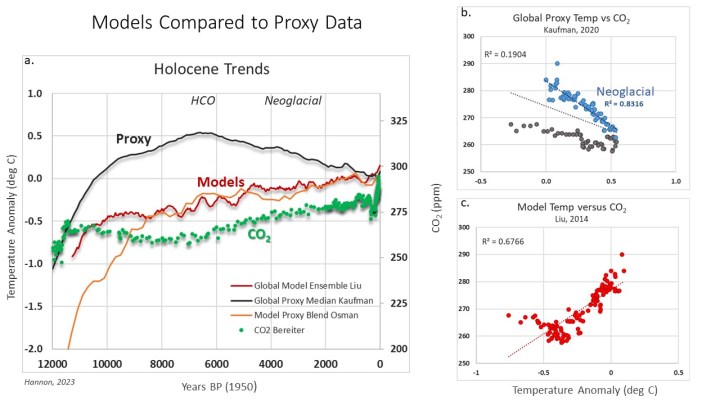
Climate models fail to match global Holocene proxy temperatures known as the Holocene temperature conundrum (Liu, 2014). Models basically show a gradual increase in temperatures throughout the entire Holocene as shown in Figure 3a. While temperature proxy data shows a Holocene Climatic Optimum of 0.5 deg C around 6000-8000 years ago that climate models simply do not reproduce.

Figure 3.  a) Global proxy median temperature anomalies from Kaufman compared to modeled annual ensemble mean (3 models) from Liu and a model that incorporates proxy data from Osman. CO2 is shown as green dots from Bereiter. b) CO2 correlated with the global proxy median from Kaufman, and c) CO2 correlated with modeled annual ensemble mean from Liu.

Holocene global proxy temperature trends show an inverse correlation with CO2 as plotted in Figure 3b. There are two distinct inverse trends separated by the HCO. During the Neoglacial period, proxy temperatures and CO2 show a strong negative correlation with an R2 of 0.8. Basically, as CO2 increases then global temperatures become cooler.

Temperatures from model simulations are typically controlled by changes in greenhouse gases, insolation, ice sheets, and freshwater fluxes, to name a few. Modeled temperature profiles parallel the global CO2 trend with a strong R2 of 0.7 confirming CO2 is a major model control knob. Additionally, modeled Holocene temperatures tend to resemble the contrarian Antarctic temperature trends (compare Figures 1a and 3a).

Scientists have begun to investigate the effect and possible dominance of forcings other than CO2. Zhang, 2022, modeled the effect of seasonal insolation influence and found better matches to proxy data when combining insolation with ice sheet forcing, although still not perfect. Thompson, 2022, showed that more vegetation influence in the Northern Hemisphere helps models simulate a Holocene Climatic Optimum evident in proxy data. The close relationship between CO2 and Antarctic temperature suggests that millennial variations are strongly influenced by Southern Ocean processes. Only when past forcings and the timing of their dominance are more accurately incorporated into climate simulations will models be able to predict future climate change.

Observations

Climate change is routinely claimed to be largely controlled by greenhouse gases, especially CO2. This was concluded, in part, by the strong relationship between CO2 from Antarctic ice core bubbles and local Antarctic temperature trends. While CO2 mimics Antarctic temperatures very well, ninety percent of Earth’s surface temperature trends do not demonstrate a positive correlation to CO2 during the Holocene. Arctic and Northern Hemisphere temperatures become cooler during increasing CO2 levels. Tropical proxy temperatures don’t seem to be influenced by CO2.

Model simulated temperatures which are strongly influenced by CO2 do not accurately history match Holocene global proxy temperatures and tend to largely reflect Antarctic trends. The fact that CO2 correlates well to Holocene temperatures for only the Antarctic, or <10% of our planet’s surface, yet CO2 is considered as the dominant influence on climate change is a scientific dilemma.

Download the bibliography here.

via Watts Up With That?

https://ift.tt/pztjonv

May 26, 2023 at 08:51PM