Month: September 2023

Zero CO2 is a Suicide Pact (Dr. Happer)

Biznews published excerpts from an interview with Dr. William Happer Sign  Elimination of CO2 is a suicide pact.  Text below in italiics with my bolds and added images.

Overview

It’s safe to assume no one consciously sets out to challenge a narrative as deeply entrenched and emotionally charged as climate change. Dr William Happer, an American physicist and Professor Emeritus in the Department of Physics at Princeton University, certainly didn’t. It was only in 1991, upon Happer’s appointment by President George W Bush as director of Energy Research in the US Department of Energy, that his interaction with climate change authorities – and their refusal to engage in customary scientific debate on climate change – piqued his interest.

Thereafter, Happer was dismissed for his contrarian views and ‘head butting’ with climate change luminary Al Gore, only to be brought back to Washington by former president Donald Trump in 2018. BizNews spoke to Happer about his prodigious career and discovery that the burgeoning climate change hysteria had no scientific basis. Happer meticulously detailed why and how CO2, the “demon gas”, is not a pollutant but is essential to mankind’s prosperity.

Professor William Happer on the effect of carbon dioxide on planet Earth

Carbon dioxide is what drives life on Earth. The growth of plants depends on carbon dioxide. The carbon dioxide in the air diffuses into the leaves of plants through little holes, and the plants combine this with water and it requires energy. This energy comes from sunlight. So, the combination of carbon dioxide, the so-called pollutant, water and sunlight is what makes life. You know, that’s what we live on. And carbon dioxide at the present time is much lower [in] concentration than has prevailed over most of geological history. [During] most of geological history, it’s pretty clear from proxy records, CO2 levels have been two or three times greater than they are now.

We probably don’t have enough fossil fuels around to restore those levels
where plants evolve and where they function best.

But even the relatively small increases we’ve had – from maybe 280, 300 parts per million 200 years ago to a little over 400 today – that’s not a big increase. It’s 35%, maybe. But it has caused greening all around the Earth. You can see that from satellites looking down over the last two or three decades. Earth is getting greener. Especially arid regions are getting greener. You know, the edges of the great deserts of the Earth are shrinking. They’re not growing, they are shrinking.

They’re shrinking because of more CO2. And the reason is that there are a number of benefits from more CO2, but one of the most important ones is that if there’s more CO2, plants can live with less water. They don’t waste as much water with more CO2 in the air, because they grow leaves with fewer holes in them so they don’t leak as much water. And the little holes, the stomata – the little mouths, that’s what it means and it’s where the CO2 comes in – don’t open as wide. So, the problem with sucking CO2 out of the air, which is what plants have to do, is for every CO2 molecule that diffuses into your leaf, you lose a hundred water molecules diffusing the other way. This is a real dilemma for the planet.

It’s true. CO2 is a greenhouse gas and it warms the Earth,
but the warming isn’t enough to matter.

It’s very small. And so, it’s probably beneficial on balance. If you double CO2, it seems like a lot, that’s a 100% increase of CO2. How much does that affect the cooling radiation that goes off to space? That sounds like a lot, but in effect it only decreases the radiation to space by 1%. So, 100% increase of CO2, 1% decrease in radiation to space. It’s a very small effect, and you don’t have to change the Earth’s temperature very much or cloudiness very much to bring it back into equilibrium with the situation before you increase the CO2.

So, it’s an ineffective climate influencer. Yet you get this demon gas that is going to cause us all to boil to death or something like that. Nothing could be further from the truth. It’s a trivial gas, but it’s very, very good for life on Earth. More CO2 has been wonderful for mankind because it helps provide the abundance of food we have today and it’s caused no harm, whatever.

On climate change activism having become like a religious cult

It is a religious cult for many people. Many people have stopped believing in traditional religions, you know? So, they don’t believe in God, but they need something beyond themselves to believe in. What could be more noble than saving the planet? “The planet is threatened by the demon gas CO2, so we’re going to save it.” The fact that it means essentially suicide for the human race doesn’t get into their brains. But that is what it means.

You cannot immediately eliminate CO2 and let the human population survive.
It can’t be done. So, it’s a suicide pact, you know, what is being proposed.

The movement is a joke – a little bit – but it’s not so different from a coalition of organised crime and religious fanaticism. And the religious fanatics … You know, you don’t argue with someone about their religion. This is not a joking matter. It brings crusades and religious wars and God knows what. So, that’s a big problem. There is this religious aspect; so many people now have been brainwashed into thinking there really is an emergency. And anyone who stands in the way of saving the planet is Satan incarnate. They are sincere people but they’re just badly misled.

Many of the most vociferous climate emergency folks; if you press them, they say, “Yes, the real problem is not fossil fuels, it’s human beings. You know, there are just too many people. We should not have more than a billion people.” We’re roughly eight billion now, so that means seven out of eight of us should disappear from the planet. This is extremely dangerous. It’s an evil cult.

On what has been lost owing to climate hysteria

The alarmist community recognised 20 years ago that the warming is a lot less than their models had predicted. “Just you wait,” they’d say, “Sooner or later it will warm. But in the meantime, we need something else to keep the alarm going.” And they seized on extreme weather and rising sea levels and ocean acidification… Things that really were not warming. And they changed the name from global warming to climate change because warming wasn’t going to cut it. There wasn’t enough warming.

Earth has an unstable climate which isn’t very well understood to this day, and it would be wonderful if we understood it better. But I think our ability to understand it has been set back very badly by the climate hysteria. So, what could’ve been 20, 30 years of good, basic research and real understanding of the climate has been wasted with hysteria about this false climate emergency, which does not exist. In the meantime, the real parts of the climate – which would be good to understand – have been ignored.


via Science Matters

https://ift.tt/eDLqfAH

September 27, 2023 at 10:32AM

Japanese Bears

I posted a comment on Open Mic yesterday, based on an article in the Guardian with the heading “Brown bear cubs in Japan die of starvation amid salmon shortage” and sub-heading “Experts blame rising sea temperatures caused by climate crisis for cub deaths at Unesco heritage site”. The Guardian is not alone in reporting on the story in this way. Sky News has a very similar article with a very similar title: “Brown bear cubs starving to death in Japan due to salmon shortage” and a very similar sub-title: “As many as eight in ten brown bears cubs born this year in Japan’s Shiretoko area have died, with experts blaming rising sea temperatures for dwindling salmon numbers.”

The suspiciously similar titles, sub-titles (and narratives) might suggest that once more news pieces are being generated by press releases, and regurgitated by journalists who are all too happy to play this game, especially if they support the “climate crisis” narrative. Nevertheless, to the credulous, it might look like “case closed”, with climate change obviously being the culprit. For instance, the Guardian tells us:

Pink salmon that hatch in rivers in Hokkaido spend the winter in the sea, before returning to streams in Shiretoko between August and October to lay eggs. Brown bears typically lie in wait for the salmon as they make their way upstream, but have been forced to swim in the sea because of the shortage of river fish….

…Experts said sea surface temperatures off Hokkaido remained above 20C from mid-July to early August 2021, 5C higher than average for that time of the year…

…Fishers caught 482,775 pink salmon in rivers in Hokkaido, Japan’s northernmost main island, between 25 July and 5 September in 2020, but only 23,298 last year, according to the Hokkaido Salmon Propagation Association. Given statistical evidence showing that good catches occur every other year, the 2022 haul was surprisingly small.

Bang to rights then – a devastatingly small salmon harvest in 2022 compared to previous years. Except that it’s possible the reason so few salmon made it into Hokkaido’s rivers in 2022 is because so many were caught at sea before they could get there.

According to the Tradex Foods website reporting on 21st November 2022 on the 2022 salmon harvest:

Japan is set to see the largest harvest of Hokkaido Chum Salmon since 2016 – however the country is still in need of more Salmon.

Preliminary catch totals as of November show 166 million pounds harvested – already surpassing 2016’s total.

This year’s harvest equates to about 57 million pounds more Chum Salmon than the past 5-year average.

And although Hokkaido Chum Salmon is mostly consumed domestically, our sources have advised Japan is still trying to source more Salmon.

Japan typically buys a lot of their Salmon requirements from Russia, however due to war imposed sanctions and Russia’s container shortages – imports of Russian Salmon into Japan have been strained this year.

Imports of Russian Sockeye into Japan for 2020 and 2021 were upwards of 40 million pounds annually, however preliminary data shows Russian Sockeye imports into Japan this year are hovering around only 15 million pounds.

Japan’s sanctions against Russia mean that Japan’s previously substantial salmon purchases from Russia had declined by over 60%, and so Japan is fishing more salmon (at sea) than for many a long year. Politicians and “green” campaigners are quick to blame the Russian invasion of Ukraine for many domestic woes, including high energy prices, but I’ve never heard anyone blame it for the problems encountered by Russia’s starving bears. And yet it just might be part of the explanation. Who knows?

Other articles are available. Teller Report informs us that not only Hokkaido autumn salmon but also sea urchins were dying in large numbers in 2021. This was blamed on the “largest ever” “red tide” in Hokkaido. This is a large plankton swarm that is not normally found in the area. Some speculation is to the effect that this is due to warming ocean temperatures as Karenia Mikimotoi plankton moved north (so climate change again), but that claim sits more than a little uneasily with another suggestion that the red tide also consists of Karenia Brevis plankton, which has moved south from colder seas to the north (in which case, presumably, not climate change).

Conclusion

Whatever the cause of declining river salmon in Hokkaido, the explanations seem to be complex and multi-faceted, and the simple blaming of climate change is perhaps just too convenient. By the way, the bears are hungry, not just because of a shortage of salmon, but also because a shortage of acorns, another of their staple foods. Acorn shortages seem to be a regular problem, unfortunately, but not because of warm weather – quite the contrary. An online article which appears to date back to 2010, when another acorn shortage led (as now) to hungry bears wandering into areas of human habitation with unfortunate bear/human consequences tells us that in that case oak trees didn’t grow enough buds due to unusually low temperatures in spring, though admittedly a hot summer also exacerbated the situation. None of the articles I have looked at in connection with Hokkaido’s currently hungry bears bother to discuss why there is an acorn shortage. I don’t know the answer, but perhaps last year was a mast year? As the Tree Council website tells us:

A mast year occurs roughly once every 5-10 years, and is where a tree species such as oak drastically increase the number of acorns they produce. The oak trees put so much energy into this bumper crop of acorns that they leave themselves little energy to continue producing the following years. So, since last year was a mast year, this year our beloved oaks are recovering resulting in far fewer acorns for wildlife and nature-lovers to enjoy.

Why do oak trees do this?

We do not know for sure why oak trees do this. But one theory is that there is an evolutionary advantage to producing an unreliable number of acorns each year. If it were too reliable, the theory goes, surrounding wildlife populations like that of squirrels, deer and birds would adjust and learn to eat the entire yearly crop. Mast years stop this from happening. In these years, oak trees flood the ecosystem and produce too many acorns for local wildlife to consume, meaning more will have the chance to grow into saplings come spring. And in the several years that follow a mast year where we see far fewer acorns, like this one, the cut to the food supply helps to control these wildlife populations so that there are fewer animals to gobble up acorns when the mast year comes back around.

If that is the explanation in Hokkaido, then again it’s nothing to do with climate change, but it’s unfortunate for the bears that a dearth year following an acorn mast year might have occurred at the same time as Japanese humans have eaten many of the salmon that would otherwise have been destined for Hokkaido’s rivers and for its bears, due to a war in Europe. Or maybe a butterfly beat its wings somewhere….

Footnote

Three years ago the Guardian reported on another Japanese acorn shortage leading to bears attacking humans. Again there seemed to be a lack of curiosity as to the reason for the shortage, but then we were told:

There is less to eat in the mountains and that is why they are coming down into villages…”

Rural depopulation and the resulting abandonment of farmland is also a factor, as it has blurred the once-distinct borders between forests and villages.

Conservationists have warned that encounters between bears and humans – a traumatic experience for both parties – will continue unless more is done to ensure an adequate supply of acorns and other foods to sustain them in the summer and early autumn.

The rise in the number of attacks in recent years has left officials struggling to strike a balance between protecting Japan’s dwindling bear population and keeping the public safe. Possible solutions include establishing safe feeding spaces to prevent bears from venturing into populated areas or leaving supplies of acorns on higher ground.

Whatever the reason for the problem, nobody was then blaming climate change. Nor were they doing so in 1915 when there were serious problems with marauding bears during a series of incidents so dramatic that they even have their own Wikipedia page.

via Climate Scepticism

https://ift.tt/0V7rNKe

September 27, 2023 at 09:03AM

Arctic Ice Refuses To Melt Away

By Paul Homewood

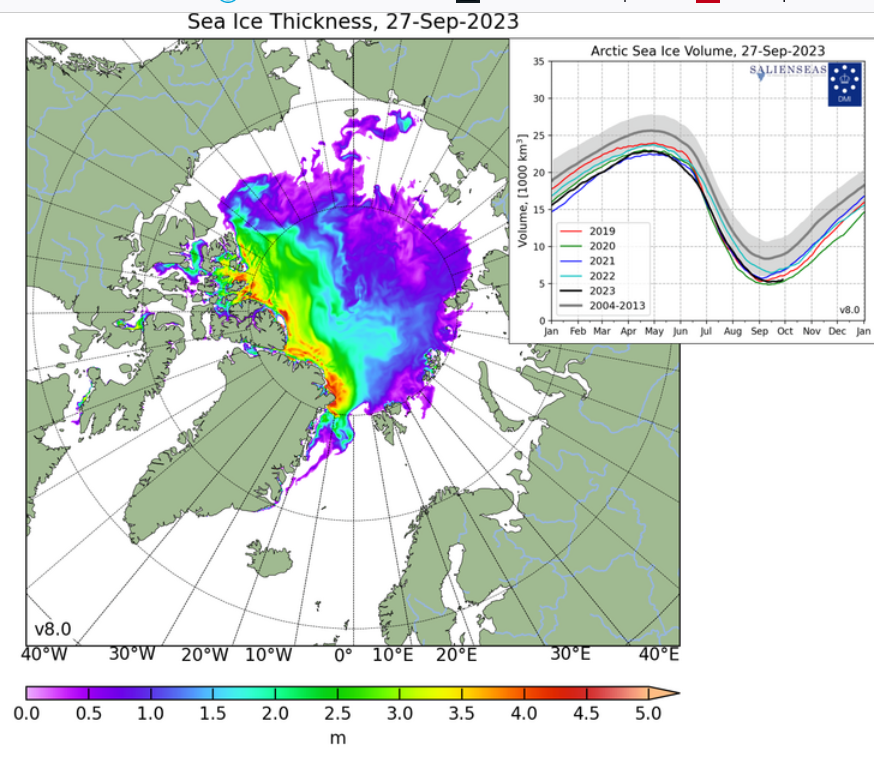
image

https://ocean.dmi.dk/arctic/icethickness/thk.uk.php

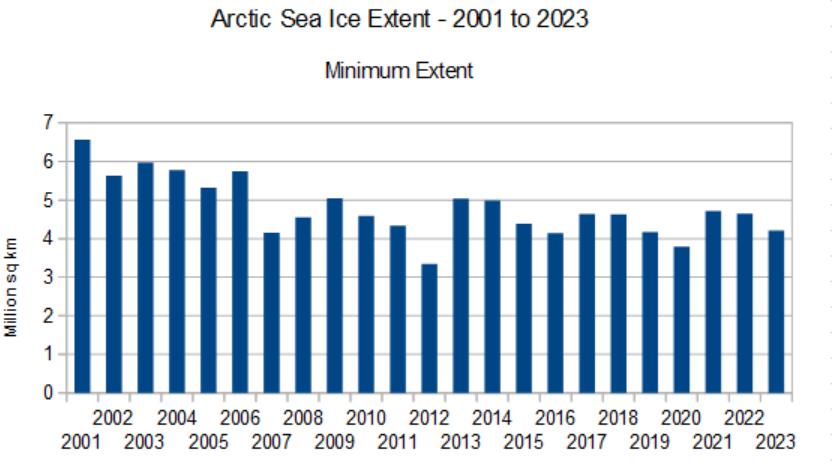
Arctic sea ice extent has now passed its minimum for this year. According to NSIDC, it dropped to 4.213 million sq km on 17th September:

image

https://noaadata.apps.nsidc.org/NOAA/G02135/seaice_analysis/

That puts it in the middle of the pack for what we have seen seen since 2007.

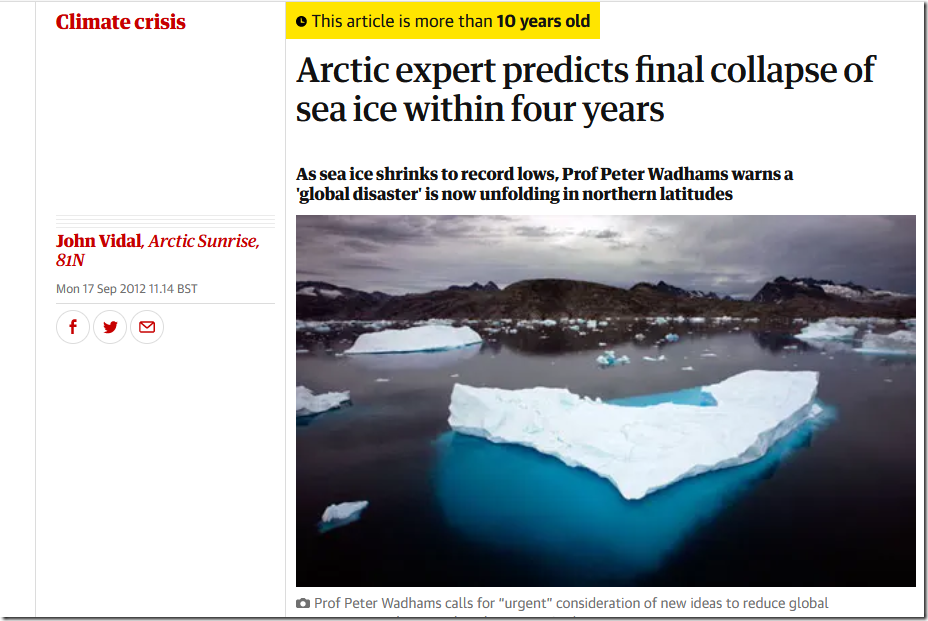
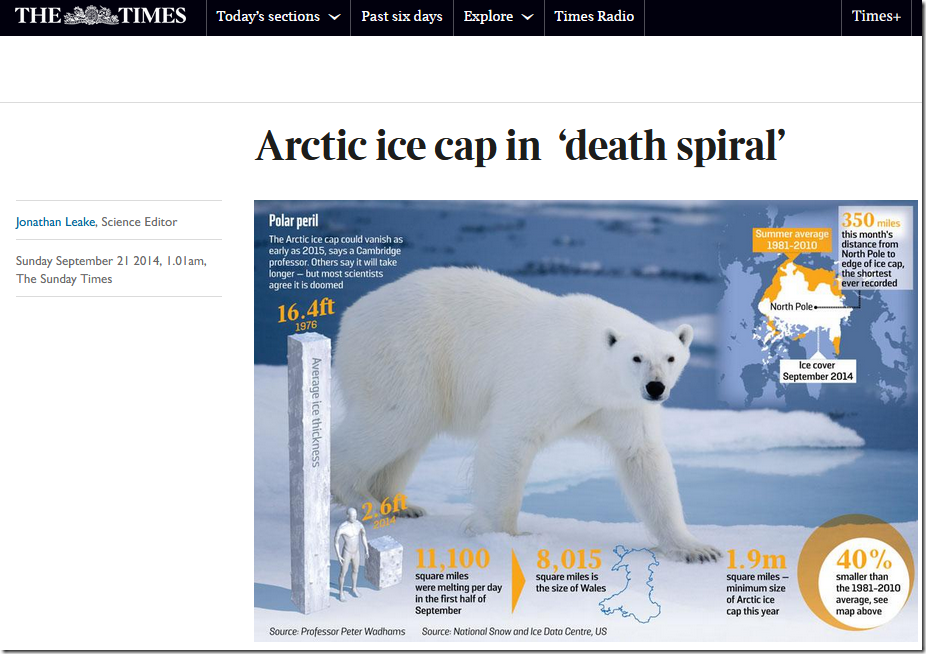
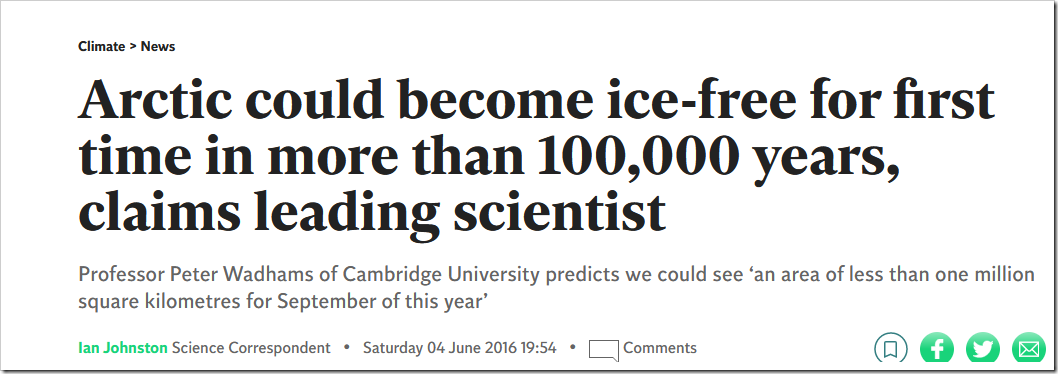
I wonder when we’ll get apologies from all of those who predicted it would all be gone years ago?

image

image

image

image

image

image

https://notalotofpeopleknowthat.wordpress.com/2022/09/26/what-happened-to-the-ice-free-arctic/

via NOT A LOT OF PEOPLE KNOW THAT

https://ift.tt/SJVN9DZ

September 27, 2023 at 08:21AM

The AI Revolution Is Bad News for Net Zero

By Steve Goreham

Originally published in Daily Caller.

Artificial intelligence (AI) is taking the world by storm. New AI applications are announced daily. Amazon, Apple, Google, Meta, Microsoft, and many companies tout plans for artificial intelligence capabilities. But the AI revolution is bad news for global efforts to achieve net-zero emissions.

The AI revolution is based on high-performance AI chips, which are capable of revolutionary levels of computer processing power and capable of sorting through vast amounts of stored data. Multiple AI chips reside on each of dozens of boards, housed in endless racks of servers, which are sited in warehouse-sized AI data centers. While the rack of a conventional server of a data center draws roughly seven kilowatts of electricity, an AI server rack can use up to 50 kilowatts of power.

Spending on artificial intelligence infrastructure is projected to grow at a compound annual rate of 44% over the next six years. Total data center power requirements will increase by at least a factor of six and maybe by as much as 10 times by 2029. Greenhouse gas emissions from AI data centers will increase by similar amount.

The International Energy Agency estimates that data centers account for 1-1.5 percent of world electricity use and are responsible for about one percent of energy-related greenhouse gas emissions. But the rapid growth of AI infrastructure, coupled with a jump in electricity consumption as power-hungry AI server racks replace conventional server racks, will cause carbon dioxide (CO2) emissions from data centers to skyrocket. Artificial intelligence will become a major contributor to global CO2 emissions by 2030, contrary to Net Zero goals.

Proponents define Net Zero as a zero balance between the amount of greenhouse gases emitted from human industrial processes and the amount removed from the atmosphere. They claim that Net Zero must be attained by 2050 to limit the rise in global temperatures to 1.5oC above the background temperature level of the 1800s. Wind turbines, solar panels, heat pumps, biofuels, hydrogen fuel, and carbon dioxide capture and storage are all promoted as vehicles to get to Net Zero.

But virtually nothing that our modern society does is “zero emissions.” If you build a house, sizeable greenhouse gases are emitted by cutting down trees for producing lumber, mining materials and manufacturing wire and components for electricity, producing plastic or copper for pipes, manufacturing drywall, roofing, brick, glass, concrete, and many other materials. Manufacturing of household furnishings, such as furniture, appliances, and computers, also emits large quantities of CO2. Transportation of all these materials emits greenhouse gases. Even a grass hut isn’t Net Zero. CO2 is released when you cut down grass and wood to build the hut.

Net Zero is fundamentally a zero-growth ideology. The United Nations, the International Energy Agency, and green leaders call for an eight percent reduction in world energy consumption by 2050. But energy consumption increased 47 percent from 2000 to 2021. They call for a 40 percent reduction in carbon dioxide emissions by 2030. But global CO2 emissions increased by 44 percent from 2000 to 2021. The AI revolution and other programs for societal development run contrary to the zero-growth plans of Net Zero.

Today, about 700 million people do not have access to electricity. Another two billion people suffer from daily electrical power blackouts. If your home in the United States has an air conditioner, you consume triple the electricity that is used by people in one-third of Earth’s population. Net Zero demands for a global reduction in energy use run counter to history and common sense.

Far away from artificial intelligence, the residents of developing nations lack many things that we take for granted in wealthy nations. People in the US and Europe enjoy at least one vehicle for every two residents, compared to fewer than four vehicles per 100 people in India and Africa. In sub-Saharan Africa, where daily temperatures often exceed 86oF (30oC), only one in sixteen people has air conditioning. Forty percent of these people don’t even own a fan. As another example, residents in wealthy countries use about 20 times as much plastic as residents in undeveloped countries. The people of developing nations will choose economic growth over the no-growth policies of Net Zero.

Driven by the expansion of new technologies such as artificial intelligence and the need for economic growth in developing countries, there is zero chance that Net Zero will be achieved by 2050. Energy consumption and CO2 emissions will continue to rise for decades to come.

Steve Goreham is a speaker on energy, the environment, and public policy and the author of the new bestselling book Green Breakdown: The Coming Renewable Energy Failure.

via Watts Up With That?

https://ift.tt/GFLI0NC

September 27, 2023 at 08:03AM