Month: March 2024

Asda Switches Off EV Chargers

By Paul Homewood

h/t Ian Magness


image

https://www.telegraph.co.uk/business/2024/03/21/issa-brothers-rip-out-ev-charging-points-at-asda-in-blow-fo/

The Telegraph appears to have got the wrong end of the stick here. It is not Asda pulling the plug, but BP.

It is BP who operate the chargers, and they have to Asda to rent each bay. I have seen figures of £2K  a month mentioned. Given the chargers are slow, it seems unlikely that BP could make any profit all, not least because of the maintenance problems frequently encountered.

It is hard to see otherwise why Asda would turn its nose up at £2K a month.

I can’t verify it, but apparently BP Pulse announced the decision last October:

Unfortunately, after a brilliant 10 years working with Asda to provide EV charging for customers at their stores, our contract will come to an end in October as bp pulse continues to focus on on-the-go charging and rolling out ultra-fast EV charging hubs.
This means that we are no longer maintaining, replacing or starting charging for any Asda units not just in Hereford, but throughout the country.
We understand that this may be inconvenient and we apologise for the frustration.

https://www.speakev.com/threads/asda-and-bp-pulse.180598/

Given that supermarket chargers are usually slow, the income stream for BP must have been tiny. An hour’s charge, for instance, might recoup five quid.

BP’s strategy is now to focus on fast chargers at busy locations, such as service stations.

Not much use for the chap driving home from work, who does not have offstreet parking!

via NOT A LOT OF PEOPLE KNOW THAT

https://ift.tt/Yaw8GHp

March 25, 2024 at 03:39PM

2024 Arctic sea ice maximum a whopping 14th below average following hottest year since 1850

Officially, the maximum winter sea ice extent for 2024 was 15.01 mkm2, reached on 14 March. At an unimpressive “14th lowest” on record, this is astounding news for the winter following the “hottest year on record.” Undeterred, the US government headline writers at the National Snow and Ice Data Center (NSIDC) today went for “Arctic sea ice reaches a below-average maximum.” Note the long-term average (1981-2010) is only 15.65 mkm2 and 15.01 is within 2 standard deviations (see below, screencapped 14 March 2024).

This is what the sea ice maximum extent of 15.01 mkm2 looked like on 14 March this year:

From NOAA’s 17 January 2024 report on the “hottest year on record” [my bold] on global temperatures:

The year 2023 was the warmest year since global records began in 1850 at 1.18°C (2.12°F) above the 20th-century average of 13.9°C (57.0°F). This value is 0.15°C (0.27°F) more than the previous record set in 2016. The 10 warmest years in the 174-year record have all occurred during the last decade (2014–2023). Of note, the year 2005, which was the first year to set a new global temperature record in the 21st century, is now the 12th-warmest year on record. The year 2010, which had surpassed 2005 at the time, now ranks as the 11th-warmest year on record.

According to today’s data from today’s NSIDC report (shown below), the lowest maximum extents were reached in 2015-2018 (14.82-14.52), with 2016 being an especially warm El Nino year. It makes sense that 2017 was the lowest, since it followed the very warm summer of 2016.

However, the max extent for winter 2023 was not far behind, which is odd considering that according to NOAA, warm La Nina conditions didn’t kick in until June 2023. March ice extent for 2023 (now the 5th lowest) was still being influenced by the cold La Nina conditions that prevailed in 2021 and 2022 (2021 now 8th lowest, 2022 now 11th lowest, at 14.88, not shown).

And now 2024 max extent is the 14th lowest, following the warmest global temperature since 1850 was reached in summer of 2023?

Rarely mentioned is that 2005-2007 (weak El Nino/El Nino years) were all below this year’s extent of 15.01 and 2006 and 2007 were both among the 10 lowest extents listed above (2005 was 14.95; 2006 was 14.68, 2007 was 14.77).

It’s almost like Arctic sea ice extent in winter has almost no relationship with global temperatures!

via polarbearscience

https://ift.tt/DB5GloN

March 25, 2024 at 03:24PM

CFC Bans Did Nothing To Interrupt The Ongoing Trend Of Antarctic Ozone Losses

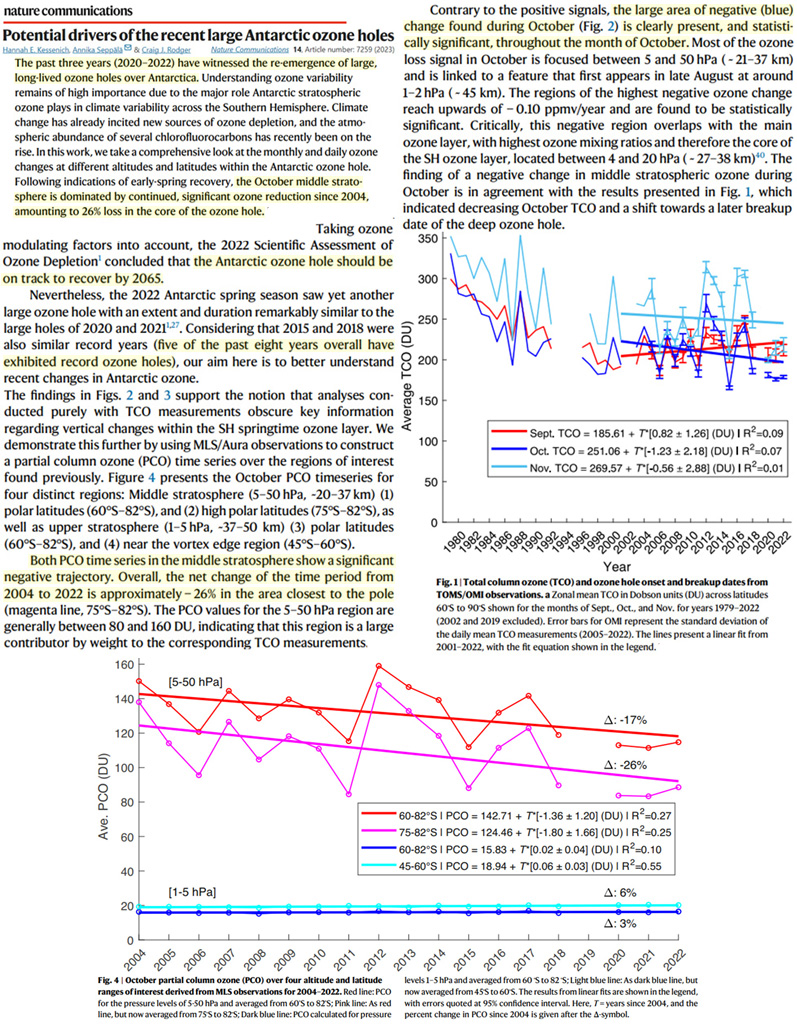
There has been a “continued, significant ozone reduction since 2004, amounting to 26% loss in the core of the ozone hole” (Kessenich et al., 2023).

It is not at all evident that the 1987 Montreal Protocol bans on presumed ozone-depleting substances (ODS) like chlorofluorocarbons (CFCs) materially affected the flat to negative trajectory of stratospheric ozone over Antarctica.

Massive Antarctic ozone holes – the largest on record in 45+ years of tracking – have been ongoing in the 21st century. In fact, “five of the past eight years overall have exhibited record ozone holes,” with a negative trend resulting in a “26% loss in the core of the ozone hole” from 2004-2022 (Kessenich et al., 2023).

Because the presumed effect of the ODS bans have not been realized in the last 35 years, the scientists who still believe humans are responsible for ozone losses (i.e., 2022 Scientific Assessment of Ozone Depletion) are now saying the ozone recovery from ODS damages “should be on track” to being realized by 2065 – over 40 years from now. This estimate is quite convenient, as most of the scientists formulating these predictions will be dead.

Image Source: Kessenich et al., 2023

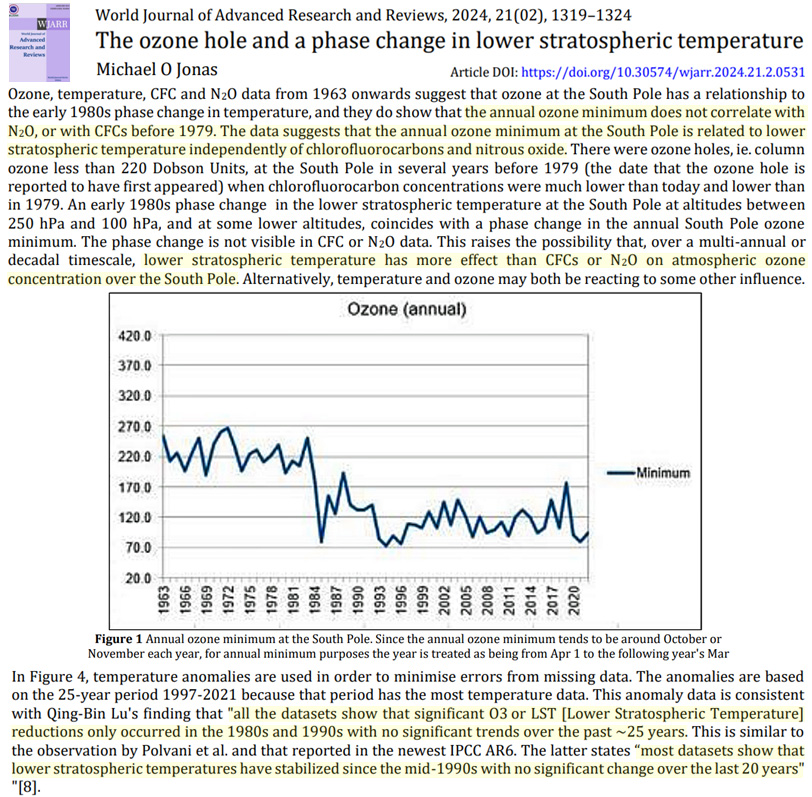
Another new study (Jonas, 2024) points out that ozone holes were observed in the 1960s too. This is well before 1979, the conveniently-chosen “start” year for ozone hole formation.

Also, the data appear to show “the annual ozone minimum at the South Pole is related to lower stratospheric temperature independently of chlorofluorocarbons and nitrous oxide.”

Image Source: Jonas, 2024

via NoTricksZone

https://ift.tt/M03cgPz

March 25, 2024 at 02:01PM

“Misinformation Experts” are almost all left wing and they want to censor you

Misinformation Expert GameBy Jo Nova

The “Misinformation Industry” has been caught with its pants down — accidentally finding, then burying, the information that  nearly everyone in their own industry “leans left”.

This is a field that generated headlines about how conservatives are more susceptible to believing misinformation, and consuming Facebook disinformation. It would be awkward then if the whole field turned out to be leftist academics, and they tried to hide that, which is exactly what just happened.

The leading “journal” on misinformation surveyed 150 of its own academic experts, then forgot to mention that one of the most striking and significant results from their own survey was that being a “Misinformation Expert” was a left wing phenomena.

Misinformation ReviewBjorn Lomborg noticed the statistics on their self-admitted political leanings buried in an appendix, and graphed it himself. He writes: “Misinformation experts are perhaps not quite unbiased”.

There was barely a conservative among them:

Speaking of misinformation, it’s a little misleading, don’t you think, to pretend this doesn’t matter in a field “devoted” to researching political misinformation?

It seems The Misinformation Review has been misinforming its readers.

The Misinformation Industry looks, acts and smells like a leftist invention to censor the right

Looking at their own statistics, the “misinformation” experts are a self-confessed group of leftist soft-scientists with little understanding of maths, physics, mining, chemistry and real life.

Experts leaned strongly toward the left of the political spectrum: very right-wing (0), fairly right-wing (0), slightly right-of-center (7), center (15), slightly left-of-center (43), fairly left-wing (62), very left-wing (21).

And they specialize in media-science and political-science and think that’s a “broad range”:

The misinformation experts represent a broad range of scientific fields. Experts specialized in psychology (39), communication and media science (32), political science (22), computational social sciences (17), computer science (9), sociology (8), journalism (8), philosophy (5), other (4), medicine/other (2), linguistics (2), history (1), physics (1).

Experts of what exactly?

As a theoretical field of science, the experts of misinformation could not even agree on a definition of misinformation itself. Only one in ten thought misinformation was “false information” alone. The rest felt that “misleading people” intentionally, or even unintentionally could qualify, which means the misinformation label can apply to anyone discussing a fact which they thought was true, and is actually true, but (as defined by the left-voting-experts) was “misleading” in the wrong context.

They just want to shut you up

When asked what we should do about misinformation, the correct answer, of course, is “explain why it’s wrong”. But the experts didn’t even think of that — instead they suggest nine ways to hide information and the vast majority of the pool of “experts” were happy with nearly all of them — deplatform, silence, moderate and censor away!
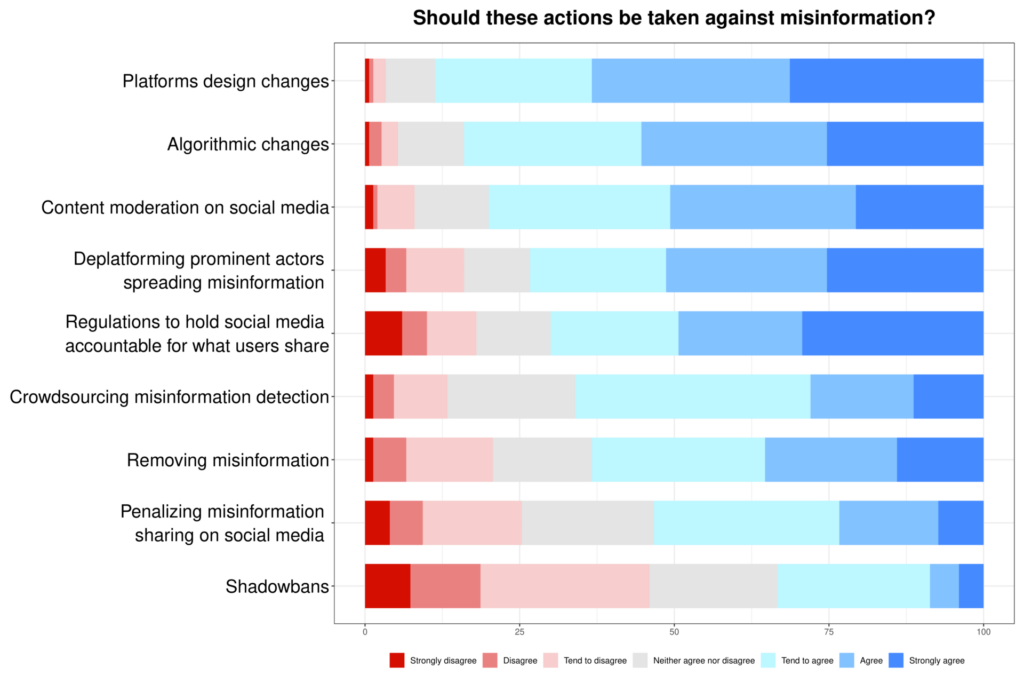
Misinformation. Censorship

When asked “why do people believe misinformation?” the politically biased experts didn’t even blink — it was the human failures of confirmation bias, social identity and partisanship they declared — while buried six feet deep in confirmation bias, social identity and partisanship.

Since when did ivory tower

REFERENCE

Altay, S., Berriche, M., Heuer, H., Farkas, J., & Rathje, S. (2023). A survey of expert views on misinformation: Definitions, determinants, solutions, and future of the field. Harvard Kennedy School (HKS) Misinformation Review. https://doi.org/10.37016/mr-2020-119
Website: misinforeview.hks.harvard.edu

h/t Ryan Maue, David Maddison


0 out of 10 based on 0 rating

via JoNova

https://ift.tt/kslM04Z

March 25, 2024 at 12:38PM