Month: March 2024

Real ‘Green’ Energy: Germany Bulldozes Ancient Fairytale Forest For Wind Turbines

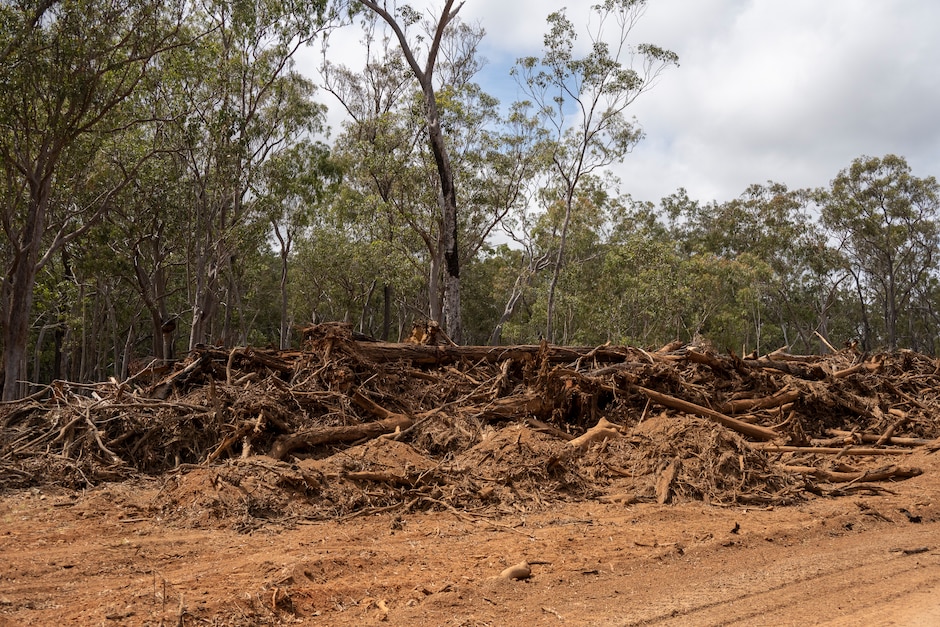
If the wilderness being turned into smouldering ash is used as a platform for hundreds of 260m high/300 tonne industrial juggernauts, it’s all for the greater good (as in the case above, where huge areas of pristine tropical rainforest is being wiped out in Far North Queensland to make way for hundreds of these things).

The German wind industry has ruthlessly clear-felled dozens of ancient forests, once considered out of bounds, to help make way for over 30,000 of these things.

Trashing thousand-year-old oak trees and carving up pristine woodland is treated as just part of the process for those promising to save the planet.

Germany’s Black Forest has already been overrun; chainsaws, bulldozers and blazing torches doing their worst to save us from the horrors of a change in the weather 50 years from now.

Now the green energy cult has sent the bulldozers into the Reinhardswald in the State of Hesse. A magical place where the Brothers Grimm brought Snow White and Sleeping Beauty to life, both literally and figuratively.

As Chris Morrison reports, those pushing Germany’s so-called ‘green energy’ policy couldn’t care less about turning aside of natural beauty and wonder into an industrial wasteland.

Germany Begins Felling 120,000 Trees From ‘Fairy Tale’ Forest to Make Way for Wind Turbines
Daily Sceptic
Chris Morrison
8 March 2024

The windmills are spinning golden subsidies in the central German ‘fairy tale’ forest of Reinhardswald, but the payment is the partial destruction of the 1,000 year-old ancient wood itself. Work has started on the clearing of up to 120,000 trees in the forest, the setting for many of the Brothers Grimm mythical stories, to provide access for an initial 18 giant wind turbines around the Sababurg ‘Sleeping Beauty’ castle.

Who is opposing this massive destruction of the ancient forest teeming with wildlife with trees over 200 years old? Certainly not the Green party, now in power at national and local level. In fact the project is being led by local Hesse Green Minister Priska Hinz who is reported to have said: “Wind energy makes a decisive contribution to the energy transition and the preservation of nature. It is the only way to preserve forests and important ecosystems.”

There is some local press interest in Germany about the destruction of part of the forest that covers a 200 square kilometre area. Nevertheless, the mainstream media generally keep well away from covering environmental destruction when the Greens are doing it in the claimed cause of saving the planet.

The BBC did cover the story under the headline ‘Battle over wind turbines in the land of Sleeping Beauty‘, but that was in 2013 when plans for the industrial development were first announced. It seems that the state-reliant broadcaster is less interested now that the Big Bad Wolf has finally made a meal of Little Red Riding Hood.

Pierre Gosselin, who runs the German-based science site No Tricks Zone, has been covering the outrage felt in a number of German quarters at the plans to destroy some of the Reinhardswald forest in the interest of inferior green technology. He feels the affair shows what an inefficient and costly scam green energy is. “It’s not cost-free, it’s full of corrupt and unresponsive politicians who no longer care about democracy, and it certainly doesn’t make the environment better. It’s a nasty juggernaut of waste, fraud, corruption and ecological degradation – with dead birds, turbine vibration sickness, strobe dizziness and landscape pollution,” he adds.

The Guardian has been curiously silent over the clearing of woodland to build wind turbines in Hesse. In 2020 it was less reticent about reporting on the construction of a 3 km highway in another Hessian forest at Dannenroder.

Thousands of climate activists gathered on the site north of Frankfurt, it reported. Dannenroder tree-felling would be a catastrophe, environmental campaigners are reported to have said. “Some parts of this forest are 250 years old,” noted Nicola Uhde of the German Federation for the Environment and Nature Conservation (Bund), “and there is simply not much of this kind of woodland around anymore.”

At the time, the Guardian noted the fate of Dannenroder was a “litmus test for the Green party” which governed the state as part of a coalition. It seems to have been remiss in not suggesting such a test with the Reinhardswald deforestation. But then it seems none of the usual climate activists have been protesting about the loss of trees and wildlife habitat on this occasion.

The Daily Sceptic has reported on numerous recent examples where the lack of interest in ecological damage is a feature of green industrial development. Last month, we noted that one of India’s iconic large birds, the great Indian bustard, was on the verge of extinction due to the growth of electric power lines in its home area of the Thar desert. To reach global Net Zero, it has been estimated that new power lines equivalent to circling the globe 2,000 times will need to be built in the next few years.

Last October, we reported that wind farms in Tasmania had reduced the population of the endangered local wedge-tailed eagle to around 1,000 individuals. Across the world, millions of bats are being chewed by giant wind blades. Any animal that relies on wind currents for flight such as a large raptor is at risk of being sucked into the whirling machines.

In California, the Democrat-controlled state Government recently relaxed controls on wildlife protections to allow permits to kill previously fully protected species for renewable infrastructure projects. Despite an increased risk to America’s national bird, the bald eagle, barely a peep of protest was recorded. Off America’s eastern coast, massive industrial parks are being constructed for wind turbines. It might be a coincidence that hundreds of whales have beached along the shore in recent years, but a more likely explanation is the deafening sonar noise, constant pile driving, extensive ocean building works and heavy shipping movements.

None of the above are likely to feature when the magic mirror is asked: “Mirror, mirror on the wall, who’s the greenest one of all?”
Daily Sceptic

via STOP THESE THINGS

https://ift.tt/BJ852w0

March 25, 2024 at 01:31AM

Houston’s Robust Fossil Future (Chronicle’s CERAWeek op-ed misdirects)

“Do we need a clean energy industry that depends on government handouts forever? Yes, if you ascribe to the climate disaster mantra…. Does anyone consider letting market forces drive technology development?”

An op-ed in Monday’s Houston Chronicle, “Houston is making a losing bet on fossil fuels,” greeted visitors to CERAWeek. Author Randall Morton attacked oil company CEOs and Houston business leaders for defending a “declining” industry. His opening sentence? “Leaders of the oil and gas industry are in Houston for CERAWeek, grappling with the inevitable decline of the industry.”

Morton then goes after the “economic development leaders at the Greater Houston Partnership [who] are doubling down on this declining industry.” He specifically identifies the GHP’s Energy Transition Initiative – hydrogen and carbon capture – as failed technologies.

Fair enough, but he misses a critical point. These technologies are less about betting on “fading fossil fuels” than they are decisions to suck on the federal teat of subsidies. That reality was acknowledged by Energy Secretary Jenifer Granholm in her CERAWeek talk when she told the audience, “Many of you are taking advantage of those irresistible tax credits. Good!” (No mention from any federal officials about deficit spending and monetary inflation to pay for it.)

Subsidies Are for Losers

Changing human behavior, which is what subsidies are designed to accomplish, apparently doesn’t sway Morton. Maybe he wants even more government money for his favorite technologies, but he never tells us what those might be. He fails to understand an Economics 101 point: The market picks winners, leaving losers for government. And losers they have proven to be to date, not unlike synthetic fuels of a half century ago.

“Inflation Reduction Act”

There seemed to be no shortage of taxpayer money being thrown at green energy technologies based on the legislation passed in 2021 and 2022. First, there was the Infrastructure Investment and Jobs Act of 2021, then it was the Inflation Reduction Act of 2022 (IRA). The former included a laundry list of favorite climate investments to help localities deal with the clean energy transition including $7.5 billion for electric vehicle charging stations, $5 billion for zero-emission and clean buses, $2.5 billion for clean ferries, and $65 billion for clean energy transmission. 

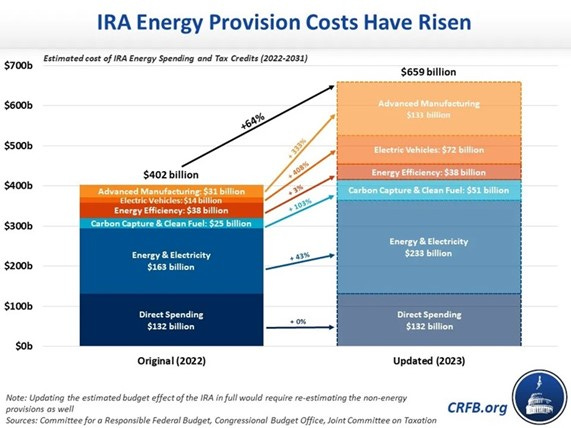
The irresponsibly named IRA bill was a trove of subsidies and tax credits for clean energy. The Congressional Budget Office at the time of its passage estimated the bill to cost $391 billion between 2022 and 2031. An analysis by investment firm Goldman Sachs put the cost at $1.2 trillion while a money manager estimated it at $1.4 trillion. Even the CBO has upped its initial cost estimate to $660 billion through 2031 and increased it to $786 billion for 2024-2033. Many of these subsidies, which originally had time limits, have had them removed allowing subsidies for the life of projects, further bloating the cost of the bill. 

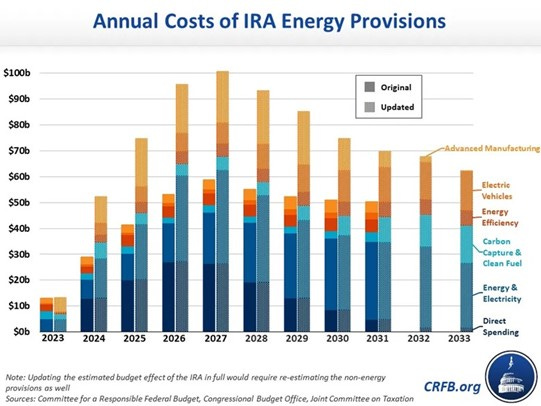
The Committee for a Responsible Federal Budget wrote about the CBO’s revised estimates. They included two charts that dramatically show how much the various categories of spending are projected to increase and how those spending categories will spread over the forecast periods. 

The Inflation Reduction Act conservatively has increased by nearly two-thirds since it was enacted in 2022.

You will note the magnitude of the spending increases. They will be even greater according to Goldman Sachs. For categories of green energy spending like electric vehicles, energy efficiency, and carbon capture & clean fuel, they will be much greater in 2031 and 2033. 

Many of the subsidies in the IRA will continue for well after the 10-year cost assessment period inflating the overall cost of the bill.

In the world of industrial policy, which the Biden administration is engaged in, the question becomes should one reject the government’s free money? For Morton, no one should succumb to the siren song of subsidies, even if they were enacted to prompt these specific investments. Shunning the subsidies would open companies and CEOs to attacks from activists and politicians for not being patriotic and supporting the government’s effort to solve the existential climate crisis. And they could be slammed by shareholders for accelerating their company sunsets. 

Do we need a “clean” energy industry? How about one that depends on government handouts forever? Yes, if you ascribe to the climate disaster mantra. How many years do we have before the world ends? This fear is what is driving the shoveling of taxpayer money into corporate coffers as long as they make the “correct” investments. Does anyone consider letting market forces drive technology development? 

The Coal Question

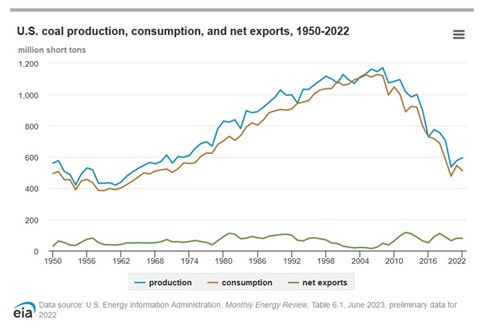
Some of the claims Morton made were superficial at best. He tried to link Big Oil to King Coal. He was using the decline in U.S. coal production and the reduction in coal employment as the lesson for oil’s future.

Our coal production has declined as shown in the chart below, but as you can see in the second chart, our coal exports are up and we continue to import coal at about the same level as we did in the late 1990s.  Coal’s decline was because we are blessed with huge natural gas resources that create less pollution. 

Our coal use is down due to soaring natural gas production and lower cost to generate electricity.
Coal exports continue growing and our imports are up as global coal markets are posting annual records with no end in sight.

Final Word

Energy has turned into a subsidy play, something for everyone. Yes, so-called Big Oil is at the table. One can join Randall Morton in calling out hydrogen and CCSU as the wrong approach. But why not consider ending similar government favor for wind, solar, and batteries? Do consumers and taxpayers–and the freedom to choose–matter?


Energy expert Allan Brooks writes at Energy Musings, from which this article is adapted.

The post Houston’s Robust Fossil Future (Chronicle’s CERAWeek op-ed misdirects) appeared first on Master Resource.

via Master Resource

https://ift.tt/cglKLQZ

March 25, 2024 at 01:03AM

California’s Electricity Disaster In Seven Charts

From Robert Bryce’s Substack

Residential electricity prices jumped nearly 12% in 2023 and they are going higher. But the carbon intensity of power generation isn’t falling and low-income ratepayers are subsidizing the rich.

California’s energy woes are getting worse. According to the latest numbers from the Energy Information Administration, the state’s residential electricity prices, already among the highest in America, jumped by 3 cents per kilowatt-hour last year, an increase of 11.9%. The average California homeowner now pays 28.9 cents per kilowatt-hour for electricity, which is the third-highest price in the U.S., behind only Connecticut and Hawaii.  

Unfortunately, the 2023 price increases are only a hors d’oeuvre. California’s electric rates are headed for the exosphere. As I explained last March in “California Screamin,” in 2022:

The California Public Utilities Commission unanimously approved a scheme that aims to add more than 25 gigawatts of renewables and 15 gigawatts of batteries to the state’s electric grid by 2032 at an estimated cost of $49.3 billion. In addition, the California Independent System Operator released a draft plan to upgrade the state’s transmission grid at a cost of some $30.5 billion. The combined cost of those two schemes is about $80 billion.

Given the raging inflation in utility products, that $80 billion estimate is undoubtedly too low. Whatever the ultimate price tag, the state’s aggressive alt-energy plans will inflict more economic pain on the low-income residents of a state with the dubious distinction of having the highest poverty rate in the United States.

From natural gas bans to aggressive alt-energy mandates and bans on vehicles with internal combustion engines, the Golden State provides a clear example of what not to do. While California’s lunatic energy policy decisions go back decades, the most relevant regulations began in 2008. That’s when, as McClatchy newspapers explained:  

Governor Arnold Schwarzenegger signed an executive order calling on utilities to provide one-third of their power from renewable resources by 2020. “This will be the most aggressive target in the nation,” he said. Increased reliance on renewable energy conceivably could hike future rates, however, because of higher production costs and the need to upgrade transmission facilities. Schwarzenegger’s order came on the eve of today’s international summit on global climate change in Los Angeles. (Emphasis added.)

These seven charts show how California’s electricity policies have unfolded since 2008.

Chart 1

The following chart uses a graphic created by Grant Chalmers, who works in information technology at the University of Brisbane. It shows that despite the massive increases in wind and solar production, the carbon intensity of California’s electric generation isn’t falling. To be clear, total electricity use in California is falling. All-sector electricity use in the state fell 11.2% between 2008 and 2023. (Hat tip to Joe Toomey.) That reduction in power use has likely helped reduce the state’s overall CO2 emissions, which, as seen in this December 14, 2023, California Air Resources Board report, have declined since 2008. But California is nowhere near net zero, and the carbon intensity of electricity production hasn’t budged in more than a decade.

Chart 2

Meanwhile, the state’s electricity prices are exploding.

Chart 3

Chart 4

The following chart shows the latest figures from the Bureau of Labor Statistics. Although the average price of residential electricity in California is 28.9 cents per kilowatt-hour, it’s even more expensive in the state’s biggest cities.

Chart 5

A devastating February 8 report from The Public Advocates Office, estimated that rooftop solar incentives in California will cost “customers without solar an estimated $6.5 billion in 2024.” The report is astonishing for its brevity and its findings. The office, which is part of the California Public Utility Commission, concluded that the cost of solar subsidies for ratepayers who don’t have solar has nearly doubled since 2021. It explains: “The recent cost increases are driven by two main factors: (1) a surge in customers installing solar prior to the phase out of unsustainably lucrative program compensation terms, and (2) higher compensation to customers with rooftop solar for the excess energy their systems generate.” The report goes on, saying the main incentive for homeowners to install rooftop solar is a program called net energy metering which compensates those homeowners for “the electricity they generate by more than seven times its relative value to the grid.” (Emphasis added.) It continues:

The Public Advocates Office estimates Pacific Gas and Electric, Southern California Edison, and San Diego Gas & Electric customers without solar will pay an additional $6.5 billion in 2024 to support the program. In 2021, the cost was approximately $3.4 billion. Our analysis estimates that in 2024, more than 15% of the average household’s electricity bill will go to subsidizing the program across all utilities if they do not have solar. The amount has trended upward in recent years: the program made up 8 to 17% of the average customer’s bill in 2022, according to a prior CPUC estimate.

On January 10, less than a month before the Public Advocates Office published its report on rooftop solar, the Legislative Analyst’s Office sent a 16-page letter to Senator Maria Elena Durazo, a Democrat from central Los Angeles, that detailed the myriad ways in which California’s climate policies — in the words of The Two Hundred for Homeownership, a non-profit group that advocates for low- and moderate-income communities — “disproportionately burden lower-income people.” The letter found that the state’s net metering policies for rooftop solar:

Have historically subsidized electricity costs for households with rooftop solar while raising them for everyone else and researchers note that NEM is one driver of high increases in residential electricity prices. The average customer without rooftop solar pays 10 percent to 20 percent on their electricity bills to subsidize rooftop solar on the homes of others. (Emphasis added.)

None of this should be surprising. I spotlighted the class divide over solar energy and the transfer of wealth from poor to rich in 2017 in the Wall Street Journal. I wrote:

According to a study done for the California Public Utility Commission, residents who have installed solar systems have household incomes 68% higher than the state average. Ashley Brown, executive director of the Harvard Electricity Policy Group, calls the proliferation of rooftop solar systems and the returns they provide to lucky people like me, “a wealth transfer from less affluent ratepayers to more affluent ones.” It is, Mr. Brown says, “Robin Hood in reverse.”

This graphic shows the change in effective solar subsidies between 2021 and 2024. Rooftop solar and net energy metering would have horrified Robin and other denizens of Sherwood Forest.

Chart 6

There’s plenty of evidence the state’s energy mandates are punishing low-income Californians. On March 10, Rob Nikolewski, a sharp-eyed reporter at the San Diego Union-Tribune, published an article that began, “Roughly one-quarter of San Diego Gas & Electric customers are still behind on their monthly bills.” He continued, saying that about 3.48 million California ratepayers had “fallen behind on their monthly payments, as of January.” He then quoted Mark Wolfe, the executive director at the National Energy Assistance Directors Association, who said the numbers in California are “alarming.” Wolfe added: “The underlying problem is energy is very expensive in California and it’s not surprising to see people owing as much as they do.”

Chart 7

Given California’s soaring energy costs and exorbitant cost of living, it’s unsurprising that people are leaving for less-expensive pastures. In December, the Census Bureau reported that California lost some 75,000 residents in 2023, an exodus surpassed only by New  York, which lost about 102,000 people. In January, Fox News reported, “For the fourth year in a row, liberal California topped U-Haul’s Growth Index list for having the largest net outbound movers in 2023.”

The Power Hungry Podcast Is On Hiatus

After nearly four years, 223 episodes, and over 900,000 downloads, I am putting the Power Hungry podcast on hiatus. I have enjoyed doing the podcast and sincerely appreciate everyone who came on the show or tuned in. My colleague, Tyson Culver — who also directed and produced our new docuseries, Juice: Power, Politics & The Grid — has been a dependable podcast producer. But I’ve been stretched too thin lately. So, I’m hitting the pause button. I may come back to the podcast or I might start putting video content here on Substack. But those are decisions for another day. I look forward to having more time to focus on my speaking business and my writing here on Substack. Thanks to all of you who listened to the podcast.

Media Hits

1. Tyson and I were on the Pacific Research Institute’s podcast, Next Round, this week, discussing our docuseries. It was a good chat. Click here to listen.

2. Reporter John Moritz quoted me in a piece about the Texas grid that was published Monday in the Austin-American Statesman. John contacted me after reading my February 20, piece “Out of Transmission Revisited.” I was glad to get quoted saying, “The number of line-miles of high voltage transmission over the last few years has been declining…So these claims that we hear routinely that, ‘Oh, we’re just going to massively expand the grid.’ No, that is not going to happen.”

3. David Staples of the Edmonton Journal published an excellent piece yesterday on the backlash against alt-energy in Canada and the U.S. He quotes me and mentions our new docuseries and the Renewable Rejection Database.


If you don’t click that ♡ button, you will be required to pay the electric bill at Arnold Schwarzenegger’s mansion in Pacific Palisades. (With apologies to Doomberg.)

via Watts Up With That?

https://ift.tt/clPXWQk

March 25, 2024 at 12:02AM

6 Of The Best Sandbox Games That You Have to Play

Gaming has come a long way from the humble days of Pac-Man and Pong. We are living in the golden age of gaming. Consoles are more powerful than ever before. VR technology has finally emerged. And there are so many different genres of game to choose from. Everything from triple-A shooters to massive role playing games. No matter what your gaming preference, you will be able to find a game that will meet it.

One genre that has really come into its own as technology has improved is the sandbox game. Players love the ability to do whatever they like, whenever they like. And no genre typifies this more than the sandbox. Sandbox games give players the freedom to approach the core gameplay loop in any way they want. And there are lots of different takes on the genre. Today we have compiled a list of the 6 best sandbox games you have to check out.

No Man’s Sky

One of the most controversial games of the last decade. No Man’s Sky took the world by storm during its marketing period. Promising players an endless procedurally generated universe with life size planets, fantastical worlds to explore, endless space faring adventures, and the ability to play with your friends.

When it launched it had hardly any of that. But over the years the developers have gained back the trust of the community with regular updates and the game is now one of the greatest sandbox games on the market. We highly recommend you check it out.

Minecraft

The most popular game on the planet. Minecraft is one of the best sandbox games on the market. Allowing players to play in creative mode or the much more challenging survival mode. You are only limited by your imagination. The Minecraft multiplayer scene is one of the most active in the gaming world. With thousands of survival multiplayer servers on offer. It can be quite daunting to find a good server but you can compare Minecraft SMP servers on this website to find the one best suited to your needs.

Red Dead Redemption 2

If you want to simulate the life of a cowboy, collecting bounties, smoking cigars, getting in shootouts. Then Red Dead Redemption is the game for you. While it does have a story, the game is essentially a giant cowboy sandbox game. You have total freedom to go wherever you want in the wild west. You can be an honorable cowboy, helping out the locals and fighting off criminals. Or you can be a ruthless killer, robbing people on the highways and murdering those who get in your way. Plus the game is packed full of side missions and content to sink your teeth into. Be warned though, this game is so good it’s addictive. Once you start playing chances are you won’t want to stop.

Blockland

If you liked Minecraft but wanted it to be much more like Lego, then Blockland is the game for you. It is the lego game we never got. Simply put you build things out of Lego-like bricks. But with that comes endless possibilities. And the community has made thousands of different game modes and maps to play on. It still has quite an active player base even after all these years. And it is relatively cheap to grab on steam.

Terraria

When Terraria was released a lot of people said it was a rip-off of Minecraft. Those people had clearly never played Terraria. The 2D side-scrolling sandbox game shares a lot of similar elements to Minecraft like a crafting and mining system. But the game is so much more. It is more akin to a sandbox RPG than a survival game. It has a lot of bosses, monsters, dungeons, loot, and so much more to be found. And the game still receives regular updates of a massive scale. The 2D aspect of the game does take some getting used to. But once you have you’re guaranteed to have a good time.

Garry’s Mod

We couldn’t talk about sandbox games without mentioning the king of the genre. Garry’s mod is the epitome of what a sandbox should be. It is less of a game and more of a playground for modders and creatives to let loose their imagination. Players can do everything from build complex robots to creating entire game modes. And because of the community driven nature of the game, there is always something new to be downloaded and played around with. Not to mention it’s home to some of the best game modes out there like Trouble in Terrorist Town. Garry’s Mod is still fairly cheap on steam and goes on sale regularly so if you don’t already own it, we highly recommend you give it a go.

via A Journey through Nature and Climate

https://ift.tt/o5xduUa

March 24, 2024 at 10:08PM