
California has adopted a target of 25,000 MW of floating offshore wind generation capacity.
via CFACT
September 10, 2024 at 03:52AM
California has adopted a target of 25,000 MW of floating offshore wind generation capacity.
via CFACT
September 10, 2024 at 03:52AM
By Paul Homewood
h/t Hugh Sharman
Europe might not have a ZEV Mandate, but car makers still can’t escape the clutches of the eco loons:

PARIS, Sept 7 (Reuters) – Europe’s autos industry could face fines of 15 billion euros ($17.4 billion) for carbon emissions due to slowing demand for electric vehicles, Renault CEO Luca de Meo said on Saturday.
Automakers face tougher EU CO2 targets in 2025 as the cap on average emissions from new vehicles sales falls to 94 grams/km from 116 g/km in 2024.
"If electric vehicles remain at today’s level, the European industry may have to pay 15 billion euros in fines or give up the production of more than 2.5 million vehicles," de Meo told France Inter radio.
"The speed of the electric ramp-up is half of what we would need to achieve the objectives that would allow us not to pay fines," de Meo, who is also president of the European Automobile Manufacturers Association (ACEA), said of the sector.
Exceeding CO2 limits can lead to fines amounting to 95 euros per excess CO2 g/km multiplied by the number of vehicles sold.
That could result in penalties of hundreds of millions of euros for large carmakers.
via NOT A LOT OF PEOPLE KNOW THAT
September 10, 2024 at 03:38AM

An observation error occurred due to overlooking the ‘gradual change in the Earth’s magnetic field over time’. Studies based on the original data, at least some of them painting unpleasant future climate scenarios, climate models incorporating it, and IPCC reports, must be considered to be in need of revision.
– – –
There is growing scientific interest in quantifying how large-scale ocean circulation is evolving as part of a changing global climate, says NOAA Global Ocean.
Of particular interest is the potential weakening of the Atlantic Meridional Overturning Circulation (AMOC).
However, the strength of the Florida Current, a key component of the AMOC, has remained stable for the past four decades, according to a new study by scientists at NOAA’s Atlantic Oceanographic and Meteorological Laboratory (AOML), the University of Miami Cooperative Institute for Marine and Atmospheric Studies (CIMAS), and the National Oceanography Centre (UK).
The AMOC is the Atlantic (Ocean) portion of the Global Meridional Overturning Circulation (MOC). It is an important part of this global system that moves water northwards and southwards in the Atlantic Ocean, connecting surface and bottom water flows across the globe.
The AMOC controls the transport of heat, freshwater, carbon, nutrients, and other properties across the basin, meaning that changes in the AMOC’s strength could impact many global scale climate phenomena such as sea level, extreme weather, and precipitation patterns.
Current state-of-the-art climate models, including the NOAA model, suggest a decline of the AMOC by up to 45% of its present-day strength toward the end of this century. The latest Intergovernmental Panel on Climate Change report is based on these models. However, there is no clear observational evidence to support a significant slowdown of the AMOC in recent decades.
In this study, scientists have found through observations that the Florida Current, one of the fastest currents in the ocean and an important part of the AMOC, has remained remarkably stable over the past 40 years.
. . .
Since 1982, NOAA’s Western Boundary Time Series (WBTS) project and its predecessors have monitored the transport of the Florida Current between Florida and the Bahamas at 27°N using a 120-km long submarine cable paired with regular hydrographic cruises in the Florida Straits.
This nearly continuous monitoring has provided the longest observational record of a boundary current in existence. Beginning in 2004, NOAA’s WBTS project partnered with the United Kingdom’s Rapid Climate Change program (RAPID) and the University of Miami’s Meridional Overturning Circulation and Heatflux Array (MOCHA) programs to establish the first transbasin AMOC observing array at about 26.5N.
Through the WBTS project, the strength of the Florida Current has been inferred from voltages measured on a decommissioned submarine telephone cable spanning the seafloor between Florida and the Bahamas. Due to the Earth’s magnetic field, as salt ions in the seawater are transported by the Florida Current over the cable, a measurable voltage is transmitted to the cable. Using regular ship-based measurements, this voltage record can be correlated to the volume transport of the Florida Current. The resulting cable measurement time series has provided a daily transport record of the Florida Current for more than 40 years.
In this new study, WBTS scientists reassessed the overall trend in the Florida Current transport inferred from the cable measurements. They found that voltages measured on the cable beginning in 2000 required a correction for the gradual change in the Earth’s magnetic field over time. The correction nearly removed a previously reported negative trend in the record, revealing that the Florida Current has remained stable for the past four decades.
This result contradicts previous claims made regarding a statistically significant decline of the Florida Current at 27°N, and subsequently reduces the negative trend (i.e., the weakening) previously observed in the AMOC time series at 26.5°N. Several previous studies that showed a slowing of the Florida Current were based on data from the cable prior to the correction.
If climate models are correct [Talkshop comment – a big ‘if’] and the AMOC is slowing or will slow down, this study indicates that such a slowdown has not yet been reflected in the Florida Current, or that the observational records are still too short to detect it with confidence.
Full article here.
– – –
Image: Florida Current [credit: NOAA]
via Tallbloke’s Talkshop
September 10, 2024 at 03:28AM

In a theatre of the absurd, wind and solar generators get paid (with your taxes) to generate nothing at all (except subsidised profits for their shareholders).
Producing no power when consumers really need it, and mountains of power when consumers don’t, is the very definition of chaos. And all that wanton waste comes with a punishing price tag.
Even so-called ‘bargains’ are a complete waste of money where the product has absolutely no inherent value.
Power consumers – be it businesses or households – only care about the power they need and are only willing to pay for the power they consume. No one cares about the rest, which is why wind and solar are worthless, always and everywhere.
In wind and solar obsessed places like Australia, huge volumes of electricity are dumped into the marketplace when the sun is up and the wind is blowing. So much so, vast amounts of wind and solar capacity is curtailed with wind and solar outfits knocked out of the game. It won’t be long before they start getting paid handsomely to produce, nothing at all. Just like their European counterparts.
Wind and solar have never made any sense, particularly in terms of base economics. Hence the massive subsidies, punitive mandates and ridiculous targets that favour the unreliables.
In the piece below, the team from Jo Nova report on what’s become a cannibals picnic, where wind power outfits and large-scale, commercial solar generators are being devoured by the ‘domestics’ – the millions of households covered in their very own panels.
The end result is that power consumers will end up paying for billions of dollars of idle wind and solar generation capacity. Welcome to your wind and sun powered future!
Random power glut means 80% of solar plant output was thrown away on Sunday
Jo Nova Blog
Jo Nova
5 September 2024
It’s just another day of profligate waste in Renewable World
It’s barely spring in Australia and already we’re reaching the point where there’s too much solar. There’s such an excess of useless energy, prices are negative, meaning the hapless generators have to pay people to take the poison power away. And on Sunday, at a time when investors ought be making their peak profit for the day, they were rushing to turn 80% of their panels off.
Feel the pain — the stunted curve of the solar plants (below) is supposed to be the same shape as the rooftop PV.
In reality, this is how we make the parabolic curve of orbital solar physics fit a rectangular box — by building five times as much as we need and wasting most of it.
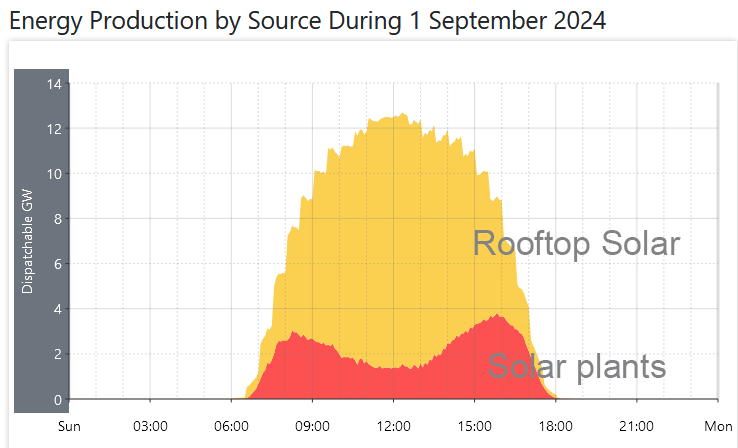
Bear in mind, this is just the start of a the lumpy road to nowhere. Even though we already have more solar panels than we can use, we’re supposed to be installing 22,000 more panels every day in Australia to reach our mystical NetZero target.
Paul McArdle of WattClarity noticed the dire situation. As he says “rooftop PV is killing it’s big brother!”
He has calculated the curtailment levels were often around 40 to 50% for large solar plants in the last week of August.
Who would want to invest in a solar plant?
And at the moment, there’s a bite out of the daily peak, every day.
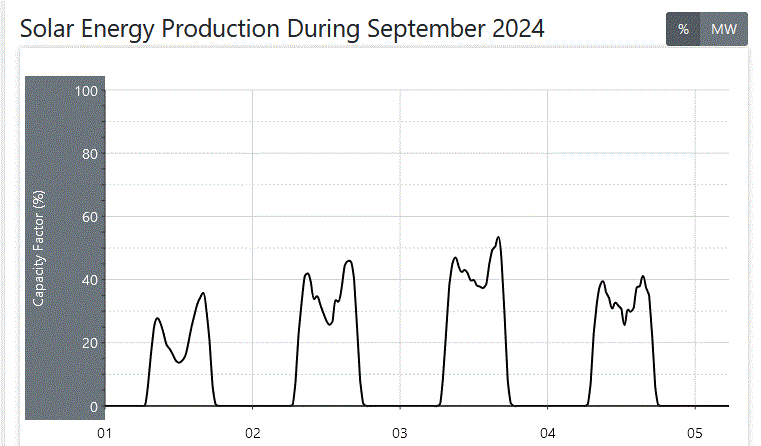
Call it “spillage”
We’ve reached this surreal point because there is more wind power than usual and it’s spring. The weather is mild, so householders don’t need as much electricity — thus the minimum demand on the grid is falling dangerously low. That’s a problem because the giant coal plants and other reliable generators need to keep running, to supply the frequency stabilization and so they can ramp up to fill the gaps.
Wild winds blow up solar farm profits
Angela Macdonald-Smith, Australian Financial Review
[Josh Stabler, managing director at adviser Energy Edge] …said the available wind and solar resource almost exceeded total demand, but noted that renewable “spillage” – where renewable output is not made use of – was also at a record high.
“Spillage and abundance will be continuous features of the electricity market into the future and will become more common, especially during spring,” Mr Stabler said.
It’s mayhem on the market:
The 24-hour average wholesale price was negative for Victoria, South Australia and Tasmania, according to National Electricity Market data, with NSW only just in positive territory at $16.81 a megawatt-hour for the 24 hours to 3am on Monday. That compares with the four-week average price in NSW of $206.23/MWh.
So wholesale electricity prices are six times higher than they used to be, and we have an overdesigned grid with twice as much infrastructure as we need and most of the time, a lot of the capital assets are sitting around doing nothing.
And people think if we just do more it will “be cheaper”.
Jo Nova Blog

via STOP THESE THINGS
September 10, 2024 at 02:31AM
 Iowa Climate Science Education