Month: September 2024

Energy Election ’25: Oil and Gas on the Ballot

“Energy policy will be on the ballot this fall, and American voters deserve meaningful answers from all candidates about how to drive production of affordable and reliable natural gas and oil for decades to come.” – American Petroleum Institute

The American Petroleum Institute (API) is no better or worse than its membership. If the companies like the free market, they are on solid consumer, taxpayer grounds. If the membership tilts toward special government favor (rent-seeking), API works against consumers and taxpayers.

Oil and gas companies should work from fundamental consumer demand out rather than political correctness in. They would have avoided boondoggles like the Strategic Petroleum Reserve in the 1970s and hydrogen and carbon capture today. They also should have fought hard against wind and solar for on-grid electricity and for batteries to overcome intermittency.

Today, API has many free-market views given the Biden-Harris Administration’s anti-oil-and-gas agenda, 250 actions (and counting) worth. Yes, the upcoming U.S. election is about energy. And one major party candidate is pro-oil-and-gas (and coal)–another rabidly against (via her handlers). No mystery there.

API’s Mark Green summarized the issues as follows:

“With demand for affordable, reliable energy rising here in the U.S. and around the world, the oil and natural gas industry stands ready to work with any administration to advance a policy agenda that helps secure America’s energy future and reduce inflation.”

Energy policy will be on the ballot this fall, and American voters deserve meaningful answers from all candidates about how to drive production of affordable and reliable natural gas and oil for decades to come.

API has offered a clear and beneficial energy plan for all candidates – a five-point policy roadmap to strengthen American energy leadership and help reduce inflation. You can see the details here and here, but the plan’s pillars are:

Protecting Consumer Choice – The Biden administration is using regulation – EPA’s tailpipe emissions rule and new fuel-economy standards – to force automakers to produce more electric vehicles and push Americans to buy them. Consumers – all of whom have different budget and family needs – deserve more freedom, not less, when it comes to deciding which vehicles they will buy and drive.

Restoring the Role of American Energy in Bolstering Our Geopolitical Strength – American liquefied natural gas (LNG) was a lifesaver for Europe when Russia invaded Ukraine and restricted natural gas supplies. LNG offers other countries an opportunity to reduce emissions from using other fuels – as the U.S. has done in its power sector. The U.S. Energy Department should lift the ongoing pause on new LNG permits and promptly approve pending export applications to support America’s status as the world’s top LNG supplier.

Leveraging Our Abundant Natural Resources – For today and the future, America must plan for robust production so that families and businesses have access to affordable, reliable energy – for transportation, home heating and cooking, and countless consumer products that are staples of modern life. Anchored by U.S. oil and natural gas, strong domestic energy production also helps control energy-related costs for Americans, even as inflation has greater impacts on the costs of food, health care, education and other necessities.

Fixing Our Broken Permitting System – America needs to be able to build critical energy infrastructure of all kinds, not just oil and natural gas projects. But this is being impeded by a federal permitting process that can take years to complete. Comprehensive reform, such as the proposals in new bipartisan Senate legislation introduced this week, is needed.

Advancing Sensible Tax Policy – America’s oil and natural gas industry supports 11 million jobs and drives billions in investment that boosts the nation’s economy. U.S. tax policy must be made competitive with policies of other nations, because capital flows to where it is most welcome. And investment in American industries is vital to a strong, diversified economy, helping to sustain the jobs, economic growth, and tax revenues that support our states and communities.

API’s roadmap is a practical, sensible, workable path forward on American energy, which should be treated as a national, strategic asset and foundational to our country’s economy and security. 

API President and CEO Mike Sommers:

As the world’s largest producer of oil and natural gas, America brings stability in a time of chaos, making our industry the envy of the world. This critical framework highlights our commitment to maintaining America’s energy advantage for decades to come.”

As the election season kicks into high gear, we look forward to an important national conversation about energy.

Final Comment

API’s 550-word summary above is pretty solid as far as it goes. But political correctness and internal rent-seeking prevents API from condemning the anti-consumer, taxpayer-enabled energies. At this late hour, principle must join pragmatism to advocate an across-the-board free market, classical liberal energy policy. To this end, the oil, gas, coal, and internal combustion engine industries should unite against climate alarmism and forced energy transformation.

The post Energy Election ’25: Oil and Gas on the Ballot appeared first on Master Resource.

via Master Resource

https://ift.tt/QtclA9H

September 10, 2024 at 01:06AM

Here’s How One Biden-Appointed Judge’s Ruling Could Bring Drilling in Gulf of Mexico to A Halt

From the DAILY CALLER

Daily Caller News Foundation

Nick Pope
Contributor

A single ruling from a judge appointed by President Joe Biden may end up halting oil and gas drilling in the Gulf of Mexico in December.

Judge Deborah Boardman, the Biden-appointed district judge in the U.S. District Court for the District of Maryland, sided with suing environmentalists in August to vacate a key National Marine Fisheries Service (NMFS) environmental review — known as a biological opinion — underlying offshore drilling in the Gulf of Mexico. Unless the federal government manages to revise the biological opinion by Dec. 20, and barring intervention from a higher court or the Congress, the ruling could force offshore oil and gas drilling to grind to a halt as developers decide whether to proceed at their own risk or shut down their operations until a new review is issued, according to multiple energy sector experts and stakeholders.

“The revocation of a duly issued permit such as this on such specious grounds by a single judge places all other duly issued permits in the areas occupied by this endangered and other endangered or threatened species in jeopardy,” David Blackmon, a 40-year veteran of the oil and gas industry who now writes and consults on energy issues, told the Daily Caller News Foundation. “Operators now will have to consider whether they’re willing to risk millions of dollars in capital in projects only to find their own permits being revoked on the whims of a judge sympathetic to the radical climate lobby.” (RELATED: Biden Concedes A Gas Export Approval, But It May Just Be A ‘Political Tactic’ To Help His VP)

“Absurd judicial decisions like this one threaten to destroy billions of dollars in investments in the U.S. by destroying the ability of companies and investors to have confidence in the proper, consistent application of laws and regulations,” Blackmon added. “Unfortunately, the destruction of this longstanding American advantage to attract capital has been a consistent feature of this administration and the activist judges it favors.”

The Gulf of Mexico is one of the largest sources of oil and gas in the U.S., with the region providing nearly 15% of all American crude oil production and 5% of total dry natural gas output, according to the Energy Information Administration. If it were a country, the Gulf of Mexico would be one of the 12 biggest oil producing states in the world, according to Bloomberg News.

Notably, oil produced in the Gulf of Mexico is less carbon-intensive than oil produced elsewhere; one May 2023 analysis commissioned by the National Ocean Industries Association (NOIA) found that oil extracted offshore in the Gulf of Mexico is 46% less carbon-intensive than the global average excluding the U.S. and Canada.

The biological opinion at the heart of the possible disruption to the industry was issued in 2020, and it assessed how oil and gas operations could potentially impact protected species living in the region, according to Bloomberg. Regulators typically use the biological opinion as a blanket analysis instead of issuing individual assessments on a case-by-case basis.

Provided developers are in compliance with the biological opinion, federal regulators had approved “takes,” meaning that developers are legally permitted to harm or harass a given number of particular species, an official for an industry stakeholder involved in efforts to solve the impasse told the DCNF. Without a valid biological opinion in place to limit liability via these takes, companies “will have to decide whether they continue to operate at their own risk” or instead cease their operations until the situation is resolved, according to an Aug. 29 memo published by Holland & Knight, a major law firm.

In the absence of a solid biological opinion, regulators responsible for approving development in the Gulf of Mexico would also probably have to weigh in on hundreds of different decisions each year, an amount of paperwork that could inundate the regulators, the official for an industry stakeholder told the DCNF. Such an outcome could cause problems for offshore green energy developments, in addition to disrupting things like vessels supplying offshore drilling platforms, operation of existing wells and future offshore oil and gas development, according to Bloomberg. (RELATED: Biden Admin Locks In Skimpiest Offshore Oil And Gas Leasing Schedule In US History As Prices Remain High At The Pump)

The NMFS has started the process of putting together a new biological opinion, but the agency may not be able to complete it until as late as the spring of next year, according to Bloomberg.

The agency “is aware of the court’s ruling on Sierra Club et al. v. National Marine Fisheries Service, and [it is] working with [its] federal agency partners on [their] next steps,” a spokesperson for the National Oceanic and Atmospheric Administration (NOAA), of which NMFS is a sub-agency, told the DCNF.

The environmental groups suing the government over the biological opinion include the Sierra Club and the Center for Biological Diversity, according to Reuters. Some industry stakeholders, including NOIA and the American Petroleum Institute (API), have intervened in the litigation on the side of the government, according to Bloomberg.

Mike Sommers, API’s president and CEO, wrote a Friday letter to Commerce Secretary Gina Raimondo to express his concern about the unfolding legal situation in the Gulf of Mexico.

“Without a solution in place, this decision will create a significant bureaucratic bottleneck for the federal government and potentially halt all oil and natural gas operations in the Gulf of Mexico,” Sommers wrote, adding that “this court decision has the potential to halt or seriously slow all operations in the U.S. Gulf of Mexico, leaving a critical source of energy supply and economic security in jeopardy.”

Additionally, industry groups and affected corporations are engaged in a lobbying blitz to try to avoid their worst-case scenario, and stakeholders have also communicated with lawmakers’ office in pursuit of a legislative solution, according to Bloomberg.  They are also considering legal strategies for relief if a solution does not come together sooner than later.

“There should be a high level of concern regarding potential disruptions to the energy flow from the U.S. Gulf of Mexico, ” NOIA President Erik Milito said in a statement shared with the DCNF. “As it currently sits, the court order related to the Biological Opinion for the Gulf of Mexico energy sector could create roadblocks to continued energy development from the region. Such disruptions would likely cause considerable economic and national security harm to our country … Given the vital importance of the Gulf of Mexico, we remain optimistic that cooler heads will prevail, and we will see much-needed resolution to this issue through the judicial process, regulatory efforts, or Congressional action.”

The White House, Bureau of Ocean Energy Management and Department of the Interior did not respond to requests for comment. The Department of Justice declined to comment.

All content created by the Daily Caller News Foundation, an independent and nonpartisan newswire service, is available without charge to any legitimate news publisher that can provide a large audience. All republished articles must include our logo, our reporter’s byline and their DCNF affiliation. For any questions about our guidelines or partnering with us, please contact licensing@dailycallernewsfoundation.org.

via Watts Up With That?

https://ift.tt/KM2GvX0

September 10, 2024 at 12:04AM

Satellite Observations Confirm 2000-’22 Warming Has Been Due To An Increasing Solar Radiation Trend

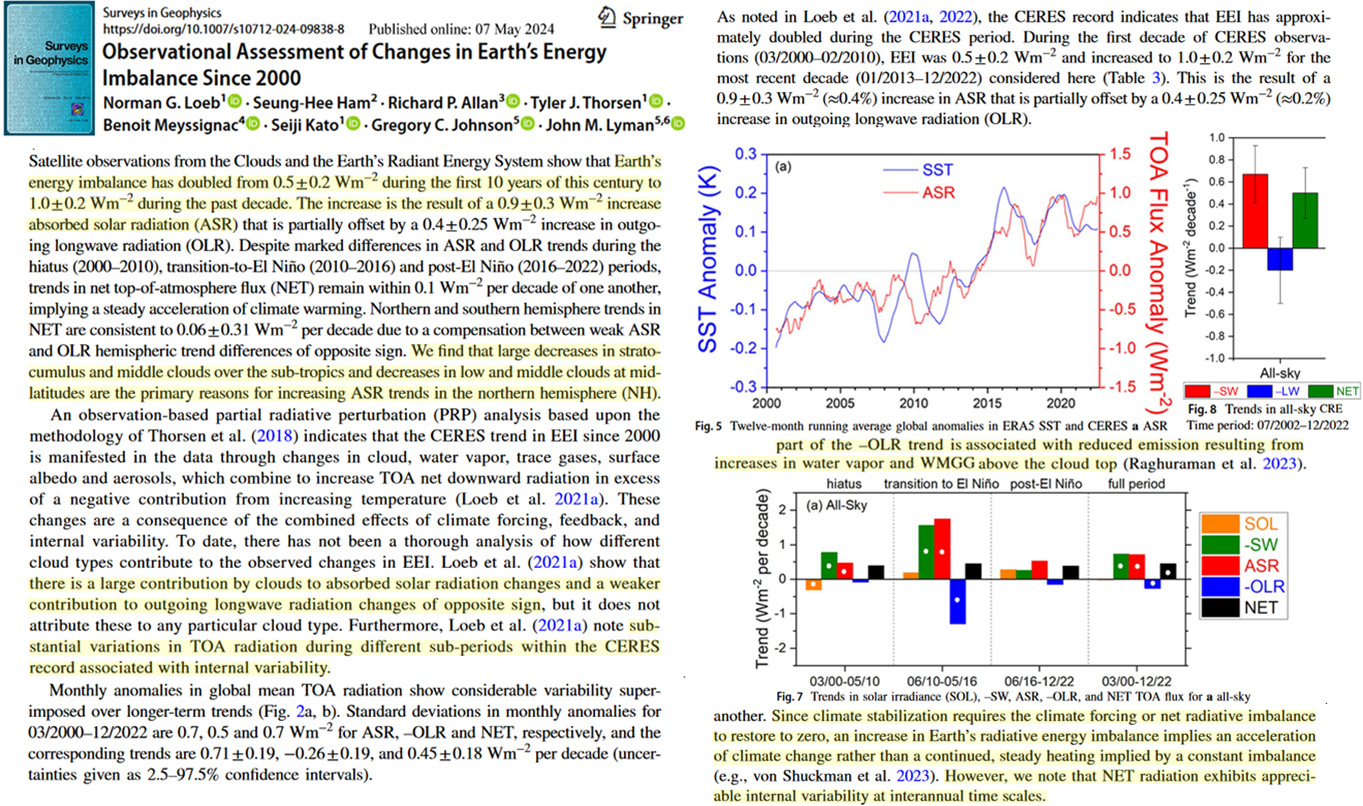
“Earth’s energy imbalance has doubled from 0.5 ± 0.2 W/m² during the first 10 years of this century to 1.0 ± 0.2 W/m² during the past decade. The increase is the result of a 0.9 ± 0.3 W/m² increase absorbed solar radiation (ASR)…”  − Loeb et al., 2024

Satellite observations from CERES (Clouds and the Earth’s Radiant Energy System) indicate cloud cover has been declining since 2000. Declining cloud cover has meant less shortwave radiation has been reflected to space, resulting in an increase in the solar radiation absorbed by the Earth’s surface (ocean).

Earth’s Energy Imbalance (the net difference between incoming and outgoing energy) has been increasingly positive since 2000, rising from an average +0.5 W/m² from 2000 to 2010 to +1 W/m² in the last decade. This positive trend is the consequence of the +0.9 W/m² increasing trend in absorbed solar radiation (ASR) due to this observed decline in cloud cover.

Thus, the 2000-2022 increase in sea surface temperatures (SST) can be explained by increases in shortwave (SW) forcing, and not an enhanced greenhouse effect due to rising greenhouse gases.

Image Source: Loeb et al., 2024

The reason we can say greenhouse gases cannot explain modern warming is because the positive shortwave (SW) forcing driving SST increases has been partially offset – reduced – by a declining greenhouse effect or longwave (LW) forcing (-0.4 W/m²) over this period. This is manifested as an increasing outgoing longwave radiation (OLR) trend (more energy lost to space) during the first 23 years of the 21st century.

The LW forcing trend is partially impacted by trace greenhouse gases like CO2 and CH4, as well as by water vapor.

“…part of the -OLR trend is associated with reduced emission resulting from increases in water vapor and WMGG [well mixed greenhouse gases] above the cloud top…”

But the predominant factor affecting OLR is the decadal-scale trend in cloud cover, referred to as the cloud radiative effect (CRE). While declining cloud cover results in increasing absorbed solar radiation (see the red positive SW bar on the CRE chart), it simultaneously enhances, rather than reduces, the outgoing longwave trend (as shown in the blue negative LW bar in the CRE chart).

In other words, the greenhouse effect impact, manifested as the trend in OLR, has been heading in the opposite direction of what it should have been if anthropogenic CO2 emissions were indeed driving global warming. CO2 emissions are not impactful enough to reverse the overall sign of longwave radiation.

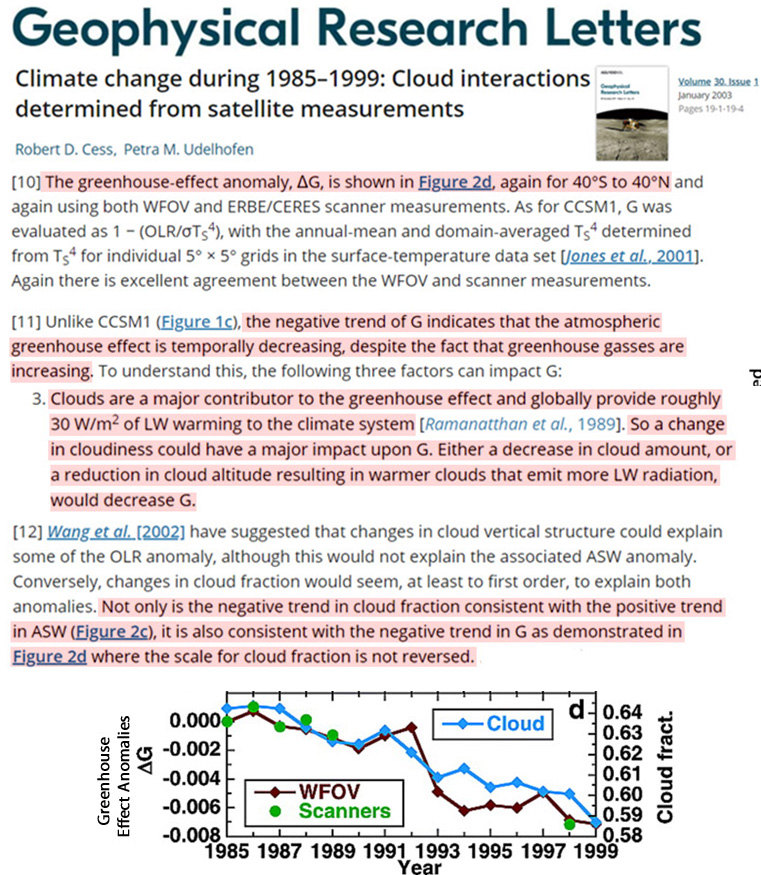
According to Cess and Udelhofen (2003), a negative greenhouse effect influence – enhancing cooling – was also observed over the 1985-1999 period. Thus, extending the 2000-2022 trend another 15 years, the total greenhouse effect forcing may have actually been cooling the Earth for more than 35 years.

Image Source: Cess and Udelhofen, 2003

Models say an enhanced greenhouse effect due to increasing trends in well-mixed greenhouse gases explains the rise in SSTs in recent decades. These model results are not supported by observations.

via NoTricksZone

https://ift.tt/4cSBlgr

September 9, 2024 at 10:17PM

VP Harris hasn’t ‘moderated’ on climate issues – She doubles down on ‘climate crisis’ narrative, still supports net-zero policies that will harm grids, U.S. farming, and domestic energy

KamalaHarris hasn’t “moderated” on climate issues. She doubles down on “climate crisis” narrative, still supports net-zero energy policies that will harm grid stability, agriculture, and all energy-related sectors. Nor does she regret her IRA vote.

via Watts Up With That?

https://ift.tt/LBHqicp

September 9, 2024 at 08:03PM