
0 out of 10 based on 0 rating
via JoNova
September 7, 2024 at 09:15AM
Another milestone on the road to complete ideological capture of our scientific institutions.
When my son prepared college applications, the only standardized test he wanted to use was ACT. It covered four academic skill areas: English, mathematics, reading, and scientific reasoning.
As many of you know, my physics-oriented son figured he would do well on the scientific reasoning portion. He did well enough to be a US Air Force Academy graduate working as a physicist.
Scientific reasoning is important, as it helps discern truth from fiction and allows sensible policies based on facts and reason to be formed.
Unfortunately, the ACT organization that administers the test has figured that American students are not getting enough science in their academic experience, so the test is now optional.
In fact, the whole test has been dumbed down.
The science portion of the ACT is no longer required. When registering for the test, students will have the option to take the science section, like the writing section.
The composite score will now be the average of the English, Reading, and Math sections.
One part of the decision was that ACT wanted to align more with other standardized tests. For example, the SAT does not have a science section. Another factor in the decision-making process was student opinions.
“They got lots of feedback from students, the test takers, about what are some things that you struggle with, with the ACT, and not needing that science component was something that those students spoke to,” said Laura Clark, Rankin County School District Assessment Coordinator.
Clark served on a district advisory committee for the ACT.
Also, the entire test will be shorter. ACT cut questions from each of the required sections, cutting a total of 44 questions.
Passages in the Reading and English sections have been shortened to give students more time to focus on the question.
The step is just another milestone on the road to the complete ideological capture of our scientific institutions. Some recent Legal Insurrection articles that highlight the unintended and potentially destructive consequences of this ideological capture include:
The trend is continuing. In City Journal, contributing editor John Tierney reviews how the preference for DEI dogma over scientific inquiry on campuses has become increasingly prevalent. His many examples are disturbing, especially as they push clear-thinking men out of science.
Other psychologists, frustrated at the growing reluctance of journals to publish anything that offends progressives, have been quietly advising their best students to avoid this politicized discipline altogether, particularly the male students hoping to become professors.
… As today’s younger professors gain seniority and hire colleagues who share their politics and fit their preferred identity groups, fewer talented scientists will remain to tackle the difficult questions—and more scientists will be determined to stop anyone from trying.
I am glad my son can do the science that he loves. I want others who follow him to be able to do the same. I hope this trend away from scientific rigor in favor of social justice metrics can be reversed.
The Legal Insurrection team has been doing good work, but there is still much more.
via Watts Up With That?
September 7, 2024 at 08:07AM
By Paul Homewood
More Bill Gates funded propaganda:


Meanwhile back in the real world, Africa continues to enjoy ever increasing food production, longer lives, record low deaths from malnutrition and steadily growing GDP.
All of this has been made possible by fossil fuels:


https://ourworldindata.org/economic-growth

https://www.statista.com/statistics/1300858/total-gdp-value-in-africa/
.Meanwhile not only has the Sahel along with other regions in Africa been greened by extra CO2 in the atmosphere, scientists say that a warmer world could see a return to the wetter climate enjoyed during the warmer early Holocene era.

In the future, the Sahara and Sahelian regions could experience more rainfall than today as a result of climate change. Wetter periods, termed African humid periods, occurred in the past and witnessed a mesic landscape in place of today’s hyperarid and semiarid environment. Such large past changes raise the question of whether the near future might hold in store similar environmental transformations, particularly in view of the growing human-induced climate, land-use, and land-cover changes. In the last decades.
https://www.sciencedirect.com/science/article/pii/S2590332220301007
via NOT A LOT OF PEOPLE KNOW THAT
September 7, 2024 at 05:14AM
According to NOAA and the IPCC, 1923 was one of the coldest years of the last millennium.

Climate at a Glance | Global Time Series | National Centers for Environmental Information (NCEI)

Glaciers were rapidly melting in the official record cold.
“Medford Mail Tribune (Medford, Oregon) – 29 Dec 1923, Sat
Glacier Park Melting at a Rapid Rate in Scientist’s Opinion
CINCINNATI, Dee. 29.—(By the Associated Press)—The hot seasons of the past few years have caused rapid disintegration of glaciers in Glacier National park, Montana, professor W. G: Waterman of North- western university declared in an ad- dress today before the Geological section of the American Association for the Advancement of Science,
Sperry Glacier, studied by Professor Waterman, has lost one-quarter, or perhaps one-third of its ice in the past 18 years, he said. If this rapid retreat should continue, the professor added, the glacier would almost disappear in another 25 years, but he expressed the opinion that the long dry seasons of the past few years is over with probabilities of a lessening in the retreat.”
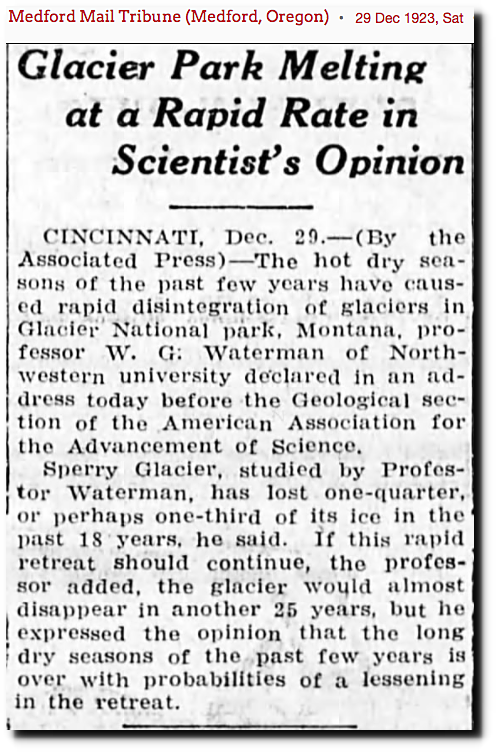 29 Dec 1923, Page 5 – at Newspapers.com
“Maitland Daily Mercury (NSW : 1894 – 1939), Saturday 7 April 1923, page 2
CHANGE OF CLIMATE. MANY GLACIERS VANISHED.
Is the North Pole going to melt en-tirely ? Are the Arctic regions warm-ing up, with prospect of a great cli-matic chaange in that part of the world ? Science is asking these questions (says “Popular Science Siftings”).
Reports from fishermen, seal hunters, and explorers who sail, the seas around Spitzbergen and the eastern Arctic all point to a radical change in climatic conditions, with hitherto unheard-of high temperatures on that part of the earth’s surface. Observations to that effect have covered the last five years during which the warmth has been steadily increasing. In August the Norweg-ian Department of Commerce sent an expedition to Spitzbergen and Bear Island under the leadership of Dr. Adolf Hoel, professor of geology in the University of Christiania, the ob-ject in view being to survey and chart areas productive of coal and other minerals. The expedition sailed as far north as 81 deg. 20min. N. lati-tude in ice free water. Such a thing, hitherto, would have been deemed impossible. The United States Consul at Ber-jen, Norway, Mr. Ifft, also reports the recent extraordinary warmth in the Arctic. He quotes incidentally the statements of Captain Martin In-gehrigststen, a mariner who has sailed those seas for fifty-four years. The captain says that he first
noted an unusual warmth in 1918, and since then temperatures have risen steadily higher. To-day the eastern Arctic is “hardly recognis-able as the same region of 1865 to 1917.” Many of the old landmarks are greatly altered, or no longer exist. Where formerly there were great masses of ice, these have melted away leaving behind them accumulations of earth and stones such as geolo-gists call “moraines.” At many points where glaciers extended far into the sea half a dozen years ago they have now entirely disappeared. The change in temperature has brought great changes in the plant and animal life of the Arctic. For merly vast shoals of whitefish were found in the waters round Spitzber-gen, but last summer the fishermen sought them in vain. SEALS DISAPPEAR.
Seals, which used to be plentiful in those seas, have almost entirely disappeared. It would seem as if the ocean must have become uncomfort-ably warm for some of its denizens which formerly frequented those latitudes, causing them to float northward towards the Pole. On the other hand other kinds of fishes, hitherto unknown so far north have made their appearance. Shoals of smelt have arrived, and immense schools of herring are reported by fishermen along the west coast of Spitzbergen. Formerly the waters about Spitz-bergen have held an even summer temperature in the neighbourhood of 5 degrees above freezing. This year it rose as high as 28 degrees. Last winter the ocean did not freeze over even on the north coast of Spitzber-gen. This is on the authority of Dr. Hoel. This state of affairs is a cause of much surprise and even astonishment to scientists, who wonder whether the change is merely temporary or the beginning of a great alteration of climatic conditions in the Arctic, with consequent melting of the polar ice sheet. ”
Just having fun
This entry was posted in Uncategorized. Bookmark the permalink.
via Real Climate Science
September 7, 2024 at 04:16AM

