Author: Iowa Climate Science Education

Net Zero targets “Unachievable” says Air New Zealand and nearly 70% of Australian companies “not even trying”

Dystopian crash. Fantasy in ruins.

By Jo Nova

And the flavor of the month is “failure”

Air New Zealand announced this week that it would not be able to cut its carbon emissions by 29% by 2030. The levers were” outside their control”, they lamented, which was the polite way of saying there isn’t enough sustainable jet fuel in the world, electric planes die after a few weeks,  and no one has invented a low emissions plane yet. At the moment the only kind of Net-Zero-flying is not to fly at all.

Current supplies of sacred sustainable fuel are rapidly growing but barely 0.5% of total requirements. Even though production is expected to triple this year to 1.5 Mt of Sustainable Aviation Fuel, the industry needs 200 times what is currently available.

If someone could just invent an anti-gravity machine, or a nuclear jet…

By Charlotte Graham-McLay, Associated Press

Air New Zealand has pulled the plug on its climate targets saying the resources needed to meet them are unaffordable and unavailable.

In a statement the airline said it was removing its 2030 carbon intensity reduction target and will withdraw from the Science Based Targets initiative.

This is the sound of the free market saying “It’s a stupid idea”:

Sustainable transport researcher Dr Paul Callister said Air New Zealand’s climate target was unrealistic and was never going to be achieved. … “We’ve seen report after report saying that sustainable aviation fuels are not being produced and the quantities they should be and part of the problem is that airlines are not willing to pay the full cost of it. They’re wanting cheap fuels and they’re wanting government subsidies to pay for those fuels. It’s a bit of a vicious cycle.

Of course, if customers thought the world was really going to end they might be willing to pay for expensive fuels to prevent that. But no one really believes it.

It was all so different just a few years ago — endorsed by the most Experty experts:

Tuesday’s update was a sharp turnaround from a 2022 announcement by Air New Zealand in which it declared itself the second carrier in the world to have its plans validated by the U.N.’s Science Based Targets initiative aviation framework. It pledged a 28.9% reduction in carbon emissions by 2030, from a 2019 baseline, with a 16.3% drop in absolute emissions.

It was a Science Based Target don’tcha’know?

Meanwhile in Australia most companies are far behind Air New Zealand. Where the airline has tried and failed, 42% of Australian companies have not even started.

By Jared Lynch, The Australian Business Review

Now, a survey of more than 500 companies from Schneider Electric — the biggest adviser of Australian commercial power users — says 28 per cent have no intention of meeting their Paris Agreement commitments. A further 42 per cent say they have not begun decarbonising their operations.

The worst performers in meeting climate goals were smaller companies, healthcare, construction and professional services, with the Schneider survey revealing 18 per cent did not know where to start, while almost a quarter did not consider it a priority.

Ponder just how devastating this is. 42% of Australian companies have not even begun, and another 28% have no intention of  finishing.

That’s a 70% failure rate.

Image by Eynoxart from Pixabay


0 out of 10 based on 0 rating

via JoNova

https://ift.tt/LZd4ksX

July 31, 2024 at 01:51PM

The Effect of a Colder Solid’s Thermal Radiation on a Warmer Solid Exposed to Sunlight

experiments performed July 10th 2024

by Dale Cloudman

Abstract

It is experimentally shown that the thermal radiation from a transparent, colder solid has the capacity to influence a solid warmer than it to become even warmer, under the right circumstances. This dispels the critique of the greenhouse effect that, as heat only flows from hot to cold, the effect is thermodynamically impossible. Even so, significant portions of the theory of the greenhouse effect remain experimentally unproven, signaling caution rather than uncritical acceptance of the theory.

Introduction

A long-running debate about the physical reality of the greenhouse effect centers around whether the thermal radiation from the colder atmosphere can possibly have a warming effect on the warmer Earth’s surface. The argument goes as follows: as heat only flows from hot to cold, the radiation emitted by a colder object cannot possibly cause a warmer object to become warmer. It might have a reduced cooling effect, but under no circumstances can it result in a warming effect.

The most salient features of such debates are that neither side provides experimental evidence in their defense, and that the debates frequently devolve into heated arguments, which is generally an indicator that solid arguments are lacking. As genuine scientific knowledge is acquired via experimentation performed in physical reality, and not theory or “experiments” (sic!) consisting of computer simulations, I sought to settle the debate once and for all with a properly-performed experiment.

I constructed a de Saussure-style hotbox, above which I placed a clear glass plate separated by a good amount of space. I pointed it towards the Sun, and, left to its own devices, the bottom of the box got to around 100ºC, with the glass plate getting to around 30ºC. I then swapped the glass plate with an identical one that was pre-heated to 60-70ºC, and the result was unmistakable: the already much hotter bottom of the box got even hotter as a result. I ruled out any possible conductive or convective effects, concluding it was due to increased thermal radiation coming from the +30-40ºC warmer glass plate. Although this neatly dispels this particular critique of the greenhouse effect, significant obstacles remain before being able to accept that the greenhouse effect behaves as-described.

The Demonstration

The apparatus (Figure 1, Figure 2) consists of a hotbox made of styrofoam, with the inside floor being cardboard and the inside walls and floors spray-painted black. Two layers of thin plastic polyethylene film suppress convection with the outside air. Surrounding these is another piece of styrofoam to further prevent heat loss through the sides. Cotton padding between the styrofoam pieces provides further insulation.

On top of the hotbox are two styrofoam walls that support an extra-clear glass plate on top. This is the glass that is swapped with an identical, hotter version during the experiment. A middle mount point allows the optional mounting of another plate in the middle.

Temperatures are measured with Type K thermocouples, labeled and color-coded for ease of reference. Styrofoam pieces immediately above yet not touching them serve as radiation shields. The solar insolation is measured with an Apogee SP-510-SS pyranometer, and the net infrared gain or loss is measured with an Apogee SL-510-SS pyrgeometer.

I pointed the apparatus at the sun and let it heat up on its own. In the meantime, I set aside an identical extra-clear glass plate, on top of which I placed an aluminum plate with a pot of water on top. An immersion heater kept the water temperature at a constant 80-90ºC, which heat diffused downwards to heat the glass plate.

Once the bottom plate exceeded 100ºC, I swapped the cool glass with the hot glass, first by hovering the hot glass above it, then removing the cool glass and placing the hot glass in the same position. This swapping technique provides a dip in measured solar insolation due to both glasses absorbing the sunlight rather than just one. This clearly delineates the swaps, and ensures there is no extra heating effect due to slightly higher insolation that would happen if we first removed one glass and then replaced it with the other glass.

I performed five swaps as above, with Tcoolglass measuring 30-38ºC and Thotglass measuring between 67-75ºC at the start of the swaps. The result was clear and unambiguous in every case: Tbottom shot up rapidly in response. The following two runs are representative (Figure 3):

As is evident, before the first swap on the graph, Tbottom was increasing at a certain steady pace. After the swap to the hot glass (delineated by the purple vertical line), the rate of increase rapidly shot up. Once swapped back to the cool glass (delineated by the gray vertical line), Tbottom stabilized around 108ºC. It remained there for ~5 minutes, after which another swap caused it to increase rapidly again.

It is notable that at the exact moment of the swaps, the net infrared radiation Net IR picked up by the pyrgeometer remains negative yet increases. That is, the bottom’s radiative cooling is measurably lessened as a result of this swap.

To rule out differences between the two glass plates, such as the possibility of slightly more solar insolation which could cause a temperature change, I did two swaps with both glass plates at around the same temperature. With these swaps, no difference was observed in the evolution of Tbottom or in the Net IR.

Confirming the Radiative Nature of the Effect

It is important to rule out any convective effects as having caused the increase. The hotter glass will, of course, heat the air around it as well. How do we know that Tbottom didn’t get hotter because the hotter glass heated the air in-between, which then heated the thin plastic films, which then reduced the convective loss of the bottom and caused its temperature to increase?

The evidence is three-fold. First, we can observe that Tlowair did not noticeably increase as a result of the swap. Indeed, it was warmer before the swap than after (Figure 4):

Second, by includingTthin1 and Tthin2 in the graph, we can see that Tbottom increased first, and only nearly half a minute later did Tthin1 start to increase, soon after which Tthin2 increased as well (Figure 5). Thus the temperature increase started from bottom to top, not from top to bottom, meaning the observed increase could not be due to the air being heated from the top. 

Third, I repeated the experiments, but with a thin borosilicate plate mounted in the middle of the apparatus (Figure 6). Borosilicate is highly absorbent of infrared radiation. If the effect is radiative, we would expect the borosilicate to absorb any extra thermal radiation from the hotter glass, preventing Tbottom from increasing. This is precisely what happened. During these runs, the Net IR did not change when the hotter glass was swapped in, nor did Tbottom respond to the swaps.

Thus we have to conclude that the increased thermal radiation from the hotter glass is what caused the bottom to increase in temperature, even though the hotter glass itself was much cooler than the bottom.

Analysis

How does this not violate the laws of thermodynamics, wherein heat only flows from hot to cold? The answer is that one must consider all the heat flows in the system. When Tbottom is at a steady temperature around 108ºC, it is because the amount of heat it is gaining from all sources is equal to the amount of heat it is losing to all sinks. At that temperature, the only heat it is gaining is from the sunlight, which is actually the thermal radiation emanating from our nearby star with its surface temperature of 5900K. It is at the same time losing heat conductively with the bottom of the hotbox and the walls, convectively with the air in the box, and radiatively with the plastic wrap layers, the glass, and the sky above. The hotbox itself is also losing heat convectively with the outside air.

When the hotter glass is swapped in, effectively the only change is that now the bottom is losing less heat radiatively to the glass. With all else being equal, it is thus now gaining more heat from the sunlight than it is losing to all other sources, and the result is an increase in temperature. Notably, without the much hotter sun as a heat source, the increase in temperature would not be observed; only a reduced cooling effect would occur.

Conclusion

There are several key differences between the experiment performed here and the theorized radiative greenhouse effect, such that this experiment does not serve as verification of the latter.

  1. The hotbox is heavily insulated and enclosed to suppress convective heat loss. By contrast, the majority of the heat loss by the Earth’s surface is due to convective loss to the air.
  2. The temperature ranges are different, with the Earth’s surface being around 15ºC and the air ranging from 15ºC to -55ºC with increasing altitude, contrasted with 100ºC for the black bottom and 30-70ºC for the glass.
  3. The colder object is a solid plate of glass as opposed to a column of atmospheric air, i.e. a large volume of gas.
  4. The warmer object is a uniform pitch-black plate, as distinct from the Earth’s surface with its varied terrain, soil, plant, foliage, ice, snow, water, etc. 
  5. The greenhouse effect is due to the air becoming more absorbent of and emissive of thermal radiation at the same temperature, while the experimental result was due to the colder object retaining the same emissive properties yet becoming hotter.
  6. The observed time duration was minimal and no conclusions can be drawn about the total magnitude of the effect or what effects it may have in the long run.

    Indeed, the greenhouse effect theory has a large gap when it comes to the empirical demonstration of the greenhouse effect’s total effect on surface temperatures. It largely relies on a simplified calculation that shows the Earth’s average temperature would be -18ºC without any atmosphere. This calculation even includes the albedo effect of clouds, which would not be present without an atmosphere. Further it ignores all the distinctions listed above, and doesn’t account for the adiabatic lapse rate, which is the main reason why the bottom of the grand canyon is +50ºC warmer on average than the peak of Mount Everest. Such a lapse rate occurs entirely due to non-radiative effects, and therefore would have some effect even if the air were fully transparent to infrared radiation.

  7. The observed temperature increase here was due to swapping in a hotter glass plate that was externally heated by another heat source (i.e. neither the sun nor the black bottom). This is in contrast with the greenhouse effect, where the atmosphere’s thermal radiation that is theorized to result in a much warmer surface temperature, is initially warmed by the surface itself. This gives the appearance that it presents a situation where an object is able to heat itself up with its own heat – first the atmosphere at the same temperature emits thermal radiation according to its own temperature, which then results in a warmer surface, that then in turn heats the atmosphere further, etc., in a (diminishing) feedback loop.

    Although the experiment performed here indicates that the presence of the sun ought to make this possible, and Infrared Halogens appear to exploit an analogous mechanism to reduce energy consumption, an experiment should be done to confirm this is the case. It is notable that past experiments have failed to definitively show a powerful effect: R W Wood’s 1909 experiment showed “scarcely a difference of one degree” between two hotboxes, one with a radiatively-absorbent glass lid and one with a radiatively-transparent rock salt lid, where we would expect the radiatively-absorbent lid to result in a much hotter temperature due its higher radiative emissions as well. More recently, a re-do of Wood’s experiment “performed more carefully” by Pratt actually replicated the result, despite being heavily critical of Wood: a difference of 1.1ºC between the floor of a hotbox with a glass lid vs one with a rock salt lid. Pratt further showed that the glass lid was actually 6.2ºC hotter than the rock salt lid. This further complicates the analysis as convective heat transfer is proportional to temperature difference and indicates the +1.1ºC result is at least in part due to reduction of convective heat loss.

  8. Finally, even if the basic greenhouse effect were to be conclusively demonstrated, it is well-known that the current levels of CO2 are already saturated with regards to higher concentrations causing higher thermal emissions. The enhanced greenhouse effect is said to occur due to the much colder higher-altitude layers of the atmosphere absorbing and emitting more thermal radiation, thus having a cascading effect on the air immediately below it, which in turn has an effect on the air below, and so on up to the surface. In other words, the hotter absorbing element in the enhanced greenhouse effect is also atmospheric air, and not a solid object. This provides further complications as atmospheric air can freely travel vertically up and down, and hot air tends to expand and rise.

In conclusion, although the thermodynamic possibility of colder objects causing warmer objects to increase in temperature has finally been conclusively demonstrated, a lack of experimental verification of other facets of the greenhouse effect theory warrants caution before accepting its conclusions.

via Watts Up With That?

https://ift.tt/tZn6yFN

July 31, 2024 at 12:05PM

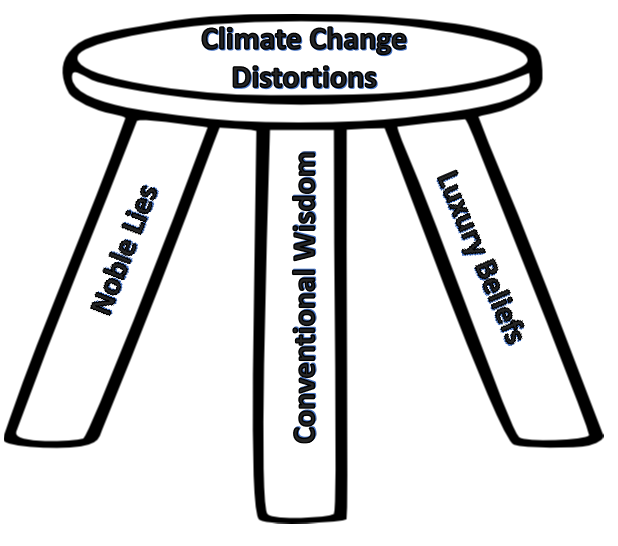
Roots of Climate Change Distortions

Roger Pielke Jr. explains at his blog Why Climate Misinformation Persists.  Excerpts in italics with my bolds and added images. H/T John Ray

Noble Lies, Conventional Wisdom, and Luxury Beliefs

In 2001, I participated in a roundtable discussion hosted at the headquarters of the National Academy of Sciences (NAS) with a group of U.S. Senators, the Secretary of Treasury, and about a half-dozen other researchers. The event was organized by Idaho Senator Larry Craig (R-ID) following the release of a short NAS report on climate to help the then-new administration of George W. Bush get up to speed on climate change.

At the time I was a 32 year-old fresh-faced researcher about to leave the National Center for Atmospheric Research for a faculty position across town at the University of Colorado. I had never testified before Congress or really had any high-level policy engagement.

When the roundtable was announced, I experienced something completely new in my professional career — several of my much more senior colleagues contacted me to lobby me to downplay or even to misrepresent my research on the roles of climate and society in the economic impacts of extreme weather. I had become fairly well known in the atmospheric sciences research community back then for our work showing that increasing U.S. hurricane damage could be explained entirely by more people and more wealth.

One colleague explained to me that my research, even though scientifically accurate, might distract from efforts to advocate for emissions reductions:

“I think we have a professional (or moral?) obligation to be very careful what we say and how we say it when the stakes are so high.”

At the time, I wrote that the message I heard was that the “ ends justify means or, in other words, doing the “right thing” for the wrong reasons is OK” — even if that meant downplaying or even misrepresenting my own research.

I have thought about that experience over the past few weeks as I have received many comments on the first four installments of the THB series Climate Fueled Extreme Weather (Part 1, Part 2, Part 3, Part 4). One of the most common questions I’ve received asks why it is that the scientific assessments of the Intergovernmental Panel on Climate Change (IPCC) are so different than what is reported in the media, proclaimed in policy, and promoted by the most public-facing climate experts. And, why can’t that gap be closed?

Over the past 23 years, I have wondered a lot myself about this question — not just how misinformation arises in policy discourse (we know a lot about that), but why it is that the expert climate community has been unable or unwilling to correct rampant misinformation about extreme weather, with some even promoting that misinformation.

Obviously, I don’t have good answers, but I will propose three inter-related explanations that help me to make sense of these dynamics — the noble lie, conventional wisdom, and luxury beliefs.

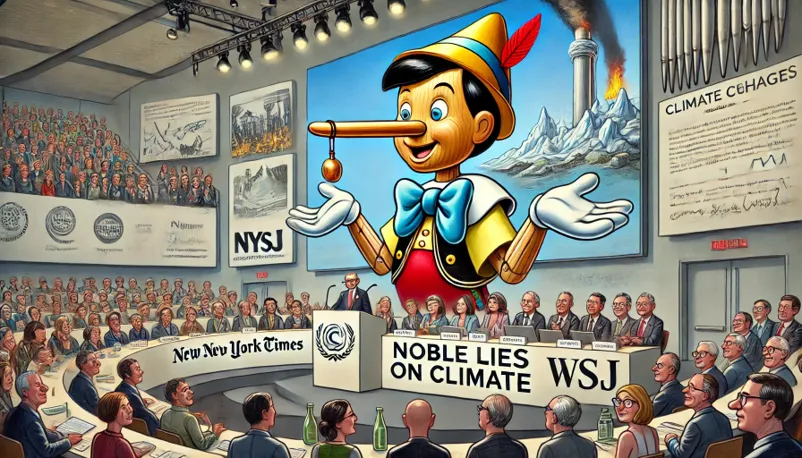
The Noble Lie

The most important explanation is that many in the climate community — like my senior colleague back in 2001 — appear to believe that achieving emissions reductions is so very important that its attainment trumps scientific integrity. The ends justify the means. They also believe that by hyping extreme weather, they will make emissions reductions more likely (I disagree, but that is a subject for another post).

I explained this as a “fear factor” in The Climate Fix:

Typically, the battle over climate-change science focused on convincing (or, rather, defeating) those skeptical has meant advocacy focused on increasing alarm. As one Australian academic put it at a conference at Oxford University in the fall of 2009: “The situation is so serious that, although people are afraid, they are not fearful enough given the science. Personally I cannot see any alternative to ramping up the fear factor.” Similarly, when asked how to motivate action on climate change, economist Thomas Schelling replied, “It’s a tough sell. And probably you have to find ways to exaggerate the threat. . . [P]art of me sympathizes with the case for disingenuousness. . . I sometimes wish that we could have, over the next five or ten years, a lot of horrid things happening—you know, like tornadoes in the Midwest and so forth—that would get people very concerned about climate change. But I don’t think that’s going to happen.” From the opening ceremony of the Copenhagen climate negotiations to Al Gore’s documentary, An Inconvenient Truth, to public comments from leading climate scientists, to the echo-chambers of the blogosphere, fear and alarm have been central to advocacy for action on climate change.

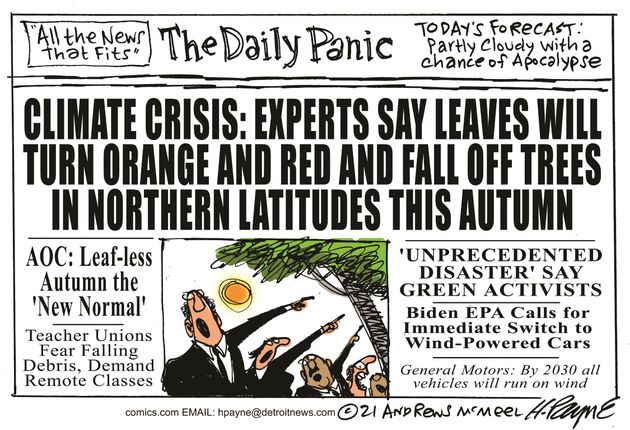
It’s just a short path from climate fueled extreme weather
to the noble lie at the heart of fear-based campaigns.

Conventional Wisdom

The phrase was popularized by John Kenneth Galbraith in his 1958 book, The Affluent Society, where he explained:

It will be convenient to have a name for the ideas which are esteemed at any time for their acceptability, and it should be a term that emphasizes this predictability. I shall refer to these ideas henceforth as the conventional wisdom.

The key point here is “acceptability” regardless of an idea’s conformance with truth. Conventional wisdom is that which everyone knows to be true whether actually true or not. Examples of beliefs that at one time or another were/are conventional wisdom include — Covid-19 did not come from a lab, Sudafed helps with hay fever, spinach is high in iron, and climate change is fueling extreme weather.

As the noble lie of climate fueled extreme weather has taken hold as conventional wisdom, few have been willing to offer correctives — Though there are important exceptions out in plain sight, like the IPCC Working Group 1 and the NOAA GFDL Hurricanes and Global Warming page.

Actively challenging conventional wisdom has professional and social costs. For instance, those who suggested that Covid-19 may have had a research-related origin were labeled conspiracy theorists and racists, those who suggested that President Biden was too old to serve another term were called Trump enablers, and those who accurately represent the science of climate and extreme weather are tarred as climate deniers and worse.

A few years ago I wrote an op-ed for a U.S. national newspaper and included a line about how hurricane landfalls had not increased in the U.S. in frequency or in their intensity since at least 1900. The editor removed the sentence and told me that while the statement was correct, most readers wouldn’t believe it and that would compromise the whole piece.

When noble lies become conventional wisdom,
they become harder to correct.

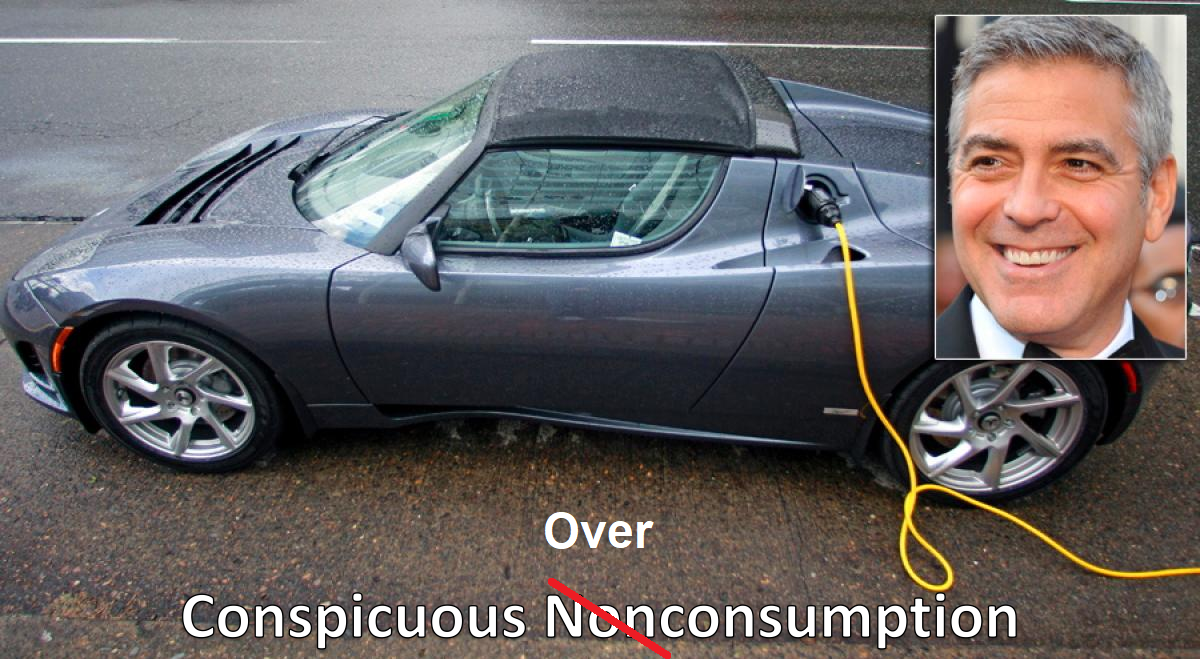
Luxury Beliefs

Yascha Mounk offers a useful definition:

Luxury beliefs are ideas professed by people who would be much less likely to hold them if they were not insulated from, and had therefore failed seriously to consider, their negative effects.

After all, what is the real harm if people believe in climate fueled extreme weather? If people believe that the extreme weather outside their window or on their feeds make aggressive climate policies more compelling, then that’s a good thing, right?

Surely there can only be positive outcomes that result from promoting misunderstandings of climate and extreme weather at odds with evidence and scientific assessments?

Well, no.

Last year I attended a forum at Lloyd’s of London — the event was held under the Chatham House rule, and in the event, later reported by the Financial Times, the company made a surprising admission contrary to the conventional wisdom (emphasis added):

Lloyd’s of London has warned insurers that the full impact of climate change has yet to translate into claims data despite annual natural catastrophe losses borne by the sector topping $100bn.

Insurance prices are surging as companies look to repair their margins after years of significant losses from severe weather to insured properties, exacerbated by inflation in rebuild costs. A warming planet has been identified by insurance experts and campaigners alike as a key factor.

But at a private event last month, one executive at the corporation that oversees the market told underwriters that it has not yet seen clear evidence that a warming climate is a major driver in claims costs.

It turns out that misunderstandings of the science of climate and extreme weather actually lead to unnecessary costs for people whose jobs involve making decisions about climate and extreme weather. Those unnecessary costs often trickle down to ordinary people. Kudos to Lloyd’s for calling things straight, even if only in a private forum — That is of course their professional responsibility.

Conclusion

In a classic paper in 2012, the late Steve Rayner explained that some forms of social ignorance are created and maintained on purpose:

To make sense of the complexity of the world so that they can act, individuals and institutions need to develop simplified, self-consistent versions of that world. The process of doing so means that much of what is known about the world needs to be excluded from those versions, and in particular that knowledge which is in tension or outright contradiction with those versions must be expunged. This is ‘uncomfortable knowledge’.

Climate fueled extreme weather is perhaps the canonical example
of dysfunctional socially constructed ignorance.  It may be
uncorrectable — a falsehood that persists permanently.

Here at THB, I am an optimist that science and policy are self-correcting, even if that takes a while. That means that the series on climate fueled extreme weather will keep going — Have a great weekend!


via Science Matters

https://ift.tt/xwTYtC9

July 31, 2024 at 11:40AM

Is This Really the Best They Can Do?

Aficionados of this website will have learnt a long time ago that I have a pronounced distaste for psychologists who try to explain climate change ‘denial’ by using taxonomies of cognitive bias. Personally, I’d throw all such research into a deep pit, were it not for the fact that it would have to be bottomless in order for it not to overflow. It just never occurs to these people that the reason why we haven’t all swallowed the authorised narrative in all its glory is because we think we can see technical flaws in it. On the contrary, they don’t have to even think about such a possibility because they already have their answer: To disagree with a scientific consensus is irrational, and so those who do so must be cognitively challenged in a way that no one else is. For example, in his piece, ‘Roots of Climate Change Denial’, climate activist David Selby, approvingly observes:

In Don’t Even Think About It, George Marshall devotes very little space to the science of climate change. What science there is appears in a four-page add-on chapter at the very end of his 260-page book. His motive here is to underscore that the climate change challenge is not primarily techno-scientific but rather psychological.

And when Selby refers to a psychological challenge, what he means is that cognitive bias is the root cause of ‘denial’. Providing frameworks for overcoming such bias is what the psychology profession is here to do.

Quite apart from the arrogant presumption on show here, what I find particularly troublesome is the failure to recognise the universality of cognitive bias and how it affects everyone’s deliberations, notwithstanding the extent to which an individual’s conclusions do or do not ultimately align with the socially accepted view. They are heuristics that have evolutionary benefit and if you want to understand how they operate you need to appreciate what they are actually good for and the circumstances in which the heuristic can nevertheless mislead. Simply focusing upon one group of people who you deem to be incorrect and observing how a bias manifests itself in their particular case does not give you the cause of the bias. For the full picture, one also has to consider how the same bias can play a role in arriving at an alternative view, and thereby recognise that the bias itself does not necessarily explain differences of opinion. It is because this basic principle is so rarely acknowledged that the vast bulk of the material written on this subject is selective at best and, at worst, opinionated nonsense. It is this failure that has resulted in a preoccupation with the psychology of the contrarian and a complete neglect of the psychology behind a blind trust in authority.

A practical example

As a case in point, consider the following paper, ‘A framework to address cognitive biases of climate change’, written by Jiaying Zhao and Yu Luo of the University of British Columbia, in which the following bold claim is made:

We propose a framework that outlines several predominant cognitive biases of climate change, identifies potential causes, and proposes debiasing tools, with the ultimate goal of depolarizing climate beliefs and promoting actions to mitigate climate change.

The opening sentence of the paper reads, ‘Climate change is an urgent crisis facing humanity’. It is clear therefore that the authors believe the ‘techno-scientific’ issue to have already been dealt with and all that remains is the challenge of identifying and combating the cognitive biases that cause people to disagree with such a verdict. Accordingly, the paper comprises a list of cognitive biases, their presupposed causes and how they may be overcome in order to put the climate change sceptic back on the right track. I’d like to quickly go through that list with you, pointing out in each case how the cause of bias is misdiagnosed and what would therefore need to be added in order to arrive at a fair and balanced assessment.

Attentional Bias

What the authors say it is:

Allowing political orientation or prior beliefs about climate change to influence what information is attended to.

What the authors say causes it:

To be fair, the authors put this down to motivated reasoning that they admit can exist on both sides of the political divide (in this case Republicans and Democrats). However, according to them, it is only the Republicans who are actually misled by this bias, because it causes them to fail to appreciate that climate change is an urgent crisis facing humanity. To overcome this, the authors propose that one should try to invoke the Republicans’ own values when seeking to convince them of the need to tackle climate change.

The true cause:

Attentional bias is the tendency to prioritize the processing of certain types of stimuli over others. This has the evolutionary advantage of prioritising those stimuli that are suggestive of threats and opportunities. Everyone is subject to this bias. You wouldn’t last long if you were not. The only difference is that we are all sensitised according to our mental model of how the world threatens us and where the opportunities it offers us lie.

What the authors should have also said to achieve balance:

The motivated reasoning runs far deeper than political orientation and prior beliefs about climate change. It is an irresistible bias that is driven by our survival instinct. There is no reason to presuppose that Democrats have a better mental model with which to prioritise the processing of stimuli. Rather than supposing this to be the case and seeking to redress the sceptical mind-set, one should instead return to the ‘techno-scientific’ issues but with a much wider scope of risk analysis and a better appreciation of how perspective and values influence risk evaluation.

Perceptual Bias

What the authors say it is:

Inaccurate perceptions of ingroup norms and outgroup norms leading to an exaggerated perception of the level of support for a given view or policy.

What the authors say causes it:

An inability to adapt to a new environment or update prior beliefs given new information. The authors propose that this may be overcome by reconstructing accurate representations of social norms.

The true cause:

Perceptual bias occurs when we subconsciously draw conclusions based on what we expect to see or experience. It has evolutionary advantage since more often than not our expectations are based upon a reliable model of how the world fundamentally works. However, this is not always the case and our perceptions can therefore be misleading.

What the authors should have also said to achieve balance:

We all carry prior beliefs that anchor us and modify the manner in which we perceive new information. Both nature and nurture play a role in deciding the form these preconceptions take, but there is no reason to assume that this is particularly true of climate change sceptics. Representations of social norms are not important to climate sceptics apart from when they argue that it is often a mistake to represent a social norm as having epistemic value.

Recall Bias

What the authors say it is:

Falsely recalling climate change to be less serious, which is associated with higher skepticism of climate change.

What the authors say causes it:

Lack of awareness of the urgency and severity of climate change. The authors propose that such ignorance can be tackled by acquiring attitudes, norms, and facts by observing the behavior of others or watching videos.

The true cause:

Recall bias is a systematic error that occurs when individuals do not remember previous events or experiences accurately or omit details. There are many reasons why such ‘false memories’ may be created. The authors’ conception of recall bias has nothing to do with true recall bias. They are instead alluding to a disputed assessment regarding the significance of past events.

What the authors should have also said to achieve balance:

The psychological affect that severe weather can have on the individual may indeed be influenced by their views on climate change, but that potential exists irrespective of what those beliefs may be. Furthermore, false recall (or more to the point, false assessment) can be just as readily inculcated by hyping the severity of recent weather as it can be by playing it down.

‘Techno-scientific’ concerns such as the integrity of climate data collection, collation and homogenisation, and of severe weather event attribution are relevant if the science is to be a reliable yardstick against which to compare personal recall. Severe weather event attribution is particularly germane here since the IPCC has openly advocated that it should be used to encourage a higher perception of the urgency and severity of climate change. It is not about changing memories so much as changing attitudes, such as viewing normal summer weather as a new threat worthy of health alerts.

Confirmation Bias

What the authors say it is:

Seeking information that confirms prior beliefs or discounting information that contradicts prior beliefs.

What the authors say causes it:

Lack of knowledge about the causes or consequences of climate change, or what actions to take.

The true cause:

The authors correctly describe what confirmation bias is but completely miss the point by suggesting it is born of ignorance. Confirmation bias provides an important evolutionary advantage since it encourages us all to be cognitive misers. With limited cognitive capacity, we should concentrate our efforts on what we understand to be effective and rewarding. This may lead to satisficing rather than optimising but this is often the best strategy for survival.

What the authors should have also said to achieve balance:

A reliance on confirmation bias is part of the human condition. Unfortunately, however, it is also a bias that commonly leads individuals to jump to the wrong conclusions and thereafter be very slow to recognise their error. However, this propensity is not limited to those who happen to hold views that lie outside the social norm. Those who believe that ‘climate change is an urgent crisis facing humanity’ are just as likely to indulge in confirmation bias to support that view. This is exemplified perfectly by the authors of this study when they assume cognitive bias is the rational explanation for climate scepticism and then mischaracterise cognitive biases to further their ‘explanation’.

Present Bias

What the authors say it is:

Priority given to people and objectives that are closer in terms of time and space than more distant ones.

What the authors say causes it:

Incorrect assumptions and inaccurate understandings of the drivers of climate change. To overcome such bias the authors suggest that one should generate arguments for forward-looking options and consider the legacy for future generations.

The true cause:

As always, one has to understand that the bias must have an evolutionary advantage, otherwise it would not have become an inherent human trait. In the case of present bias the underlying cause is an ambiguity aversion in which opportunities and risks that are better known or more easily formulated are preferred to those that require speculation. Normally this is a sensible approach; however, there are circumstances in which this strategy may turn out to be flawed, leading to a failure to delay gratification or to excessively downplay future risk. The authors are assuming that climate change is one of those situations, i.e. although it is a future risk that is hard for the individual to apprehend, it is nevertheless inappropriate to favour the present day rewards gained by failing to address this future risk.

What the authors should have also said to achieve balance:

It is wrong to portray present bias as the inappropriate discounting of future risk since it can just as easily apply to legitimate discounting. Whether or not it is appropriate on a given occasion is a highly ‘techno-scientific’ question that requires a full understanding of uncertainties and impacts associated with both the risk and its proposed reduction. When one looks at what the current UK Government proposes to do to ‘tackle climate change’, it actually becomes quite easy to argue for a greater degree of present bias.

Status Quo Bias

What the authors say it is:

An unwillingness to change the status quo because any change involves effort and uncertainty.

What the authors say causes it:

A false sense of contentment due to a lack of knowledge regarding the seriousness of climate change. To prevent individuals from making incorrect decisions based upon such ignorance, the authors suggest making ‘climate-friendly’ options the default.

The true cause:

Status quo bias assists us all by discouraging us from potentially unnecessary expenditure and the taking of unnecessary risk. Nevertheless, research has shown that the preference for a status quo can often be irrationally held, suggesting that that are other factors at play such as loss aversion and regret bias.  

What the authors should have also said to achieve balance:

Sometimes, of course, doing nothing is not the best course of action, but the fact that status quo bias has become a human instinct suggests that more often than not it is. As with present bias, the question as to whether status quo bias is beneficial or harmful in any given instance can only be settled by a ‘techno-scientific’ argument. Even so, there is no reason to focus purely upon the relevance of status quo bias to the sceptical position. It is equally of relevance to consider the effort and uncertainty that some individuals are prepared to advocate in order to retain a climatic status quo.

Pseudo-inefficacy

What the authors say it is:

A false sense of inefficacy of individual actions not making an appreciable contribution to solving a large overall problem.

What the authors say causes it:

Misperceptions such as the underestimation of carbon footprints associated with individual actions. The authors claim that this can be overcome by highlighting human contributions to climate change as opposed to natural causes.

The true cause:

Pseudo-inefficacy is a form of ‘psychic numbing’ in the face of a seemingly overwhelming challenge. It is not due to a misperception of the scale of the problem or that of available mitigations. Rather, it is a tendency to undervalue a given mitigation when the resulting risk remains large. For example, reducing the potential financial impact of a risk by £100 will be valued much greater if the initial potential impact were £200 than if it were £2,000,000. As such, pseudo-inefficacy bias has its basis in prospect theory.

What the authors should have also said to achieve balance:

Rather than pushing the narrative that every little helps, the authors should be emphasising the futility of a country achieving net zero in order to reduce global emissions by less than 2 per cent, whilst far larger contributors to the problem are increasing their emissions by a much larger amount. As well as pseudo-inefficacy there is such a thing as pseudo-efficacy.

Single-action Bias

What the authors say it is:

Perceiving a reduced risk of climate change after taking one climate action.

What the authors say causes it:

The temporary alleviation of negative affect after taking one climate action. The authors claim that this bias can be overcome by reinforcing the connection between climate actions and a person’s identity or values by reflecting on how the behavior is related to their values, identity, or views on how people in society should behave.

The true cause:

It is not clear from the literature that this bias even exists. It is a term coined by a Professor of Psychology and Public Affairs at Princeton University when observing that farmers tend to do only one thing to address climate change. The presupposition is that they are engaging in tokenism, i.e. they simply wish to be seen to have at least done something.

What the authors should have also said to achieve balance:

One cannot argue that there is such a thing as pseudo-inefficacy (‘a false sense of inefficacy of individual actions not making an appreciable contribution‘) and then complain about a supposed single-action bias. If individuals only wish to take one action, then they should be encouraged to do so because ‘every little helps’.

Conclusions

One has to question the motivation for writing papers such as this. It’s not as if it is original in any shape or form and so no one is going to give its authors credit for providing the breakthrough that finally unlocks the door to tackling climate change. What it does do, however, is lay on top of all of its predecessors, thereby helping to compost the genre. As such it is just another example of how a whole profession seems to have prostituted itself to the will of scientific consensus, not for one moment questioning the ‘techno-scientific’ details of which its members are only vaguely aware. Instead, they are finding a way to make what they think they understand about human nature fit their preconceptions of the climate sceptic. Furthermore, they think this can safely be achieved without actually engaging with them. In fact, avoiding such contact is deemed essential for a successful diagnosis. What follows is high-handed condescension.

All I can say is, whatever happened to peer review?

via Climate Scepticism

https://ift.tt/XJgkFZN

July 31, 2024 at 11:07AM