Gulf Stream Collapsing Again!

By Paul Homewood


Yes, it’s that old bogeyman again!


From the Mail:


image

The network of ocean currents which keep the Earth’s climate stable could be about to collapse, scientists have warned.

In an open letter, 44 of the world’s leading climate scientists say that key Atlantic Ocean currents – including the Gulf Stream – are on the brink of failure.

The scientists caution that the collapse of the Atlantic Meridional Overturning Circulation (AMOC) could lead to ‘devastating and irreversible impacts’ which will affect ‘the entire world for centuries to come’.

The resulting climate fallout could plunge the UK into a ‘new Ice Age’, with winter temperatures plummetting up to 15°C (27°F) below the current average.

While the collapse of the Gulf Stream would be disastrous for Britain, that vital current is just one small part of AMOC’s massive global system.

This giant ocean conveyor belt is critical for moving heat around the planet, but research suggests that it has been slowing down and could soon reach a tipping point.

Without urgent action, the scientists warn that AMOC could fail completely within the next few decades.

As warm water travels northwards from the tropics, it hits the sea ice around Greenland and the Nordic countries, cooling and becoming much saltier.

As the water cools it becomes denser, sinking rapidly towards the bottom of the ocean where it flows back southwards before once again warming and rising to the surface.

This process of ‘deep water formation’ is the engine for a vast global conveyor belt which pumps heat and water all around the Atlantic Ocean.

However, studies suggest that AMOC’s deep water engine has started to slow and is now showing worrying signs of breaking down altogether.

As global temperatures rise, melting ice pours fresh water back into oceans, diluting the denser salty water and preventing it from sinking.

If this process were to break down entirely, it would have catastrophic knock-on effects including the weakening of the Gulf Stream and the disruption of global weather patterns.
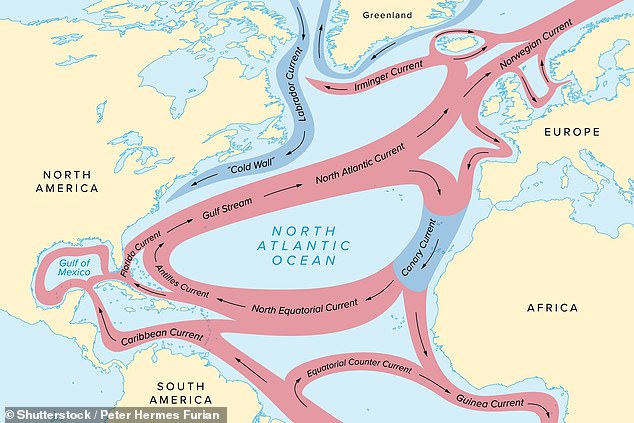
44 leading climate scientists have written an open letter to Nordic policymakers calling for action on the risk of the Atlantic Meridional Overturning Circulation (AMOC) ocean currents collapsing. These currents (pictured) are a vital engine for moving warm water around the planet 

https://www.dailymail.co.uk/sciencetech/article-13991003/Gulf-Stream-COLLAPSE-soon-scientists.html#newcomment

Its “The Day After Tomorrow” all over again!

As with a lot of climate scams, this one is based on just a few years data, from which the “scientists” conclude that they have identified cataclysmic changes that have not happened for millennia.

The Met Office give a more balanced summary:

image

image

image

https://www.metoffice.gov.uk/weather/learn-about/weather/oceans/amoc

“We do not believe any group of men adequate enough or wise enough to operate without scrutiny or without criticism. We know that the only way to avoid error is to detect it, that the only way to detect it is to be free to inquire. We know that in secrecy error undetected will flourish and subvert”. – J Robert Oppenheimer.

AMOC To Collapse Scam Is Back

February 10, 2024

tags: amoc, Arctic

By Paul Homewood

h/t Patsy Lacey

It’s the usual scam:

image

The circulation of the Atlantic Ocean is heading towards a tipping point that is “bad news for the climate system and humanity”, a study has found.

The scientists behind the research said they were shocked at the forecast speed of collapse once the point is reached, although they said it was not yet possible to predict how soon that would happen.

Using computer models and past data, the researchers developed an early warning indicator for the breakdown of the Atlantic meridional overturning circulation (Amoc), a vast system of ocean currents that is a key component in global climate regulation.

They found Amoc is already on track towards an abrupt shift, which has not happened for more than 10,000 years and would have dire implications for large parts of the world.

Amoc, which encompasses part of the Gulf Stream and other powerful currents, is a marine conveyer belt that carries heat, carbon and nutrients from the tropics towards the Arctic Circle, where it cools and sinks into the deep ocean. This churning helps to distribute energy around the Earth and modulates the impact of human-caused global heating.

image

But the system is being eroded by the faster-than-expected melt-off of Greenland’s glaciers and Arctic ice sheets, which pours freshwater into the sea and obstructs the sinking of saltier, warmer water from the south.

Amoc has declined 15% since 1950 and is in its weakest state in more than a millennium, according to previous research that prompted speculation about an approaching collapse.

Until now there has been no consensus about how severe this will be. One study last year, based on changes in sea surface temperatures, suggested the tipping point could happen between 2025 and 2095. However, the UK Met Office said large, rapid changes in Amoc were “very unlikely” in the 21st century.

The new paper, published in Science Advances, has broken new ground by looking for warning signs in the salinity levels at the southern extent of the Atlantic Ocean between Cape Town and Buenos Aires. Simulating changes over a period of 2,000 years on computer models of the global climate, it found a slow decline can lead to a sudden collapse over less than 100 years, with calamitous consequences.

The paper said the results provided a “clear answer” about whether such an abrupt shift was possible: “This is bad news for the climate system and humanity as up till now one could think that Amoc tipping was only a theoretical concept and tipping would disappear as soon as the full climate system, with all its additional feedbacks, was considered.”

https://www.theguardian.com/environment/2024/feb/09/atlantic-ocean-circulation-nearing-devastating-tipping-point-study-finds

As with a lot of climate scams, this one is based on just a few years data, from which the “scientists” conclude that they have identified cataclysmic changes that have not happened for millennia.

The Met Office give a more balanced summary:

image

image

image

https://www.metoffice.gov.uk/weather/learn-about/weather/oceans/amoc

.

Not this particular sentence:

Oceanographers have been measuring the AMOC continuously since 2004. The measurements have shown that the AMOC varies from year to year, and it is likely that these variations have an impact on the weather in the UK. However it is too early to say for sure whether there are any long term trends. Before 2004 the AMOC was only measured a few times,

So we only have data since 2004, and the year to year variations are large. To pretend that such a short series is in any way significant is not only unscientific but fraudulent.

This is what the series shows:

 time series

https://climexp.knmi.nl/getindices.cgi?WMO=NOCData/moc_mar_hc10_mon&STATION=AMOC_26N&TYPE=i&id=someone@somewhere&NPERYEAR=366

.

It would appear that there is little trend since around 2008.

The idea that the AMOC never changed before 2004 is absurd anyway.

Bob Dickson & Svein Østerhus laid out in their study, “One hundred years in the Norwegian Sea”, the major climatic changes in the Norwegian Sea and the rest of the Arctic:

image

All were associated with changes in Atlantic currents and the AMOC. The Warming in the North, for instance, occurred because of the influx of warm Atlantic seawater, in exactly the same way as with recent Arctic warming. As the Met Office explain, warm water evaporates leaving saltier water, which sinks because it is more dense. Saltier water of course freezes at lower temperatures, so Arctic sea ice tends to contract. (Note when it freezes, the salt tends to leech out, so either way the sea becomes saltier).

The Great Salinity Anomaly which followed the Warming was the result of that influx of warmer water retreating, in part because of northerly airflow :

image

http://www.tandfonline.com/doi/pdf/10.1080/00291950701409256

.

These weather patterns are part and parcel of the Arctic Oscillation, another perfectly natural cycle. The anomalously higher pressure over Greenland marks the time of the negative AO:

image

From NSIDC:

https://notalotofpeopleknowthat.wordpress.com/wp-content/uploads/2024/02/image-79.png

https://nsidc.org/cryosphere/icelights/2012/02/arctic-oscillation-winter-storms-and-sea-ice

As fresh, polar water replaced warmer Atlantic water, salinity levels fell – hence the name given to the event. Just as Arctic sea ice had retreated during the Warming, it expanded rapidly during this period. The GSA was not just a phenomenon in the Norwegian Sea, because the polar gyre carried this fresh water around the whole of the Arctic Ocean.

Another factor identified by Dickson and Osterhus in the freshening of the Arctic Ocean is increasing discharge from Eurasian rivers into the basin. A warming climate means a wetter climate in those regions. And more river discharge leads to more sea ice and a colder Arctic.

In other words, these processes tend to be self correcting. Milder weather leads eventually to more sea ice and a colder climate, until eventually the AO flips back to positive again.

I’ll leave the final comment to Dickson & Osterhus:

image

All these changes were the result of natural processes. There is no evidence that these will change in future.

via NOT A LOT OF PEOPLE KNOW THAT

https://ift.tt/Cx614f0

October 24, 2024 at 04:49AM

California Keeps Driving Up Gas Prices With ‘Layers And Layers’ Of Green Rules And Regs

From THE DAILY CALLER

Daily Caller News Foundation

Nick Pope
Contributor

California’s latest law cracking down on fuel refiners in the state is likely to drive already-high prices at the pump even higher, according to several energy experts.

Democratic California Gov. Gavin Newsom signed ABX2-1 into law on Oct. 14, empowering state bureaucrats to require refiners to maintain certain inventory levels in an effort to prevent alleged price gouging by energy companies and adding to the list of anti-fossil fuel industry policies and regulations in the state. Along with rules already on the books, the new policy will further squeeze refiners and fuel producers, undermine supply and send prices even higher with the help of other costly rules on the books regulating the fossil fuel industry, according to several energy sector experts.

At about $4.64, California already has the highest per-gallon gas prices of any state in the U.S., according to AAA gas price data. In the week since the bill became law, Phillips 66 announced that it plans to close one of its refineries in the Los Angeles area in 2025, meaning that one of California’s nine refineries and 8% of the state’s available refining capacity will be closing down, according to the Los Angeles Times. (RELATED: What Has California’s War On Fossil Fuels Actually Accomplished?)

“Price spikes have cost Californians billions of dollars over the years, and we’re not waiting around for the industry to do the right thing — we’re taking action to prevent these price spikes and save consumers money at the pump,” Newsom said upon signing the bill. “Now, the state has the tools to make sure they backfill supplies and plan ahead for maintenance so there aren’t shortages that drive up prices. I’m grateful to our partners in the Senate and Assembly for acting quickly to push this forward and help deliver relief for Californians.”

However, Patrick De Haan, a prominent gas market analyst who writes for GasBuddy, rejects Newsom’s contention that energy companies are ripping off Californians. He instead places most of the blame for the state’s high energy costs at the feet of overzealous regulators and politicians.

“It can’t be understated — it’s not the oil industry ‘screwing you’ in California, it’s hell-bent politicians with layers and layers of costly legislation,” De Haan wrote in an Oct. 15 post to X, formerly Twitter. “It’s more Newsom’s government than anything.”

De Haan also expects other refiners to follow in Phillips 66’s footsteps and close down California refineries in the wake of ABX2-1’s passage, he wrote in a separate post. About 90% of the gasoline consumed in the state is refined at in-state facilities, according to the California Energy Commission, so prices would likely increase in the event of more refinery closures as supply decreases and if all else is held equal. (RELATED: Energy, Business Groups Ask Supreme Court To Stop California From Forcing EVs On The Rest Of America)

“They keep running around talking about how companies are price gouging. In reality, it’s the politicians. You just wonder when people are going to wake up,” Dan Kish, a senior research fellow at the Institute for Energy Research, told the DCNF. “What they’re clearly doing is they want all electric vehicles, and so they’re driving up the cost of gasoline every way they can to do it. They’re making gas more scarce and more expensive, and they hope that this will help ‘nudge,’ as they like to say, people into doing what they want them to do, rather than listen to the citizens.”

Newsom’s office disputes that state policy is primarily responsible for driving up gas prices in the state.

“Gas prices overwhelmingly consist of crude oil costs and industry profits,” a spokesperson for Newsom said in an email to the Daily Caller News Foundation. “Analyses have shown that the legislation last week will save Californians upwards of billions of dollars every year,” the spokesperson continued, further referring the DCNF to Newsom’s remarks at a press conference announcing the new refinery law.

“Also, gas prices are significantly lower this year than in past years — after the Governor signed into law new accountability and transparency tools,” the spokesperson added.

Andy Walz, president of downstream, midstream and chemicals for Chevron, slammed ABX2-1 in an Oct. 8 letter to California lawmakers describing how the bill is likely to increase costs at the pump for consumers in a misguided attempt to prevent supposed price gouging. In the letter, Walz wrote that the new law is evidently political rather than practical, and that it will make gas even more expensive for Californians in the long-run.

“California’s policy choices have led to a gasoline shortage by driving suppliers away,” Walz wrote. “We have a shortage of incentivizing policy for additional refiners and supply. California, stop making consumer conditions worse.”

The new law for refineries is not the only policy in California that is expected to increase gas prices in the near future.

The California Air Resources Board (CARB) will decide after Election Day whether to tighten the state’s Low Carbon Fuel Standard (LCFS), a program that aims to decrease the carbon intensity of transportation fuels in the state, according to Politico. CARB initially estimated that doing so could raise prices at the pump by 47 cents per-gallon, though CARB subsequently walked back that projection.

However, Danny Cullenward, a climate economist at the University of Pennsylvania’s Kleinman Center for Energy Policy, recently published his own analysis projecting that CARB’s forthcoming LCFS decision could actually jack up prices by 65 cents per-gallon in the near future and by 85 cents per-gallon come 2030.  

Additionally, California has a statewide cap-and-trade program that sets a declining limit on major sources of emissions across the state to incentivize corporations to adopt low-emitting green technologies. Walz named California’s cap-and-trade program as one of the most aggressive regulatory schemes in the state that contributed to his company’s August decision to relocate its headquarters to Texas and out of California in an August interview with the DCNF.

“There are two reasons that gas is more expensive in California, and neither of them have to do with price gouging. The first reason, which we’re all very familiar with, is the extra taxes that are added on,” Edward Ring, the director of water and energy policy for the California Policy Center, told the DCNF. “When you take all of the state taxes, fees and programs, you’re going to add another $1.23 to the price of a gallon of gas, and that’s not including the 18 cents a gallon of federal excise tax.”

“Now, the other part, which is worth mentioning, to be fair, is California does have a different formulation that they require for gasoline that does make it a little bit more expensive to refine, but again, that’s not that big a factor,” Ring continued. “If California wants to spare its citizens the high cost of gas, they should maybe figure out how to run the state for a little bit less money, because they’re doing a terrible job anyway, and they could lower these taxes.”

CARB did not respond to a request for comment.

All content created by the Daily Caller News Foundation, an independent and nonpartisan newswire service, is available without charge to any legitimate news publisher that can provide a large audience. All republished articles must include our logo, our reporter’s byline and their DCNF affiliation. For any questions about our guidelines or partnering with us, please contact licensing@dailycallernewsfoundation.org.

via Watts Up With That?

https://ift.tt/pLa42Xq

October 24, 2024 at 04:02AM

Something Is Wrong With The Telegraph!

By Paul Homewood

This is another Bill Gates bought and paid for piece of propaganda:


image

Everyone remembers the diagram – water evaporates from the ocean, first condensing into clouds, then falling on land as rain, before winding its way back to the sea.

The water cycle, or, more properly, the hydrological cycle, has long been a staple of primary school Geography lessons. For even longer – about 3.8 billion years – it has been sustaining life on Earth.

But hundreds of years of human activity have put immense strain on the system, as well as having a huge sweeping impact on the planet as a whole.

Humankind’s use of water is also compounding the climate crisis. Global temperatures are warming at such a rate that they have warped the earth’s natural cycles, and what was once an easily predictable cycle has now become increasingly erratic, scientists say.

“As a result of rising temperatures, the hydrological cycle has accelerated. It has also become more erratic and unpredictable, and we are facing growing problems of either too much or too little water,” Celeste Saulo, Secretary-General of the World Meteorological Organisation (WMO), warned.

The consequences of this shift have been devastating. On every continent, water is either too plentiful or in desperately short supply, and it’s getting harder to know when and where flooding or drought will strike.

From a violent hurricane season in the Atlantic, to devastating drought in the Amazon and across east Africa, and record flooding on four continents, this year’s extreme weather is a symptom of new volatility in the hydrological cycle, say experts.

Something is wrong with the most basic planetary system of all, but how that disruption makes its mark depends on where you are in the world.

https://www.telegraph.co.uk/global-health/climate-and-people/water-world-something-is-wrong-with-the-most-basic-planetar/


.

So the Earth’s climate was stable for 3.8 billion years, despite the fact it was much hotter than now for most of that time!

There is the usual nonsense about hurricanes, floods and droughts all getting worse, which is strange given that the IPCC have spent years trying to find evidence of this without success.

But the most noteworthy part about this article is its author, Lilia Sebouai. Obviously she must be an experienced science writer. Well as it turns out, just three years ago, she was working as a bartender!

image

image

image

Are the Telegraph so desperate for Bill Gates’ millions that they are prepared to such risible nonsense?

via NOT A LOT OF PEOPLE KNOW THAT

https://ift.tt/FXJMZze

October 24, 2024 at 03:46AM

RISE IN METHANE DUE TO MICROBES NOT FOSSIL FUELS

Researchers have found that between 2020 and 2022, the drastic increase in atmospheric methane was driven almost entirely by microbial sources. Since 2007, scientists have observed microbes playing a significant role in methane emissions, but their contribution has surged to over 90% starting in 2020. Methane from fossil fuels has a higher carbon-13 ratio, but even though fossil fuel use was rising, the carbon-13 levels of atmospheric methane was dropping.  So it could not be due to fossil fuels after all! 

 Mysterious record methane surge since 2020 was not fossil fuels but “90% due to microbes” « JoNova

via climate science

https://ift.tt/uclhX7V

October 24, 2024 at 01:40AM