
Soft Targets: Giant Lithium-ion Batteries Perfect For Enemy Hacker Attacks

The remote targeting and detonation of the pagers and walkie-talkies used by Hezbollah terrorists has shaken security experts around the globe. What else might be targeted, they muse?

Well, obviously enough, distributed wind and solar power generation systems which are all connected to the Internet (in one way or another) provide pretty decent targets for malign foreign actors keen to wreck their enemies’ power supply. But, what really has them excited, is the ability to set off the lithium-ion batteries used to store the power occasionally generated by wind turbines and solar panels.

Their explosive power and thermodynamic properties are well-known. And they hardly need much encouragement to burst into toxic fireballs, that burn for days and which are impossible to extinguish. Thermal runaway events happen all by themselves.

As the team from Jo Nova details below, with hundreds of thousands of batteries installed all over this country, we have set ourselves up as the perfect target for enemy hacker attacks.

What if a foreign hacker could turn home batteries into “pager-bombs” but 7,500 times bigger?
Jo Nova Blog
Jo Nova
24 September 2024

You think exploding pagers was a wicked trick….

Hypothetically, suppose you were distracted while you tried to change tropospheric jet streams, and accidentally gave away your national manufacturing to a foreign adversary. Next thing you know, you’re buying the batteries they make, and installing them in essential grid infrastructure and thousands of homes. You’re patting yourself on the back for getting a cheap deal (never mind the slaves) and it all seems dandy until one sunny day, a leader who was cheesed off with a trade deal, quietly switched off the “overcharge protection” on all of them remotely.

At that point, millions of solar panels are pumping excess electricity into batteries that have no safety cut off. A few houses start to go off like popcorn, and an hour later we’re all living at the Western Front.

Brian Craighead – chief executive of Energy Renaissance, has come to warn us — it’s a hidden threat to national security. He says Australia has already installed 220,000 batteries that were made in potentially unfriendly places, and each home battery has roughly 7,500 times as much energy as a pager. As he remarks: “overcharge is when all hell breaks loose”.

Now, he happens to sell secure battery management systems — so he has an interest in scaring the socks off Energy Ministers and hyping things up, but ask yourself this: would Anthony Albanese have seen this coming?

To ask the question is to know we’re in trouble.

Energy entrepreneur says Australia’s solar and battery boom is a ‘clear and present danger’
By Jared Lynch, The Australian

“When everyone talks about battery safety, we tend to think about the chemical stuff – these fires that you see on videos of Tesla cars going up. But those are relatively unusual. The key thing to focus on is battery software … that’s what protects them from overcharging.

“Let’s say you were a bad actor from a bad country, here’s what you could do, and this would be horribly easy. For example, you could say on January 7, 2025, I’m going to turn off the overcharge on 200,000 batteries installed in homes in Australia. Nothing is going to happen until then.”

It would make a great movie, but a lousy life:

“A co-ordinated attack exploiting these vulnerabilities could lead to widespread fires, explosions, and a crippling of our energy infrastructure. The risk extends beyond individual homes. Large, imported grid-connected batteries are becoming integral to Australia’s national energy grid. These massive storage systems, often managed by foreign-developed software, could be susceptible to cyber-attacks or sabotage, posing a threat to national security and public safety.

“There’s a clear and present danger.”

As Craighead says (so colorfully) — it’s like pink-batts on steroids. (A program here in Australia where a Big Government-made bubble in home insulation killed 3 poorly trained people and set fire to 200 homes.)

In the end, after the bombs and the blackouts, the hit to the GDP and the death toll — it will all be deemed a dreadful accident, due to a fault in a minor part, and a hot day caused by climate change. Everyone will know what happened, but no one will want to risk the lobster-wine-coal-barley-beer-students deal, and besides the nation needs to order new fridges and solar panels.

Unless, of course the home-battery-bombs were a decoy in a larger hostile plan, in which case we’ll have bigger things to worry about.

Speaking of which:

The US banned the Pentagon from buying batteries from six Chinese manufacturers earlier this year.
Jo Nova Blog
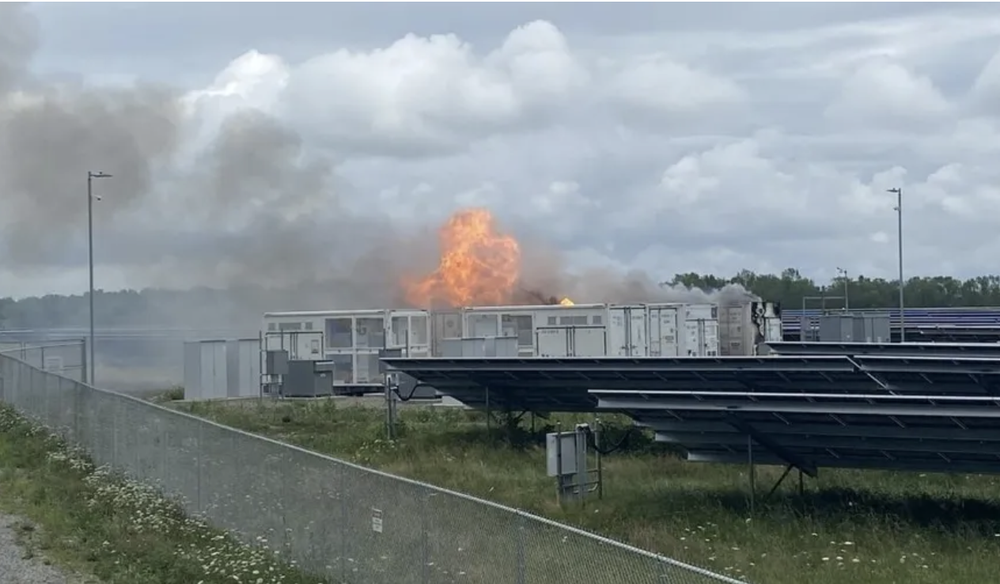
via STOP THESE THINGS

https://ift.tt/9BKTZaO

October 24, 2024 at 01:31AM

The Party For Socialism and Liberation (another Left choice for the US election)

“The climate catastrophe demonstrates the disastrous self-interest of the capitalist class. To avoid excessive warming, as well as the many severe environmental threats produced by capitalism, it is necessary to shift from fossil fuels to renewable energy.” (PSL, below)

Previous posts at MasterResource have examined the energy platforms of the Democrat Party, Green Party, and Cornel West for President. On the free-market side, summaries have been provided for the GOP Platform, American Petroleum Institute, and Heritage Foundation/Agenda 25, and America First Policy Institute (AFPI, a think tank in the Trump fold). Today’s post turns again to the interventionist/socialist view of energy and climate.

The Party For Socialism and Liberation (PSL). “For the planet to live capitalism must end,” states the website banner. The “About” section reads:

The Party for Socialism and Liberation believes that the only solution to the deepening crisis of capitalism is the socialist transformation of society. Driven by an insatiable appetite for ever greater profits regardless of social cost, capitalism is on a collision course with the people of the world and the planet itself. Imperialist war; deepening unemployment and poverty; deteriorating health care, housing and education; racism; discrimination and violence based on gender and sexual orientation; environmental destruction—all are inevitable products of the capitalist system itself….

A forceful overthrow is supported:

The idea that the capitalists’ grip on society and their increasingly repressive state can be abolished through any means other than a revolutionary overturn is an illusion. Equally unrealistic are reformist hopes for a “kinder, gentler” capitalism, or solutions based on economic decentralization or small group autonomy. Meeting the needs of the more than 6.5 billion people who inhabit the planet today is impossible without large-scale agriculture and industry and economic planning.

Turning to climate, PSL starkly states: Climate crisis: Unsolvable under capitalism

The climate catastrophe demonstrates the disastrous self-interest of the capitalist class. To avoid excessive warming, as well as the many severe environmental threats produced by capitalism, it is necessary to shift from fossil fuels to renewable energy. But the capitalist class is driven to protect its investments in coal, oil and gas, as well as associated industries. It will do whatever it takes to hold on to power, even if that means destroying much of the world.

The struggle to adapt to and mitigate the impacts of global warming is therefore a class struggle. It is a struggle for power — not a struggle over morality or individual consumer choices. All people are not equally responsible for the climate change. Imperialist countries reaped the benefits of fossil fuels while they exploited the resources of countries they colonized. Within industrialized countries the proceeds of workers’ labor were channeled into the pockets of the capitalists while the neighborhoods of working, poor and oppressed people were treated as sacrifice zones, dumping grounds for the toxic waste products of the carbon economy.

The class war around the climate is also an imperialist war. Countries damaged by imperialist exploitation and colonialist expropriation are the first to experience the devastation of rising sea levels and disrupted weather patterns. The imperialist response to climate change appears in the closure and militarization of borders. Ever more people are forced to migrate. Yet immigrants are violently apprehended and imprisoned in concentration camps.

The imperialist dimension of climate change is undeniable when we recall that the U.S. military is the world’s biggest institutional danger to the environment. Dismantling the U.S. war machine is thus crucial for human survival. Addressing the climate catastrophe and environmental racism in an equitable and just way requires specialized planning at multiple levels ─ international, state, regional, and local. Agriculture, transportation, shipping, construction, mining and virtually all heavy industries must be reconstructed. Even information networks ─ from the coltan used in cell phones to the vast amounts of energy used by massive server farms ─ will have to be reconfigured.

The work force of all these industries is immense. Capitalists try to convince workers that threats to the carbon economy are threats to the working class. But of course, the capitalists’ interests are antagonistic to the workers. Such transition to socialist production is to guarantee economic stability for workers who transition to sustainable jobs.

No specific language regards energy policy, but the implicit message is really explicit: nationalize, socialize. As if Venezuela was the prize.

The post The Party For Socialism and Liberation (another Left choice for the US election) appeared first on Master Resource.

via Master Resource

https://ift.tt/KI7R9yG

October 24, 2024 at 01:08AM

NC Floods, CA Drought, and The Role of Randomness

From Dr. Roy Spencer’s Global Warming Blog

by Roy W. Spencer, Ph. D.

The recent devastating floods in western North Carolina were not unprecedented, but were certainly rare. A recent masters thesis examining flood deposits in the banks of the French Broad River over the last 250-300 years found that a flood in 1769 produced water levels approximately as high as those reported in the recent flood from Hurricane Helene. So, yes, the flood was historic.

Like all severe weather events, a superposition of several contributing factors are necessary to make an event “severe”, such as those that led to the NC floods. In that case, a strong hurricane combined with steering currents that would carry the hurricane on a track that would produce a maximum amount of orographic uplift on the east side of the Smoky Mountains was necessary in order to produce the widespread 12-20 inch rainfall amounts, and the steering currents had to be so strong that the hurricane would penetrate far inland with little weakening.

Again, all severe weather events represent the somewhat random combining of amplifying components: In the case of Hurricane Helene, they produced the unlucky massive flooding result that the region had not seen in hundreds of years.

The Random Component of Precipitation Variability

The rare superposition of several rare contributing factors, or the more common superposition of more common factors, can be examined through statistics when one examines many events. For example, it has long been known that precipitation statistics gathered over many years exhibit a log-normal frequency distribution. Simply put, the lowest precipitation amounts are the most frequent, and the highest amounts are the least frequent. This is the statistical result of the superposition of contributing factors, such as (in the case of excessive rainfall) abundant humidity, an unstable air mass, low-level convergence of air, a stationary or slow-moving storm (In western NC, the mountains providing uplift are stationary), etc.

Extreme precipitation events are (of course) the most rare, and as such, they can exhibit somewhat weird behavior. This is why hydrologists disagree over the usefulness of the term “100-year flood”, since most weather records don’t even extend beyond 100 years. One would probably need 1,000 years of rainfall records to get a good estimate of what constitutes a 100-year event.

Simulating Extreme Rainfall Events through Statistics

It is easy in Excel to make a simulated time series of rainfall totals having a log-normal distribution. For example, the following plot of hypothetical daily totals for the period 1900 through 2024 shows an seemingly increasing incidence of days with the heaviest rainfall (red circles). Could this be climate change?

But remember, these are randomly generated numbers. Just like you can flip a coin and sometimes get 4 heads (or 4 tails) in a row doesn’t mean there is some underlying cause for getting the same result several times in a row. If we extend the above plot from 125 years to 500 years, we see (following plot) that there is no long-term increasing trend in heavy rainfall amounts:

Black Swan Events

Or, how about this one, which I will call “The Great Flood of August 28, 2022”?:

Note that this event (generated with just log-normally distributed random numbers) far exceeds any other daily event in that 500-year plot.

The point here is that too often we tend to attribute severe weather events to some underlying cause that is emerging over time, such as global warming. And, I believe, some of the changes we have seen in nature are due to the (weak and largely benign) warming trend most regions of the world have experienced in the last 100 years.

But these events can occur without any underlying long-term change in the climate system. To attribute every change we see to global warming is just silly, especially when it comes to precipitation related events, such as flood… or even drought.

A “Random Drought”

Now changing our daily random log-normal precipitation generator to a monthly time scale, we can look at how precipitation amounts change from decade to decade. Why monthly? Well, weather variations (and even climate cycles) tend to have preferred time scales. Several days for synoptic weather patterns, quasi-monthly for some kinds of persistent weather patterns, and even yearly or decadal for some natural internal climate cycles.

When I generate random log-normal time series at monthly time scales, and compute decadal averages over the last 120 years, seldom is the long-term trend close to zero. Here’s one what shows low precipitation for the most recent three decades, just purely through chance:

That looks like something we could attribute to drought in California, right? Yet, it’s just the result of random numbers.

Or, we can choose one of the random simulations that has an increasing trend:

I’m sure someone could tie that to global warming.

A Final Word About 100-Year Flood Events

There seems to be some misunderstanding about 100-year events. These almost always apply to a specific location. So, you could have 100-year events every year in the U.S., and as long they are in different locations, there is nothing unusual about it. A 100-year flood in western North Carolina this year could be followed by a 100-year flood in eastern North Carolina next year. That doesn’t mean 100-year floods are getting more frequent.

I’m not claiming that all severe weather is due to randomness. Only that there is a huge random component to it, and that’s what makes attribution of any kind of severe weather event to climate change essentially impossible.

via Watts Up With That?

https://ift.tt/hY4syvP

October 24, 2024 at 12:05AM

AEMO Head Avoids Endorsing a Government Guarantee that Renewables will Reduce Energy Prices

Essay by Eric Worrall

The Australian Energy Market Operator, the industry body tasked with overseeing electricity supplies in East Coast Australia, has shied away from endorsing an Aussie government claim that renewables will reduce prices.

The full video is well worth watching, the commentators go into an in depth explanation of why renewables are the most expensive form of power, and will remain so for the foreseeable future.

The guy in the screenshot above is Minister for Climate Change and Energy Chris Bowen, who persists in claiming if you spend enough money on renewables prices will come down – a view apparently not shared by the head of the Australian Energy Market Operator Daniel Westerman.

The senator who pushed AEMO head Daniel Westerman into giving a straight answer on whether he endorsed the view renewables will bring down prices was LNP Federal Senator Matt Canavan, whom I spoke to in person at the recent Aussie CPAC conference. Matt Canavan together with my local MP Keith Pitt appear to be leading an effort to bring a sensible discussion about coal back into mainstream Aussie politics.

via Watts Up With That?

https://ift.tt/tV2jrET

October 23, 2024 at 08:07PM