SecureWorks attribution of Podesta phishing to Russia was false

The SecureWorks’ attribution of March 2016 phishing and hacking of Podesta and other DNC bosses to Russia (1, 2) by Bitly links was false. This is why.

The hackers did not need Bitly. They could insert a direct link to the phishing page. Usage of Bitly had only a downside: the risk of being exposed before the hacking campaign started, and the risk that the redirect from bit[.]ly would trigger a browser warning.

At the relevant time, Bitly shortlinks could be created and used without a Bitly account.

Bitly shortlinks in an account do not indicate that they were used. They cost no money and require very little time. Clicks are even cheaper. A smart hacker can create thousands of decoy shortlinks to hide one used for important business.

The phishing site’s log allows tracking clicks, so creating a Bitly account for that purpose is not warranted.

“GRU created a Bitly account but forgot to set it to private mode” is a fairy tale for idiots.

According to SecureWorks, the “accounts-google.com” domain was used in many phishing campaigns starting in April 2015. One would expect it to be blacklisted by most security software and services long before March 2016.

SecureWorks announced on June 16 that it tracked TG-4127 since 2015. I searched and could not find any trace of this name or number 4127 on its website and its archived versions of it. For two years, 2014-2015, SecureWorks announced the detection of only two “threat groups”, TG-3279 and TG-3390. They were not tracking “threat groups”, possibly because they knew it was futile.

All that we know about this Bitly account (or 2-3 accounts) is what SecureWorks and Bitly told us. Although it was allegedly public, Bitly hid it after the attribution, potentially becoming an accomplice. A presentation purportedly containing the information from this Bitly account was sealed evidence in Gubarev v. Buzzfeed. Bitly fought to keep it sealed and succeeded (See 0:17-cv-60426-UU, Document 416-3, Entered on FLSD Docket 01/14/2019). An article from Motherboard was entered in the docket instead.

Given all the discrepancies in their story, the only explanation for this conduct is that SecureWorks and Bitly lied, and this Bitly account is either different from how it was described or shows evidence of tampering.

Thanks to Stephen McIntyre for the timely attention to this misattribution.

P.S. Creation of Bitly account and making it open might indicate actions of a phisher for hire, selling the use of suitable domain(s) and/or his services to multiple clients. This situation is also incompatible with the SecureWorks’ theory, which requires of a single actor behind all the shortlinks in the alleged account.

P.P.S. SecureWorks’ website contains interesting material that tends to refute the fallacy of attribution to specific groups based on the similarity of tools and methods.

Underground Hacker Marketplace, June 2016

Imagine a marketplace where illegal vendors offer hackers a wide range of goods, tools, and training to enable them to exploit or breach unsuspecting individuals, groups or organizations. Now imagine the walls of this marketplace lined with advertisements offering services and information. The point is, the underground marketplace is booming and only getting bigger, more sophisticated, and competitive.

Some SecureWorks articles even cite prices.


via Science Defies Politics

https://ift.tt/ZEch9uz

October 23, 2024 at 08:05PM

Kenyan Government: “Climate policies must not write off livestock”

Essay by Eric Worrall

… In the context of development progress, animals like cows, goats, camels, and pigs should be seen as “solutions with legs” …

Climate policies must not write off livestock

Cattle when grazed sustainably can be part of climate action and help vulnerable populations build resilience.

Ali Mohamed Climate Envoy in the Office of the President of Kenya

Livestock are a vital component of both the African food system and rural livelihoods. Africa has around 400 million cattle alone, and the livestock sector accounts for a significant 30 to 40 percent of the total agricultural gross domestic product across the continent.

Small amounts of meat, milk and eggs can have life-changing benefits in tackling malnutrition, and livestock animals also provide a reliable income source when alternatives simply do not readily exist.

Yet, from an environmental perspective, livestock are often perceived only as a problem, contributing to habitat loss, greenhouse gas emissions, and land degradation. This narrow view misses a much more nuanced reality. It is also the reason much-needed finance is not being invested in the sector.

…

In the context of development progress, animals like cows, goats, camels, and pigs should be seen as “solutions with legs” in combatting these intensifying climate and environmental crises at scale.

…

Read more: https://www.aljazeera.com/opinions/2024/10/21/climate-policies-must-not-write-off-livestock

While there are plenty of places cattle are grazed which could also be used for growing vegetables, cattle farming is also viable in places where vegetables simply shrivel up and die.

Grazing also improves grassland health – grasslands need to be grazed. Ecologists once believed the opposite, that grazing degrades grassland and increases the risk of desertification. This wildly wrong belief led to the slaughter of over 40,000 elephants – before one of the ecologists who helped organise the slaughter realised to his horror it was all a big mistake.

There are other considerations. On Monday this week a medical specialist I see for an annual checkup told me I had to eat more meat, his advice was I had to replace most of the carbohydrates in my diet with meat. Vegetables are mostly carbohydrates, so I have to cut back on vegetables, particularly starchy vegetables like Potatoes.

There are plenty of other people in my situation.

Reducing meat in the global diet would create a lot of sick people and, in time, a lot of prematurely dead people.

But who knows, maybe some greens see quietly killing off the hundreds of millions of people who medically require meat rich diets as a milestone towards their goal to reduce global population.

via Watts Up With That?

https://ift.tt/PZTjLE8

October 23, 2024 at 04:05PM

Safe Climate Of 1791

A look at the “safe climate”‘ of 1791, as defined by NASA’s James Hansen.

About Tony Heller

Just having fun

This entry was posted in Uncategorized. Bookmark the permalink.

via Real Climate Science

https://ift.tt/h1xRQbX

October 23, 2024 at 03:28PM

The mystery of a thousand dead whales and dolphins

By Jo Nova

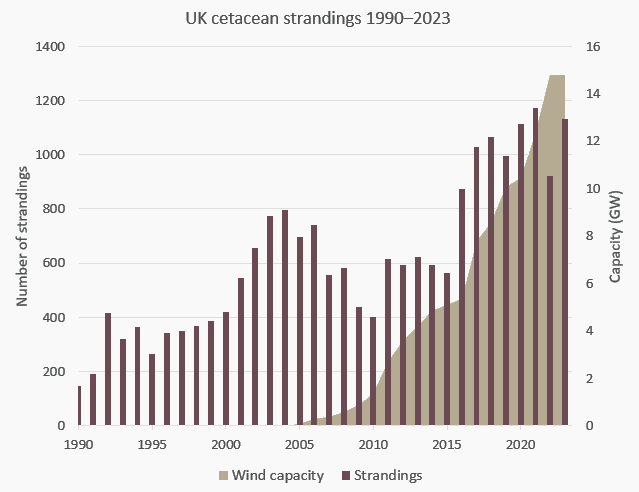
For some reason more than a thousand whales, dolphins and porpoises died around the UK’s coastline every year for the last eight years. This is roughly twice as many as in the 25 years before that. What could it be?

Whatever it is, it isn’t windfarms. Greenpeace says so:

“There is no evidence whatsoever linking offshore wind to whale deaths. The manufactured hysteria is the result of fake news promoted by politicians, big oil, and their cronies to save the oil and gas industry”

Greenpeace Australia says  wind-plants save whales.:

…”building offshore wind is way, way better for ocean wildlife than fossil fuels”.

And yet there are a thousand dead cetaceans.

Andrew Montford of NetZeroWatch graphed beached dolphins, whales and porpoises against the rise of a new industrial marine machine:

Cetacean Strandings in the UK graphed against offshore wind capacity.

Cetacean Strandings in the UK graphed against offshore wind capacity. @Dissentient

There’s no evidence, say Greenpeace, sounding just like Philip Morris.

We don’t know for sure what is causing so many whales and dolphins to die, but Greenpeace doesn’t even want to find out. The only thing we know for sure is that Greenpeace is craven, counterfeit, eco-imposter front for Big Business, or the Globalist Blob. As Matt Ridley said what happened to the Precautionary Principle?

Jason Endfield is tracking the carnage:

The UK’s 2023 annual report to Ascobans* reveals an appalling level of cetacean deaths in British seas, and comes in the wake of record-breaking increases in whale, dolphin and porpoise mortality in recent years. This shocking statistic should be a wake-up call to those planning to further industrialise our seas …

Researchers have known since at least 2013 that pile drivers were permanently deafening porpoises, leaving them, presumably to die miserable deaths wandering blindly through dark or murky seas. Where were all the professors of marine science, paid by the public to know these things, and where was the BBC?

They were all silent for ten years until someone invented and tested “bubble curtains” to protect porpoises, and then they could say “well isn’t that clever”?

Spread the word: fifty years ago environmentalists would have raised hell about a thousand dead whales and dolphins. Today they are a part of the cover up. They’re not even blaming climate change and 0.001 degree of warming. They don’t want to draw attention…

h/t Willie Soon.


10 out of 10 based on 3 ratings

via JoNova

https://ift.tt/p2wbCQf

October 23, 2024 at 02:32PM