
Prior to the Paris COP in 2015, French scientists debunked the green agenda in a White Paper drawn up by the Société de Calcul Mathématique SA (Mathematical Modelling Company, Corp.) The battle against global warming: an absurd, costly and pointless crusade. The whole document is evidence-based, and on the second point concerning energy, they said this:
Chapter 2: The crusade is costly
Direct aid for industries that are completely unviable (such as photovoltaics and wind turbines) but presented as ‘virtuous’ runs into billions of euros, according to recent reports published by the Cour des Comptes (French Audit Office) in 2013. But the highest cost lies in the principle of ‘energy saving,’ which is presented as especially virtuous. Since no civilization can develop when it is saving energy, ours has stopped developing: France now has more than three million people unemployed — it is the price we have to pay for our virtue….
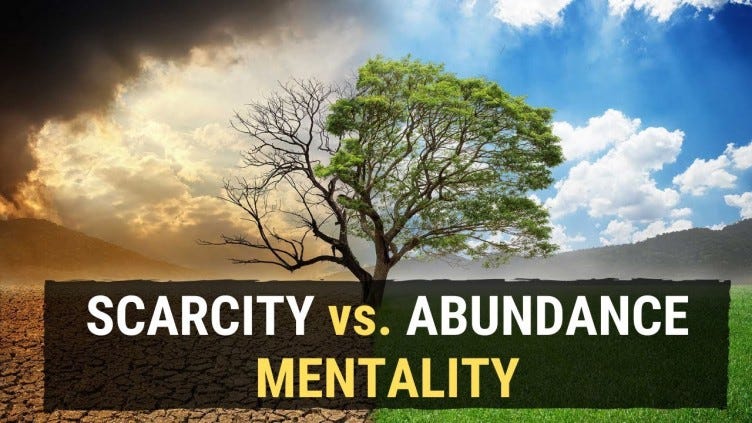
Finally, the world seems to be waking up to energy realities. The actual transition is away from the green imperative to make energy scarce, replaced by driving energy abundance. Kevin Killough writes, including commentary from Mark Mills of Energy Analystics, in his Just The News article: World moves away from ‘green gospel of scarcity’ and now embraces ‘energy abundance,’ experts say
“I think we’ve gone from scarcity to abundance — from the green gospel of scarcity and its Trinitarian ESG god — to the promised land of abundance guided by the values of affordability and reliability,” David DesRosiers, conference co-chair of the RealClear Energy Future Forum, said.
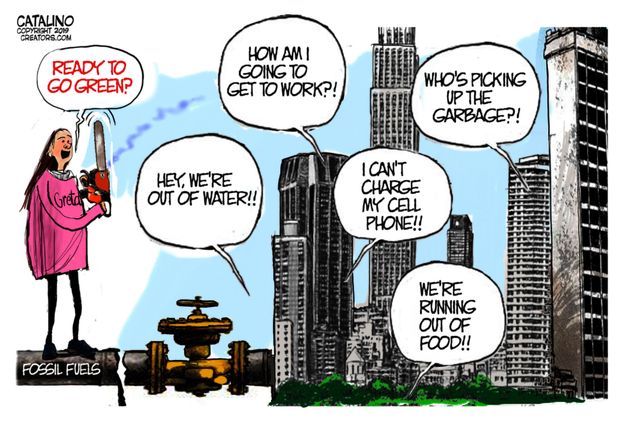
In 2019, Swedish climate activist Greta Thunberg — then a high-school dropout — was invited to the U.N. Climate Action Summit in New York City. There, she would deliver her famous — or infamous, depending on who you ask — “how dare you” speech, to which legacy media responded with overwhelming enthusiasm. Thunberg claimed that we were at the start of a “mass extinction,” and she admonished the world for ignoring the alleged crisis while talking “about money and fairy tales of eternal economic growth.”
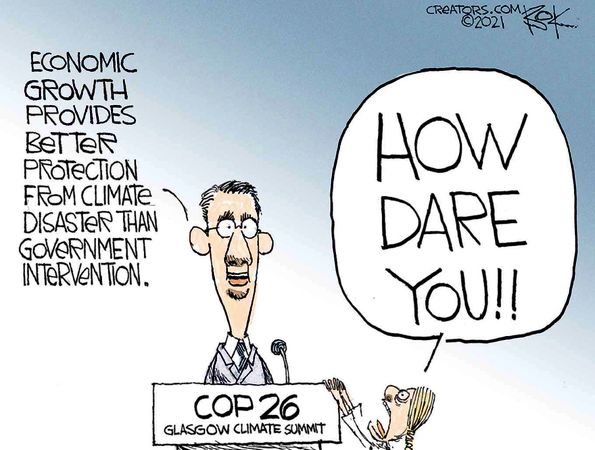
What a difference six years can make. Voters elected a president in November who signed an executive order aimed at “unleashing American energy,” and Energy Secretary Chris Wright followed the president’s order with a directive to promote “energy abundance.”
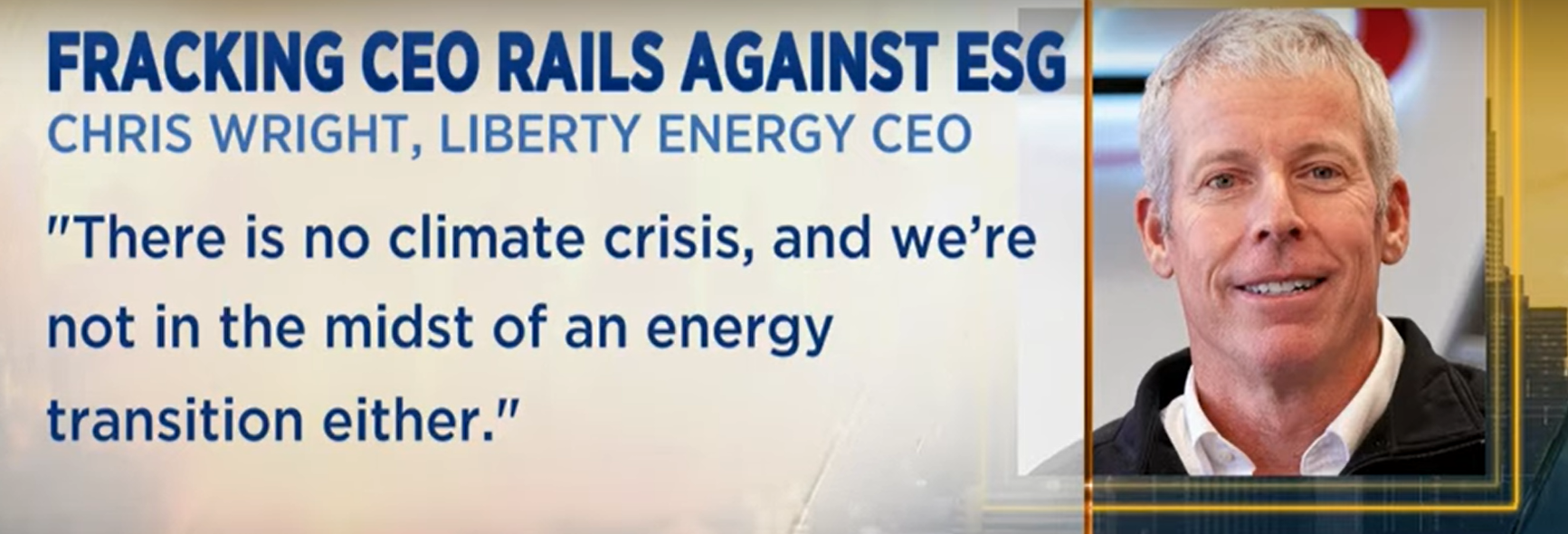
This U-turn in views on energy isn’t limited to a change in administration in the U.S.
In May 2021, the International Energy Agency (IEA), which has been criticized for cheerleading emissions reductions, launched a roadmap to reach net zero by 2050, and IEA Executive Director Fatih Birol told The Guardian that “there will not be a need for new investments in oil and gas fields, or new investments in coal mines.”
At the March CERAWeek energy conference in Houston this year, Birol was calling for more investments in oil and gas.
This shift away from the de-growth fervor that was popular for over a decade was the overriding topic at the RealClear Energy Future Forum Monday. Panels of experts in engineering, data centers, mining, oil and gas, and the electricity grid discussed how this change of views has impacted various aspects of the world’s energy picture.
“I think we’ve gone from scarcity to abundance — from the green gospel of scarcity and its Trinitarian ESG god — to the promised land of abundance guided by the values of affordability and reliability,” David DesRosiers, conference co-chair and founder of the RealClear Foundation, said.

When reality hits
Mark Mills, conference co-chair and director of the National Center for Energy Analytics, discussed the role of increasing energy demand as a result of the growth of data centers and artificial intelligence. While many tech companies, such as Microsoft, embraced net-zero goals, Mills explained that the energy demands of data centers forced companies to contend with the reality that although fashionable in some circles, intermittent wind and solar power are not adequate.

“Eventually, reality rears its ugly head, and we recalibrate around what reality permits,” Mills said.
The IEA last month released an in-depth report on how the demand for electricity will be shaped by AI in the coming years. According to the report, a single data center uses as much electricity as 2 million households. Powering one of these data centers, Mills said, requires as much natural gas every day as a single Space X rocket launch.
“With myriads of data centers planned and announced, this means that lighting up the digital infrastructure will soon have the energy demands equivalent to reliably powering hundreds of millions of households,” Mills said.
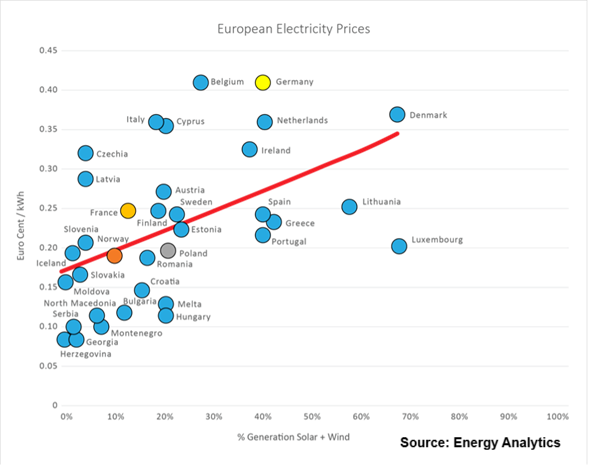
Mills said, besides the energy to power these data centers, they will also require an abundance of materials. A skyscraper requires the same amount of materials to build a single giga-scale data center, which is a data center requiring 1 billion watt-hours of electricity every hour — the same amount of power consumed by approximately 1,100 homes in a month.
While some have argued that increased efficiencies will address the demand, Mills pointed out that a single smartphone operating at the energy efficiency of a 1984 computer would use more electricity than an entire city block. More efficiency won’t reduce demand for energy, he explained, it will only increase how much can be done with more energy.

The way the grid works
Energy abundance is not only producing more energy. The supply has to be reliable, the experts at the conference said. A few speakers pointed to the blackouts that gripped Spain and Portugal last month as an example of how dangerous an unreliable energy supply can be. Estimates place the death toll from the one-day event at seven people.
James Robb, CEO of the North American Electric Reliability Corporation, said that the exact cause of the event is still under investigation, but there are facts that point to the overreliance on intermittent wind and solar.
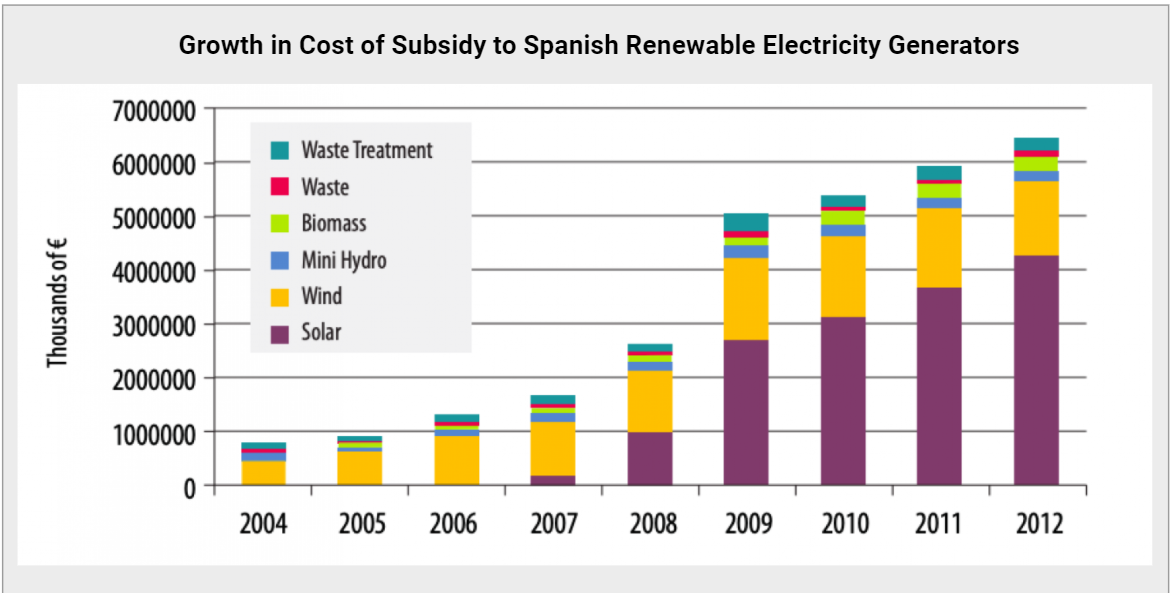
At the time of the blackout, Robb said, there was little traditional generation — coal, natural gas, hydroelectric and nuclear — operating. To make wind, solar and battery power work on the grid, it has to go through an inverter, which doesn’t have the spinning inertia of generators powered by traditional sources. Grid operators need to maintain a certain frequency of power, and when there’s a disruption, spinning inertia can absorb some of the frequency changes until things stabilize.
Federal Energy Regulatory Commission Chairman Mark Christie explained inertia as a 100-acre lake 6-inches deep. At one end is a river flowing into the lake, like power generated on the grid. At the other end is a river flowing out of the lake, which is the demand for power. To make the grid work, the water has to be kept 6-inches deep at all times.
“If that lake, at any point, becomes an inch deeper or loses an inch of depth, the lake ceases to operate. That’s the way the grid works. It has to be balanced at all times, and that’s the term frequency,” Christie said.

Robb said there are technologies that create synthetic inertia for wind and solar generators, but these are unproven at scale.
“They’re not without their issues there, and one of the big challenges we always have in the electric grid with any new technology is you can study something in the lab. You can deploy…a pilot [project] on a grid somewhere. But when you try to scale it to the level of the North American grid, which is a terawatt of generation, typically in that translation from pilot to terawatt, we discover things that we don’t understand,” Robb said.
Holding back
Despite many signs pointing to the overreliance on solar energy on the Iberian Peninsula grid as being the cause of the blackouts, other speakers noted that politics is often holding back more discussion on the problem of intermittency.
“It is very clear that the intermittency of wind and solar had a great deal to do with shutting down the grid, but you cannot admit that if you’re in power in Spain or Portugal. Because there are liabilities,” Terrence Keely, CEO of 1PointSix, LLC, a financial advisory firm, said.
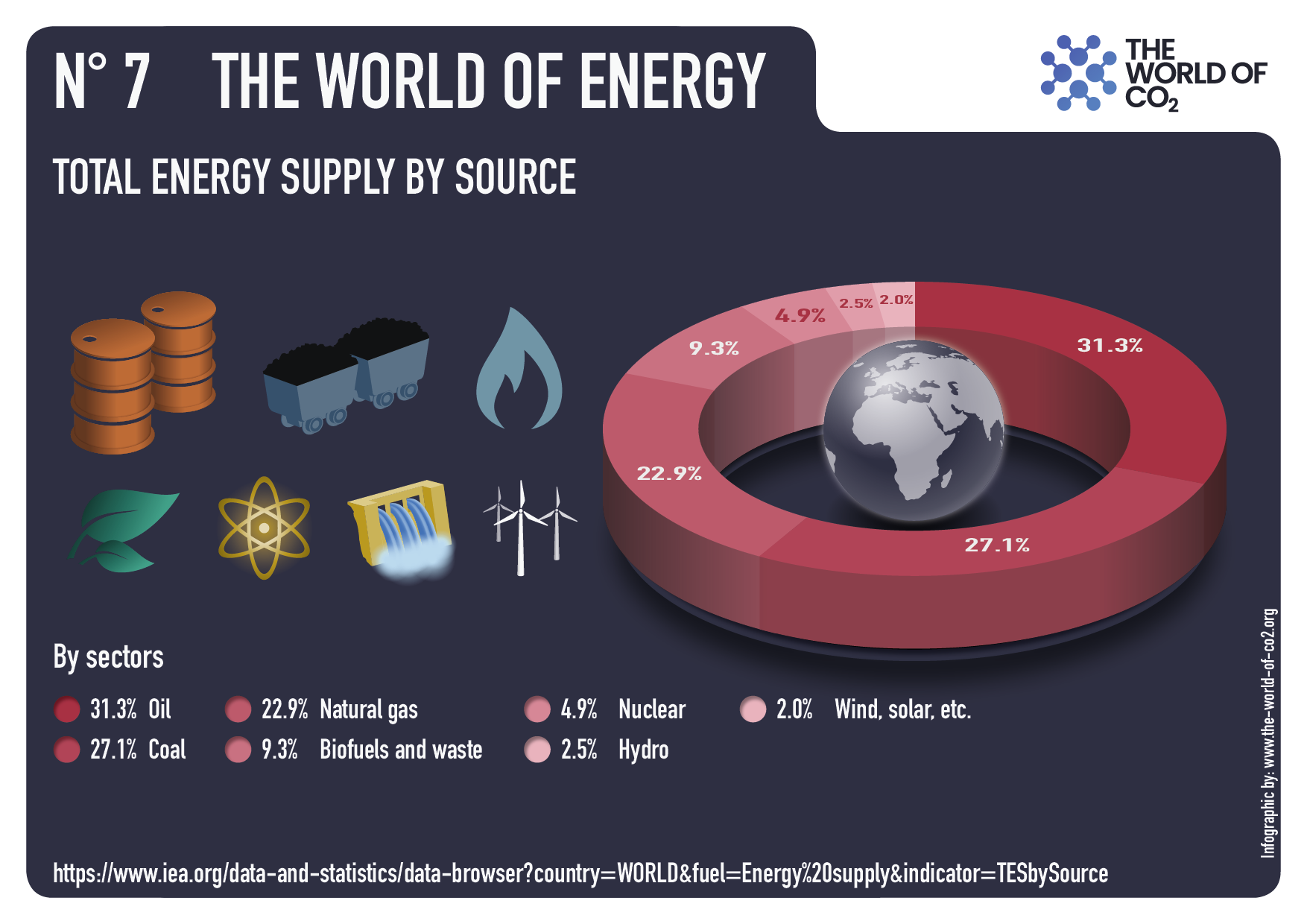
Daniel Yergin, vice chairman of S&P Global, said that between 2022 and 2023, the world’s dependence on fossil fuels was down less than one half of one percent. Yet, he said there were still contradictions coming from leaders. As an example, he pointed to British Prime Minister Sir Keir Starmer who recently said that Britain would increase emission-reduction efforts to 2050.
“But he also said, ‘Oh, let me be clear with you, oil and gas are going to be in the mix for a long time.’ That really captures the struggle of people, of leaders, to kind of adjust to a reality that’s different from what has been the conventional wisdom,” Yergin said of Starmer.
As with any global shift in thinking on issues, some nations are slow to change — or reject it altogether. But the experts at the forum concluded generally that the so-called energy transition, and the de-growth attitudes that drove it for so long, are losing steam.
via Science Matters
May 28, 2025 at 12:30PM
 Iowa Climate Science Education