Update to the Default Tariff Cap

The new levels of the default tariff cap have been announced by Ofgem.

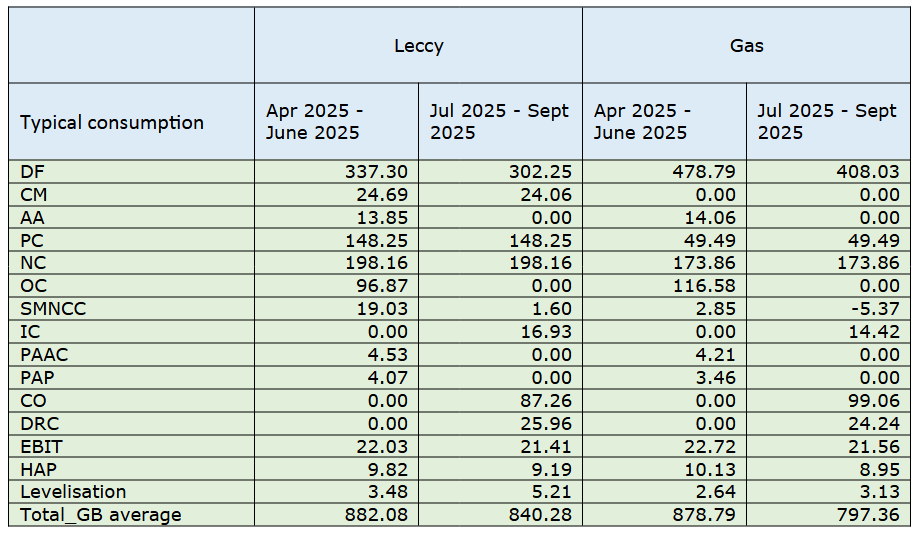
Leccy: was £882.08, will be £840.28

Gas: was £878.79, will be £797.36

The breakdown’s components have altered; in case there was anyone left who was still following, there probably isn’t now.

Source: from tab 1c Consumption adjusted levels on “Final levelized cap rates model (Annex 9) 1 July to 30 September 2025_0.xlsx” from this page.

So, OC (operating costs) have gone, PAAC and PAP have gone (Payment method Adjustment Additional Charge and Payment method Additional Percentage); the smart meter net cost charge (SMNCC) has shrunk markedly, AA (adjustment allowance) has gone; new in the charts are IC, CO and DRC. “Industry charges”, “Core operating costs”, and “Debt-related costs.”

To this we must add VAT at 5%, which gets us:

Old tariff cap: £1849

New tariff cap: £1720

Miliband’s original, and I have decided, impossible (under his own terms) promise was to reduce bills by £300. That, I said, was off the July-September 2024 tariff cap of £1568. The bill, in other words, needed to go down to £1268 to fulfil the promise. The present £1720 means that an additional £452 savings are necessary to achieve it.

Finally, I may note that at the previous tariff cap, you could not slide a plastic £5 note between the “typical” household’s gas and electricity bills (£923 and £926 inc. VAT, respectively). However, we now can slip said fiver between, and much more.

Apr-Jun ’25 Jul-Sep ’25
Leccy £926 £882
Gas £923 £837

Gas is now £45 cheaper than leccy. Of course, a fall in the price of gas has a larger effect on the cost of a domestic gas bill, as it is a far larger proportion of the bill. That makes it difficult to see how a war on gas exploitation in this country is going to drive down the overall domestic energy bill.

Note

The above costs are based on 2.7 MWh of leccy and 11.5 MWh of gas. [Lower usage than originally used for the price cap: was 3.1 MWh / 12 MWh.]

And yes, heat pumps are more efficient than gas, but here we are looking at a typical household using 4 X as much energy from gas as it does from leccy. [And the typical household is not yet suffering the heat pump blues.]

Featured image

I asked the AI to draw me a Penrose triangle. It replied with a square, but I kinda like it.

via Climate Scepticism

https://ift.tt/c4xQ9vp

May 24, 2025 at 10:01AM

Sunday

0 out of 10 based on 0 rating

via JoNova

https://ift.tt/joLtxTX

May 24, 2025 at 09:22AM

Why “cheaper” solar raises costs. Part II: The hidden costs of residential solar

From Climate Etc.

by Planning Engineer (Russ Schussler)

In Part 1, we showed how wind and solar’s low costs over 80% of the time are overwhelmed by expenses at peak times such that they offer no cost advantages to the generation mix. Residential solar follows a similar pattern: it seems affordable for homeowners, but raises system costs through rate structures that over-incentivize adoption. Generous subsidies, like retail-rate net metering, drive excessive solar growth, risking grid stability and shifting costs to non-solar customers that are often less affluent. Less generous rates for residential solar slow adoption, but better align solar adoption with grid needs, ensuring fairness and sustainability.

The Economic Problem: Cost-Shifting Through Rate Structures

It’s hard to understand why many don’t see the unfairness in rate structures, as similar arrangements would seem absurd in other industries. Imagine hotels required to keep rooms ready for all customers (at standard rates) just in case they “might” want them. Worse, during low occupancy, hotels must send guests to customers’ Airbnb properties whenever there are excess rooms. Or consider pizza chains forced to buy excess pizzas from restaurants during slow hours while supplying low-cost pizzas during peak hours and covering all pickup and delivery costs. In all of these cases, the major problem is that large infrastructure investment is required that will sit idle most of the time and receive inadequate compensation from the beneficiaries.

How Residential Solar Rate Structures Work

Residential solar systems, typically  tied to net metering, let homeowners generate and sell power in ways that appear cost-effective:

  • Serving own needs: Solar panels produce during sunny, low-demand periods (e.g., midday spring), letting homeowners avoid utility charges. These charges are usually a flat rate based on average costs. (Note: The utility backs them up when panels don’t produce enough electricity.)
  • Selling excess power: Surplus power goes to the grid, with net metering crediting it at rates varying by state. Typically, these payments exceed the energy’s value to the utility during low-demand periods.
  • Hard Times: At night, on cloudy days, or during peak demand (e.g., summer evenings), panels produce little. Homeowners buy grid power at flat rates, which don’t reflect the high costs of peaking plants.

Rate structures today vary to the degree to which they subsidize residential solar. Below are general categories of rate structures, ordered by levels of subsidies, from high to low.

  • Retail-Rate Net Metering: Credits residential solar at full retail rates (~$0.20–$0.42/kWh, e.g., Hawaii, Massachusetts, New York, New Jersey, Rhode Island). Yields high returns for residential  solar (20–50% ROI) and encourages rapid adoption (e.g., Hawaii’s 30% penetration, ~200,000 homes).
  • Partial Retail/Hybrid Net Billing: Credits at 50–80% of retail (~$0.10–$0.20/kWh, e.g., Connecticut, Vermont, Maryland, Minnesota) support moderate adoption of residential solar (e.g., Vermont’s 8% penetration, ~15,000 homes) with less cost-shifting.
  • Net Billing at Avoided Cost: Lower credits (~$0.05–$0.08/kWh, e.g., California’s NEM 3.0, Arizona, Arkansas) slow growth.
  • Wholesale/Avoided Cost Rates: Minimal credits (~$0.03–$0.07/kWh, e.g., Alabama, South Dakota, Tennessee, Idaho, Kentucky) yield low penetration (0.02–1.2%, ~270–10,000 homes), reducing subsidies and

Initially, solar power rate structures used retail-rate net metering. Lower subsidies  could not attract sufficient participation.  Since participation was low initially, the small subsidies from the overwhelmingly  large group of non-participants were not significant. As more customers adopt solar, the economics change.  California’s experience highlights the unsustainability of this approach. California  now on version 3.0 of its net metering approach, which pays only for avoided costs for new customers. Retail-rate net metering became unsustainable as participation levels increased.

This chart shows the relationship between higher credits and the resulting penetration of residential  solar for a sampling of states.

Of course, higher subsidies correlate with greater participation. California NEM 3.0 looks like an outlier, but it must be understood this participation rate was built not on the NEM 3.0 rate structure. The big base they have of residential solar was built on legacy policies, and viability today is supported by the area’s high retail rates and grandfathering of existing residential solar customers under the old tariffs.

In a 2015 post, I discussed various approaches to cost sharing for residential solar.  It’s worth reviewing at this time as it provides additional coverage on the topic at hand.  In that piece I noted that the models with the least subsidies still only required residential solar users to pay the incremental costs they incur, not shared system costs. Should residential solar customers help with basic system costs?   The answer becomes increasingly important with high levels of residential solar.  Responsibility for the basic system costs becomes attributable to fewer and fewer customers.  Unfortunately, those footing the bill are disproportionately less affluent consumers who are most burdened by increasing energy costs.

The economic toll of overly generous rates:

  • Lost Revenue: Utilities need steady charges to cover fixed costs (grid lines, backup power). Solar homeowners avoid these during low-demand periods, reducing revenue.
  • Overpaid Purchases: High credits for low-value power strain utility budgets.
  • Fat Tail Costs: Peak periods drive high costs (peaking plants and transmission and distribution expansion). Non-solar customers face 1-2% rate hikes in high-solar areas, per National Renewable Energy Laboratory studies.

Generous rate structures, like retail-rate net metering, fuel excessive solar adoption, raising costs and inequity. Less supportive rates, like California’s NEM 3.0 or South Dakota’s wholesale rates, reduce uptake, which is proper when solar outpaces system needs.

Early net metering aimed to boost solar, but its costs—shifted expenses and grid risks—are now evident. Regulators, prioritizing green energy, often mandated generous rates, as in California’s NEM 1.0/2.0, which achieved 25% penetration before NEM 3.0’s lower rates slowed growth. Fair pricing proposals are often labeled as anti-renewable, stifling reform.

A common justification is that subsidizing residential solar will lower prices and increase affordability.  What goes unrecognized is that the cheaper residential solar becomes, it exacerbates unsustainable rate designs as fewer non-solar customers remain to support the system.

A Path Forward

Residential solar programs rely on structures that overpay for power and undercharge for grid use. Better designs would reduce incentives and align adoption with grid economics.  Potential options for improving solar tariffs include:

  • Time-of-Use Rates: Credit solar at market value less during the mid-day and charge more for peak power. This slows adoption, as seen in California’s NEM 3.0 (80% installation drop).
  • Pay Avoided Costs: unlike time-of-use rates, avoided costs could be set at average rates to avoid costly metering and complexity.
  • Grid Access Fees: Fixed fees ensure solar homeowners pay for reliability.
  • Peak Demand Charges: Bills based on peak usage reflect true costs.

These options promote equity, reducing subsidies from non-solar customers to wealthier adopters. The key is recognizing cost differentials between what solar customers receive and what they provide.  Fewer incentives mean less solar, which is proper when it drives costs, as in states like Alabama (0.7% penetration). Political pressure to support solar will resist such efforts.

Wrapping Up

Poor rate designs hide solar’s true costs, making it seem affordable while raising electricity rates for all. Retail-rate net metering drives excessive adoption of solar, shifting costs to non-solar customers. Less supportive rates, like avoided costs or California’s NEM 3.0, slow solar growth, aligning it with grid needs. This ensures fairness and avoids cost spirals. A sustainable energy supply requires pricing that reflects true costs, ensuring affordability for all.

Future posts will focus on utility economics, discuss problems with energy markets and delve into many of the often-ignored unaccounted costs associated with wind and solar.  For example, many assume the grid is easier to operate when part of the load base meets its own needs. In reality, residential solar burdens system operators, increasing complexity and costs of stabilization efforts. In Australia, a renewables leader,  operators see a need to switch off rooftop solar during stressful periods to maintain system stability.  Look for follow-up posts in the coming weeks.


Discover more from Watts Up With That?

Subscribe to get the latest posts sent to your email.

via Watts Up With That?

https://ift.tt/xpyObg0

May 24, 2025 at 08:04AM

East Bergholt DCNN3141 – Another weather station to add to the 103-missing-met-stations-mystery.

51.95958 1.02317 Met Office CIMO Assessed Class 4 Installed 1/1/1952 Temperature records from 1/1/1959 – claimed current but no records from 20/3/2020.

The current list of operational Met Office Climate and Synoptic weather stations includes East Bergholt as below {n.b. this list is so up to date that it includes stations opened as recently as May 2024 such as Whitesands}

So it is clearly an operational weather station…….yes? Well maybe, maybe not!

The CEDA archive shows East Bergholt as “current” which reinforces its inclusion in the list of “all” those weather stations. Further proof comes from the Met office’s site grading list of stations I obtained under FOI from August 2024 when it was assessed as “Excellent”

Three official sources show this as an operational site. Google Artificial intelligence goes even further with the following contributions.

It goes on, under further interrogation, to give precise figures and a forecast.

This second claim of current readings is quite remarkable given that the “East Bergholt weather station” is/was a manual reporting climate station reporting once daily only and with no anemometer. It would be impossible for it to report such details in real time. Artificial Intelligence really does not have a rational brain.

As I have stated many times before, almost everyone just accepts all this “data” as true, it is from a UK government agency after all, why would any sane person dispute any of this? East Bergholt is a current Met office operational weather station – “It’s a no brainer”

The only problem with all this is that……....it has not been operational at all in over 4 years. Welcome to the birth of a Zombie and an “Excellent” one at that.

This “Constable Country” weather station is located near Flatford Mill and operated by the Field Studies Council. Where FSC sites are still manual and not automated, to put it bluntly, the readings record rank as atrociously bad. Readings are in many cases so sporadic that if not automated the sites end up being closed down such as at Malham Tarn. The Met Office are fully aware of this problem though seem unable to remedy the problem. When Talkshop associate, Dave Woolcock, queried the irregularity of readings from Mickleham this was his reply:

“Good Morning Dave,

Looking at Mickleham it is a Field Studies Council site.

This means that it has a high turnover of staff usually with a new observer each year. They tend to need to have one committed member of staff to keep engagement going, even if they are the supervisor not necessarily taking the readings. When they move on engagement drops off sharply. I would guess that is what happened at this site.
Over the last 10 years or so, there has been a general drop off in observations from all of our FSC sites. We get peaks when a new person starts and is enthused, then it drops off again as they get busy with other duties.

I hope that helps answering your query.

Kind regards,

Marc

Weather Desk

Met Office  FitzRoy Road  Exeter  Devon  EX1 3PB  United Kingdom

As Dave wryly observed at the time “Feckless modern students then !”

The FSC are responsible for a large number of climate reporting sites and not only is the lack of readings a concern, the accuracy of those that are manually taken is highly questionable. Though not overly complex, there are skills required in taking readings accurately that require training. Casual, uncommitted observers can readily make mistakes. This Facebook video shows the (very good) observer at Floors Castle explaining the process. https://www.facebook.com/watch/?v=1893457610801591

The latter years readings at East Bergholt were

  1. 2020 Of 79 days only 56 viable readings taken to derive a daily average (i.e. both t.max and t.min) 70%
  2. 2019 296 days viable readings just 81%
  3. 2018 257 days viable readings just 70%

Whether or not this unreliability in fulfilling the sole purpose of a weather station in producing readings was the cause of this site’s demise is not clear. Usefully, though, East Bergholt did have records from 1/1/1959 to 20/3/2020 covering almost the entirety of the 60 year climate averaging period from 1960 to 2020 that the Met Office highlight on its 30 year rolling climate averages page now renamed Location Specific Long Term Averages. For reasons only fully known to the cabal of anonymous peer reviewers who oversee Met Office procedures, this is how East Bergholt’s figures are (not) portrayed.

What logic is there in referring to Levington which is 11 miles away, only opened in 1977 and closed in 1996? Is a site that was only open for 19 of those 60 years and requiring a total of 41 years of numerical fabrication (with 17 of those even prior to its existence) somehow superior to a site that was actually open with readings for ALL of those 60 years?

What is the attraction that makes Walton-on-the-Naze some 14 miles distant, similarly as long closed as Levington and again in need of a computer modelled mathematical conjuring trick to fabricate numbers that makes it so much more “credible” than East Bergholt?

I cannot think of any real world claimed “scientific approach” that opts to use artificially derived numbers in preference to hard real world numbers readily available. Furthermore, can anyone give credibility to an organisation that, having opted to use fabricated numbers in lieu of actual readings, then REFUSES to provide the (alleged) real world data from which those fabricated numbers were derived on the grounds that it has not retained them……………………the dog ate my homework!

East Bergholt did actually die over 4 years ago despite all the above claims from official and derived sources claiming otherwise. However, its somewhat partial (and likely inaccurate data) will have been used (despite Met Office refusals to acknowledge) in the compilation of other Zombie stations. The ongoing likelihood is that when the next 30 year set of rolling climate averages are published to 2030, then East Bergholt will appear on them. Such weather stations never die when the Met Office finds them “useful” in their data misrepresentation.

via Tallbloke’s Talkshop

https://ift.tt/G3uIaw8

May 24, 2025 at 05:05AM