
By Paul Homewood
You may recall that I posted an article last month called “Green ideology, not climate change makes wildfires worse”. The post is here, but essentially it was sourced from an article last March by the Volunteer Firefighters Association of NSW, which pointed out that the major factor in why Victoria’s bushfires at the time were so bad was poor management of national parks and the failure to reduce hazardous fuel loads and clear vegetation.
My post was shared on Facebook by the Friends of Science, a group of active and retired earth and atmospheric scientists, engineers, and other professionals, based in Canada:

https://www.facebook.com/FoSClimateEd/posts/2627494517329381
So far so good! However, Facebook in their infinite wisdom decided to flag the post as “Misleading”, based on a report by the self proclaimed Factcheck site, Climate Feedback. A quick look at their website confirms they are not an impartial site, and regularly push climate alarmism.

Below is the “judgment” by Climate Feedback:

DETAILS
Misrepresents a complex reality: While authorities in Australia are investigating the source of some of the bushfires, this does not preclude other factors from being important for some aspects of these fires. For instance, the magnitude of wildfires is controlled primarily by the conditions of the fuels.

The important contribution of climate change to fires is not in starting fires (although increases in lightning are possible) but in making fuels drier. The current fires in Australia are not so extreme because fires were sparked, but because 2019 was the hottest and driest year on record, with dry and windy weather patterns in place as the fires burned. The source of ignition for each fire is not relevant to understanding whether climate change contributed to their extent and intensity.
REVIEW
CLAIM: "Authorities in Australia have confirmed the bushfires were caused by arsonists and a series of lightning strikes, not ‘climate change’ as many activists have claimed."
Dozens of outlets, blogs and social media users have made the claim that climate change has no influence on the bushfires currently burning record areas in Australia because authorities are investigating who or what started some of these fires, suspecting some fires were ignited by people and many more by lightning.
This flawed reasoning misunderstands that fires are exacerbated by hot and dry conditions and Australia is currently facing a severe drought amidst increasing temperatures. The temperature trend is linked to human-caused climate change and contributes to drier fuel and soils by increasing evaporation.
While conditions were exceptionally warm and dry in southern Australia, there is no evidence to suggest that the current season has seen a higher level of arson, although some bushfires are indeed typically caused by humans (intentionally or not).
Regarding the potential influence of climate change so far, the Australian Bureau of Meteorology’s website indicates that
“Climate change is influencing the frequency and severity of dangerous bushfire conditions in Australia and other regions of the world, including through influencing temperature, environmental moisture, weather patterns and fuel conditions”.
A recent study has identified a “clear trend toward more dangerous [fire] conditions during spring and summer in southern Australia”1. Another study found that “climate change increases the potential for extreme wildfires”2. While a precise attribution study will be needed to quantify the influence of climate change on this specific series of fires in Australia, the above claim prematurely rules out climate change as a factor in the severity of these fires. Conversely, one should not conclude that climate change is the only factor influencing bushfires (you can read more on this at Carbon Brief).
Stefan Doerr, Professor, Swansea University:
This statement misleadingly suggests that many activists argue that the fires are “ignited” due to climate change. The “authorities” are focusing here on the ignitions, which are typically lighting, arson, or accidental in each fire season in Australia. (That noted, increases in atmospheric temperature do increase lightning frequency and hence wildfire probability1.)
What activists are concerned about is not the “ignitions” per se; there will always be potential sources of ignitions. What most activists (and many scientists) are concerned about is that the extreme intensity and extent of the fires in this fire season are a result of the environmental impact of climate change. The combination of such widespread temperature maxima not recorded before combined with very dry live and dead vegetation following a long and severe drought has allowed the ignitions (be it arson, lightning, or accidental) to conflagrate to fires covering an unprecedented geographic range in recorded history.
For example, in New South Wales alone the extent of the area burned in a single fire season is unprecedented in recorded history and so is the severity of the drought in this state. The increased likelihood of extreme drought and high temperatures occurring is consistent with observed recent trends and predictions of the impact of climate change in this region3. This article concludes:
“there is a clear trend toward more dangerous conditions during spring and summer in southern Australia, including increased frequency and magnitude of extremes, as well as indicating an earlier start to the fire season. Changes in fire weather conditions are attributable at least in part to anthropogenic climate change, including in relation to increasing temperatures.”
https://climatefeedback.org/claimreview/climate-change-bushfires-australia-breitbart-newspunch/
.
The decision by Facebook to flag the post is extremely troubling in a number of ways.
Firstly, who decides who should be the arbiter of facts, and how is this decision made? Why should Facebook trust Climate Feedback anymore than any other expert source?
We must remember that the article originated from the NSW firefighters association. The idea that their expert views, based on experience and intimate local knowledge, should be ditched in favour of those of an academic thousands of miles away is absurd.
Secondly, the claim which Climate Feedback say is misleading, was never even made in our article:
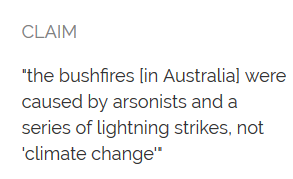
This claim appears to have been made in a Breitbart article, and the rebuttal then used to kill off other articles sceptical of the role of climate change. This is a shoddy practice to say the least.
Thirdly, the “Factcheck” fails to find anything actually incorrect with the Friend of Science post, (or as far as I can see with the Breitbart story either).
It merely moans that it does not cover every aspect concerning the severity of the fires. Yet how many thousands of stories have seen in recent weeks blaming the fires on climate change, without a mention of other factors? And how many of these have been “factchecked” by Climate Feedback? I suspect the answer is nearer to zero than one!
Indeed, the Climate Feedback’s own Key Takeaway, shown above, blames climate change, yet makes no mention of forest management:
The current fires in Australia are not so extreme because fires were sparked, but because 2019 was the hottest and driest year on record, with dry and windy weather patterns in place as the fires burned.
The idea anyway that every article on any subject should fully analyse all aspects of an issue is ridiculous. In this instance, the firefighters were raising a very real problem, which deserved to be considered in its own right.
Even the supposed factcheck contains some highly questionable statements. For instance:
The important contribution of climate change to fires is not in starting fires (although increases in lightning are possible) but in making fuels drier. The current fires in Australia are not so extreme because fires were sparked, but because 2019 was the hottest and driest year on record,
In fact, there is no evidence whatsoever that the “driest year on record” has anything at all to do with “climate change”. On the contrary, according to the Australian BOM, rainfall in Australia has been much greater since the 1970s than before, last year notwithstanding.

Then there is this claim by Climate Feedback’s “expert”, Prof Stefan Doerr:
For example, in New South Wales alone the extent of the area burned in a single fire season is unprecedented in recorded history and so is the severity of the drought in this state. The increased likelihood of extreme drought and high temperatures occurring is consistent with observed recent trends and predictions of the impact of climate change in this region.
But the actual data does not agree with Prof Doerr, as again we find that NSW has been much since the 1950s than before, when severe droughts were endemic. One would rightly conclude that global warming has led to a wetter climate in NSW:

Doerr links his claim to a paper, “Dowdy (2018) Climatological Variability of Fire Weather in Australia, Journal of Applied Meteorology and Climatology”, which states:
“there is a clear trend toward more dangerous conditions during spring and summer in southern Australia, including increased frequency and magnitude of extremes, as well as indicating an earlier start to the fire season. Changes in fire weather conditions are attributable at least in part to anthropogenic climate change, including in relation to increasing temperatures.”
However Dowdy explains that his analysis only starts from 1950. Full data back to 1900 contradicts his findings.
As we can see, there is little apparent trend in spring rainfall in southern Australia, but a definite rising trend in summer.


It is clear from the data that the role of climate change in Australia’s bushfires is by no means certain, and it is perfectly reasonable to discuss the importance of other factors such as forest management.
It is utterly wrong for Facebook to attempt to shut down such debate, based on the partisan views of a self appointed factcheck site. Indeed it could be argued that Climate Feedback’s analysis is actually far more misleading than the stories they are criticising!
Finally, this all raises important questions.
Who actually decides to flag post like this one at Facebook?
What evidence do they consider?
Who reports posts considered to be “misleading” to Facebook?
What role do websites like Climate Feedback have in Facebook’s decision making?
What checks do Facebook themselves make on the factcheckers?
via NOT A LOT OF PEOPLE KNOW THAT
January 11, 2020 at 11:06AM
 Iowa Climate Science Education
Reblogged this on Climate- Science.press.
LikeLike