YouTube Cheating Now Too
I just watched YouTube knock almost 4,000 views from my latest video.
Analytics:

Displayed count:

via Real Climate Science
July 15, 2020 at 09:36AM
I just watched YouTube knock almost 4,000 views from my latest video.
Analytics:
Displayed count:
via Real Climate Science
July 15, 2020 at 09:36AM
by Vijay Jayaraj
The United States is the only major Western country that is not part of the Paris climate agreement, which seeks to restrict and reduce fossil fuel consumption across the world. But the country is not immune from the impacts of the restrictive energy policies the agreement imposes on its trade partners. One of those is my own country, India.
India imports large amounts of coal, oil, and natural gas from the U.S., mostly to generate affordable power for its electric grid. That grid must grow rapidly to meet the needs of over 1.3 billion people. Over 300 million of them—comparable to the whole U.S. population—currently have no electricity. But they need it desperately for their health and their escape from severe poverty.
The justification for reducing fossil fuel use is the claim that climate change will create havoc in the future unless we reduce our greenhouse gas (GHG) emissions. But this claim is not as black and white as the mainstream media and politicians make it out to be.
In fact, data on temperature suggest that the claim is exaggerated and tends be informed by incorrect interpretations from faulty models.
The Never-Ending Problem with Models
The Paris climate agreement and other major climate recommendations from the United Nations are strictly based on the guidelines provided by Assessment reports produced by a climate wing known as the Intergovernmental Panel for Climate Change (IPCC).
The IPCC uses forecast data processed by a large set of computer climate models to arrive at the policy recommendations in its assessment reports.
Among them are forecasts from the Coupled Model Inter-comparison Project (CMIP). CMIP consists of 100 distinct climate models, run by leading modelling groups across the world. Their predictions drive the IPCC’s reports. In 2013, the IPCC fifth assessment report (AR5) featured climate models from CMIP5 (fifth generation).
But the forecasts from these models proved wrong. They exaggerated the temperature trend and differed markedly from temperature data derived from ground-based thermometers; sensors on weather balloons aircraft, ships, and buoys; satellite remote sensing; and “reanalyses”—the latter integrating the input of many different data sources.
Yet, political appointees in charge of determining climate and energy policy around the world used these forecasts to justify international climate agreements like the Paris agreement. And they do no stop with that.
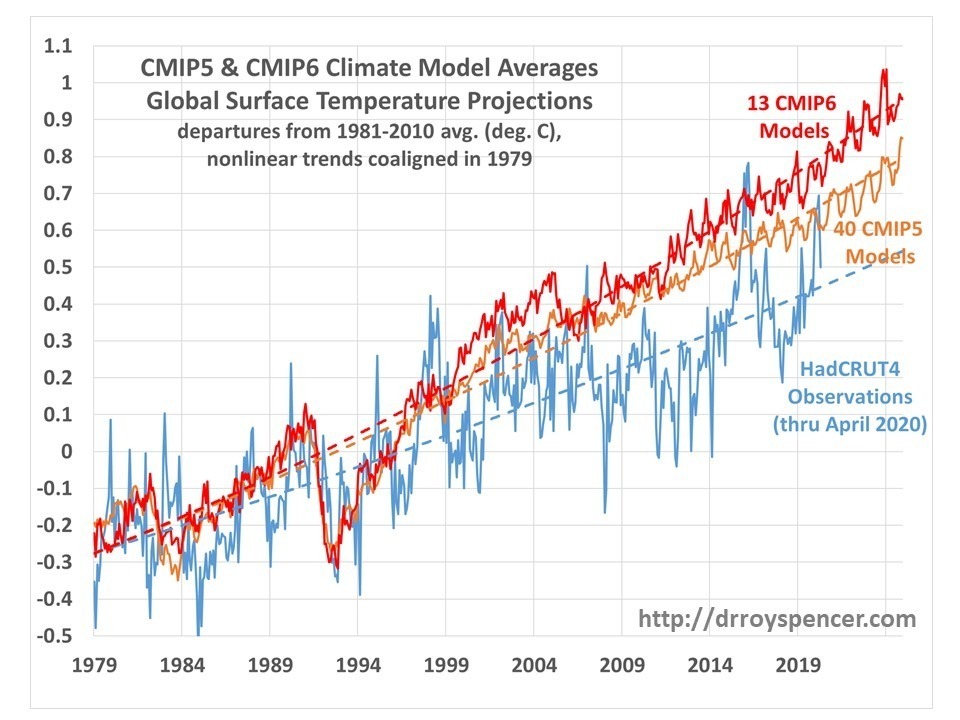
The upcoming IPCC sixth assessment report (AR6), forecast for release in 2021, features forecasts from CMIP6. But the CMIP6 models are turning out to be no better than CMIP5 models. In fact, CMIP6 they’re worse!
Senior climatologist Dr. Roy Spencer has observed that the “CMIP6 models are showing 50 percent more net surface warming from 1979 up to April 2020 (+1.08 degree Celsius) than actual observations from the ground (+0.72 degree Celsius).”
Beyond doubt, comparing both CMIP5 and CMIP6 forecasts to official HadCRUT temperature data sets reveals a very old story: models are always way off the mark, and—suspiciously—always in the same direction, namely, upward, in predicting real-world temperatures.
So, not only were we lied to about the climate, we are going to be misled again by the next IPCC assessment report. And with more extreme false forecasts, there will be calls for more restrictive energy policies.
It is quite astonishing how the unelected politicians at the UN can convince and persuade global leaders to adopt climate policies that are based on unscientific conclusions from faulty models.
The mainstream media have also played their part. Public perception on climate change has been heavily influenced by biased coverage on the climate issue, with no major attention to the huge discrepancies between the model forecasts and real-world observations.
It is not clear how much faultier the projections will become by the time the new assessment report is finally released. But one thing is clear: energy sectors across the globe are being held hostage by pseudo-scientific interpretations from the United Nations’ flagship climate wing.
Vijay Jayaraj (M.Sc., Environmental Science, University of East Anglia, England), is a Research Contributor for the Cornwall Alliance for the Stewardship of Creation living in New Delhi, India.
via Watts Up With That?
July 15, 2020 at 09:00AM
.
.
SC 25 – are we nearly there yet?
July 14, 2020: NOAA has released a new interactive tool to explore the solar cycle. It lets you scroll back through time, comparing sunspot counts now to peaks and valleys of the past. One thing is clear. Solar Minimum is here, and it’s one of the deepest in a century.

Solar Minimum is a natural part of the solar cycle. Every ~11 years, the sun transitions from high to low activity and back again. Solar Maximum. Solar Minimum. Repeat. The cycle was discovered in 1843 by Samuel Heinrich Schwabe, who noticed the pattern after counting sunspots for 17 years. We are now exiting Solar Cycle 24 and entering Solar Cycle 25.
During Solar Minimum, the sun is usually blank–that is, without sunspots. The solar disk often looks like a big orange billiard ball:
 The spotless sun on July 13, 2020
In 2019, the sun went 281 days without sunspots, and…
View original post 245 more words
via Tallbloke’s Talkshop
July 15, 2020 at 08:21AM
.jpg?ext=.jpg)
A government-commissioned report, meanwhile, has made recommendations for boosting the capability of the UK’s nuclear R&D sector and domestic supply chain to support future AMR deployment.
Three-quarters of the funds will support three SMR projects. Oxfordshire-based Tokamak Energy, working with industry partners and research establishments including Oxford University, is developing fusion reactors. Lancashire-based Westinghouse is developing a lead-cooled fast reactor, while Cheshire-based U-Battery is working on a small high-temperature gas-cooled reactor. Each project will receive about GBP10 million. This funding was awarded following the companies’ successful participation in Phase 1 of the AMR competition, which sought to determine the feasibility of, and provide support for, the design and development of AMR designs.
The remaining GBP10 million will be invested in “unlocking smaller research, design, and manufacturing projects to create up to 200 jobs”, the Department for Business, Energy and Industrial Strategy (BEIS) said. GBP5 million of that will be invested in British companies and start-ups, developing new ways of manufacturing advanced nuclear parts for modular reactor projects both at home and abroad. The remaining GBP5 million will be used to strengthen the UK’s nuclear regulatory regime, “ensuring it remains one of the most robust and safest in the world as the UK looks to develop and deploy advanced nuclear technologies”.
The funding is being provided through BEIS’s GBP505 million Energy Innovation Programme, which aims to accelerate the commercialisation of innovative clean energy technologies and processes.
“Today’s funding will ensure the technology is more attractive to private sector investors, supercharging the development of the industry and creating supply chains feeding future modular reactor developments,” BEIS said.
The post UK Government Announces Fund To Develop Small Nuclear Reactors appeared first on The Global Warming Policy Forum (GWPF).
via The Global Warming Policy Forum (GWPF)
July 15, 2020 at 08:15AM

 Iowa Climate Science Education