Month: July 2020

The Simple Ergodicities

Here’s a question for you to take your mind off COVID-19: Who is your favourite bear?

Is it Paddington? Or maybe it’s Rupert. For many it is Yogi, who is, after all, smarter than the average. Personally, I always had a soft spot for Boo-Boo. But if my life depended upon it, I think I would have to choose Baloo, if only for his wise counsel that we should all “Look for the bare necessities.”

Wise words indeed. But wiser still would have been the bear that entreaties we look for the ergodicities. Yes, the simple ergodicities of life will come to you. But only if you plan for them. Sadly, that bear of my dreams has yet to be born, and so the majority of us, unable to rest at ease without the ergodicities, continue to live out our decidedly non-ergodic lives with nothing but the precautionary principle to console us. Allow me to explain.

Me Explaining

Under the somewhat misleading heading of ‘Informal Discussion’, Wikipedia explains the simple ergodicities as follows:

“For a discrete dynamical system (X,T), where the space X is endowed with the additional structure of a probability measure space which is invariant under the transformation T, ergodicity means that there is no way to measurably isolate a nontrivial part of X which is invariant under T.”

Need I say more?

Okay, so let me put it this way. If you took 100 dice and threw them simultaneously, do you think (allowing for statistical fluctuation) that the total score would be the same as if you took just a single die and totaled the score after 100 throws? If the answer is yes, then you are dealing with an ergodic system.

Why does this matter? It matters because so much of risk assessment implicitly assumes ergodicity, since it seeks to predict the average performance over time using a probability density function that assumes ‘invariance under T’. In effect, the throwing of a die 100 times is treated as statistically equivalent to 100 dice thrown at the same time, thereby enabling the probabilistic calculations required for economic evaluations such as cost benefits analysis. In oh so many cases this is a perfectly safe assumption, but in oh so many more, it is not. Very often a throw of the die has a huge bearing on what follows, in which case there is no equivalent to the scenario of 100 simultaneous throws. Take, for example, a game in which throwing snake eyes means ‘game over’. With such, so-called ‘ruin’, scenarios the old economic game of calculating ‘equivalent values’ and performing costs benefits analyses doesn’t make much sense. Instead, the game is non-ergodic and we need a game play that takes into account the fact that, in order to attain the 100 die readings required to determine an average, one will need an extraordinary run of good luck. What we need instead is a precautionary approach.

As an example of this principle in action, take the case of house insurance. Every day of our lives we cast the die. We win when our house and contents are safe at the end of the day, but we lose when they are not. Furthermore, we are out of the game, because most of us cannot afford to replace everything in the event of catastrophe. The probability of that happening on any given day is low, but the probabilities stack up. So we take out insurance. With insurance we lose every day (by paying out a pro-rata daily insurance fee) but the losses are predictable and never enough to remove us from the game. A non-ergodic setup has been turned into an ergodic one. Of course, from the perspective of the insurance company the situation has always been ergodic. They are throwing die simultaneously and paying out for housing disasters every day, but the premiums have been set up so that even on a statistically bad day, they can always take it on the chin and stay in business.

And so, in our daily lives, the successful management of risk depends critically upon identifying the ergodic and non-ergodic situations and acting appropriately. In the non-ergodic situation, it’s all about minimizing the maximum loss in order to keep oneself in the game so that one can reap the compensatory benefits of any upside further down the road. Ideally, one would always wish to transform the non-ergodic into the essentially ergodic, usually by means of a judicious risk transfer such as taking out insurance. Unfortunately, however, this is not always possible, and so other strategies are often required, normally involving the precautionary principle.

And then Along Comes Global Warming

Global warming is often cited as the classic ruin scenario leading to a non-ergodic game. Worse still, the human race cannot transfer the risk in order to contrive ergodicity because there is no one out there listening (apologies to all the religious readers). It should come as no surprise therefore that the precautionary approach is advocated. No one wants to talk about cost benefits analysis anymore because no one is deceiving themselves that ergodicity applies. In fact, no one even wants to talk about probabilities anymore. All that is required to invoke non-ergodicity, and the lurking precautionary principle, is to conceive a plausible worst case that takes us all out of the game. Now any cost can be justified to manage the risk – and I do mean any cost.

I might be going along with all of this if it were not for one thing: Even when probability is deemed immaterial, uncertainty still has a role in the game. It isn’t risk aversion anymore, because one needs to assess probabilities in order to assess levels of risk. But it is still uncertainty aversion because we are basing our decision-making upon the notion of plausibility – a concept heavily invested in epistemic uncertainty. This is a crucial point since, as soon as a plausible worst case scenario has been agreed, it forms the basis for a deterministic approach in which one proceeds on the premise that the worst case will happen. This is all very well but there is now an awful lot at stake based upon the somewhat problematic notion of plausibility. Nor is it simply a case of replacing a non-ergodic game with an ergodic one. Can we really be confident that we will stay in the game, considering the economic shock entailed when following Extinction Rebellion style ‘climate emergency’ management?

Hold on a minute! I’ve just remembered that my favourite bear is Sooty. He’s a rebellious little sod, so forget everything I’ve just said. What’s that Sooty? You’ve got a magic wand?

Like this:

Like Loading…

Related

via Climate Scepticism

https://ift.tt/2ZsmbVC

July 15, 2020 at 04:08AM

Climate Predictions: “It’s Worse Than We Thought”

As the temperature of the eastern U.S. normally reaches its summer maximum around the last week of July, every year at this time we are bombarded with tired “climate change is worse than we thought” (WTWT) stories.

These stories take time to produce, from imagination to final copy to editing to publication, so they have usually been submitted well in advance of the summer peak. Hence, orchestrated fear.

For once, I’m in agreement about the WTWT meme, but it’s about the climate models, not the climate itself.

Every seven years or so, our friends at the United Nations Intergovernmental Panel on Climate Change (IPCC) produce a new “scientific assessment” of climate, including forecasts to the year 2100 (and, in some cases, even beyond). These reports have only one basis: quantitative calculations known as “general circulation models,” or increasingly comprehensive “earth system models.”

Each report is based on a suite of standardized models that are collated into a “Coupled Model Intercomparison Project” (CMIP). The fifth one, CMIP5, was the forecasting basis for the last (2013) IPCC report.

Anyone can access the CMIP models at a Netherlands website known as KNMI Climate Explorer. A few years ago, John Christy, now interim dean of science at the University of Alabama in Huntsville, did just that and plotted the output of all 32 families of models over the vast tropics. He looked at the whole lower atmosphere there, from the surface up to the stratosphere, and found that the models were predicting twice as much warming since 1979 than had been observed at altitude—a critical systematic error that misdirects the prime moving force for the earth’s global climate circulation, driving everything from agriculturally critical midlatitude precipitation to the likelihood of hurricane formation.

One model got it right: the Russian INM-CM4 (Institute for Numerical Mathematics–Climate Model Four), but it also predicted the least warming—by far—of all the CMIP5 models.

At the surface, the 2013 IPCC report predicted a climate “sensitivity” (the amount of warming resulting from the doubling of atmospheric carbon dioxide) of 1.5⁰C–4.5⁰C, based on the spread of the CMIP5 models. The sensitivity of the cold Russian model was 2.1⁰C.

You’d think that, in the seven-year period between CMIP5 and CMIP6, the modeling community would address the critical errors that all the other models were making. But CMIP6 models are out and are indeed “worse than we thought.” While their error in the tropical atmosphere is very close to the same as it was in CMIP5 (which isn’t good), the range of global predictions is even larger than before. This is also not a good sign, especially because it has been documented that the models are “tuned” to give an answer that the modeling team wants.

Full post

The post Climate Predictions: “It’s Worse Than We Thought” appeared first on The Global Warming Policy Forum (GWPF).

via The Global Warming Policy Forum (GWPF)

https://ift.tt/3esWA3a

July 15, 2020 at 03:52AM

East European Nations Reject New Climate Targets

The European Union remains deeply divided over plans to increase its CO2 emissions targets, with East European ministers refusing to commit to bigger cuts.

The EU has agreed to unilaterally cut greenhouse gas emissions by 40% by 2030. This target has been criticised by climate activists who claim that more radical cuts are needed to prevent ‘catastrophic’ climate change.

Responding to this campaign, the European Commission plans to publish an impact assessment of the additional cost of a revised CO2 target to 50% or 55% by 2030. The EU would then need to agree a new target with member states and lawmakers.

According to Reuters, a meeting of environment ministers from the EU’s 27 member states failed to find agree on whether the target should be raised at all.

“Some are sceptical,” German Environment Minister Svenja Schulze said after the meeting.

On Monday, Poland, Slovakia, Bulgaria, Romania, Czech Republic and Hungary wrote to the European Commission, announcing that they will not support a new CO2 target until they have seen the Commission’s economic impact assessment.

The post East European Nations Reject New Climate Targets appeared first on The Global Warming Policy Forum (GWPF).

via The Global Warming Policy Forum (GWPF)

https://ift.tt/2ODQi6p

July 15, 2020 at 02:41AM

Another All-Renewables Hoax Busted: Wind ‘Powered’ Hawaii Really Runs On Fossil Fuels

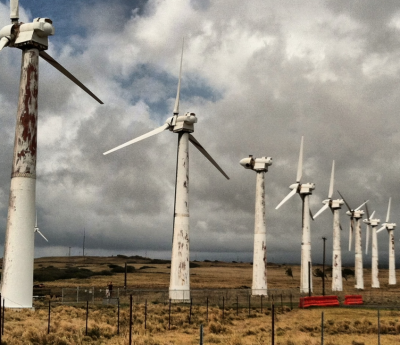
Here’s some the wind industry prepared earlier.


RE zealots claim Hawaii is well on its way to getting 100% of its power from the wind and sun. In truth, it’s fossil fuels (bunker oil) that’s powering the Pacific islands, whereas wind and solar deliver a trifling 7%. Notwithstanding the hundreds of $millions in subsidies thrown at an ‘industry’ that remains more talk than action. And one which has had its fair share of false dawns (see above).

David Shorman takes a look at what’s really powering Hawaii, focusing on the island of Oahu.

Heart of Hawaii: Oil Powers Oahu’s Sustainable Energy Program
Master Resource
David Shorman
10 June 2020

… on Oahu, generating 1 MW of power using wind and solar requires 154 acres of land. That’s more than 800 times as much land as the Kahe petroleum-fired power plant requires to generate the same amount of power. Using wind/solar projects to produce the same amount of electricity Oahu utilities produced in January 2020 would require … almost one-third of Oahu … be covered with solar panels, wind turbines, and battery storage systems.

On Oahu’s west side, a Hawaiian green sea turtle snuggles up to a reef for an afternoon nap. But this is no ordinary reef. It’s the warm water outflow structure for Oahu’s biggest electric power producer, the Kahe Power Plant.

Built in the early 1960’s, the 651 megawatt (MW) workhorse often provides over 40% of Oahu’s power. Hawaii being what it is, you are probably imagining Kahe runs on clean, renewable energy. Guess again. Kahe runs on oil.

You read that right, the power plant that draws crystal clear Pacific waters close to shore, while providing a massive artificial reef, runs on 100% oil. Residual fuel oil to be exact. And Kahe is not Oahu’s only power plant running on petroleum liquids. In fact, using data gathered from the U.S. Energy Information Administration (EIA), I estimated that in January 2020, a whopping 72.6% of Oahu’s power generation was from petroleum liquids.

One of the most expensive forms of power generation, a plan was in place to scrap Oahu’s aging oil-fired plants and replace them with cheaper, cleaner-burning natural gas plants. However, that plan was rejected in 2016.

With a goal of 100% renewable energy by 2045, Hawaiian Electric claims that as of 2018, 22% of Oahu’s power is generated from renewable forms. However, my estimates using EIA’s data put that number closer to 13.8%.

*Wind data estimated from 2018 EIA data (2019 and 2020 not available). EIA does not measure power from household solar, but Hawaiian Electric estimates output is about 1.7 times greater than the amount produced by independent solar companies. The percentage in the chart includes a household estimate.

Green Energy Runs on Fossil Fuels

Where am I going with all this? Well, after reading this article, I watched the film Planet of the Humans (before YouTube censored it). While the film was a little too “doomsday scenario” for me, it was an eye-opener regarding how backwards the green energy movement can be. Especially the anti-fossil fuel mentality and where that is leading us.

Take solar panels for example. To acquire the silicon used in the panel, quartz must first be blasted out of a mountainside, then smelted using coal. For every ton of metallurgical-grade silicon produced, 5-6 tons of CO2 are produced. And this is just the first step in becoming a silicon wafer for a solar panel. Everything, including transporting the panels to their final destination, uses fossil fuels.

Wind turbines and solar panels don’t last forever, either. In fact, those currently operating in Hawaii will have to be replaced, at least once, before reaching Hawaii’s 2045 deadline for 100% renewables. And, how do you recycle a massive, fiberglass wind turbine blade? At the moment, you don’t.

Perhaps the most surprising part of Planet of the Humans was the Green movement’s adoration of biomass for fuel. The word “biomass” is a general term for a surprising array of “renewable” products. Wood chips are a main source of biomass, but woodchips are made of carbon, right? So burning them produces carbon dioxide–the same global-warming-crisis-gas produced by burning fossil fuels.

Confused? Me too. Turns out biofuels, which Oahu’s new Schofield Generating Station is “capable” of using, are produced using fossil fuels.

Back to biomass, those woodchips have to come from somewhere, which means trees, and there are places on the planet where major deforestation is occurring to satisfy the demand.

Did you know “biomass” also means household trash and sewage sludge? Ewwww. Oahu’s H-POWER facility runs off these two products. Plus some fossil fuels. Supposedly, the city gets penalized (meaning taxpapers) if they do not provide enough trash to satisfy a predetermined quota. In other words, the system encourages increasing trash amounts. Also, consider the fact that a lot of this trash includes plastic wastes, which are of course produced from fossil fuels.

Looking back at the chart, biomass plus coal plus fossil fuel liquids account for 92.3% of Oahu’s power generation, all of which give off greenhouse gases.

Cover One-third of Oahu with Wind and Solar?

Personally, I’m not completely against trash-burning facilities like H-Power. If run well, they can reduce the size of landfills, which is important on a small island in the middle of the Pacific Ocean. Hence the irony of massive solar and wind projects on Oahu. For example, a quick look on Google Earth revealed the recently-completed Kawailoa wind and solar project sprawls across a whopping 2,900 acres.

A fraction of the Kawailoa wind and solar project, a 2,900 acre monstrosity on Oahu’s North Shore. Note the deforestation (and therefore soil destabilization), which has led to recent water quality issues.

The Kawailoa wind and solar installation boasts a combined generating capability of 118 MW (49 MW for solar and 69 MW for wind). But, the wind and sun aren’t always there, and my estimates show the actual output is more like 18.8 MW.

My estimates also show that, on Oahu, generating 1 MW of power using wind and solar requires 154 acres of land. That’s more than 800 times as much land as the Kahe petroleum-fired power plant requires to generate the same amount of power. Using wind/solar projects to produce the same amount of electricity Oahu utilities produced in January 2020 would require a staggering 119,735 acres. Almost one-third of Oahu would need to be covered with solar panels, wind turbines, and battery storage systems.

The Kawailoa project has already been fined at least once for excessive stormwater discharges.On an island where clean and clear ocean water is so valued, perhaps it is time to look again at energy sources that take up less space. Instead of being hypocritical and bashing fossil fuels while using them to meet a politically correct agenda, maybe we humans should focus on being more efficient and creative, developing products that require less energy and materials to manufacture and use.
Master Resource

Like this:

Like Loading…

Related

via STOP THESE THINGS

https://ift.tt/2DDd6kc

July 15, 2020 at 02:31AM